Turn Intention Into Action: A 90-Day Execution System for Real Estate Agents
Turn Intentions Into Action
The 90-Day Real Estate Execution System
A practical operating rhythm for real estate agents who need time blocking, follow-up, accountability, delegation, and weekly scorekeeping to turn existing opportunities into conversations.

How real estate agents turn intention into execution
The fastest way to turn intention into action is to stop treating marketing as a mood-based task. Build a 90-day sprint with two primary channels, one daily 15-minute business-development block, one weekly Follow-Up Friday block, delegated production, and a simple scoreboard. When the calendar, CRM, and accountability loop are visible, existing leads and relationships have a better chance to become real appointments.
- Most agents do not need more ideas first. They need a tighter operating rhythm for the ideas, leads, and relationships they already have.
- A 90-day sprint works best when the agent limits the plan to two primary channels instead of adding new tactics every week.
- Follow-Up Friday turns the CRM from a storage locker into a production system for overdue tasks, warm leads, and past-client conversations.
- Time-Block Adherence and Follow-Up Completion Rate are the first numbers to watch because they reveal whether the business is being run.
Why Real Estate Execution Breaks Down
Most agents do not fail because they lack ambition. They fail because their marketing plan depends on memory, motivation, and leftover time. When the week gets busy, prospecting blocks move, CRM tasks age out, emails sit unfinished, and follow-up gets pushed behind whatever feels urgent that day.
A useful execution system removes that friction. It turns vague goals into visible calendar blocks, simple weekly actions, and numbers that show whether the business is actually being run. It also connects the bigger strategic work from Business Growth Strategy for Real Estate Agents to a daily rhythm that can survive a normal real estate schedule.
- Calendars replace good intentions because unscheduled work usually becomes optional.
- Scoreboards replace vague effort because weekly numbers show whether the agent is following through.
- Delegation protects production time because repeatable marketing tasks move away from the agent’s highest-value appointment work.
What To Do First In Your 90-Day Sprint
Start with a three-day time audit. Track every thirty-minute block spent on email, CRM cleanup, scrolling, listing work, content tweaks, client communication, and administrative tasks. This exposes the hidden time leaks that make agents feel busy while the highest-value growth work never gets done.
Then choose two primary channels for the next ninety days. For most agents, the practical mix is direct follow-up to existing contacts plus one consistent broadcast channel, such as Email Marketing for Real Estate Agents, Social Media Marketing, or a small Digital Retargeting campaign. The point is not to do everything. The point is to stop switching systems every week.
That channel discipline should also match audience quality. A smaller campaign aimed at the right homeowners, past clients, and warm buyers is more useful than a broad campaign that reaches people with no near-term intent. That is why the targeting principles in Is Your Marketing Targeting Those Most-likely to Use Your Real Estate Services? matter before the sprint begins.
Planning Paralysis
Research, tools, outlines, and strategy notes keep expanding, but nothing ships to the market. The fix is one shippable business-development task every weekday.
The Silent CRM
Contacts are stored but not activated. The fix is a protected weekly follow-up block tied to overdue tasks, warm leads, and past-client conversations.
Shiny Object Drift
Every platform, script, or lead source becomes the new answer. The fix is a written 90-day channel focus statement and a refusal to add new tactics mid-sprint.
An Unaccountable Schedule
Nobody notices when the hard block gets skipped. The fix is a weekly scoreboard shared with a coach, vendor, assistant, or accountability partner.
The 8-Step Real Estate Execution Map
This map turns the quarter into a production loop. Every step has a deliverable and a KPI. That keeps the plan measurable enough to manage and simple enough to repeat.
| Step | Action | Deliverable | KPI | Owner |
|---|---|---|---|---|
| 1 | Audit three days of real work in thirty-minute blocks. | List of five to seven time leaks. | Time-block score. | Agent |
| 2 | Select two primary channels for the full sprint. | Written 90-day channel focus statement. | Channel adherence. | Agent |
| 3 | Schedule one 15-minute shippable task before noon. | Five completed daily tasks per week. | Morning block completion. | Agent |
| 4 | Protect a 90-minute Follow-Up Friday block. | Cleared overdue CRM tasks and five warm conversations. | Follow-up completion. | Agent |
| 5 | Delegate repeatable marketing production. | Active nurture sequences and scheduled content. | Task completion time. | Vendor |
| 6 | Create a simple asset library. | Shared folder with brand basics and reusable templates. | Production time. | Vendor |
| 7 | Run a weekly accountability check-in. | Weekly score log with misses and next steps. | Adherence trend. | Agent |
| 8 | Audit the quarter on day ninety. | Trim, keep, or double-down recommendation. | Cost per appointment. | Agent |
The Daily Rhythm That Carries the System
Two habits carry most of the weight. The first is the 15-minute rule. Every weekday, ship one meaningful business-development task before lunch. That may be five SOI texts, three CMA check-ins, one short market update, or a follow-up note to a buyer who went quiet.
The second habit is Follow-Up Friday. This is the protected block where overdue CRM tasks get cleared, warm leads are called, and past clients are moved into the next touchpoint. It is not a casual reminder. It is a production appointment with your own pipeline.
Delegation supports both habits. A vendor or assistant can queue emails, schedule social posts, clean lists, organize assets, and build recurring content. The agent should keep ownership of relationship judgment, live calls, pricing conversations, and appointment strategy.
Execution becomes easier when the plan is smaller, the blocks are visible, and the same scorecard gets reviewed every week. The goal is not to feel busy. The goal is to create enough repeated action that warm relationships stop slipping through the cracks.
Three Accountability Scripts You Can Use This Week
These scripts are intentionally simple. The goal is not clever persuasion. The goal is to make the next action easy enough to start immediately.
The 15-Minute SOI Check-In Text
Agent dialogue
HookQuick question for you about your place.
BuildI am updating a few value ranges for friends this morning.
CTAWant a simple two-minute range for your address?
Send five during the morning block, log every reply as a CRM task, and do not pitch a meeting until they respond.
The Follow-Up Friday Call Opener
Agent dialogue
HookI am closing my week by calling a few clients I keep thinking about.
BuildYou mentioned a possible move in the next year. Has your timeline shifted at all?
CTAWe can map a simple 90-day plan so you are ready when the moment hits.
Block ninety minutes, aim for five quality conversations, and end every call with a clear next step.
The Accountability Partner Message
Weekly message
ReportHere is my execution scoreboard for the week.
ScoreBlocks scheduled: five. Blocks completed: four. Follow-Up Friday: completed.
AskAsk me about my 15-minute block by noon on Wednesday so I stay honest.
Send it at the same time every week, show misses without spin, and assign one fix for the next week.
Budget Ranges and Time Requirements
The purpose of budget in this system is to buy consistency, implementation, and accountability. These ranges are examples, not guarantees. A lower-budget agent can still win with disciplined time blocks. A higher-budget agent can move faster by delegating production and reporting.
Approximate 90-day range: nine hundred to eighteen hundred dollars. Focus on manual follow-up, simple email sends, light coaching, and a strict daily task block. The work is lean, but the calendar discipline has to be real.
Approximate 90-day range: thirty-six hundred to seventy-five hundred dollars and up. Add delegated scheduling, social media support, nurture content, listing marketing, reporting, and accountability so the agent can focus on conversations.
Agents using a fuller operating stack can turn the same weekly idea into blog content, social posts, email nurture, direct mail, listing support, and retargeting. That is where a managed system becomes useful: it reduces the number of production decisions the agent has to make while keeping the market message consistent.
KPIs That Tell You the Truth
Internal execution metrics usually move before revenue. Watch the numbers that reveal whether the business is being run: calendar adherence, follow-up completion, replies, appointments, and delegated task speed.
| Execution KPI | Good | Great | Elite |
|---|---|---|---|
| Time-block adherence score | 75% | 85% | 95%+ |
| Follow-up completion rate | 90% | 95% | 100% |
| Email reply rate from warm list | 0.5% | 1.0% | 1.5%+ |
| Lead-to-appointment rate | 10% | 15% | 20%+ |
| Delegated task-to-completion time | 72 hours | 48 hours | 24 hours |
These are target benchmarks, not promises. If Time-Block Adherence and Follow-Up Completion Rate stay in the great range for eight to twelve weeks, the agent has a stronger base for pipeline consistency. If those numbers fall, fix the operating rhythm before adding more leads or new channels.
Tracking Mechanics You Can Actually Keep Up With
Keep tracking simple. Use one shared accountability log for scheduled blocks, completed blocks, Follow-Up Friday results, and delegated task completion. Review it weekly. The goal is not an analytics dashboard. The goal is a management tool that tells the truth quickly.
Use your CRM to produce the weekly overdue-task list. Start Follow-Up Friday with that report. End the block with every task either completed, rescheduled, or intentionally closed. This turns the CRM from a storage locker into an active production system.
Tag every lead source at entry. When a contact comes from a retargeting ad, website inquiry, social message, email reply, or referral, log the origin. On day ninety, keep the channels that produced appointments and trim the ones that only produced noise.
Creative and Messaging That Drive Action
Creative in this system has one job: trigger the next useful action. The best message is not always the most polished message. It is the one that gets a reply, a saved checklist, a forwarded resource, or a booked appointment.
- SOI email subject: Your seven-day neighborhood pulse is ready. Want the one-page chart?
- Retargeting headline: Still browsing public sites? Get price changes for your street sooner.
- Follow-Up Friday text: Quick one. Curious what your home could realistically list for this season?
- Warm nurture subject: Three quiet signals sellers are watching this month.
The strongest agents keep their message consistent across channels. They repeat the same useful promise in email, social, follow-up, and listing conversations. That consistency is part of what builds the trust discussed in Impactful Client Appreciation, Reviews, and Reputation Management.
Mini Case: Accountability Drives Conversion
Consider an agent with solid market knowledge and a healthy contact list. The strategy is not the problem. The problem is skipped follow-up whenever escrow, showings, and daily service demands take over. Over time, warm leads cool off because nobody protects the relationship rhythm.
The fix is not another platform. It is a weekly scoreboard, delegated marketing production, and a non-negotiable Follow-Up Friday block. Once Time-Block Adherence and Follow-Up Completion Rate become visible, the agent can see where the system is breaking and correct the behavior before the pipeline goes quiet.
Execution Checklist Before You Start
Before launching the sprint, use this checklist to make the operating system clear enough to run.
- Complete a three-day time audit and identify the recurring time leaks.
- Pick two primary marketing channels and write down what will not be added during the sprint.
- Create one daily 15-minute business-development block before noon.
- Protect one 90-minute Follow-Up Friday block every week.
- Assign repeatable production tasks to a vendor, assistant, or simple workflow.
- Create a shared folder for brand assets, reusable templates, and campaign notes.
- Set a weekly accountability check-in and review the same scorecard each time.
- Schedule the day-90 review before the sprint begins.
How This Becomes Marketing
A 90-day execution system is more than a productivity routine. It is a business-development asset. It gives the agent a reason to contact people, a structure for staying visible, and a repeatable way to move relationships from vague interest into clear next steps.
Use the same operating rhythm across Real Estate Blog Writing Services, Social Media Marketing, Listing Marketing, Email Campaigns, Direct Mail, and Digital Retargeting. Each channel should reinforce the same premise: the agent is organized, proactive, and easy to respond to.
If you are serious about turning years of good intentions into a 90-day execution rhythm that actually ships, AmericasBestMarketing.com helps install the structure, produce recurring marketing assets, and keep the scoreboard visible so existing relationships and leads have a better chance to become real appointments.
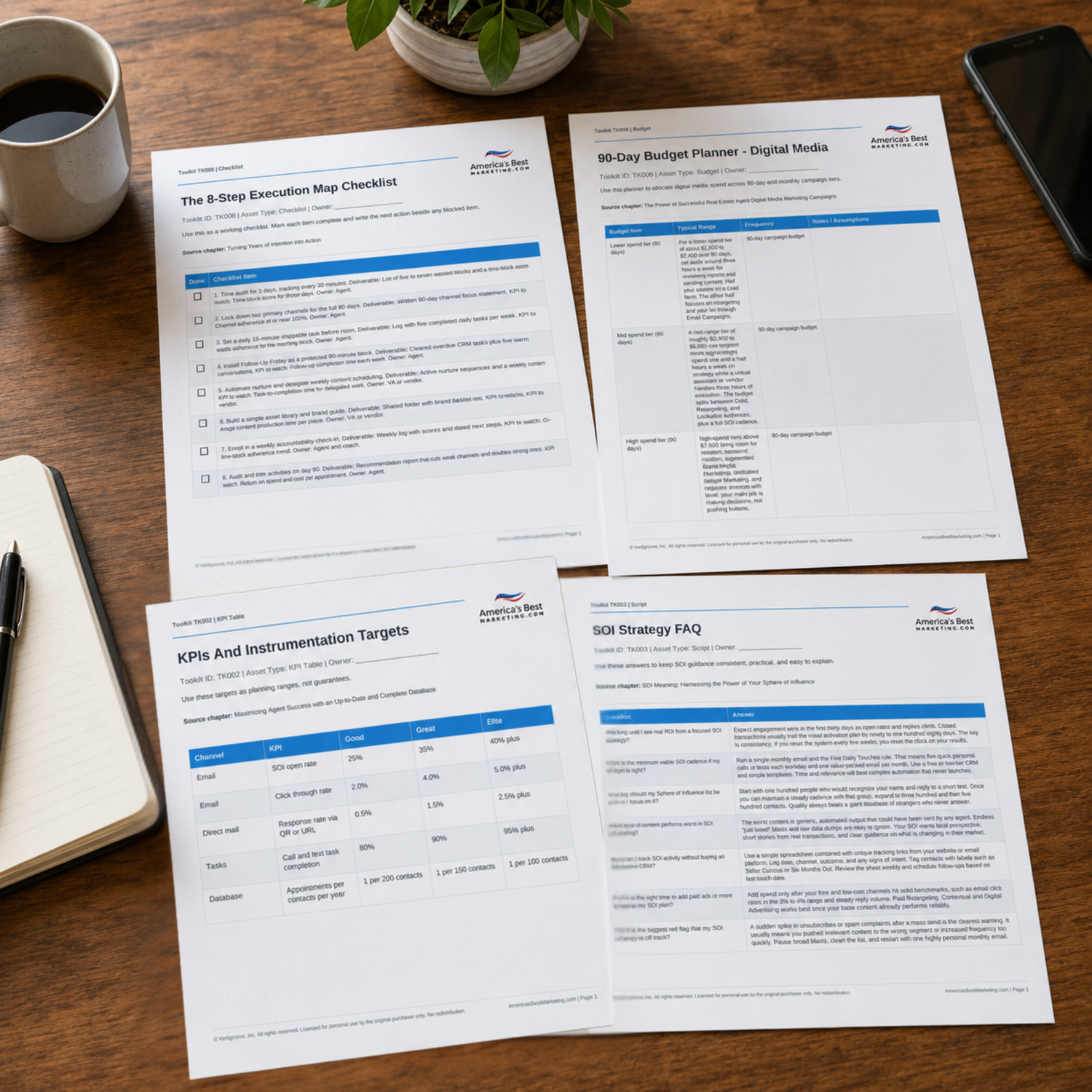
Download The 90-Day Real Estate Execution Toolkit
Use the companion Toolkit to move from intention to implementation with budget ranges, the 8-step execution map, KPI benchmarks, accountability scripts, checklist prompts, and FAQ support for the 90-day sprint.
Download the Toolkit ZIPRecommended reads
Recommended Reads for Real Estate Agents
These articles help agents connect follow-up discipline, database habits, client communication, and marketing execution into a repeatable system.

27 Real Estate Marketing Ideas for Real Estate Agents for Summer
Bring more structure to summer marketing ideas so every touchpoint supports visibility and trust.
Read article
Build a Relocation Lead Engine in [Your City] (Guide for Real Estate Agents)
Use relocation lead engine to strengthen visibility, follow-up, and client conversations without adding more random tasks.
Read article
Real Estate Call-to-Action Examples That Drive More Clicks
Bring more structure to real estate call-to-action examples that drive more clicks so every touchpoint supports visibility and trust.
Read article
How Much Should a Real Estate Agent Budget for Marketing?
Use execution to create a stronger bridge between client education and real conversations.
Read article90-Day Execution Questions Real Estate Agents Should Be Ready To Answer
What is a 90-day real estate execution system?
A 90-day real estate execution system is a short operating plan that turns marketing goals into scheduled weekly actions. It includes channel focus, daily time blocks, CRM follow-up, delegated production, accountability check-ins, and a small KPI scorecard.
What should an agent do first if they struggle with follow-through?
Start with a three-day time audit. Track how the workweek is actually spent, then protect one daily 15-minute business-development block and one weekly Follow-Up Friday block. The system should begin with schedule control before adding new tactics.
How long does it take to see measurable ROI from this system?
There are no promises. Execution metrics can improve first because they measure controllable behavior. Revenue requires more runway. Agents should evaluate early progress through Time-Block Adherence, Follow-Up Completion Rate, replies, appointments, and task completion before judging closed transactions.
What is the minimum viable cadence if the budget is tight?
Keep the plan simple. Run the 15-minute daily rule five days per week, protect one Follow-Up Friday block, send a consistent email to the warm list, and track the same scorecard weekly. Consistency with a small plan beats an ambitious plan that never ships.
Which tasks should be delegated first?
Delegate repeatable tasks that do not require the agent’s judgment. Good candidates include email scheduling, social media queueing, list cleanup, basic reporting, template setup, and campaign reminders. The agent should keep live conversations, relationship judgment, and appointment strategy.
What KPI matters most in the first month?
Time-Block Adherence is the first KPI to watch because it predicts whether the operating system is being followed. Follow-Up Completion Rate is the second. If those two numbers are weak, adding leads or ad spend usually compounds the same execution problem.
What is the red flag that means the plan needs a reset?
The main red flag is Time-Block Adherence dropping below seventy percent for two straight weeks. That means the calendar structure has broken down. Pause new tactics, repair the blocks, clear the CRM backlog, and restart with a smaller weekly workload.
Next step
Build the System Behind the Advice
Continue from one useful article into the larger ABM ecosystem: the book series for strategic depth and the full marketing program for done-for-you execution.

View the Book Series
Explore the America’s Best Real Estate Agent Marketing System books for a deeper strategic framework around visibility, referrals, listings, lead generation, and growth.
View the Book Series
See Full Marketing Program
See how AmericasBestMarketing.com runs real estate blog writing, social media, listing marketing, email, direct mail, and retargeting as one managed system.
See Full Marketing Program