Real Estate Call-to-Action Examples That Drive More Clicks
Real Estate Call-to-Action Examples That Drive More Clicks
A Channel-by-Channel Conversion System
A practical operating brief for writing, placing, and testing real estate calls-to-action across websites, email, social media, direct mail, and digital ads.

What Makes a Real Estate CTA Convert
A high-converting real estate call-to-action starts with a clear action verb, names the immediate value, matches the prospect’s readiness, and asks for only the information needed for that next step. The best CTA gives one primary choice, appears where the reader naturally pauses, and carries the same promise from the ad or message through the landing page and follow-up.
- Strong CTAs describe the result of the click, not the mechanics of submitting a form.
- Soft, mid-level, and hard CTAs should match how much trust and intent the prospect has already shown.
- Channel context matters. A postcard, email, social post, website, and retargeting ad need different CTA lengths and commitment levels.
- CTA performance improves fastest when you test one variable at a time and measure clicks, form starts, completions, and booked conversations.
Why the Right CTA Is a Marketing Asset
A real estate call-to-action is not a decorative button or a throwaway line at the end of a post. It is the point where attention becomes measurable intent. Every ad, email, social post, postcard, and web page should move the right person toward one clear next step.
When the CTA is vague, the marketing investment leaks. Submit tells the visitor what the form does but says nothing about the outcome. Click here creates motion without value. Contact me asks for a conversation before the prospect understands what the conversation will produce.
When the CTA is specific, the same traffic becomes more productive. Get your personalized equity snapshot gives the visitor an outcome. See the new listings that match your wish list gives the click a purpose. Reserve your fifteen-minute pricing review frames the time commitment and the benefit before the calendar opens.
This is why calls-to-action belong inside the larger system described in How Contextual and Retargeting Digital Marketing Help Real Estate Agents Build Their Business. Visibility creates opportunity, but the CTA converts that visibility into an identifiable next step.
- Weak language makes the next step feel like work and gives the visitor no reason to act now.
- The wrong commitment level can stop a cold prospect who would have accepted a lighter first step.
- Competing choices create decision friction and make the primary action harder to see.
- A clear CTA creates a trackable bridge from channel activity to pipeline movement.
The Five-Part Formula for High-Converting CTAs
The strongest real estate CTAs are not clever. They are clear enough that a visitor can understand the action, value, and commitment in a few seconds. Use the five elements below as a preflight check before publishing a page, ad, email, mailer, or social caption.
Start with a strong verb
Lead with words such as get, see, download, compare, book, reserve, request, start, or claim. The verb should tell the reader exactly what to do without adding mental work.
Replace learn more when a more specific action is available. See the seller timeline is stronger because it previews the next screen.
Name the immediate outcome
Tell people what they receive after the click. Download the seller prep checklist is stronger than download now because the asset is part of the CTA.
Use the language your client would repeat. Equity snapshot, pricing review, new listing alerts, and relocation plan are easier to understand than generic lead magnet language.
Add concrete detail
Location, timing, audience, and scope make a click feel safer. See what your Oak Ridge home could sell for this month is more credible than check value.
Specificity also filters the audience. A CTA aimed at condo owners, first-time buyers, or relocation prospects can generate fewer but more useful responses.
Use honest urgency
Reserve your tour today or check your equity in sixty seconds gives the prospect a reason to act now. The timing claim must be real and operationally supportable.
Avoid fake scarcity. Trust is more valuable than a temporary click spike, especially when the prospect may be choosing an agent for a high-value transaction.
Match the ask to the reward
A full phone number and address request needs a meaningful payoff such as a custom equity review. A simple checklist can usually be exchanged for an email address alone.
Every extra field should have an operational reason. Remove fields that do not change the next response, routing, or follow-up sequence.
Give one primary choice
One primary CTA plus one softer alternative usually outperforms a wall of equal buttons. The page should show the reader what matters most at that moment.
Secondary links can support research, but their size and placement should not compete with the conversion action.
Read the CTA by itself and ask whether a stranger could repeat the offer after seeing it for two seconds. If the answer is no, the line needs a clearer verb, result, or qualifier.
Match the CTA to the Prospect’s Readiness
Not every prospect is ready to schedule a listing meeting. Some are curious, some are comparing agents, and a smaller group is ready to talk now. A good funnel respects that progression instead of forcing every visitor into the same hard conversion.
Earn a low-friction micro-commitment
Use soft CTAs for cold traffic, social feeds, educational articles, and early research. Examples include read the local guide, save this checklist, follow for weekly pricing updates, or join the list for market notes.
The objective is not immediate appointment volume. The objective is permission to remain visible and useful.
Trade clear value for contact information
Use mid-level CTAs when the prospect has a defined question or problem. Examples include get your equity snapshot, download the seller timeline, compare neighborhoods, or receive matching listing alerts.
The value should justify the information requested and trigger a relevant follow-up sequence.
Secure time or a direct conversation
Use hard CTAs when the prospect has shown strong intent. Examples include book your pricing review, request a listing walk-through, schedule a buyer strategy call, or reserve a private tour.
Frame the meeting around a concrete outcome so it feels advisory rather than sales-driven.
Move from light action to booked time
A prospect might scan a mailer, download a guide, read three nurture emails, see a retargeting ad, and then book a strategy call. Each CTA should make the next step feel proportionate.
The funnel works because every touch carries the same promise forward instead of changing direction at each channel.
High-Performance CTA Examples by Marketing Channel
CTA language should fit the device, attention span, trust level, and behavior of the channel where it appears. Keep the core offer consistent while adapting the line to the context.
Bridge offline attention to one trackable response
Use a short path, one action, and a clear reason to scan, text, or visit.
CTA: Scan to see what homes like yours sold for in this neighborhood.
CTA: Text HOME for your private equity estimate.
CTA: Visit the short link to see your likely price range.
Every mailer should point to one response path. That discipline makes Direct Mail Marketing easier to track and improve.
Make the main button unmistakable
One main action per email reduces hesitation and supports cleaner reporting.
CTA: See the new listings that match your wish list today.
CTA: Check your estimated home value in three quick steps.
CTA: Tell me your timeline so I can send the right plan.
Use segmentation and a consistent template inside Email Marketing for Real Estate Agents so each audience receives the most relevant next step.
Ask for an action that fits the feed
Micro-commitments should move passive viewers toward saves, messages, and link clicks.
CTA: Save this post for your pre-listing checklist.
CTA: Comment EQUITY for the private value link.
CTA: Message TOUR for the open house plan.
A consistent schedule supported by Social Media Management for Real Estate Agents makes the CTA feel like part of a real presence rather than a random sales pitch.
Connect the CTA to page intent
A valuation page, buyer guide, listing page, and blog article should not all use the same generic button.
CTA: See the local market report for your address.
CTA: Start your custom home search with live listing updates.
CTA: Get the seller prep checklist in the right order.
Your website becomes a stronger conversion hub when IDX Real Estate Websites connect property search, saved searches, and local pages to a clear follow-up path.
Keep the promise aligned from ad to page
Warm audiences respond to a direct outcome that continues without a message switch.
CTA: See what your neighbors actually sold for.
CTA: Find out how much equity could support your next move.
CTA: Book a price and timing review.
Digital Retargeting works best when the creative, CTA, landing page, and follow-up repeat the same value proposition.
Remove uncertainty from registration
The invitation should make the action, timing, and guest value obvious.
CTA: Reserve your spot for the neighborhood market night.
CTA: Grab your guest pass before registration closes.
CTA: Add your name to the private tour list.
Use the same CTA across mailers, email, social posts, and the registration page so guests never have to interpret a new instruction.
Several of these lines can plug directly into seasonal campaigns. A postcard and social sequence built around seasonal real estate marketing ideas can carry one call-to-action through print, stories, and email so prospects hear one invitation instead of scattered offers.
Placement and Design Rules That Protect the Click
The best copy cannot work if the CTA disappears into the page. Message and placement operate together. Put the primary action where the eye and thumb naturally land, then repeat it only at meaningful decision points.
Make the primary action visually distinct
The button should stand apart from the background and nearby links on mobile and desktop. Contrast should signal priority without making the page feel chaotic.
Give high-intent pages an immediate path
Home pages, valuation pages, buyer guides, seller guides, and listing pages should present a useful action before the visitor has to search for it.
Repeat at natural decision points
Place the CTA after proof, pricing context, long explanations, and final recommendations so readers do not need to scroll backward when they are ready.
Design for the thumb
Use a large tap target, enough spacing around adjacent links, and a concise label that does not wrap into an awkward block.
KPIs and A/B Testing for Real Estate CTAs
Calls-to-action are ideal for controlled tests because one line can be changed without rebuilding the entire campaign. Start with one or two high-value CTAs, such as the main valuation page and the seller guide download, then test one variable at a time.
Do not declare a winner from a handful of clicks. Use a consistent traffic source, let both versions collect enough activity, and compare the full sequence from page visit to booked conversation. A higher click rate is useful only when the resulting leads remain relevant.
One page, one traffic source, thirty days
Send traffic from one mailer and one promoted post to a single valuation page. Track visits, CTA clicks, form starts, completions, and booked conversations for the main CTA.
Split traffic between two CTA versions
Use search ads and nurture emails to compare two lines on the same seller guide page. Keep the offer and page unchanged so the CTA is the only meaningful variable.
| CTA Type | Primary Goal | Target Range | Operator Note |
|---|---|---|---|
| Guide offer | Increase download clicks | 2.5% to 5% | Pair the action verb with the asset name so the visitor knows exactly what arrives after the click. |
| Email button | Lift click-to-open rate | 15% to 30% | Place one clear button near the top of the email and repeat the same action once near the end. |
| Book a call | Convert warm leads | 10% to 20% | Frame the call as a short review with a defined outcome rather than a general sales meeting. |
Change the verb, benefit, specificity, placement, or form length one at a time. When several variables change together, the result may improve, but you will not know which decision caused the lift.
Fix the Alignment Before Rebuilding the Funnel
Consider a home value page receiving traffic from social media, direct mail, and digital ads. The page gets visits, but the main button says submit your details. The instruction sounds like work and does not explain the reward.
The first fix is alignment, not a new funnel. Change the CTA to get your personalized equity snapshot. Make sure the headline, form introduction, confirmation message, and follow-up email repeat the same promise. The offer feels safer because the prospect understands the outcome before providing information.
Then review friction. Ask only for the fields needed to create the estimate and route the response. If the visitor is not receiving a truly personalized result, lower the information request or improve the deliverable. The exchange must feel fair.
The Eight-Point CTA Audit
Run this checklist before a new page, ad, email, mailer, or social campaign goes live. The objective is to confirm that the action is visible, specific, proportionate, and measurable.
- Start with a strong action verb instead of a vague label.
- Spell out the asset, answer, or outcome in plain language.
- Name a location, topic, audience, or timing detail when it improves relevance.
- Use urgency only when the timing advantage is honest.
- Make the primary action visually distinct from surrounding links.
- Keep one primary action in each screen or decision section.
- Match the CTA promise to the headline, landing page, confirmation, and follow-up.
- Keep the line short enough to scan instantly, usually fewer than twelve words.
After the audit, choose the single CTA that matters most to your current pipeline. Improve that line first, then carry the winning language into the channels that support it. A managed program from AmericasBestMarketing.com can connect blog writing, social media, listing marketing, email, direct mail, and retargeting around the same conversion goal.
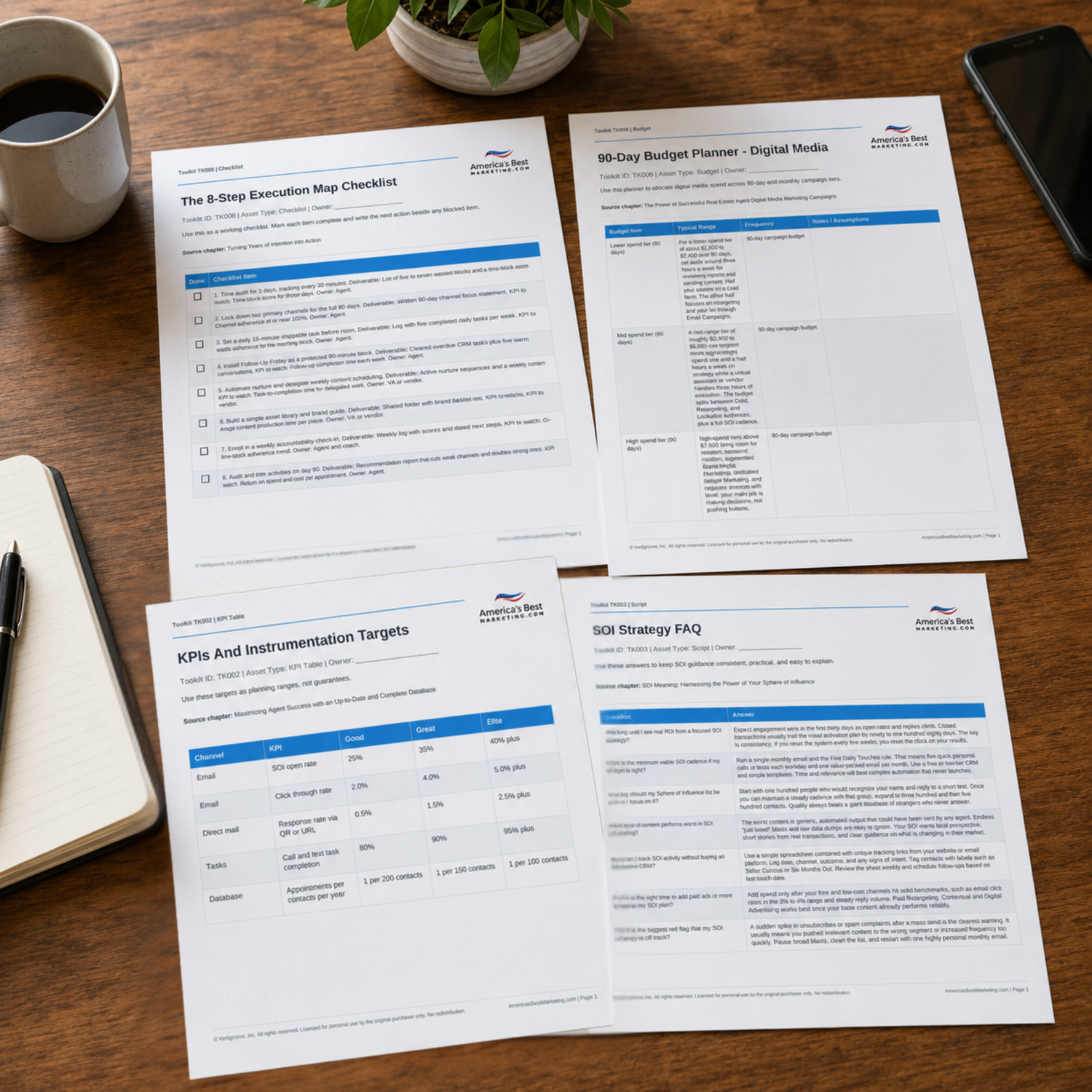
Download the Real Estate CTA Toolkit
Use the companion Toolkit to audit existing calls-to-action, compare KPI targets, and deploy stronger next-step language across websites, email, social media, direct mail, and digital ads.
Download the Toolkit ZIPRecommended reads
Recommended Reads for Real Estate Agents
These articles help agents connect follow-up discipline, database habits, client communication, and marketing execution into a repeatable system.

Turning Years of Intention into Action
Bring more structure to 90-day execution so every touchpoint supports visibility and trust.
Read article
How to Choose the Right Real Estate Agent
Make “How to choose the right real estate agent” more useful by turning the topic into a clear buyer-and-seller education resource with a defined audience, message, and next step.
Read article
Video Testimonials: Shot List, Questions, and an Editing Workflow Real Estate Agents Can Repeat
Create video content with clearer scripts, simpler formats, and a cadence agents can actually maintain.
Read article
Proven Real Estate Marketing Strategies: A 30 Day Plan for More Leads and Sales
Bring more structure to real estate marketing strategies so every touchpoint supports visibility and trust.
Read articleReal Estate Call-to-Action Questions Agents Should Be Ready to Answer
How long should a real estate call-to-action be?
Short usually wins. Aim for three to seven words that start with a verb and end with a clear result. Download the seller prep checklist is long enough to explain yet short enough to scan. If it feels like a sentence from a brochure, trim it until it reads like a direct instruction.
Where should I place the main CTA on my website?
Put one primary CTA above the fold on your home page and any core landing pages such as valuation, buyer guide, and seller guide. Repeat that same CTA at the end of the main content. The goal is to make the next step obvious to a first-time visitor without forcing them to hunt for a button.
Should I use the same CTA on every channel?
The offer can stay the same across channels while the exact line and length change. A mailer might invite a scan for an equity check, an email might say tap to see your value, and a social caption might say message me for your price range. The journey stays consistent even though the words adjust to the format.
How do I know if my CTA is underperforming?
Watch the click rate and completion rate against the ranges in the KPI table. If your main buttons on emails or landing pages sit far below those ranges after a few hundred visits, you likely have a message issue instead of a traffic problem. Change one element at a time so you learn from each test.
Can I have more than one CTA on a page?
You can, yet only one should be the clear hero at any point on the screen. A primary CTA might drive valuation requests while a softer footer line invites people to join your newsletter. If everything looks equal in size, color, and position, visitors have to think too hard and often leave.
How do CTAs support client events and appreciation campaigns?
Events work best when the invitation and call-to-action are just as strong as the in-person experience. Use a simple CTA such as reserve your spot or grab your guest pass when you promote ideas from 21 Client Appreciation and Event Ideas for Fall. That line can live on mailers, emails, and registration pages so guests never wonder what to do next.
How often should I test new CTAs?
Set a monthly rhythm for your most important CTAs and a quarterly rhythm for everything else. Each month, pick one high-impact location such as your valuation page or main guide and try a new verb, benefit, or specificity angle. Over a year, those small experiments can create a noticeable lift in booked calls and signed clients.
Next step
Build the System Behind the Click
Continue from stronger CTA language into the larger ABM ecosystem: the book series for strategic depth and the full marketing program for done-for-you execution.

View the Book Series
Explore the America’s Best Real Estate Agent Marketing System books for a deeper strategic framework around visibility, referrals, listings, lead generation, and growth.
View the Book Series
See Full Marketing Program
See how AmericasBestMarketing.com runs real estate blog writing, social media, listing marketing, email, direct mail, and retargeting as one managed system.
See Full Marketing Program