Impactful Client Appreciation, Reviews, and Reputation Management: Your Guide to Referral Growth
Client Appreciation Reviews & Reputation
A referral growth system for real estate agents
A twelve-month operating model for turning post-closing goodwill into reviews, repeat conversations, reputation proof, and referral introductions.

Client appreciation systems for referral growth
A real estate agent should treat every closing as the beginning of a twelve-month relationship track. The system starts with a specific thank-you, moves quickly into an honest review request, keeps the client visible in the database through useful touches, and creates natural openings for referrals without making the relationship feel transactional.
- Client appreciation works best when it is assigned, scheduled, tracked, and tied to the client’s actual move.
- Review requests should be clear, timely, and focused on honest feedback instead of pressure or incentives.
- Reputation Equity grows when reviews, testimonials, social proof, email, direct mail, and referral prompts reinforce one another.
- The strongest program is a twelve-month lifecycle that combines personal contact with delegated marketing execution.
Why This Pays Off After Closing
Many agents lose referral potential in the months after closing because appreciation is improvised, late, or generic. The client may have had a strong experience, but the agent does not create enough moments for that experience to become visible through reviews, testimonials, social proof, repeat conversations, or warm introductions.
A structured post-closing system changes the economics of the relationship. Appreciation creates goodwill. Goodwill makes the review request feel appropriate. Reviews create public proof. Public proof makes future prospects more comfortable. Referral prompts give satisfied clients an easy way to introduce you when real estate comes up in conversation.
This is the same operating discipline behind Achieving Top-of-Mind Awareness. The goal is not to buy loyalty with gifts. The goal is to stay present, useful, and memorable long after the transaction file is closed.
- You turn closed clients into visible proof points without asking them to do heavy lifting.
- You create a consistent review pipeline instead of hoping people remember on their own.
- You give past clients a natural reason to mention your name when a friend or neighbor needs help.
The Mechanics Of Appreciation, Reviews, And Referral Momentum
Your reputation is not what you claim in a listing presentation. It is the visible, verifiable consensus of what past clients say about your service in conversations, texts, review platforms, social posts, emails, and referrals. Reputation Equity is the value created when those positive signals accumulate and remain easy for prospects to find.
The appreciation-to-referral loop has four working parts. First, a specific gesture tells the client they were not just another file. Second, a short review request captures the client’s experience while details are fresh. Third, strong reviews become proof assets for your website, email, social media, and presentations. Fourth, the referral bridge makes it easy for a happy client to introduce you without feeling awkward.
Make the client feel remembered
A thoughtful touch does not need to be expensive. It needs to connect to the home, neighborhood, lifestyle, or specific transaction moment the client will recognize.
Specificity is the difference between a gift that feels like advertising and a gesture that feels like care.
Ask while the story is fresh
The best review request arrives soon after closing, includes one direct link, and gives the client a prompt that makes the review easier to write.
Use your Email Campaigns system to make the timing automatic while the agent keeps the message personal.
Turn praise into proof
A review should support more than one platform. Use strong client language on your website, in social proof posts, in listing presentations, and in future nurture campaigns where allowed.
Paired with Social Media Marketing, one thoughtful testimonial can keep working for months.
The highest-leverage move is not the gift. It is the timing system behind the gift. A small, well-timed personal touch beats a larger gesture that arrives late, feels generic, or never connects to a review or referral pathway.
What To Fix Before You Add More Gifts
Most client appreciation programs fail for operational reasons. The agent means well, but the process is not documented, delegated, or measured. The result is a burst of effort after a few closings, then silence.
Common breakdowns
- A generic closing gift arrives late and feels like branded advertising.
- The review request happens only when the agent remembers.
- The client hears from the agent once, then disappears into the database.
- The review prompt is too vague, so the client leaves a short generic comment.
Better operating moves
- Use a dated task list for every closed transaction.
- Send one clear review link seven days after closing.
- Support the relationship with quarterly education through Direct Mail Marketing, email, and social.
- Ask the client to mention the challenge you solved, not just the final star rating.
The Twelve-Month Client Appreciation Track
The goal is simple. Every closed transaction enters a twelve-month appreciation and reputation track. The agent protects the relationship. A virtual assistant, marketing partner, or vendor handles logistics, reminders, printing, content repurposing, and list hygiene.
Use this cadence as a starting framework. Adjust gift values and timing for your market, average commission, client volume, and brand position.
Prep the move
Deliver a branded moving kit or useful supplies and send a short pre-thank-you text. This reduces stress before moving day and signals that the relationship is not ending at the closing table.
Write the note
Mail a handwritten note that mentions one specific moment in the transaction where the client showed trust, patience, or courage.
Capture the review
Send a clear email asking for honest feedback on your primary review platform. Include one direct link and one short prompt so clients know what to write about.
Check in with value
Call or text to ask how the home is settling in, then send a local gift card that matches the client’s neighborhood or lifestyle.
Share social proof
Turn strong reviews into short graphics, stories, or posts. Add them to your social cadence so prospects repeatedly see evidence that you deliver.
Mail the market update
Send a short print piece with local stats, homeowner tips, and one invitation to reply for a quick equity check-in.
Renew the relationship
Send an anniversary card that references a detail you logged, such as a patio, view, garden plan, child, pet, or neighborhood preference.
Three Scripts That Turn Gratitude Into Action
Your words are the bridge between appreciation and measurable outcomes. Each message should start with gratitude or value, then make the next step easy. The best scripts are direct, human, and specific.
The seven-day review email
Agent dialogue
Opening lineI have one quick favor, and it helps more than you think.
Context lineReviews are how future buyers and sellers decide who to trust. Your experience carries real weight.
Ask lineIf you feel we earned five stars, would you share a short review using this link?
Prompt lineIt helps if you mention what was most stressful before we started and one thing that surprised you in a good way.
Send from the agent, use one direct review link, follow up once with non-responders, then stop.
The thirty-day check-in text
Agent dialogue
Opening lineHow are the new keys treating you so far?
Value lineI like to send a small thank-you once clients are past the first hectic weeks.
Choice lineWould a gift card to the local cleaners or pizza spot near you be more helpful right now?
Referral lineIf you hear anyone else talking about moving this year, I’m always happy to take good care of them.
Log the response in the CRM and assign any referral hint as a follow-up task immediately.
The anniversary referral call
Agent dialogue
Opening lineHappy home anniversary. It has been a full year since we handed you those keys.
Memory lineI still remember you talking about how much you wanted to enjoy that patio.
Check-in lineHow has the home changed things for you this year?
Ask lineIs there anyone you care about who needs the same level of guidance this season?
Thank them whether or not they have a referral today. The relationship is still the asset.
Budget Levels And Time Requirements
You do not need a luxury budget to run a serious appreciation program. You need consistency, clear caps, and a plan that matches your transaction volume. Use these tiers as planning ranges, not guarantees.
Up to six closings per quarter
Spend: About $1,200 to $2,500 per ninety days, depending on gift choices, mail volume, and vendor support.
Cadence: Run the full seven-step track, keep physical mail to one piece per quarter, and reserve larger experience gifts for the one-year mark.
Time: About one hour per week for the agent and one hour per week for an assistant or vendor.
Twelve to eighteen closings per quarter
Spend: About $3,500 to $6,000 per ninety days, depending on gift value, print volume, review content creation, and event activity.
Cadence: Run the full seven-step track plus one client event such as a movie night, pie pickup, photo day, or seasonal gathering.
Time: Around thirty minutes per week for the agent, with three or more hours per week for delegated logistics.
For event ideas that expand the relationship beyond a single gift, use Client Appreciation and Gifting Programs for Real Estate Agents and Client Appreciation Events: 7 Plug-and-Play Ideas Agents Use.
KPI Table For Reputation Velocity
You cannot improve what you do not measure. In this system, the most useful numbers show whether client sentiment is turning into reviews, repeat conversations, and referrals. Treat the benchmarks below as planning targets to review against your market, client base, and follow-up consistency.
| Category | Metric | Good | Great | Elite |
|---|---|---|---|---|
| Reputation capture | Review conversion rate per closed client | 15% | 25% | 35%+ |
| Reputation quality | Average rating across platforms | 4.8 | 4.9 | 5.0 |
| Referral volume | Referral inquiries per ten past clients per year | 2.5 | 3.5 | 4.5+ |
| Social proof | Save or share rate on review posts | 3.0% | 5.0% | 7.0%+ |
| Bottom line | Referral to signed client conversion rate | 65% | 75% | 85%+ |
Use unique review links where possible, ask every inbound lead how they heard about you, and log the exact past client name when referrals are involved. Add a simple satisfaction question to your post-closing workflow, and call anyone who expresses frustration before they reach a public review screen.
Compliance And Ethics That Keep The System Clean
A reputation system built on pressure or incentives will eventually fail. You want a program that would still meet your standards if every message were read out loud in public.
Keep appreciation separate from the review request. If you offer anything connected to feedback, disclose that relationship clearly and follow the rules of the review platform you are using. Never run contests that reward only five-star reviews. Never pay directly for ratings. Ask for honest feedback and respond professionally when criticism appears.
Also respect data privacy. If you record family names, pet names, anniversary dates, or preferences in your CRM, use that information only for relevant client care. A thoughtful note is valuable. A message that feels like surveillance is not.
Case Study: Sofia’s Post-Closing Reputation Track
Consider a fictional but realistic agent named Sofia. She closed twenty transactions last year and decided that every client would enter a structured twelve-month appreciation track instead of receiving one generic gift.
Sofia used a moving kit, handwritten note, review request, thirty-day check-in, quarterly market update, review-based social proof, and one-year anniversary touch. A virtual assistant managed the review sequence through Email Campaigns, turned the best client comments into posts through Social Media Marketing, and kept past clients out of cold prospecting campaigns in Retargeting, Contextual & Digital Advertising.
The result was not just better follow-up. It was better visibility. Her best client stories supported social posts, email proof, presentations, and the testimonials page on her IDX-Integrated Websites. New prospects encountered evidence of service quality before the first consultation, and past clients had more reminders to introduce her when real estate came up in conversation.
The Post-Closing Action Plan
This checklist makes sure every client enters the system the moment the deal closes. Run it the same day you mark a transaction as closed.
- Create a client tag. Tag the contact in your CRM as Past Client Appreciation Track so reporting and exports are simple.
- Record personal details. Capture names of children and pets, key home features, and preferences that make future notes and gifts feel tailored.
- Schedule gifts. Book the pre-close moving kit and the twelve-month anniversary gift as dated tasks.
- Draft the thank-you note. Write the handwritten message while the transaction details are still fresh.
- Launch the review sequence. Add the client to your seven-day review workflow in Email Campaigns.
- Block the thirty-day check-in. Create a calendar event for the call or text and choose a local gift option.
- Exclude from cold ads. Add the past-client segment to an exclusion list in your Retargeting, Contextual & Digital Advertising campaigns so they receive relationship messages instead of generic lead ads.
- Prepare social proof. When a review is received, pull one or two strong sentences for future posts and graphics.
- Assign quarterly outreach. Confirm the client is included in the next print drop and email newsletter.
- Set the anniversary reminder. Block time one week before the closing anniversary for a personal touch.
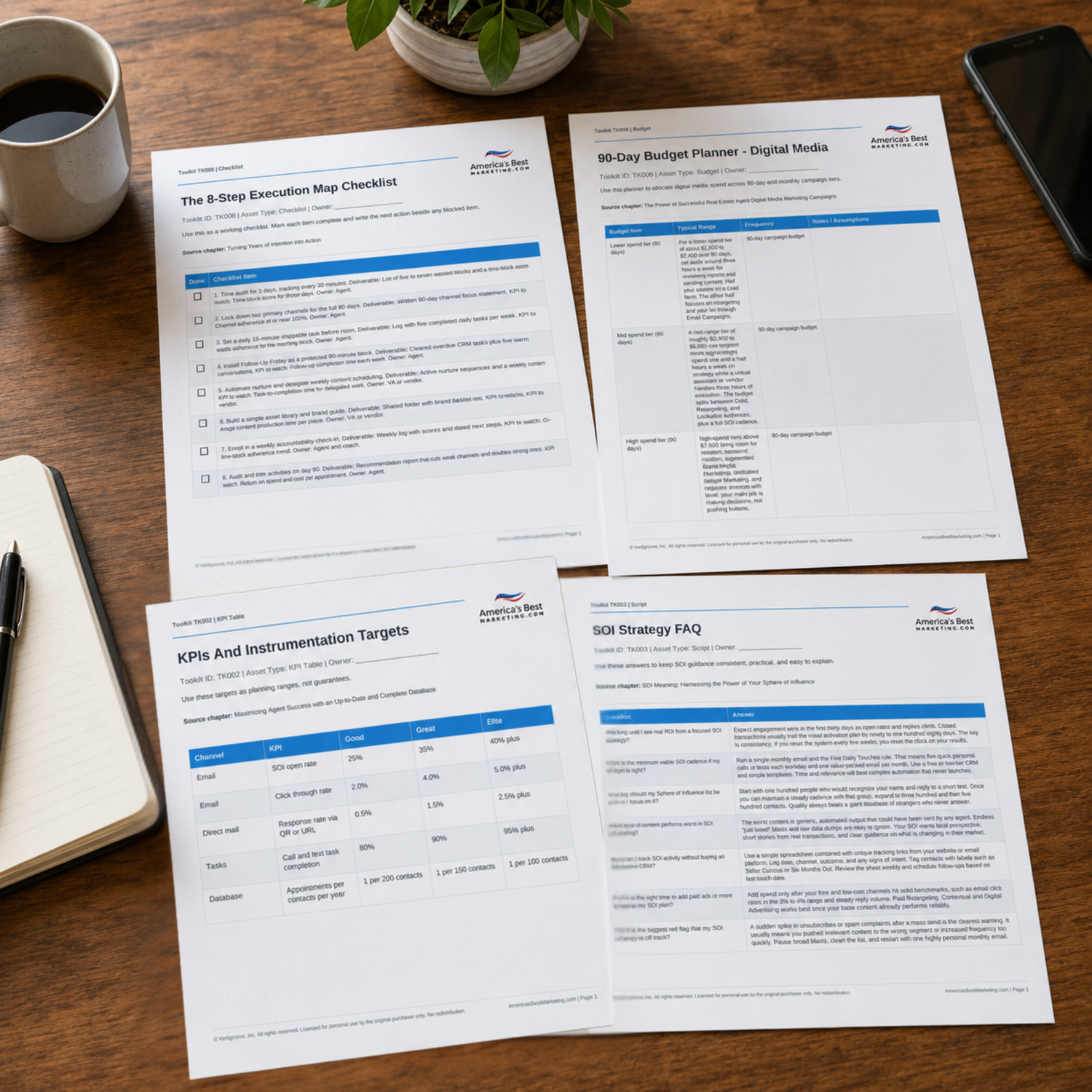
Download The Client Appreciation And Reputation Toolkit
Use the companion Toolkit to install the twelve-month client appreciation cadence, review request workflow, post-closing checklist, KPI table, gift budget plan, and scripts that help agents turn goodwill into referral-ready proof.
Download the Toolkit ZIPRecommended reads
Recommended Reads for Real Estate Agents
These articles help agents connect follow-up discipline, database habits, client communication, and marketing execution into a repeatable system.

Client Appreciation Events: 7 Plug-and-Play Ideas Agents Use
Give client appreciation events a clearer role in the marketing system instead of treating the work as a one-off idea.
Read article
Build a Relocation Lead Engine in [Your City] (Guide for Real Estate Agents)
Use relocation lead engine to strengthen visibility, follow-up, and client conversations without adding more random tasks.
Read article
Investor Content for Real Estate Agents: Build a Real Estate Investment Portfolio Series That Attracts Clients
Make investor content easier to plan, publish, and measure as part of a weekly marketing rhythm.
Read article
Client Appreciation and Gifting Programs for Real Estate Agents
Create more leverage from client appreciation and gifting programs with a clear path from attention to follow-up.
Read articleClient Appreciation, Reviews, And Reputation Questions Agents Ask
How long does it take to see results from a client appreciation program?
You can often see review activity within the first thirty to sixty days as recent closings move through the review request and check-in sequence. Referral activity usually takes longer because it depends on relationship timing, market conditions, and whether past clients encounter people who need help.
What is the minimum viable client appreciation plan if my budget is tight?
Run a three-step version first. Mail a handwritten note within three days of closing, send a review request email at day seven, and make a personal phone call at the one-year anniversary. Stay visible between those dates with low-cost touches through Social Media Marketing and your email list.
How do I get detailed reviews instead of short generic comments?
The quality of your prompt drives the quality of the review. Ask clients to mention what worried them before they called you, one challenge you solved, and why they would recommend you to a neighbor. Specific prompts lead to more useful reviews.
What types of gifts tend to perform worst in client appreciation programs?
Generic items with your logo and no real utility are usually the weakest performers. Branded keychains, generic baskets, and low-context promotional items can feel like advertising. Useful, local, or experience-based gifts generally feel more thoughtful.
How should I respond if a client gives me negative feedback privately?
Pause any automated review request for that client. Thank them for being honest, ask clarifying questions, and offer a specific solution or adjustment when appropriate. Private negative feedback is an opportunity to recover the relationship before it becomes a public reputation problem.
When is the best time of year to host client appreciation events?
Early summer and late fall tend to work well. Summer supports outdoor gatherings, while late fall is ideal for pie pickups, photo events, or seasonal appreciation touches. Use client appreciation and gifting resources to plan the event and the follow-up that comes after it.
How should I use my website to support reputation management?
Create a dedicated testimonials page on your IDX-Integrated Websites and feature your best reviews with names, neighborhoods, and short context where allowed. Link to that proof from your email signature, social bios, and listing presentation materials.
Can I run this system on my own or do I need outside support?
You can run a slimmed-down version solo if you are consistent. As volume grows, it is usually more effective to delegate gifting, print, review capture, and content repurposing to a virtual assistant or to a partner like AmericasBestMarketing.com so you can focus on client conversations and negotiations.
Next step
Build the System Behind the Advice
Continue from one useful article into the larger ABM ecosystem: the book series for strategic depth and the full marketing program for done-for-you execution.

View the Book Series
Explore the America’s Best Real Estate Agent Marketing System books for a deeper strategic framework around visibility, referrals, listings, lead generation, and growth.
View the Book Series
See Full Marketing Program
See how AmericasBestMarketing.com runs real estate blog writing, social media, listing marketing, email, direct mail, and retargeting as one managed system.
See Full Marketing Program