Charting Your Course: A Strategic Growth Plan for Long-Term Success
A Real Estate Strategic Growth Plan turns broad ambition into a ninety-day operating map. Instead of waking up each week and guessing what to post, who to call, what to mail, or which number matters, you know the destination, the priority audience, the weekly inputs, and the scorecard. That kind of structure is also what makes stronger relationship systems possible, including Real Estate Agent Client Appreciation and Gifting Programs that feel intentional instead of last-minute.

What A Real Estate Strategic Growth Plan Actually Is
A Real Estate Strategic Growth Plan is a simple operating map that connects your twelve-month business goal to the actions you will take over the next ninety days. It should define where you are headed, which results matter most, what you will measure before the quarter ends, which channels deserve attention, and which activities must happen even when the week gets messy.
The best plans are not giant binders full of language nobody uses. They are clear enough to read when you are tired. They tell you what to do Monday morning, what to fund this month, which people deserve personal follow-up, and which distractions are not allowed to impersonate progress.
Twelve-month outcome
Write the business result you want in plain language, such as more listings from a specific neighborhood or steadier referrals from your sphere.
Ninety-day priorities
Choose no more than three outcomes for the quarter so your time, budget, and content stay pointed in the same direction.
Weekly activity
Define the calls, notes, emails, direct mail touches, social visibility, and database cleanup that must happen consistently.
What you will not chase
Decide what is outside the plan so you stop abandoning strong priorities for every new idea or slow-week panic.
Why Strategy Beats Hustle For Real Estate Growth
Most agents do not lose because they lack effort. They lose because the effort has no clear path. One week is packed with calls, pop by gifts, listing prep, social posts, and open house follow-up. Then two quiet weeks follow with almost no outbound activity. Income swings usually follow the same pattern.
Hustle creates motion. Strategy creates direction. There is a big difference between doing a lot and doing the right things often enough for the results to compound. One agent reacts to whatever feels urgent. Another protects ninety minutes a day for live conversations, sends one useful message to the right people each week, reviews the score every Friday, and stays with the plan long enough for trust to build.
- Vague goals stay vague results, so every target needs a clear number, deadline, and owner.
- Shiny new channels distract from the two core engines that already work for you.
- Marketing treated as a luxury never gets funded, which is why serious agents reserve growth money before lower-value spending absorbs it.
- Weekly review protects your confidence from fantasy and your discouragement from becoming permanent.
Build A Ninety-Day Plan That Holds Up
Think of your business vision as the long route on a map and your next ninety days as one focused leg of that trip. The vision might be a dominant position in a niche, such as lakefront homes, new construction, probate, relocation, or a specific neighborhood. The ninety-day plan translates that story into actions such as listing count goals, database size targets, seller conversations, mail drops, email touches, and appointment targets.
The strongest plans align every tool you use with that vision. Your database, your Social Media Marketing for Real Estate Agents, your email plan, and your direct mail should all reinforce the same market position. If you want a model of what coordinated execution looks like, study The Best Real Estate Marketing Agency: Why Real Estate Agents Choose AmericasBestMarketing.com and notice how each channel reinforces the same promise.
Most agents confuse busy calendars with growth. The real divide is between five-dollar tasks such as formatting flyers and five-hundred-dollar tasks such as live conversations with likely sellers, past clients, and referral sources. When you plan each week, mark the high-value actions first and refuse to erase them for anything short of a signed contract or a true emergency.
- Write the twelve-month result. Use plain language. Do not write a vague goal like grow my business. Write the result you can recognize when it happens.
- Choose three ninety-day outcomes. Examples include new listings from a geo farm, signed buyers from open house follow-up, or a specific number of live seller conversations.
- Work the math backward. Decide how many mail pieces, calls, texts, emails, social posts, events, and personal notes you need to support those outcomes.
- Pick one or two primary channels. Email and direct mail might carry one quarter. Social visibility and retargeting might carry another. Avoid chasing six channels at once.
- Segment your sphere of influence. Separate core advocates, past clients, active prospects, cold leads, and local connectors so the best people receive the most personal touches.
- Protect prospecting time. Reserve ninety minutes each weekday for live conversations or direct follow-up before the rest of the calendar gets access to that time.
- Clean the database. Confirm phone, email, address, relationship type, last contact date, and source tags are accurate enough to support a real campaign.
- Prepare four reusable messages. Build one seller update, one buyer progress note, one local market story, and one human check-in that does not sound automated.
- Schedule the weekly review. Review lead flow, database hygiene, appointment rate, and missed inputs once a week before a weak pattern becomes a weak quarter.
- Name what you will stop doing. Every plan needs a stop-doing list so your best energy has somewhere to go.
Three Strategic Growth Conversations You Can Use
A growth plan does not create revenue until it creates conversations. Use scripts like these to turn the plan into human follow-up with people who already know you, may need a selling plan, or would benefit from local market clarity.
The Sixty-Second Sphere Check-In Call
Dialogue: agent
- Hook: “You were on my mind because I am helping a few people think through their next move before it becomes urgent.”
- Build: “A short plan can lower stress and help you make smarter decisions later, even if you are not ready right now.”
- Question: “When you think about the next few years, do you picture staying put, moving up, or simplifying?”
- Close: “If it would help, I can send a short written outline of what your options could look like.”
Shot list and notes
- Face-to-camera clip at your desk with a visible notebook and pen.
- Quick pan over a handwritten list labeled sphere game plan.
- Close-up of a simple equity estimate or value range on a tablet.
- End on a smile with a lower third that says book your short plan call.
Beat mapping
Open with genuine context, ask a future-oriented question, then close by offering clarity instead of pressure.
The Seller Strategy Conversation
Dialogue: agent
- Hook: “Most sellers ask about price first, but the better first question is what kind of plan will help you sell with the least stress.”
- Build: “Price, prep, and timing work together. When one is ignored, the whole move gets harder than it needs to be.”
- Question: “Would it help if I showed you the three decisions that usually make the biggest difference before a home goes live?”
- Close: “I can put that into a short plan you can read in ten minutes and think about with a clear head.”
Shot list and notes
- Begin at a whiteboard that shows price, prep, and timing as three simple boxes.
- Cut to a tidy living room that clearly looks photo ready.
- Show a calendar page with strategic dates circled in a bright color.
- End with a close shot of your phone screen ready for a message from the viewer.
Tie this script to a seller prep guide, quick valuation review, or short strategy call. The goal is to move the homeowner away from random pricing talk and toward a structured plan.
The Local Market Story Conversation
Dialogue: agent
- Hook: “The big headlines are loud, but your neighborhood tells a more useful story.”
- Build: “Inventory, days on market, and sale-to-list ratios at the street level often reveal opportunities people miss.”
- Question: “Would a short local report in plain language help you see where your home sits right now?”
- Close: “Send me your street name and I will point you to the numbers that matter most.”
Shot list and notes
- Walk toward a recognizable neighborhood landmark with light handheld motion.
- Overlay quick cuts of simple charts that show local trends.
- End on a map view zoomed tightly to your farm with a clear pointer near the center.
This script works best when your strategic growth plan includes a geographic farm, neighborhood content, or seller-focused follow-up rhythm.
Planning Rhythms You Can Repeat
A Real Estate Strategic Growth Plan lives or dies on rhythm. You need a simple cadence that balances time, money, and energy. The aim is not perfection. The aim is to hit your inputs on most days so the math has a chance to work.
Use these two starter budgets as example ranges rather than promises. They show how to match spend, time, and vendor support so you stay inside a plan that fits your stage of growth.
Invest four hundred to eight hundred dollars over ninety days into focused direct mail, basic Email Campaigns, and a light Social Media Marketing rhythm. Focus on one small geo farm plus your top one hundred relationships. Cap yourself at three send days per month so you never scramble at the last minute.
Invest one thousand eight hundred to three thousand five hundred dollars over ninety days across Email Marketing for Real Estate Agents, Social Media Marketing for Real Estate Agents, Direct Mail Marketing for Real Estate Agents, and light retargeting support. Vendor teams can protect six to eight hours of execution work each week while you keep live prospecting time on the calendar.
Strategic growth also needs clear call-to-action tiers. Soft calls invite simple replies or clicks. Mid-level calls trade value such as guides, checklists, or local reports for light information. Hard calls invite full strategy sessions or listing appointments and should be aimed at people who already engaged through your website, email list, direct mail, or retargeting funnel.
The point is not to look busy. The point is to repeat the right activity long enough for recognition, trust, and response to compound. Multi-channel plans work best when each touch reminds the same audience that you are the steady guide for that market.
Use the quarterly benchmarks in the table as target ranges. They help you steer early rather than wait for a slow season to reveal gaps. The goal is not to hit perfect numbers. The goal is to keep the trend line honest and moving in the right direction.
| KPI | Acceptable | Goal | Tracking note |
|---|---|---|---|
| Lead flow | 10 new leads per month | 20+ new leads per month | Count new leads each month by source. Rebalance when one channel carries too much of the load. |
| Database hygiene | 75% | 95%+ | Measure the share of contacts with clean phone, email, and address fields. Fix duplicates every week. |
| Appointment rate | 5% | 10%+ | Track the percent of outreach that books a next step. Review the number by channel and by script. |
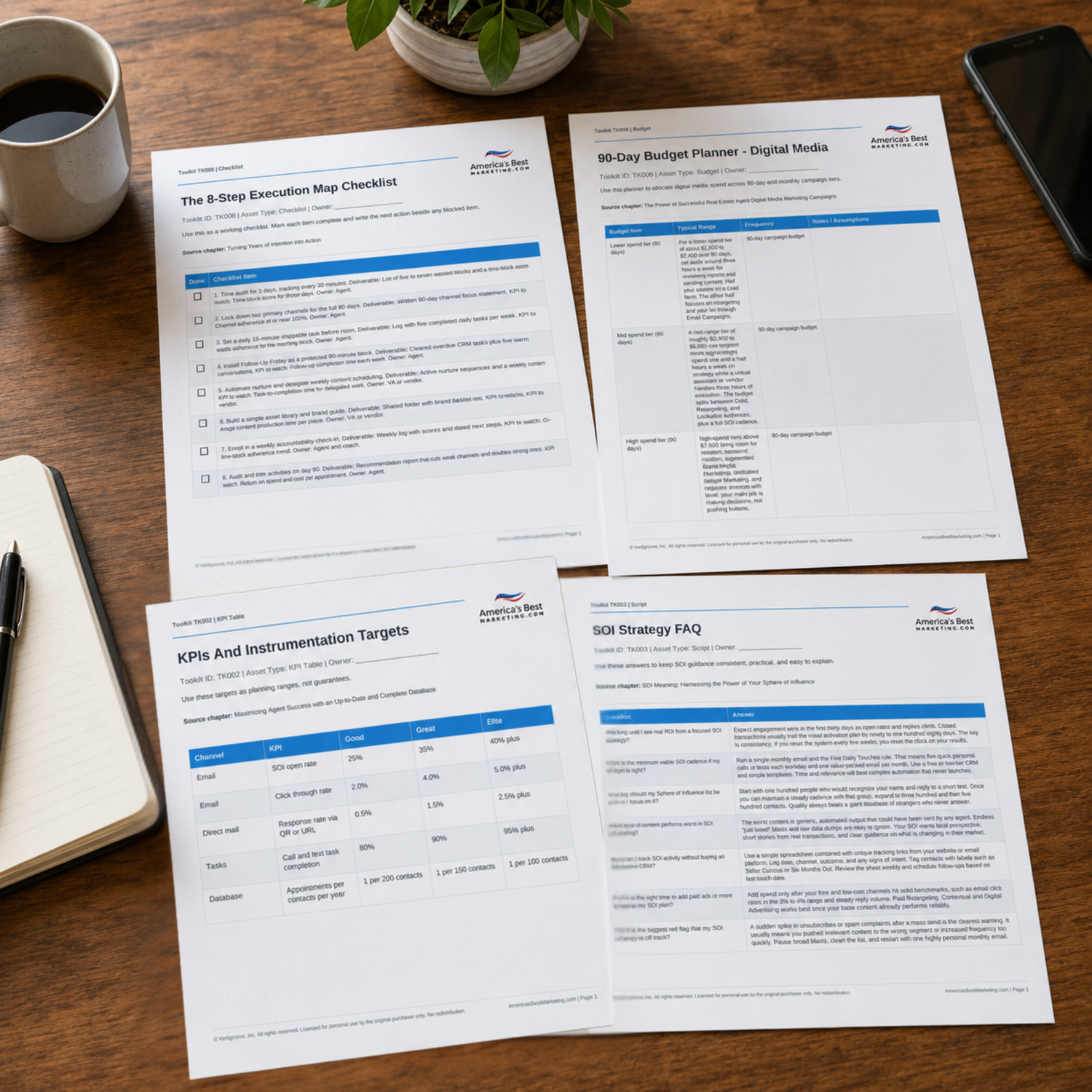
Download The 90-Day Strategy Map Toolkit
Use this toolkit to turn the article into an execution plan. The ZIP includes a 90-day growth budget planner, a 90-day strategy-map checklist, a quarterly benchmark planner, FAQ blocks, and strategic conversation scripts.
- Map the next ninety days into realistic actions, budget ranges, and owner-ready follow-up.
- Track lead flow, database hygiene, and appointment rate before the quarter gets away from you.
- Use the conversation scripts to move sphere, seller, and local-market discussions toward a clear next step.
What Successful Real Estate Agents Are Reading


FAQ
How long should I follow my Real Estate Strategic Growth Plan before major changes?
Give a new plan a full ninety-day cycle before you judge the core channels or messaging. Use that time to track input KPIs such as calls, emails, mail touches, and conversations. At the end of the cycle, adjust based on real data instead of emotion from one slow week or one hot streak.
What is the smallest realistic commitment for a tight marketing budget?
If cash is tight, time must carry more of the load. Focus on daily live conversations, one useful email to your sphere each month, a simple client text rhythm, and one weekly block for follow-up and database cleanup. Do not add channel complexity until your basic rhythm is stable.
How can I track campaign performance without complex automation tools?
Use one simple tracking sheet or a clean CRM note process. Record source, date, first response, and next step for every new lead. If you use IDX Real Estate Websites, email campaigns, or direct mail, tie each new lead back to the channel that created the first response.
What is the biggest warning sign that my growth plan is failing?
The clearest warning sign is missed input targets for more than two weeks in a row. When calls, notes, emails, or mail touches keep slipping, the problem is usually execution design, not bad luck. Either simplify the plan or protect the calendar more aggressively.
Should my plan lean harder into buyers or sellers right now?
Choose your mix on purpose. Many agents prefer to put more energy into listing control while keeping a smaller buyer pipeline active. What matters is that every channel supports the choice you made instead of sending mixed signals to your market.
What content usually performs worst in a strategic marketing calendar?
Self-focused victory laps usually underperform. Posts that brag about awards, volume, or vague just-sold wins without context rarely build trust. Replace those with short stories that explain how you solve real problems in specific neighborhoods.
How large should my first geo farm be when I launch this plan?
Start with depth instead of reach. A farm of five hundred to one thousand doors is usually enough to execute consistently with mail, local market updates, social visibility, and personal follow-up. Add another area only after the first one is receiving steady attention.
Every strong Real Estate Strategic Growth Plan ends with a clear next step. If you want the campaigns handled while you focus on appointments, AmericasBestMarketing.com builds and manages multi-channel marketing systems for real estate agents so the plan does not stay trapped in a notebook.