How a Real Estate Coach Helps Agents Set Goals and Stay Accountable
Real Estate Coach Goals and Accountability
A 90-Day Plan for Agent Execution
A coaching accountability system for agents who want clear goals, weekly scorecards, better follow-up, and consistent marketing execution without chasing every new idea.

How a coach helps real estate agents stay accountable
A real estate coach helps agents turn broad ambition into visible weekly behavior. The best coaching system starts with one quarterly goal, converts that goal into a 90-day plan, tracks a few controllable inputs, and reviews the scorecard every week so follow-up, marketing, and pipeline work do not disappear when the calendar gets busy.
- A coach should clarify the agent’s real business target before adding more tactics.
- The most useful 90-day plan tracks controllable inputs such as conversations, follow-up completion, protected prospecting time, and marketing assets shipped.
- Accountability works better when it is framed as data review, not personal judgment.
- Done-for-you marketing support gives the coach more room to focus on strategy, prioritization, and weekly decision discipline.
Start With The Business You Actually Want
Most real estate agents do not need more ideas. They need a coach who turns half-finished plans into a simple weekly scorecard. Why a Real Estate Agent Should Hire a Coach explains the case for coaching, and this briefing shows how to keep marketing, lead generation, follow-up, and time allocation on track.
Your coach cannot fix a moving target. The first job is to decide exactly what you want the business to look like over the next twelve months and how much of that work you want marketing to carry. That clarity lets every coaching call become a prioritization session instead of a therapy session.
A clean target starts with the inner work. Use Defining Your True North: Affirming Your Goals and Dreams to write down your non-negotiables, then translate them into one measurable target for the next quarter, such as signed listings, booked consultations, referral conversations, or net income.
- Pick one quarterly outcome you will measure, not five competing outcomes.
- Decide what portion of that outcome must come from marketing activity rather than pure hustle.
- Agree with your coach on three controllable inputs that have the strongest link to that outcome.
- Put those inputs into a weekly scorecard before you debate new tactics.
A good coach forces the business into observable behavior. How many follow-ups will happen? When will they happen? What marketing asset will ship? What will be reviewed next week?
Build A 90-Day Plan That Lives In The Calendar
A good coach will not let you chase every shiny idea. Instead, you build a 90-day plan that lives in a calendar and a scorecard. The calendar protects your time blocks. The scorecard tracks the controllable activities that feed your pipeline so you can adjust while there is still time to correct course.
Focused Real Estate Activities: How Successful Real Estate Agents Prioritize What They Can Control outlines the logic. Your coach’s role is to enforce it. Three controllable activities get locked in for the next quarter, for example daily follow-ups, weekly email campaigns, and monthly direct mail touches to your core farm.
The plan works when progress is visible in one glance. Treat the benchmarks below as instrumentation, not promises. Your numbers may start lower or higher. The value is in the trend from week to week.
| Metric | Target benchmark | Healthy week | Needs attention |
|---|---|---|---|
| New live conversations logged | 30 per week | 28 to 40 conversations | Under 18 conversations |
| Follow-up completion rate | 85 percent of tasks | 85 to 100 percent completed | Under 70 percent completed |
| Time blocked for prospecting | 10 hours per week | 8 to 12 hours protected | Under 6 hours protected |
| Marketing assets shipped | 3 per week | 1 email, 1 post, 1 mailer | No new assets shipped |
Your coach helps you read the table without emotion. A soft week is not a personal failure. It is a signal to adjust your calendar, tighten your list, or ask for execution support such as Email Campaigns or Direct Mail Marketing so the inputs stay consistent even when your schedule gets messy.
The coaching conversation should move in this order: goal, scorecard, obstacle, decision, next action. If you start with feelings, the call drifts. If you start with data, the coach can help you make a business decision. The goal is not to shame the agent. The goal is to make the operating system visible.
Use Scripts That Make Accountability Easier
Accountability breaks down when conversations feel like judgment. Simple scripts remove that tension. You can use them with a paid coach, a peer partner, or even with yourself during a Friday review. The goal is to keep the tone honest, fast, and focused on the next action instead of replaying the entire week.
The Weekly Goal Reset Check-In
Use this when last week’s activity needs a clean reset.
StartHere is the goal we set for this quarter and what last week’s scorecard shows.
RealityThe numbers say I hit these inputs and missed these ones.
Next stepFor this week I will protect these time blocks and cut this distraction.
Data first, story second, decision third. That sequence keeps the call calm and actionable.
The Pipeline Reality Conversation
Use this once a month when the pipeline needs honest inspection.
StartHere is the current pipeline by stage and timing.
GapIf nothing changes, this is where the quarter will land compared to the target.
PlanThis week I will add these touches to shorten the gap.
Tie this conversation to decisions about where you invest support such as Digital Retargeting.
The Time Block Protection Script
Use this when prospecting and marketing blocks keep getting displaced.
StartHere are the prospecting and marketing blocks on my calendar this week.
RiskHere are the meetings that could knock those blocks off the schedule.
ProtectionHere is how I will say no or delegate so these blocks stay intact.
CheckWill you hold me to this and ask about it next week?
Accountability only matters if the protected time survives contact with the real week.
Make Coaching A Business Decision, Not A Mystery
Your coaching budget should feel like a business decision. A common target benchmark is 3% to 5% of gross commission income for coaching, training, and accountability tools combined. Start small, review quarterly, and ask your coach to justify the fee in terms of process improvements, not promised outcomes.
Use the cards below as examples. They show how an agent might structure a starter coaching budget and then level it up once revenue grows. The goal is to avoid random spending and tie every dollar to a cadence and a clear purpose.
Monthly Coaching Call
Work with a coach for one 45-minute call each month and one short check-in message each week. Commit to three core inputs on your scorecard and two focus blocks on your calendar. Cap the total time so the plan remains sustainable during busy months.
Weekly Accountability Rhythm
Upgrade to weekly 30-minute calls plus shared access to a live scorecard. Ask your coach to review your pipeline monthly and your marketing cadence quarterly. Keep the total coaching and development budget under 5% of last year’s gross commission income.
Clear creative briefs keep coaching conversations out of the clouds. When your coach understands the campaign you are running, they can hold you accountable to specific steps instead of vague goals. These two example briefs can drop into a scorecard or project tracker.
SOI Nurture Campaign
Goal: Increase warm conversations with your Sphere of Influence. Audience: Past clients and personal contacts. Creative: Monthly value email plus one quarterly physical mailer. CTA: Invite readers to reply and ask for a quick personalized pricing check.
Hyperlocal Farm Consistency
Goal: Become the most recognized name in a chosen neighborhood. Audience: Owners in your core farm. Creative: Quarterly mailer and supporting retargeting. CTA: Drive owners to a valuation page you can follow up on quickly.
Done-For-You Production
When the plan is clear but production keeps slipping, connect coaching decisions to managed execution through Social Media Marketing, Listing Marketing, and IDX Real Estate Websites.
Protect A Repeatable Coaching Cadence
Coaching only works when your week has a basic rhythm. Your coach should help you design a pattern that repeats so the small wins compound. The point is not to create a complicated planner. The point is to make sure the right things happen at roughly the same time each week.
Use this sequence as a starting point. Adjust it with your coach so it matches your market, your energy, and your family schedule. The list is not meant to be perfect. It is meant to be consistent.
- Friday afternoon: fill out your scorecard and send it to your coach.
- Sunday or Monday: review last week, choose one theme for the new week, and confirm protected time blocks.
- Daily: complete follow-ups before checking social feeds or inbox digests.
- Midweek: ship one marketing asset such as a targeted email or farm mailer.
- End of week: write down one lesson and one win to share in your next session.
A strong coach does not replace your effort. They simplify your decisions, protect your calendar, and help you turn inputs like calls, mailers, emails, and campaigns into a predictable rhythm.
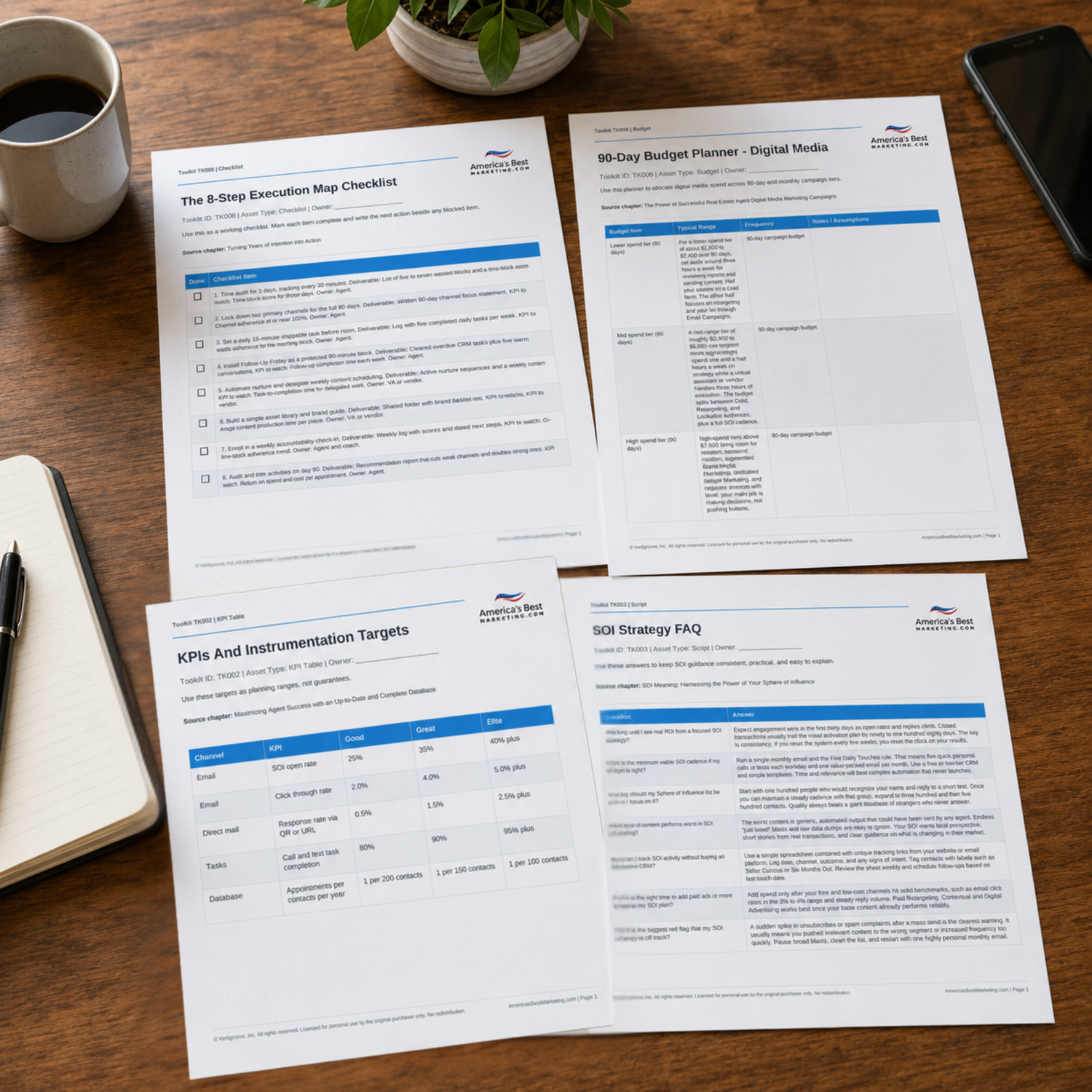
Download The Coaching Accountability Toolkit
Use the companion Toolkit to tighten your 90-day plan, weekly accountability scorecard, budget examples, rhythm checklist, coaching FAQ, and copy-ready scripts for goal reset, pipeline review, and time block protection.
Download the Toolkit ZIPRecommended reads
Recommended Reads for Real Estate Agents
These articles help agents connect follow-up discipline, database habits, client communication, and marketing execution into a repeatable system.

Defining Your True North for Real Estate Agents | 90 Day Goal Plan
Use systems, delegation, and scorecards to protect the work that creates future business.
Read article
The Pros and Cons of All-Cash Offers
Use the pros and cons of all-cash offers to create a stronger bridge between client education and real conversations.
Read article
Behind-the-Scenes Content: A Weekly Storyboard for Real Estate Agents (BTS That Sells)
Use a weekly storyboard to create a stronger bridge between client education and real conversations.
Read article
Why a Real Estate Agent Should Hire a Coach
Turn good intentions into a weekly operating rhythm with clearer priorities and accountability.
Read articleReal Estate Coaching Accountability Questions
How often should a real estate agent meet with a coach?
Weekly or biweekly sessions usually work well. Weekly calls keep momentum high during growth seasons. Biweekly calls can work once your systems are stable. The operating test is simple: do you leave each session with three clear actions and a scorecard you can update before the next call?
What does a productive coaching session agenda look like?
A strong agenda starts with last week’s scorecard, then reviews pipeline, calendar blocks, and priority decisions, and ends with three specific commitments. Your coach should spend more time on decisions than on storytelling. You should walk away with updated time blocks, clear numbers to track, and one habit you are strengthening this week.
How do I stay accountable without feeling micromanaged?
Use tools that track outcomes rather than every minute of your day. A simple scorecard or CRM report that shows follow-ups completed, marketing assets shipped, conversations logged, and appointments set is usually enough. Share the numbers with your coach, talk about patterns, and protect your autonomy on how you hit the targets.
Is coaching still useful if my broker already offers training?
Yes. Training and coaching serve different jobs. Training gives you knowledge. Coaching helps you execute consistently on a small set of moves that match your business. Many agents use broker training for skills and a separate coach to create accountability around marketing, follow-up, and business planning.
How much should I budget for coaching and accountability tools?
A common benchmark is 3% to 5% of gross commission income for coaching, training, and accountability tools combined. Start at the low end, track how often you use the support, and increase only when you can connect the spend to better execution patterns.
What if I am embarrassed about the current state of my business?
Most coaches have seen messy databases, thin pipelines, inconsistent branding, and missed follow-up before. Their job is not to judge. Their job is to help you pick a starting point. Share the real numbers once, then focus on the first three wins you can create in the next thirty days.
Can a coach help with marketing execution or only mindset?
Some coaches focus on mindset. Others specialize in execution details such as campaign planning, calendar design, and pipeline review. Look for someone who can speak concretely about email cadence, direct mail, social media, and follow-up, and who is comfortable working alongside done-for-you marketing support.
How does coaching work with a done-for-you marketing service?
A done-for-you service handles production and delivery. Coaching keeps you accountable for the strategic choices that sit above that work. When both are aligned, you spend less time tinkering with creative, more time talking to clients, and every campaign has a clear owner, goal, and review rhythm.
Next step
Build the System Behind the Advice
Continue from one useful article into the larger ABM ecosystem: the book series for strategic depth and the full marketing program for done-for-you execution.

View the Book Series
Explore the America’s Best Real Estate Agent Marketing System books for a deeper strategic framework around visibility, referrals, listings, lead generation, and growth.
View the Book Series
See Full Marketing Program
See how AmericasBestMarketing.com runs real estate blog writing, social media, listing marketing, email, direct mail, and retargeting as one managed system.
See Full Marketing Program