The 90-Day Real Estate Marketing Plan: Pillars, Budgets, & KPIs for Real Estate Agents
The 90-Day Real Estate Marketing Plan
Pillars, Budgets, And KPIs For Real Estate Agents
A working planning brief for agents who want to connect brand, audience, cadence, channel mix, budget, tracking, scripts, and weekly accountability.

The 90-Day Marketing Plan In Plain English
A successful real estate marketing plan is a documented 90-day operating rhythm. It names one business objective, defines the right audience, repeats a consistent message across mail, email, social, ads, website activity, and CRM follow-up, then judges the work by appointments, signed clients, Cost Per Lead, and Cost Per Appointment rather than by scattered impressions.
- The plan should run as a 90-day sprint, not a collection of disconnected one-off campaigns.
- Consistency, reach, frequency, and multi-channel integration are the four operating pillars.
- Warm audiences, clean source tracking, and CRM follow-up should earn budget before broad cold expansion.
- The real scoreboard is qualified conversations, appointments, signed clients, and source quality.
Why This Pays Off
Guessing your way through marketing is expensive. Random posts, one-off postcards, inconsistent emails, and occasional ads may create activity, but they rarely create an operating system. A 90-day real estate marketing plan gives every channel a job and gives every week a measurable purpose.
The point is not to do everything. The point is to run a focused mix of high-value channels with enough consistency that your market starts to recognize the same message in more than one place. Your website and CRM become the hub. Mail, email, social media, paid ads, and follow-up become the spokes.
This is where the planning concepts from Business Growth Strategy for Real Estate Agents become execution. The article explains why agents need a real business growth strategy; this brief turns that strategy into a campaign calendar, a budget structure, a reporting routine, and a weekly accountability loop.
- Your calendar becomes more important than your mood.
- Your website and CRM become the operating center instead of social feeds.
- Your budget is judged by Cost Per Lead and Cost Per Appointment instead of impressions.
- Your message repeats often enough to create recall without becoming noise.
The Four Pillars Of A 90-Day Real Estate Marketing Plan
The difference between a productive real estate marketing plan and a pile of random tactics is operating discipline. The plan should rest on four pillars: consistency, reach, frequency, and multi-channel integration. When these are documented and measured, your marketing can run without constant reinvention.
One look, one voice, all channels
Consistency is the antidote to the silence gap. A homeowner who sees your mailer, social post, and email should feel they came from the same brand.
Draft a one-page Brand Style Guide that defines logo usage, three core colors, preferred tone, and a simple mission statement. Share it with every assistant, vendor, and marketing partner.
Review five recent marketing touches and score them on an internal 10-point Brand Consistency Score. Aim for eight or higher.
Focus on people most likely to move
Reach does not mean everyone in your city who might buy real estate someday. Broad targeting is budget blindness.
Prioritize past clients, sphere contacts, website visitors, homeowners in selected ZIP codes, move-up buyers, downsizers, investors, or another clearly defined segment.
Use the questions in Is Your Marketing Targeting Those Most Likely to Use Your Real Estate Services? to choose who deserves attention first.
Earn recall with useful repetition
Frequency is how often one person sees your message, not how often you post. A homeowner may need multiple touches before they recognize, trust, or answer you.
Plan three to five high-value touches each week across email, social, mail, ads, and CRM follow-up.
Keep retargeting ad frequency in a reasonable range, often three to five impressions per person per day depending on platform, audience size, and creative fatigue.
Multi-channel integration is the multiplier. A postcard on the counter and an ad on a phone are stronger together than alone when both route back to the same website, CRM, offer, and follow-up sequence.
Where Plans Usually Break
Most agents do not fail because they lack effort. They fail because their marketing has no operating structure. The plan collapses when brand voice drifts, budgets chase cold strangers, and nobody looks at the numbers.
Make the style guide policy
A polished email followed by a chaotic social post teaches people you are unpredictable. Treat the Brand Style Guide as policy, not a suggestion.
Fund warm audiences first
Pouring most of your spend into cold geo targeting can feel bold, but warm website visitors, database contacts, and prior engagers often deserve the first paid-media priority through Retargeting.
Do not vanish between listings
Only posting when you have a new listing teaches your audience you only show up to ask for something. If daily or weekly posting is unrealistic, lean on Social Media Marketing support so your baseline presence stays steady.
Likes are not the scoreboard
Route traffic back to your IDX Real Estate Websites, tag campaign links, and measure sign-ups, replies, appointments, and source quality.
What To Do First: The 90-Day System
This system gives you a clear ramp from planning to scaling. Treat each phase as a sprint with specific owners, deliverables, and measurement. The goal is to get a working loop live, then tune it. Perfection on paper does not produce leads. A consistent campaign in market does.
Preparation and foundations
Lock your audience focus, confirm your website loads quickly, and test every lead form.
Segment your database into past clients, active prospects, general sphere, website registrants, and cold farm contacts.
Build twelve weekly themes, draft three ad concepts, write three email subject lines, and prepare the first mail or social campaign theme.
Launch and deployment
Launch always-on warm audience advertising for website visitors and a smaller cold campaign only if the budget supports it.
Send a focused email and, if budget allows, drop a postcard through Direct Mail Marketing.
Publish around one weekly theme across your main social platforms and use Email Campaigns to move strong ideas into your database.
Optimization and scaling
Build or refine warm audiences from website visitors, email clickers, prior leads, and saved-search activity.
Replace stale ad creative and test new hooks based on the strongest email, social, or mail themes.
Pull a 90-day report that separates warm and cold traffic, then calculate Cost Per Appointment before increasing the budget.
Before you spend meaningful money, submit a test lead and confirm that the inquiry reaches the right destination. If the lead form, tag, email notification, or CRM source field is broken, scaling is not strategy. It is guesswork.
Script Frameworks You Can Use Right Away
Scripts keep the plan from staying theoretical. Use these as editable frameworks for warm sphere outreach, retargeting lead follow-up, and high-intent CRM text messages.
Warm SOI Check-In Call For Equity Conversations
Dialogue
Hook “I have a quick neighborhood update for you. Is now a bad time?”
Build “Homes like yours in your area have shifted in price over the last few months, and I am updating a short equity report for a few owners.”
Call to action “If I send you a two-page snapshot this week, do you want it by email or text?”
Keep the call under four minutes. Do not ask for a meeting on the first contact. Log the contact method and next follow-up date immediately.
Retargeting Lead Follow-Up Email
Dialogue
Subject “Quick local update for you in {Neighborhood}.”
Open “You were recently browsing homes in {ZIP} on my site, so I pulled the three most useful shifts I am seeing right now.”
Call to action “If you want a simple three-option plan for buy, sell, or hold, reply with ‘plan’ and I will send a custom version for your address.”
Send this within twenty four hours of a new website registration from your IDX website. Tag replies as “Plan Requested” and schedule a follow-up call within two days.
Text Message For Hot Leads In Your CRM
Dialogue
Hook “Hi {Name}, it is {You}. I am updating a quick plan for owners in {Neighborhood}, and you are on my short list.”
Build “If you were to make a move in the next twelve to eighteen months, what would be the biggest puzzle piece to solve?”
Call to action “Text me a number: one for timing, two for price, three for repairs, and I will send a short note on that one topic.”
Send only to leads who have engaged in the last ninety days. Batch twenty texts at a time so replies do not overwhelm your follow-up window.
Budget Plans You Can Actually Run
Your budget should be treated as a test lab, not a gambling table. These ranges are example bands that show how much fuel a 90-day plan can reasonably require. Adjust them to your market, average commission, audience size, and media costs. Treat every dollar as data collection rather than a guarantee.
About $2,100 to $3,600 across one quarter
Keep the farm smaller, prioritize warm audiences, and avoid spreading money across too many cold campaigns.
Use one focused mail drop or a smaller direct mail test, one high-value email per month, steady social content, and modest retargeting.
This is a proof-of-rhythm budget, not a large-farm takeover budget.
About $4,800 to $7,500 across one quarter
Run a stronger warm-audience program, a defined direct mail cadence, and a smaller cold-audience test.
A practical split may include retargeting, email, direct mail, organic social, and limited cold geo targeting.
Use implementation support if the calendar keeps slipping.
A higher tier can push $9,000 or more in ninety days, but only after reporting proves that warm and lookalike audiences are producing Cost Per Appointment numbers that justify more fuel. Treat that as a scaling phase, not the opening move.
Messaging, CTAs, And Creative Briefs
Your plan lives or dies on relevance. A cold homeowner does not want the same message as a warm website visitor. Align each headline and call to action with the audience’s level of intent so you are asking for the right size commitment.
- Direct mail headline: “How Many Homes Sold On Your Street Last Month? Scan for a two-minute value check.”
- SOI email subject: “The {Neighborhood} price check: are your neighbors cashing out?”
- Retargeting ad line: “Still checking {ZIP} listings? See today’s price drops in one place.”
- Organic post hook: “Three things to never waive in a buyer offer in {City}.”
- Listing marketing teaser: “Sneak peek: five standout features from this kitchen.” Link that teaser to your Listing Marketing hub so traffic stays in your ecosystem.
Use soft CTAs such as “Read the full report” for cold visibility, mid CTAs such as “Get your local seller scorecard” for email and retargeting, and hard CTAs such as “Schedule your listing consultation” when intent is already strong.
What Matters Most: KPIs, Tracking, And Compliance
Dashboards are only useful if they are tied to business outcomes. For this plan, the real scoreboard is appointments and signed clients. The channel metrics below are practical guardrails, not promises. Use them to decide where to push, pause, or refresh.
| Channel KPI | Good target | Great target | Elite target |
|---|---|---|---|
| Direct mail response rate | 0.5% | 1.5% | 2.5%+ |
| Email click through rate | 2.0% | 4.0% | 6.0%+ |
| Retargeting Cost Per Lead | $12-$18 | $8-$11 | $7 or less |
| Website sign-up rate | 1.5% | 2.5% | 4.0%+ |
| Organic social engagement | 2.0% | 3.5% | 5.0%+ |
| Lead to appointment rate | 12% | 16% | 20%+ |
Standardize campaign tags, use unique landing pages where practical, log original source for every inquiry, update lead stage weekly, and remove inactive contacts from your email list monthly. Without source discipline, your Cost Per Appointment report becomes fiction.
All targeting, creative, and copy must respect Fair Housing rules, avoid excluding protected classes, and follow platform-specific housing ad policies. Every commercial email should include a clear sender name, a physical mailing address, and an easy unsubscribe link.
Why This Pays Off In Market
Consider a realistic example. Agent Jane runs a mid-range budget focused on empty nesters in two ZIP codes. For ninety days she syncs a mail piece on downsizing costs, a recurring email about local amenities for older owners, and an always-on retargeting campaign that promotes a downloadable downsizing guide.
Her postcard response rate lands just under 1%, her email click-through rate hovers a little above 4%, and her website sign-up rate on the guide page reaches almost 4%. Across the quarter she adds qualified leads to her warm audience and books listing conversations at a Cost Per Appointment that sits inside her target range.
The numbers are sample ranges, not promises, but they show how a synchronized system compounds effort. If you want extra structure for execution discipline, pair this plan with the mindset work in Turning Years of Intention into Action.
The Short List: 90-Day Execution Checklist
- Finalize a one-page Brand Style Guide and circulate it to every partner who touches your marketing.
- Select two or three high-priority ZIP codes, neighborhoods, or audience segments.
- Install and test website forms, tracking events, and lead notifications on your IDX website.
- Segment your database into past clients, active prospects, website registrants, and general sphere.
- Build a 90-day calendar with a single theme for each week across mail, email, social, and ads.
- Launch Retargeting to website visitors and other warm audiences.
- Schedule your first direct mail drop and email send to align around one outcome-focused theme.
- Apply consistent source tracking to every link in mail, email, and ads so you can trace lead sources later.
- Set a weekly reporting routine for Cost Per Lead and a monthly review for Cost Per Appointment.
- After ninety days, compare warm versus cold Cost Per Appointment and adjust budget based on the gap.
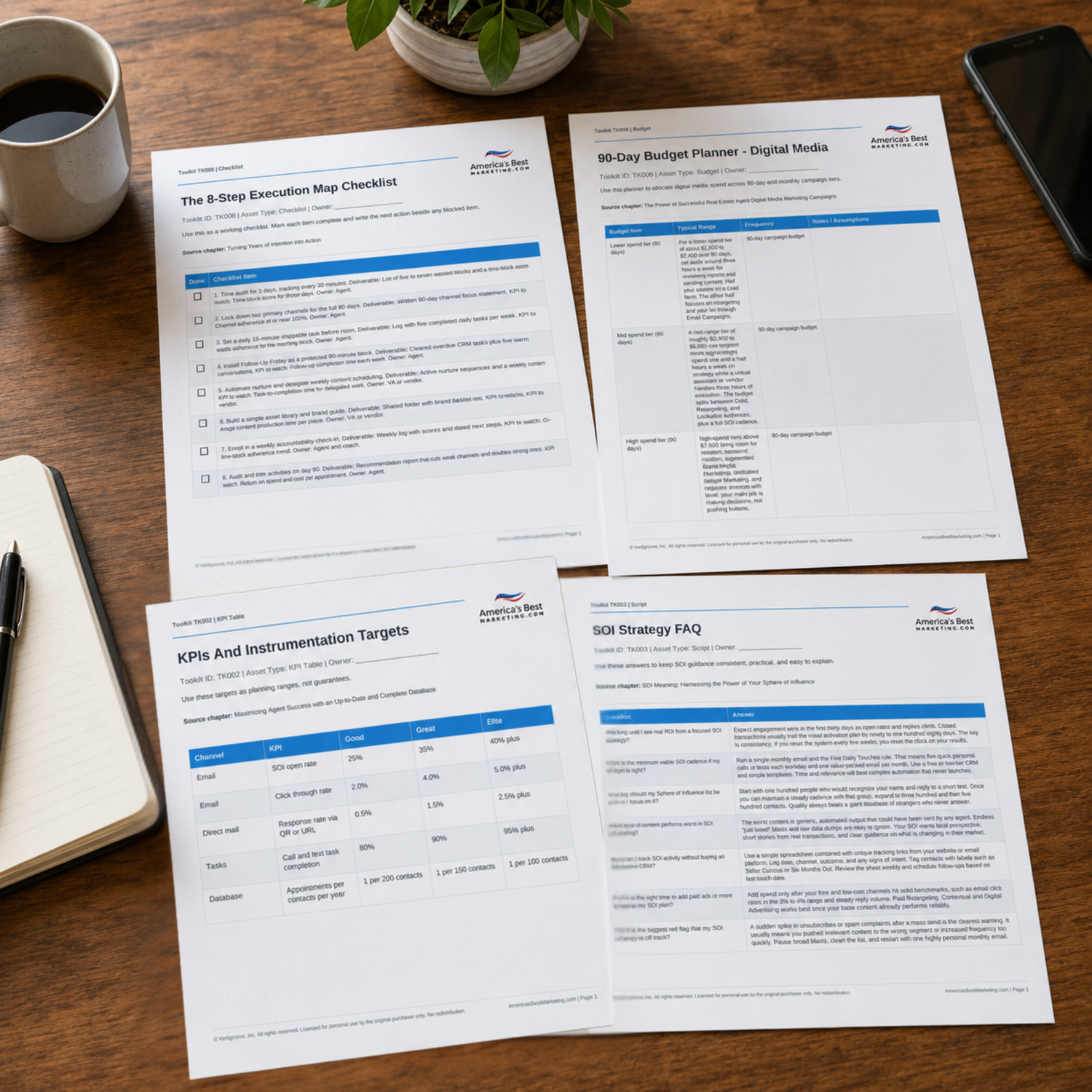
Download The 90-Day Marketing Plan Toolkit
Use the TK007 companion Toolkit to turn this article into an operating system with starter budget guidance, 90-day execution checklists, KPI target sheets, FAQ guidance, and ready-to-use outreach scripts.
Download the Toolkit ZIPA Plan Beats A Burst Of Activity
A successful marketing plan for real estate agents is not about doing everything. It is about doing the right things in a repeatable way. If you want a partner to help you build and run a 90-day system that connects mail, email, social, ads, website activity, and CRM follow-up, explore the Full Marketing Program at AmericasBestMarketing.com. There are no long-term contracts, only clear execution and consistent reporting.
Recommended reads
Recommended Reads for Real Estate Agents
These articles help agents connect follow-up discipline, database habits, client communication, and marketing execution into a repeatable system.

Proven Real Estate Marketing Strategies: A 30 Day Plan for More Leads and Sales
Bring more structure to real estate marketing strategies so every touchpoint supports visibility and trust.
Read article![Build a Relocation Lead Engine in [Your City] (Guide for Real Estate Agents) article preview for real estate agents](https://images.squarespace-cdn.com/content/v1/674ca5283c99f218d8bbb451/af9d20d1-51ed-4e2c-9c4d-f00444ec2a10/Blog+142+Build+a+Relocation+Lead+Engine+in+%5BYour+City%5D+%28Guide+for+Real+Estate+Agents%29.png?format=1500w)
Build a Relocation Lead Engine in [Your City] (Guide for Real Estate Agents)
Use relocation lead engine to strengthen visibility, follow-up, and client conversations without adding more random tasks.
Read article
Investor Content for Real Estate Agents: Build a Real Estate Investment Portfolio Series That Attracts Clients
Make investor content easier to plan, publish, and measure as part of a weekly marketing rhythm.
Read article
Done-for-You Real Estate Marketing: What It Is & Why It Works
Make done-for-you real estate marketing easier to plan, publish, and measure as part of a weekly marketing rhythm.
Read articleMarketing Plan Questions Agents Should Be Ready To Answer
How long does it usually take to see results from a new real estate marketing plan?
You may see tactical improvements such as better click-through rates, more website sign-ups, or more replies within forty five days as retargeting and email audiences build. Signed listings and closed transactions usually lag behind. A 90 to 180 day window is more realistic for judging Cost Per Appointment trends.
What is the minimum viable cadence if my budget is tight?
Start with warm audiences. Run a small always-on retargeting campaign, send one high-value email each month, post consistently, and use direct mail selectively. Cut most cold geo targeting until your warm channel proves it can generate leads or appointments that justify reinvestment.
How large should my farm or list be before I start?
You do not need a massive audience to begin. A smaller, well-targeted farm or database can outperform a large, unfocused list because you can afford meaningful frequency. The key is to define the audience clearly and track response by source.
Which types of content tend to perform worst for real estate agents?
Generic, self-focused, or disconnected content usually underperforms. Random quotes, broad national housing news, and unrelated lifestyle posts rarely drive appointments. Focus on local data, specific owner or buyer problems, and useful tools such as equity reports, buyer planning guides, and neighborhood updates.
Can I track performance without a full CRM platform?
Yes. Start with a spreadsheet and consistent campaign tags. Each time a lead registers, replies, calls, or requests information, log the date, source, campaign, status, and next follow-up step. Over ninety days, that simple tracking habit will show which channels and messages are producing real pipeline.
When should I increase ad spend or expand to new ZIP codes?
Do not raise spend or expand territory until your warm audience Cost Per Lead and Cost Per Appointment are stable for at least two months. Increase budget first on the best-performing warm campaigns. Only add new ZIP codes once your current audience reliably produces qualified conversations.
What if I cannot keep up with the suggested weekly content volume?
Keep the plan but reduce the volume. Move from weekly to biweekly email, from larger mail drops to smaller tests, and lean on Social Media Marketing support for baseline visibility. The rhythm still works at lower frequency; it just takes longer to collect enough data.
Should I handle all campaigns myself or bring in help?
Most agents can set strategy and write key messages but struggle with consistent execution. If implementation keeps slipping, offload build and deployment work to a specialist. A done-for-you partner can manage multi-channel campaigns and reporting so you can focus on leads, appointments, and clients.
Next step
Build the System Behind the Advice
Continue from one useful article into the larger ABM ecosystem: the book series for strategic depth and the full marketing program for done-for-you execution.

View the Book Series
Explore the America’s Best Real Estate Agent Marketing System books for a deeper strategic framework around visibility, referrals, listings, lead generation, and growth.
View the Book Series
See Full Marketing Program
See how AmericasBestMarketing.com runs real estate blog writing, social media, listing marketing, email, direct mail, and retargeting as one managed system.
See Full Marketing Program