How to Build a High-Converting Free Home Valuation Funnel
How to Build a High-Converting Free Home Valuation Funnel
A Seven-Step Seller Lead System
Build a focused landing page, connect fast CRM follow-up, deliver personalized value reports, and keep homeowners moving toward a listing conversation.

Automation Must Hand Off to Local Expertise
A high-converting home valuation funnel uses one focused offer, one dedicated landing page, immediate CRM confirmation, and a personalized value report that leads to a human conversation. Automation protects response time, while the agent adds local sales context, pricing judgment, and a clear appointment invitation. Retargeting, email, direct mail, and disciplined follow-up keep the homeowner engaged until timing becomes real.
- The landing page should make one specific value promise and ask only for the information needed to deliver it.
- The first automated response should arrive immediately, set expectations, and make the next human step obvious.
- A personalized value range with local context earns more trust than a bare automated estimate.
- Retargeting, email, and direct mail should point back to the same seller pipeline instead of creating disconnected campaigns.
- Form conversion, cost per lead, and report-to-appointment rate reveal where the funnel needs improvement.
Why a Home Valuation Funnel Pays Off
A strong home valuation funnel turns homeowner curiosity about equity into predictable seller conversations. Instead of sending cold traffic to a generic lead form, you build a clear path from ad, to landing page, to personalized report, to listing appointment. If you already understand the structure outlined in Real Estate Marketing Funnels: What They Are and How to Build One, this article shows you how to make the home value offer the most powerful seller entry point in your business.
Homeowners are surrounded by instant estimates on major portals and finance apps. Those automated numbers light the spark of curiosity, yet they rarely answer the deeper questions that matter to a serious seller such as timing, pricing strategy, and local buyer demand. Your home valuation funnel exists to capture that curiosity and redirect it into a personal conversation with a trusted local expert.
The engine behind that shift is a simple value exchange. You promise a tailored home value report and clear context about the local market. In return, the homeowner shares their address and contact details and expects a fast, thoughtful response. Automation gives you speed. Personalization earns trust. When those two work together through one clean system, your cost per seller lead falls and your appointment count rises.
- Slow response after form submission. If the lead does not hear from you within a few minutes, the moment of intent passes and they either lose interest or submit the same request on three other sites.
- Shallow tech-only delivery. A raw automated number with no explanation tells the owner you are a commodity. That experience trains them to shop on price instead of expertise.
- No real nurture path. Many agents send the report once, then disappear. Without a built-in follow-up rhythm, you hand serious sellers back to the loudest portal ad in their feed.
The Seven-Step Home Valuation Funnel
A home valuation funnel is more than a widget on your website. It is a sequence that carries one homeowner from first click through to signed listing agreement. The steps below give you a clear build order so you avoid the usual trap of launching ads before your follow-up and reports are ready.
You will define the offer, stand up a dedicated landing page, wire automation inside your CRM, deliver a personalized report, and then layer on retargeting and offline touches. That structure keeps every new lead inside one pipeline instead of scattered across random spreadsheets and inbox threads.
The biggest leak in most home valuation funnels is not the ad or the landing page. It is the quiet gap between the form submission and the first human touch. Treat the report as a conversation starter instead of a finished product and you will see more owners reply, ask questions, and step into real strategy calls.
Define a specific value promise
Generic lines such as “What is your home worth” blend into the noise. Lead with a sharper promise such as a custom equity snapshot, net sheet range, or pricing strategy preview. The more clearly you speak to timing, fear, or opportunity, the more high intent owners will respond.
Build a dedicated landing page
Send traffic to a focused page instead of your homepage. One headline, one short explainer, one simple form. Keep fields to address, name, email, and optional phone. Your strongest version will live on a fast site with clean design and a clear button. Many agents pair that with IDX Real Estate Websites so property data and search tools live under the same brand roof.
Wire the funnel through your CRM
The moment a form is submitted, your CRM should create a contact, apply a tag, and fire an automated confirmation email. For setup help, study both What Every Agent Needs to Know About Their Real Estate CRM and The Best CRM Software for Real Estate Agents. Then enroll the contact into an eight week nurture track built from Email Marketing for Real Estate Agents so every new lead receives consistent value whether you are at your desk or at a listing appointment.
Deliver a personalized valuation report
Do not send a bare automated estimate. Pull recent local sales, note condition and upgrades where possible, and present a value range with clear commentary on demand, days on market, and pricing strategy. A short loom style video that walks through the report and speaks to the owner by name adds a surprising level of trust for very little extra time.
Layer retargeting and contextual ads
Some owners will visit your page and hesitate. Others will submit the form and then stall before booking a call. Install your pixel and run Retargeting, Contextual & Digital Advertising that shows social proof, recent seller wins, and clear invitations to schedule a quick pricing huddle.
Add offline nurture to the same pipeline
Digital touches work harder when sellers also see you in the real world. Use Direct Mail Marketing to send a short market update or just listed and just sold proof to the address they provided. Mention that the mailing is part of the same valuation service so the experience feels intentional instead of random.
Review data and keep one improvement in motion
Once the funnel runs for a few weeks, stop guessing. Look at conversion rate on the page, cost per lead from each ad set, and the share of reports that turn into conversations. Choose one bottleneck at a time and test a new headline, new audience, or new follow-up line instead of rebuilding the entire system every month.
Write Valuation Offers That Earn the Next Click
Your copy decides whether the right owners even enter the funnel. The goal is not to sound clever. The goal is to speak directly to the questions running through their mind about equity, timing, and pressure from rising or falling rates. Use plain language and promise one clear outcome.
- Get a real number, not a guess: custom home value range based on current buyers in your neighborhood.
- Your equity has changed more than you think: see the updated value of your address in one clear report.
- Thinking about selling in the next year: start with a quiet value check and timing plan.
- See what buyers are actually paying for homes like yours on nearby streets right now.
- Get a simple equity snapshot and net sheet that shows what you would walk away with after fees.
- Curious whether you can trade up or downsize without raising your payment: start with a private valuation.
- Claim your local expert valuation report so you can decide whether to stay, sell, or rent with real numbers.
Use one version on your landing page, another inside ads, and a third in your follow-up email subject line. Keep the promise identical across every surface so the homeowner never feels tricked by bait and switch messaging.
Match Each Call to Action to the Funnel Stage
Every stage of the funnel needs its own style of call to action. Early touches invite curiosity and low friction clicks. Mid funnel pushes the owner to engage with the report. Late funnel asks for a live conversation with clear next steps. Map each CTA to the real decision you want next, not to a generic hard sell.
| Funnel stage | CTA style | Primary goal | Example CTA line |
|---|---|---|---|
| Ads | Soft curiosity | Earn first click | See your updated home value without any public listing. |
| Landing page | Mid commitment | Collect contact | Get your custom value report sent straight to your inbox. |
| Report email | Mid engagement | Start dialogue | Reply with your timeline and I will tailor this value range for your plans. |
| Follow-up | Hard close | Book meeting | Choose a fifteen minute pricing call so we can shape a plan around your goals. |
Track the Metrics That Reveal the Leak
Once the system is live, data keeps you honest. Instead of arguing about which headline sounds better, you can look at form submission rate, cost per lead, and the share of reports that turn into live conversations. A small shift in those numbers has a huge effect on your long term listing volume.
Treat each metric below as a benchmark range, not a promise. The point is to flag where the funnel is struggling. When a number drifts outside the band, adjust only the stage that owns that metric so you can see cause and effect clearly.
| Metric | What it tracks | Target range | Action if off track |
|---|---|---|---|
| Form conversion | Share of visitors who submit the valuation form. | 15% to 25% | Tighten the headline, simplify page copy, and remove extra fields from the form. |
| Cost per lead | Average marketing spend for each new seller lead. | $15 to $35 | Refine audiences, pause weak ads, and reuse the best creative in more channels. |
| CMA to appointment | Share of delivered reports that lead to a booked call. | 3% to 7% | Add a short video, a direct booking link, and a clear reason to talk now instead of later. |
Budget and Time Requirements
You do not need a massive budget to launch a useful valuation funnel. You do need a steady spend number and a clear decision about how much of the work you will keep in house versus delegate. Start lean, then scale once you see real appointments, not just clicks.
Plan for a monthly budget between two hundred fifty and six hundred dollars. That covers basic CRM fees, a simple landing page tool, and a modest social ad budget focused on one neighborhood. Expect five to ten hours per week for manual report creation, follow-up calls, and small tweaks to copy and targeting.
Plan for a monthly budget between eight hundred and eighteen hundred dollars. That supports stronger creative, split testing across two or three channels, plus outsourced design and copy for ads and mailers. Your personal time drops to one to three hours per week focused on live conversations and data review.
A high volume tier above two thousand dollars per month belongs to agents who already close multiple listings from this funnel. At that point you treat the valuation system as a core business asset and lean on partners for web, ads, mail, and coaching so your calendar stays focused on client work.
Ten Actions to Launch the Funnel
Use this sequence to protect the operating order. Build the offer, page, data flow, report, and follow-up before you increase traffic.
- Pick one target farm where you want more listings and commit your budget there.
- Write three versions of your home value offer and choose one to launch first.
- Stand up a clean landing page with a short form and one clear button.
- Map fields on the form to the right contact fields inside your CRM.
- Create an instant confirmation email that sets expectations for timing and next steps.
- Draft a simple valuation report template that you can reuse and brand.
- Record a reusable video script that explains how you think about pricing and timing.
- Turn on a small ad budget to your chosen neighborhood or zip code.
- Add a basic retargeting audience so you stay in front of visitors who hesitate.
- Block thirty minutes each weekday to send reports and make follow-up calls.
Protect Data, Consent, and Communication Expectations
Every lead hands you a home address and contact details with a quiet expectation that you will treat that information with care. Your emails must include a clear unsubscribe link and a real office address. Your landing page should state that you will use their details to deliver a valuation report and periodic market updates, not to sell their information to third parties.
Text messages must also respect consent. Make it clear that the homeowner can stop messages at any time by replying with a single word. Honor opt outs across every system you use so they do not keep hearing from you in other channels after they ask to step back.
- State how the homeowner’s information will be used before the form is submitted.
- Include a clear unsubscribe path in email and honor text opt-outs across every connected system.
- Use the address and contact details only for the promised valuation service and related market communication.
- Document consent and suppress opted-out contacts from future campaigns.
Scale the Funnel Through Consistent Automation
Picture an agent who launches a focused home valuation funnel aimed at owners who have lived in their homes for at least five years in one core zip code. She sets a steady monthly budget, commits to same day turnaround for each valuation report, and adds a short video explanation with a simple pricing roadmap. The system does not depend on one lucky ad. It depends on repeated follow-up, clear reporting, and a direct invitation to talk through timing.
The real win is not a single campaign that spikes and fades. The win is a living seller system that keeps feeding the agent’s calendar. Each month she checks her three core metrics, adjusts a headline or audience, and lets the automation and nurture tools quietly do their work while she stays focused on client conversations.
Put the Landing Page and Daily Follow-Up First
A home valuation funnel is the cleanest way to turn online curiosity into real seller conversations. The offer is familiar, yet most agents treat it as a throwaway widget instead of a full marketing system. You can win simply by responding faster, delivering a more personal report, and following through longer than the big portals do.
Your first move is to claim one dedicated landing page and link it to your CRM so no seller lead ever disappears into an inbox. Your second move is to block a daily slot to send human reports and make short follow-up calls. Once those two pieces are locked in, every dollar you invest into ads, mail, and nurture has a real place to land.
The valuation report is not the finish line. It is the reason to begin a useful seller conversation. Speed earns attention, local context earns trust, and consistent follow-up turns timing into appointments.
Connect the Funnel to Every Marketing Channel
Ready to build a valuation system that runs every day without you reinventing it from scratch. AmericasBestMarketing.com connects landing pages, CRM automation, Email Marketing for Real Estate Agents, retargeting, and Direct Mail Marketing into one seller funnel so you can spend more time in living rooms and less time wrestling with tech.
Use the same seller promise across Email Marketing for Real Estate Agents, Digital Retargeting, Direct Mail Marketing, and Social Media Marketing. One coordinated message creates a cleaner path from first impression to report request and from report request to appointment.
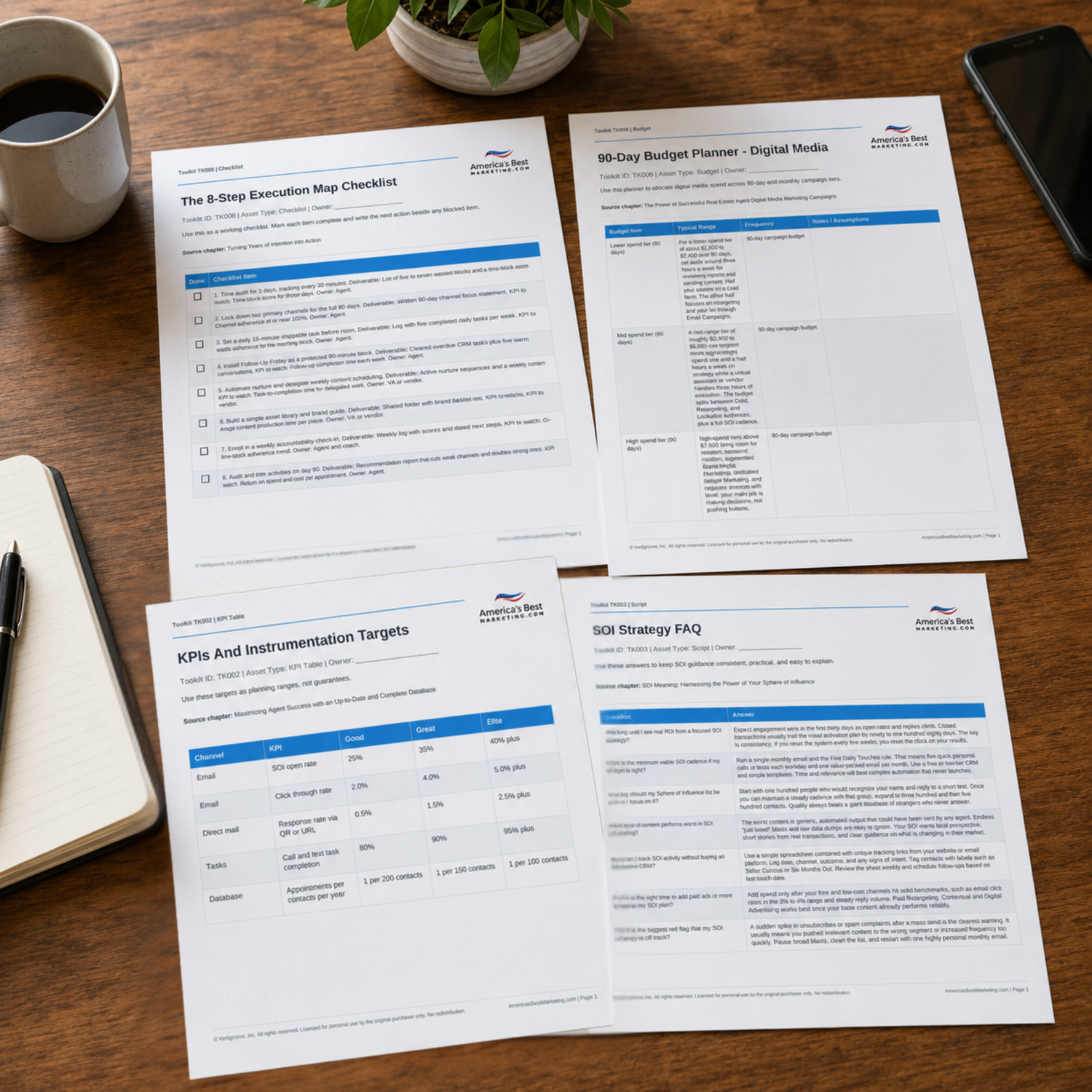
Download the Home Valuation Funnel Toolkit
Use the companion Toolkit to organize the launch checklist, offer options, CTA stages, KPI review, budget plan, and seller follow-up reference for a repeatable valuation pipeline.
Download the Toolkit ZIPRecommended reads
Recommended Reads for Real Estate Agents
These articles help agents connect follow-up discipline, database habits, client communication, and marketing execution into a repeatable system.

How to Build and Promote a High-Converting Real Estate Lead Magnet for Agents
Use lead magnet promotion to create a stronger bridge between client education and real conversations.
Read article
Home Inspection Waivers: Real Estate Agent Scripts, Risk Management, and Deal-Saving Options
Create more leverage from home inspection waivers with a clear path from attention to follow-up.
Read article
Building Your Personal Brand with Video Content
Use video to explain value, show proof, and stay visible without chasing every trend.
Read article
Full-Service vs DIY Marketing: What Works
Create more leverage from full-service vs diy marketing with a clear path from attention to follow-up.
Read articleHome Valuation Funnel Questions Agents Should Be Ready to Answer
How long does it take for a home valuation funnel to show real results?
You can see leads arrive within a few days once ads are live and your page is wired to the CRM. Real financial impact usually follows the normal seller cycle, which runs roughly ninety to one hundred eighty days from first contact to closed sale. Judge early success by booked pricing calls and signed listing agreements, not just raw lead volume.
Do I need a big audience to justify building this funnel?
No. A small but clearly defined farm often outperforms a huge audience. Focus on one or two zip codes or a group of nearby streets where you want more listings. That focus makes your examples, sold stories, and pricing commentary feel tailored instead of generic, which leads to better conversion and stronger long term brand lift.
Should I send an automated estimate or only manual valuation reports?
Automated numbers are helpful for instant confirmation that the form worked and give the owner a quick sense of the range. The trust builder is your manual report that explains how you arrived at the value and how timing or repairs might change it. Use automation for speed and use your expertise for accuracy and context.
How many times should I follow up after sending a valuation report?
A useful rhythm is one confirmation email right away, one check in within forty eight hours, and then a weekly market or strategy touch for the next eight weeks. After that, shift the contact into a lighter long term nurture segment. The goal is to stay present and helpful without flooding their inbox or mailbox.
What happens with leads that submit fake phone numbers or partial information?
Expect some bad data whenever you run free offers. Use email as the default follow-up channel since addresses are easier to verify. If the street address looks accurate, send a short printed note with a market summary and a simple way for the owner to update their contact details if they want a deeper valuation.
Is this funnel only useful in hot markets with fast appreciation?
Homeowners care about clarity in any market. In slower cycles, the questions shift toward how long a sale might take and what price reductions to expect. A well run valuation funnel helps you explain that reality early, which builds trust and keeps sellers from chasing fantasy prices they picked up from national headlines.
How does this funnel fit with my other marketing channels?
Think of the valuation offer as the front door for your seller side marketing. Social content, mailers, and even open house conversations can all point back to the same landing page. From there, your CRM and nurture systems keep every owner inside one clean pipeline so you do not juggle separate lists for each channel.
Next step
Build the System Behind the Funnel
Continue from the valuation funnel into the larger ABM ecosystem: the book series for strategic depth and the full marketing program for done-for-you execution.

View the Book Series
Explore the America’s Best Real Estate Agent Marketing System books for a deeper strategic framework around visibility, referrals, listings, lead generation, and growth.
View the Book Series
See Full Marketing Program
See how AmericasBestMarketing.com runs real estate blog writing, social media, listing marketing, email, direct mail, and retargeting as one managed system.
See Full Marketing Program