The 4-Stage Playbook: Mastering the Real Estate Marketing Funnel for Consistent Lead Conversion
Build Your Real Estate Marketing Funnel
The Four-Stage Agent Playbook for Conversion
A field-ready system for moving local attention through awareness, interest, decision, and action without relying on random promotion or inconsistent follow up.

How a four-stage real estate marketing funnel works
A real estate marketing funnel assigns every channel a specific job. Awareness attracts the right local audience. Interest converts anonymous traffic into known contacts. Decision builds trust through education, proof, and consistent follow up. Action gives qualified prospects one clear way to book a conversation. The funnel works when each stage hands the prospect to the next stage without delay, mixed messages, or missing automation.
- One audience, one useful offer, one nurture path, and one appointment request are easier to measure than several disconnected campaigns.
- Every awareness asset should lead to a relevant value exchange, not a generic home page or vague contact request.
- Decision-stage content should combine local insight, proof, process clarity, and five to seven quality touches before a stronger sales invitation.
- Budget should increase only after the handoffs from lead to appointment and appointment to client are working consistently.
Why Funnels Outperform Random Promotion
A real estate marketing funnel is the bridge between local attention and signed client conversations. It gives every channel a job: attract the right people, capture the contact, nurture trust, and ask for a clear next step. Without that operating logic, agents accumulate posts, ads, landing pages, and contact records that never become a coordinated revenue system.
Most funnel failure starts after the click. A homeowner reads a pricing article, downloads a guide, or views a listing ad, then receives no meaningful follow up. The marketing generated attention, yet the business failed to convert that attention into a relationship. A documented funnel forces the next step onto paper so Social Media Marketing, search content, Email Marketing for Real Estate Agents, Digital Retargeting, and Direct Mail Marketing reinforce one another.
The system becomes more powerful when the offer is already proven. A resource such as How to Build a Free Home Valuation Funnel that Actually Works can serve as the entry point. The funnel then governs what happens before the download, immediately after it, and during the weeks that follow.
- Funnel leaks become visible because every stage has a defined conversion event and owner.
- Messaging becomes more relevant because the next request matches what the prospect has already shown interest in.
- Attribution improves because the first touch, lead source, nurture activity, appointment, and closed outcome stay connected.
The Four Stages of a Real Estate Marketing Funnel
The funnel should mirror the way people make a high-consideration decision. A prospect rarely moves from first exposure to a signed agreement in one step. The job is to reduce uncertainty in the right order. First earn attention. Then earn contact information. Next earn trust. Finally earn a conversation.
Attract the right local attention
Awareness begins when a stranger encounters your content, advertising, search result, community presence, or referral proof. Focus on problems the market already feels, including pricing uncertainty, timeline anxiety, relocation questions, preparation decisions, and fear of choosing the wrong agent.
Use search-friendly articles, short-form video, social posts, local guides, and contextual advertising to answer those questions. Each asset should point toward one value offer you own, such as a pricing guide, buyer checklist, relocation resource, or home valuation pathway.
Turn anonymous traffic into known contacts
Interest begins when the visitor exchanges contact information for something useful. The lead magnet must match the reason the prospect arrived. A seller reading about pricing should see a valuation or sale-planning offer. A first-time buyer should see a timeline, affordability worksheet, or preparation checklist.
Route traffic to a focused landing page rather than a generic home page. IDX Real Estate Websites can support dedicated pages that explain the offer, keep the form simple, deliver the resource quickly, and establish what helpful communication comes next.
Nurture with proof and process clarity
Decision-stage prospects are evaluating whether you are organized, trustworthy, and capable of handling the move. Build a five to seven message sequence that combines concise education, local judgment, client proof, and a transparent explanation of how you work.
Your CRM should trigger the right messages and keep those touches on schedule. What Every Agent Needs to Know About Their Real Estate CRM explains the operating role of the database. Retargeting can reinforce the sequence with testimonials and service proof shown only to people who already engaged.
Ask for one clear commitment
Action is where the funnel stops hinting and asks for a real conversation. The offer should be specific and low friction, such as a fifteen-minute strategy call, listing planning call, buyer consultation, or home value review.
Use a calendar that lets prospects choose a time, provide basic context, and receive automatic confirmations and reminders. Send qualified prospects to a strong service or process page before the meeting so they can understand your approach and arrive ready to discuss the next decision.
Before increasing awareness spend, test the handoff. Submit the form yourself, confirm the contact reaches the CRM, verify the first email arrives immediately, click every link, and book a test appointment. Better handoffs often create more revenue than more reach.
Where Real Estate Marketing Funnels Break
A funnel does not fail because one post underperforms. It fails when the prospect reaches a transition and the business does not know what should happen next. The most expensive problems are usually simple: no follow up sequence, an irrelevant offer, a weak appointment request, or no attribution between the original source and the closed client.
- Leads enter the database but receive no welcome message, no useful resource, and no reason to continue the relationship.
- Awareness content educates the audience but never presents a relevant lead magnet or next step.
- Hard sales language reaches people who only requested early-stage information and are not ready for an appointment.
- Decision-stage prospects see general brand claims instead of local proof, client outcomes, and a clear process.
- The database grows while the appointment calendar stays flat because stage movement is not measured.
Copy That Matches the Prospect’s Stage
Messaging should become more direct as the prospect moves through the funnel. Awareness earns attention with a useful observation. Interest presents a focused value exchange. Decision demonstrates judgment and proof. Action asks for a specific conversation. Using the same appointment request at every stage is one of the fastest ways to suppress response.
The awareness post that feeds the funnel
Agent voice
Hook lineMost homeowners guess at value because online estimates miss what is happening on their street.
Value lineI track recent local sales so you can see what buyers are actually paying and what may influence your timing.
Soft inviteI turned the latest pricing notes into a simple guide for homeowners who want a clearer starting point.
Use a face-to-camera clip or a clean branded graphic. Name the neighborhood or seller situation clearly and point every related post to the same lead magnet.
The interest-stage landing page
Message stack
Main promiseGet a clear home sale game plan before you make your next move.
Support lineSee pricing, timing, and preparation steps in one place.
Form noteTell me where to send the guide.
Keep the page focused on one offer. Use three concise benefit points and remove competing calls to action that distract from the form.
The decision-stage email that earns an appointment
Email structure
SubjectQuestions to ask before you hire a listing agent.
OpeningThe questions you ask before listing can change the entire experience.
CloseUse this link to schedule a short listing planning call.
Send this after the lead has received useful education. Exclude anyone who already booked and link to a specific appointment type rather than a vague request to chat.
Build One Funnel Before You Build Several
Start with the highest-value audience in your core area and run one complete system for ninety days. A focused seller funnel with one pricing resource, one landing page, one nurture sequence, one retargeting audience, and one appointment type will teach you more than five partially built campaigns.
Publish one search-friendly article each month that feeds the offer, add two awareness posts each week, and use a welcome message plus a four-part nurture sequence. Keep the audience narrow and use Email Marketing for Real Estate Agents to automate delivery so your time stays focused on replies and conversations.
Add a second offer only after the first path is producing qualified replies. Split buyers and sellers into separate sequences, build dedicated landing pages, and layer in Retargeting for past visitors and subscribers. Review performance weekly and change one variable at a time.
Budget does not need to be large, but it must be intentional. Use ninety-day windows so every stage has enough traffic and time to produce a pattern. The table below is a planning benchmark, not a guarantee. Local media costs, audience size, existing database strength, and offer quality will change the economics.
| Tier | Primary Focus | Spend Over 90 Days | What the Setup Should Prove |
|---|---|---|---|
| Low build | Organic content with light paid testing | $150 | The offer attracts the intended audience, forms work, delivery is immediate, and leads move from awareness into interest. |
| Mid-range | Full funnel with balanced promotion | $1,800 to $2,500 | Traffic, nurture, retargeting, email, and direct mail produce a measurable lead-to-appointment pattern. |
| High scale | Full funnel with heavier traffic | $4,000 or more | Each stage can absorb more volume without reducing response quality, appointment show rate, or client conversion. |
Instrumentation and KPI Hygiene
Good funnels are not only creative. They are instrumented. Tag every lead with the original source so you can connect social media, search, direct mail, referral, contextual advertising, or retargeting to later appointments and closed business. Use UTM parameters on campaign links and preserve source data when contacts move between forms, email systems, and the CRM.
Review the funnel as a sequence of ratios. Awareness produces traffic. Interest produces contacts. Decision produces qualified engagement. Action produces appointments. Your most useful metrics are form completion rate, cost per lead, lead-to-appointment rate, appointment show rate, appointment-to-client rate, cost per acquisition, and return on ad spend.
| Stage | Primary Conversion | Core KPI | Leak Signal |
|---|---|---|---|
| Awareness | Qualified visit or content engagement | Cost per qualified visit and click-through rate | Reach grows but the intended local audience does not visit the offer page. |
| Interest | Form completion or direct response | Landing page conversion rate and cost per lead | Visitors arrive but the offer, form, or delivery promise does not earn contact information. |
| Decision | Reply, return visit, proof-page click, or consultation intent | Engaged lead rate and lead-to-appointment rate | The list grows while replies, return visits, and appointment intent stay flat. |
| Action | Booked and completed appointment | Show rate, appointment-to-client rate, and acquisition cost | Prospects book but do not attend, or meetings happen without a defined next commitment. |
Run the Funnel by Hand Before You Add More Traffic
A short end-to-end test often exposes the silent breaks that suppress conversion. Complete the same journey a prospect will complete, using a real mobile device and an email address that is not already in your database.
- Submit the lead magnet form and confirm the new contact enters the CRM without manual work.
- Verify the contact receives the correct source tag and enters the intended awareness or interest workflow.
- Confirm the welcome email arrives within sixty seconds and the promised resource opens correctly.
- Click every nurture link and confirm UTM parameters remain attached.
- Test the landing page on mobile and confirm the page, form, and confirmation experience load cleanly.
- Verify engagement rules move the contact from interest into decision-stage automation.
- Confirm the retargeting audience receives eligible visitors while excluding people who already converted.
- Book a test consultation and confirm the calendar, confirmation, reminder, and rescheduling links work.
- Document every gap, delay, duplicate message, or confusing instruction before new promotion begins.
One Audience, One Offer, One Follow-Up Path
A solo agent seeking more seller conversations can begin with one pricing guide for a core neighborhood. Search content, social posts, direct mail, and contextual advertising point to the guide. The landing page captures the contact. A short nurture sequence explains timing, preparation, pricing, and appointment options. Retargeting reinforces proof after the prospect has already shown interest.
The simplicity is deliberate. One audience, one offer, one follow-up path, and one appointment request are easier to diagnose than several disconnected campaigns. Once the agent can see where prospects stop moving, the next improvement becomes obvious.
Protect Trust While You Build the Funnel
Funnel strategy never overrides fair housing requirements, advertising rules, privacy expectations, or email law. Audience building should rely on geography, content behavior, property interest, and legitimate business context rather than protected characteristics. Life-event targeting and exclusion logic require particular care.
Use clear consent language, visible unsubscribe controls, truthful testimonials, and claims you can support. Do not imply guaranteed results. The funnel is not only a conversion system. It is a record of how your brand treats people before they become clients.
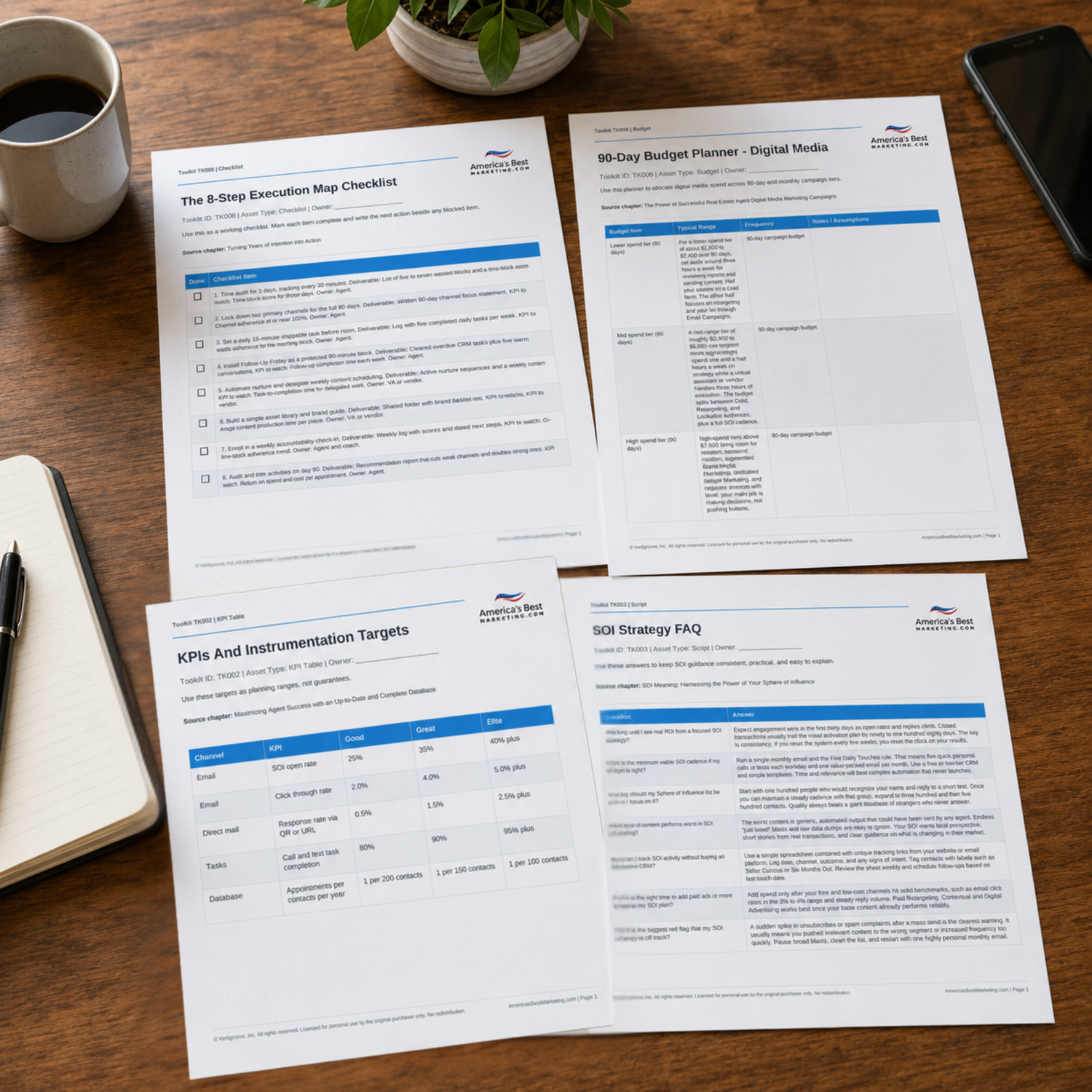
Download The Real Estate Marketing Funnel Toolkit
Use the companion Toolkit to map the four stages, set budget benchmarks, run the technical integration audit, adapt the messaging frameworks, track KPIs, and plan a focused ninety-day rollout.
Download the Toolkit ZIPRecommended reads
Recommended Reads for Real Estate Agents
These articles help agents connect follow-up discipline, database habits, client communication, and marketing execution into a repeatable system.

Targeted Real Estate Marketing: Reach People Most Likely To Hire You
Turn targeted real estate marketing into a steady operating habit, not another item that waits for a quiet week.
Read article
HOA Navigation for Real Estate Agents: Red Flags, Document Requests, and Buyer Scripts
Give hoa navigation a clearer role in the marketing system instead of treating the work as a one-off idea.
Read article
How Contextual and Retargeting Digital Marketing Work for Real Estate Agents and Why They Matter More Than Ever
Make paid ads easier to evaluate by tying audience, creative, budget, and next step together.
Read article
The Best Real Estate Marketing Agency: Why Real Estate Agents Choose AmericasBestMarketing.com
Bring more structure to the best real estate marketing agency so every touchpoint supports visibility and trust.
Read articleReal Estate Marketing Funnel Questions Agents Should Be Ready To Answer
How long does it take for a real estate marketing funnel to generate a closed listing?
The technical funnel can be live in a few days, but real results come from ninety day runs. Expect the first month to focus on volume and testing offers, the second month to refine nurture, and the third month to deliver closings. The more existing audience you can send into the system, the faster you will see signed agreements.
What is the minimum number of touches to move a lead from interest to decision?
Plan for at least five to seven quality touches before you expect a serious conversation. That can include emails, retargeting proof ads, and replies to questions they ask. The key is consistency and variety so the lead sees you as a steady professional rather than a one time blast. Short, helpful messages beat long sales letters every time.
Should I create separate funnels for buyers, sellers, and investors?
Separate funnels work best when you already have enough traffic for each audience. Start with one primary funnel that serves your highest value group such as sellers in your core area. Once that system performs, clone the structure for buyers or investors with tailored lead magnets and messaging. Do not spread your time so wide that nothing gets fully built.
What types of content cause high funnel drop off rates?
Drop off often spikes when content feels generic, overly technical, or disconnected from the promise that brought someone in. Long market reports with no clear point, emails that only brag about awards, and ads that shout about volume without context tend to lose people. Focus on specific problems, local proof, and next steps that tie directly back to the original offer.
How can I manually track lead movement through the funnel stages?
If you are not ready for complex automation, use simple tags and lists inside your CRM. Create tags for awareness, interest, decision, and action, then update them after each key move such as download, reply, or appointment. Review a small sample of leads every week and note where they stall. The article titled The Best CRM Software for Real Estate Agents can help you choose tools that make this easier over time.
When is the right time to increase budget on Retargeting and Contextual Ads inside the funnel?
Scale spend only after you see leads travel from awareness to appointments at a rate you like. Once your funnel delivers consistent lead to appointment and appointment to close ratios for at least one full cycle, you can add more traffic at the top. If decision stage numbers look weak, fix the nurture and proof before you pour more ad dollars into the system.
What is the biggest red flag that shows a real estate marketing funnel has a leak?
The clearest warning sign is a growing list of leads who never hear from you again after the first download. If your database grows while your appointment calendar stays flat, assume you have broken follow up. Fix that gap before you launch new offers or audiences. A smaller list that hears from you regularly will usually create more revenue than a huge silent one.
Next step
Build the System Behind the Funnel
Continue from one useful article into the larger ABM ecosystem: the book series for strategic depth and the full marketing program for done-for-you execution.

View the Book Series
Explore the America’s Best Real Estate Agent Marketing System books for a deeper strategic framework around visibility, referrals, listings, lead generation, and growth.
View the Book Series
See Full Marketing Program
See how AmericasBestMarketing.com runs real estate blog writing, social media, listing marketing, email, direct mail, and retargeting as one managed system.
See Full Marketing Program