How to Build and Promote a High-Converting Real Estate Lead Magnet for Agents
Build a Real Estate Lead Magnet That Converts
A High-Converting Campaign System for Agents
Choose the offer, build the landing page, promote it across channels, nurture each opt-in, and measure the conversations that follow.

A real estate lead magnet converts when the offer and follow-up work as one system
A high-converting real estate lead magnet gives one clearly defined audience a useful resource in exchange for contact information, then moves that person into a focused landing page, immediate delivery email, short nurture sequence, and measurable next step. Downloads are only the opening signal. Replies, valuation requests, saved searches, booked calls, and consultations show whether the campaign is creating real business.
- Choose one audience and one urgent decision instead of creating a broad resource for everyone.
- Keep the landing page focused on one promise, one form, and one next action.
- Promote the same core offer through social, email, ads, direct mail, open houses, and your database.
- Judge the campaign by conversations and appointments, not by download volume alone.
Why Lead Magnets Work Before Prospects Are Ready to Talk
A real estate lead magnet gives a buyer, seller, investor, or relocation prospect a useful next step before that person is ready to book a call. Instead of asking a cold visitor to contact you, the campaign offers a narrow resource that solves one immediate problem. A seller might want a repair-priority checklist. A buyer might want a bidding-war plan. A relocation prospect might want a city comparison worksheet.
The value exchange has to feel specific enough to justify sharing an email address. Generic resources struggle because they sound like information a prospect can find anywhere. Local tools convert because they are tied to a real decision, a place, a price band, or a timeline. A focused offer also gives your real estate lead capture page a sharper reason to exist.
The strongest campaigns create leverage across your owned marketing system. One asset can feed your CRM, strengthen Email Marketing for Real Estate Agents, build retargeting audiences, support direct mail, and reduce dependence on portal leads that may not remember who paid for the click.
- A seller in one school district is more likely to request a repair checklist than a broad home-selling eBook.
- A buyer in a competitive price band is more likely to request a bidding plan than a generic buyer guide.
- A relocation prospect is more likely to request a city comparison worksheet than a national moving article.
The real score is not how many people request the file. The real score is how many opt-ins move into a conversation. A focused offer that attracts fifty serious sellers can outperform a broad checklist that attracts five hundred casual browsers.
Build the Campaign in Four Connected Stages
A lead magnet is not the campaign. It is the offer inside the campaign. The system becomes productive when the audience, asset, landing page, promotion cadence, nurture sequence, and measurement plan reinforce one another.
Choose the audience and promise
Start with the client type you most want to attract, such as first-time buyers, move-up sellers, downsizers, investors, relocation buyers, luxury sellers, expired listing owners, or homeowners in a farm area.
Name the urgent decision that audience is trying to make. Sellers want to know what to repair, when to list, and how to protect equity. Buyers want to know what they can afford, how to compete, and what to do before closing.
Write the title like a promise. Seven Repairs to Prioritize Before Selling in 78704 is stronger than Home Selling Guide because it identifies the audience, the decision, and the local context.
Build the asset and landing page
Keep the resource easy to finish. A one-page checklist, five-page guide, short worksheet, or local report often performs better than a long PDF.
Repeat the promise in the landing-page headline, add three concise value bullets, show a preview, and keep the form short. First name and email are usually enough for the first step.
Connect the form to your CRM or email platform before launch. Tag every contact by source and offer so the follow-up matches what the person requested.
Promote the offer across channels
Publish one short social tip from the resource and point people to the full download. Add the offer to your newsletter, open-house materials, seller packets, and direct mail.
Use Digital Retargeting to bring back people who visited listings, community pages, valuation pages, or your lead capture page.
Keep the destination stable long enough to compare traffic sources. Rotate the creative, not the core promise.
Nurture and qualify every opt-in
Deliver the resource immediately. Follow with messages that expand the highest-value point, answer an objection, show a local scenario, and invite a reply.
A simple five-message sequence can deliver the asset, add context, address friction, demonstrate the process, and invite a clear next step.
When old opt-ins go quiet, use the same resource inside a cold lead re-engagement campaign with email and retargeting.
Make the Landing Page and Follow-Up Do More of the Work
The landing page should have one job. Repeat the promise in the headline, explain what the reader will receive, show enough of the resource to make the value tangible, and remove unrelated navigation or competing calls to action. When the audience needs segmentation, add one simple field such as buyer, seller, investor, or relocation.
The first email should arrive immediately with the correct file link and a short reminder of what the person will learn. The remaining emails should lead toward a decision. Message two expands the strongest idea. Message three answers a common objection. Message four shows a client-style scenario. Message five invites a call, valuation, custom home list, lender introduction, saved search, or reply with one question.
One promise and one action
Use a direct headline, three outcome-focused bullets, a short form, and a preview image. Avoid asking for information you do not need at the first step.
One clear next step per message
Each email should add value and move the prospect one step closer to a reply, consultation, valuation, saved search, or custom recommendation.
If your site uses IDX Real Estate Websites, connect the lead magnet to a relevant property search, valuation request, or neighborhood page. The resource should open the relationship, and the site should make the next action easy.
Three Lead Magnet Offers You Can Reuse
Use these structures as starting points, then localize the title, examples, and follow-up for the market segment you want to attract.
Local housing snapshot
Best for homeowners, move-up buyers, investors, and relocation prospects who need local context before they act.
AssetUse recent sales, days on market, inventory, and price-band examples. Keep the report local and plain-spoken so it feels more useful than national market commentary.
PromiseGet the local housing snapshot before you decide whether to buy, sell, or wait.
Follow-UpExplain what the numbers mean for timing, pricing, and the next practical decision.
The value is not the data alone. The value is helping the prospect understand what the data changes.
Seller preparation checklist
Best for homeowners who may sell in the next six to twelve months.
AssetShow which repairs matter, what to skip, how to prepare for photos, and how to avoid wasting money before listing.
PromiseKnow what to fix, clean, price, and prepare before your home reaches the market.
Follow-UpInvite the homeowner to request a custom walkthrough or pricing conversation.
The strongest seller magnet reduces uncertainty before the homeowner chooses an agent.
First-time buyer action plan
Best for renters and early-stage buyers who need a clear sequence.
AssetBreak the process into money, credit, search, offer, inspection, appraisal, and closing steps.
PromiseFollow a three-month plan so you are ready before the right home appears.
Follow-UpConnect the final message to a lender introduction, saved search, or buyer consultation.
A clear sequence gives early-stage buyers confidence without pressuring them to move faster than they are ready.
Use the First Thirty Days as a Learning Sprint
You can launch a lead magnet with almost no ad spend, but a modest campaign budget can accelerate the learning cycle. Build one offer, promote it, measure opt-ins, and watch which contacts move into replies, calls, valuations, or consultations.
| Tier | Main Focus | Thirty Day Spend | Primary Benchmark |
|---|---|---|---|
| Low | Organic reach and basic tools | $50 | Track warm-traffic conversion rate and look for replies from known contacts. |
| Mid | Paid traffic plus automation | $400 to $800 | Track cost per lead by source and monitor email engagement after the download. |
| High | Multiple offers with support | $1,500 plus | Score appointments and listing opportunities from the best-performing offer. |
Measure the full path, not only the form fill. Track landing-page conversion rate, cost per lead, email open and click rate, direct replies, booked calls, and eventual appointments. Add UTM codes to social, email, paid ads, QR codes, and newsletter links so each source can be compared.
Review the resource quarterly. Update local numbers, pricing examples, rules, and outdated advice. A current asset reinforces trust and gives prospects confidence that your guidance reflects the market they are entering now.
Protect Consumer Data and Keep the Targeting Fair
Collect only the information you need, explain how the contact will be used, and make unsubscribing easy. Every automated email should include a working unsubscribe link. Your privacy language should be understandable before the form is submitted, not buried after the fact.
Keep fair housing discipline in the offer, copy, and targeting. Focus on property type, price range, timing, goals, and geography rather than protected characteristics. When the resource touches financing, legal obligations, taxes, or disclosures, keep the advice educational and direct the prospect to qualified professionals for individualized guidance.
- Do not collect phone numbers, income details, or other data unless the campaign genuinely needs them.
- Do not use sensitive personal characteristics to define the audience or ad targeting.
- Do document the source, consent path, campaign tag, and opt-out status for each contact.
- Do test every form, delivery email, file link, and unsubscribe process before promotion begins.
Maria’s Bidding-War Campaign Shows the Operating Logic
Consider Maria, a solo agent in a competitive urban market who wanted to rely less on portal leads. She created a resource titled Seven Steps to Win a Bidding War in Her Favorite Neighborhood. The guide explained offer structure, appraisal gaps, timing, and lease-end planning.
She invested $650 in retargeting and contextual ads over thirty days. The campaign produced 180 new leads, and her five-email sequence invited the strongest prospects to book a short planning call. Twelve people scheduled calls, which placed the cost per scheduled call at about $54.
The strategic lesson is the structure, not the headline number. One targeted resource, one landing page, one follow-up path, and one metric that mattered gave the campaign a clean operating model that could be improved rather than reinvented.
Lead Magnet Pre-Launch Checklist
Before traffic goes live, confirm the complete opt-in journey from a phone, tablet, and desktop. The campaign should work without manual rescue.
- Confirm the landing page loads cleanly and presents one clear call to action.
- Confirm the lead magnet downloads quickly on mobile.
- Confirm the form sends contacts into the CRM or email platform with the correct source and offer tag.
- Confirm the thank-you page or first email delivers the correct file link.
- Confirm every promotion link uses UTM tracking.
- Confirm the nurture sequence is active before promotion starts.
- Confirm replies, booked calls, and consultations are tracked as conversion events.
A lead magnet becomes a durable owned asset when the offer, page, promotion, follow-up, and measurement plan stay connected. The asset gives strangers a useful first step, gives your CRM better context, and gives your marketing a reason to keep showing up.
Turn One Resource Into a Multi-Channel Campaign
The strongest lead magnets do not live in one launch email. Pull short tips from the resource for Social Media Marketing. Feature the offer inside Email Marketing. Add a QR code to Direct Mail, open-house materials, and seller packets. Use Digital Retargeting to keep the offer visible after a prospect leaves your site.
Keep the promise consistent across every channel so the campaign compounds. The creative can change, but the offer and destination should remain stable long enough to identify which source produces the strongest contacts and the most valuable conversations.
If you want help turning a focused real estate lead magnet into a repeatable marketing engine, AmericasBestMarketing.com can build the surrounding system so the asset is promoted, measured, and followed up consistently.
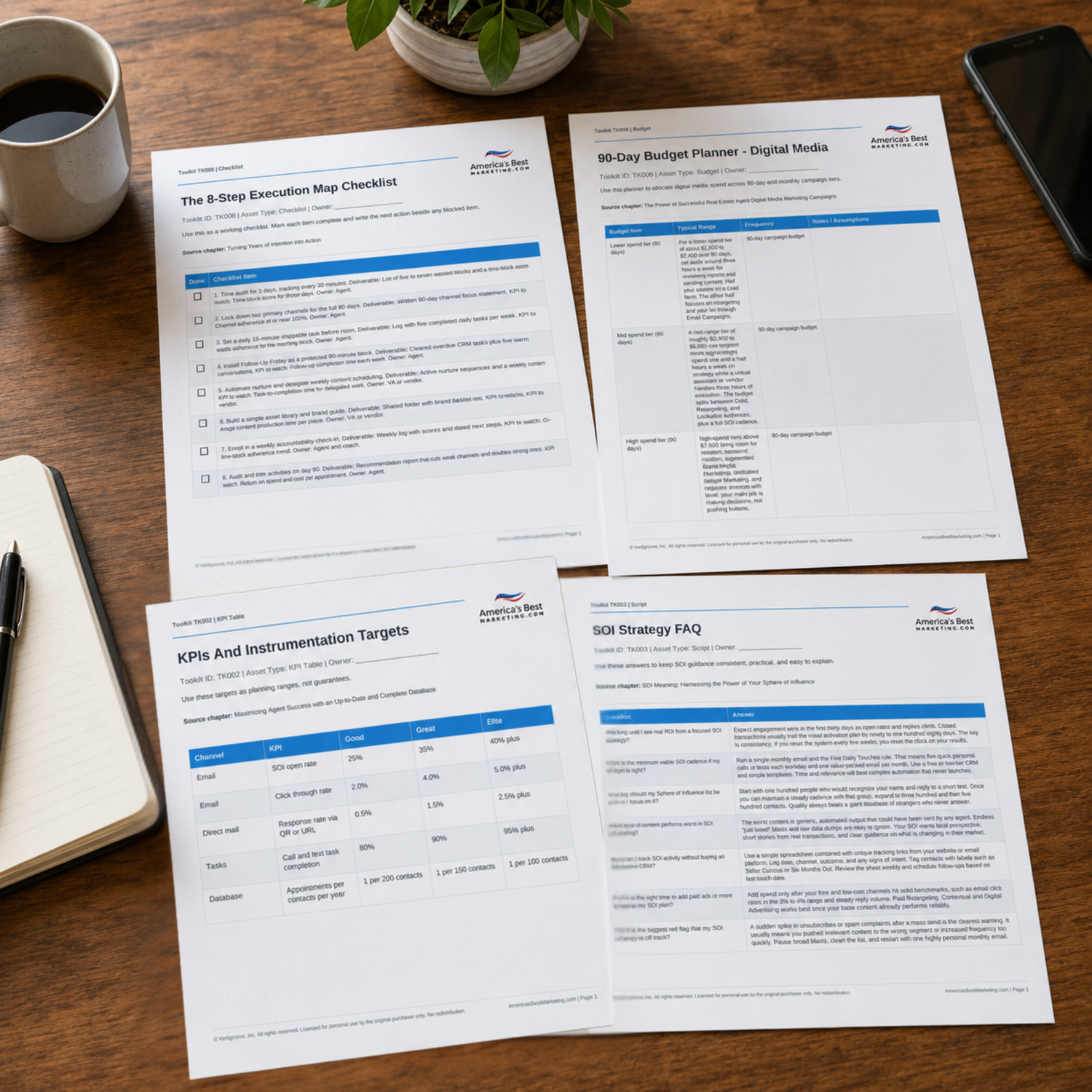
Download the Real Estate Lead Magnet Campaign Toolkit
Use the companion Toolkit to plan the offer, prepare the launch, set the budget, organize follow-up, track KPIs, and move from a lead magnet idea to a working campaign.
Download the Toolkit ZIPRecommended reads
Recommended Reads for Real Estate Agents
These articles help agents connect follow-up discipline, database habits, client communication, and marketing execution into a repeatable system.

Zillow Leads vs Realtor.com Leads. Which is Worth It?
Use paid lead source decisions to create a stronger bridge between client education and real conversations.
Read article
Property Taxes Explained: Real Estate Agent Cheat Sheet + Client Email Templates
Make property taxes explained more useful by tying the message, audience, and next step together.
Read article
Real Estate Blogging Made Simple: How Agents Can Attract Leads and Boost Their Online Presence
Make real estate blogging easier to plan, publish, and measure as part of a weekly marketing rhythm.
Read article
How to Get Real Estate Leads Online: The Ultimate Guide for Real Estate Agents
Use get real estate leads online to strengthen visibility, follow-up, and client conversations without adding more random tasks.
Read articleReal Estate Lead Magnet Questions Agents Should Be Ready to Answer
How long does it take for a lead magnet to deliver a closed client?
Expect to see opt-ins during the first week if you already have traffic and a clear offer. Conversions into closed clients usually trail by one to three sales cycles, depending on timelines in your market. Early leading indicators include replies to your emails, booked calls, and listing or buyer consultations. Track those before you judge success on closings alone.
How often should I promote my lead magnet if my budget is tight?
Aim to mention your real estate lead magnet at least once every week on your main social channels and inside your newsletter. Rotate creative so it does not feel repetitive, but keep the core offer stable. When a post performs well, save it and reuse it for new followers. Consistency beats one loud launch that disappears after a few days.
Should my lead magnet focus on buyers, sellers, or investors first?
Choose the group that already drives most of your commission income and that you enjoy serving. If your business leans heavily toward listings, start with a seller prep guide or valuation path. If you specialize in first-time buyers or small investors, design the magnet around their biggest fear or confusion. One clear audience always beats a split focus.
Which lead magnet topics tend to underperform for real estate agents?
Broad home buying or selling guides tend to underperform because prospects can find similar content anywhere online. Long market explainers without local detail also struggle because they feel generic. Overly technical financing content can push people away instead of pulling them closer. Focus on short, specific action plans tailored to one neighborhood, decision, or life stage.
How can I track lead magnet performance without a paid CRM system?
You can start with a simple form tool that sends email alerts and stores contacts in a spreadsheet. Use separate UTM links for social, email, and ads, then review traffic and conversion data inside your form or analytics tool. Create one column for lead source and another for status so you can mark replies and appointments. Upgrade tools once volume justifies the spend.
When should I increase advertising spend for a successful lead magnet?
Consider raising spend once you see a healthy landing page conversion rate and a cost per lead that fits your average commission. Confirm that at least a handful of leads booked calls or meetings through your nurture sequence. Increase budget in small steps while monitoring cost per lead and lead quality. If either drifts in the wrong direction, pause and adjust.
What is the biggest warning sign that a real estate lead magnet is failing?
The clearest warning sign is low engagement after the download. If people request the resource but ignore follow-up emails, the offer may be too vague or misaligned with your audience. A second red flag is a cost per lead that keeps climbing even after you refine creative. Revisit the audience and promise before sending more traffic into the funnel.
Next step
Build the System Behind the Lead Magnet
Continue from one useful campaign into the larger ABM ecosystem: the book series for strategic depth and the full marketing program for done-for-you execution.

View the Book Series
Explore the America’s Best Real Estate Agent Marketing System books for a deeper strategic framework around visibility, referrals, listings, lead generation, and growth.
View the Book Series
See Full Marketing Program
See how AmericasBestMarketing.com runs real estate blog writing, social media, listing marketing, email, direct mail, and retargeting as one managed system.
See Full Marketing Program