The 5-Point Conversion Framework for a High-Performance Real Estate Lead Capture Page
Real Estate Lead Capture Page
The 5-Point Conversion Framework
A conversion briefing for real estate agents who want lower-friction forms, stronger trust signals, cleaner attribution, and a follow-up path that turns traffic into appointments.

What makes a real estate lead capture page convert?
A high-performing real estate lead capture page aligns one specific promise with one low-friction form, places credible proof close to the action, sends every lead into a tracked follow-up system, and uses the thank-you page to advance the relationship. The page should remove navigation and competing links so every element supports one measurable conversion goal.
- Match the headline to the exact promise that generated the click so visitors know they reached the right page.
- Keep the first form to three required fields or fewer and collect deeper qualification data after trust is established.
- Place local testimonials, review proof, and privacy reassurance close to the form and call-to-action button.
- Track conversion rate, cost per lead, form abandonment, source attribution, and thank-you-page action as one operating system.
Why This Page Controls Your Lead Cost
Every ad click, email link, and social post you pay for has one job: send someone to a page that can carry its weight. When the destination underperforms, even a strong traffic mix from 11 Best Real Estate Lead Sources Ranked by ROI and Results leaks value before the prospect reaches your database.
A real estate lead capture page is a dedicated landing page built around a single conversion goal. Visitors see one clear offer, one simple form, and one path forward. The rest of your website can tell your story. This page exists to trade useful value for contact data at the highest responsible rate.
Your general IDX Real Estate Websites layout is built for search, browsing, and brand depth. A capture page is built for one move: the visitor gives you data in return for a specific result that matters now. That difference in intent is why page quality dictates how much you ultimately pay for every qualified lead and booked appointment.
- Higher conversion makes every dollar invested in ads, email, social, and direct response work harder.
- Cleaner forms improve data quality inside the CRM, which makes follow-up more personal and specific.
- A single-focus layout makes headlines, offers, buttons, and form length easier to test without disrupting the primary website.
The Five-Point Conversion Framework
Two concepts sit at the center of capture-page performance. Conversion rate is the percentage of visitors who complete the form. Friction versus value is the balance between how much effort and perceived risk you ask for and how much benefit the visitor believes will arrive in return.
Strong pages keep friction low for the first step and make value specific. You can ask for more detail later through Email Marketing for Real Estate Agents and follow-up calls. Up front, you are asking for one small action in exchange for a result that feels immediate, local, and useful.
Lead with an irresistible value proposition
Match the headline to the exact promise in the ad, email, or social post. If the traffic source promises a fast, specific benefit, the landing-page headline should repeat that promise in plain language.
Pair the headline with a short subheadline and a visual that makes the offer tangible, such as a pricing guide cover, buyer checklist sample, or local market dashboard.
Make the form frictionless
The first form starts the relationship. It does not need to qualify the entire opportunity. Name and email are often enough, with an optional phone or short note field when the campaign requires it.
Use clear field labels, visible error messages, and button copy that repeats the benefit instead of using a neutral word such as submit.
Move trust beside the button
Visitors wonder whether the offer is real, whether you will overwhelm them with outreach, and whether you understand the local market. Answer those concerns without forcing them to search your site.
Place a concise local testimonial, review badge, privacy reassurance, or proof statement close to the form and call-to-action button.
Connect the page to the CRM
Every form submission should enter the CRM with the correct tags, source data, segments, and automation. The first email should deliver the promised asset and make the next step obvious.
Use UTM parameters and unique campaign URLs for Digital Retargeting, paid campaigns, email, and Social Media Management.
Design the thank-you path
The moment after submission is the highest-intent moment before a live conversation. Redirect the visitor to a thank-you page that delivers the asset quickly and sets up the next action.
Use a short video or concise explanation, then offer one clear calendar button. Track how many visitors move directly from form completion to an appointment request.
Form abandonment is the quiet killer of lead capture pages. When visitors reach the form and exit, the page usually has a trust gap or asks for too much work. Cut required fields to three, pull one credible testimonial close to the button, and make the action feel like one safe decision instead of a sequence of hurdles.
Creative and Messaging That Pull Prospects Through the Form
Strong capture pages sound as though they were written for one specific person who clicked one specific message. That requires a concrete benefit, a recognizable local context, and button copy that feels like the delivery mechanism for the promise rather than a chore.
Seller pricing clarity
Headline and button alignment
HeadlineSee the Three Numbers That Decide Your Sale Price Before You List
Support lineGet a concise local pricing roadmap built around current competition, buyer demand, and your likely net.
ButtonSend My Pricing Roadmap
Use this direction when the campaign promise is seller clarity, not a vague automated valuation with no explanation.
Buyer decision support
Headline and button alignment
HeadlineThe Buyer Checklist That Helps You Avoid Overpaying in This Market
Support lineReview the local pricing signals, inspection risks, and offer terms that deserve attention before you commit.
ButtonSend My Buyer Checklist
Use this direction when the visitor needs confidence and a decision framework more than another property-search link.
Low-pressure home value offer
Headline and button alignment
HeadlineGet Your Home Value Range Without a Phone Call
Support lineReceive a local pricing range first, then decide whether a deeper strategy conversation makes sense.
ButtonShow Me My Value Range
Use this direction when the audience is interested but not ready for a hard appointment request on the first interaction.
Think about calls to action in three levels. A soft action confirms delivery, such as send me the PDF. A middle action completes the full form, such as request the local guide. A hard action asks for immediate calendar commitment. Match the level to the visitor’s awareness and the strength of the traffic source.
Budget and Time Plans You Can Repeat
Building the page is only half the system. You also need a disciplined plan for sending traffic, reviewing performance, and making one controlled adjustment at a time. The goal is to graduate from a light validation test to a serious campaign only after the conversion economics make sense.
One hour weekly
Drive traffic from your sphere, past clients, and a small paid audience. Plan around one hundred dollars in ads for thirty days plus one focused email push.
The objective is simple: confirm that this page converts better than sending the same traffic to your general website.
Ninety minutes weekly
Layer in steady cold traffic through Digital Retargeting, contextual advertising, and regular social promotion.
Plan around six hundred to twelve hundred dollars in monthly spend and use the volume to test headlines, offers, and button copy while watching cost per lead and appointment volume.
KPIs That Keep the Page Honest
Treat the real estate lead capture page as a live system, not a static brochure. Conversion rate is the headline metric, but it becomes useful only when you pair it with cost per conversion, form abandonment, attribution accuracy, and the action rate on the thank-you page.
| Tier | Primary focus | Spend range | How to read the numbers |
|---|---|---|---|
| Low tier | Validate the offer | $100 to $250 | Watch form conversion and bounce rate to confirm that the dedicated page beats the main website. |
| Mid tier | Test messages | $600 to $1,200 | Run headline and button tests while tracking cost per lead by traffic source inside the CRM. |
| High tier | Scale a proven funnel | $2,500 and above | Increase volume only after the page reaches target conversion and cost-per-lead benchmarks. |
Instrument the page with analytics, UTM parameters, form goals, and source tags so each campaign can be evaluated independently. Heatmaps and scroll maps can show where visitors hesitate. Review the page at least every two weeks, and change one major variable at a time so the result remains readable.
- Conversion rate: completed forms divided by unique page visitors.
- Cost per lead: campaign spend divided by completed forms from that source.
- Form abandonment: visitors who begin or reach the form but do not complete it.
- Attribution accuracy: the percentage of leads with a reliable campaign, audience, and source record.
- Thank-you action rate: completed leads who click the calendar or next-step button.
Privacy, Consent, and Fair Housing Guardrails
Your form should respect reasonable privacy expectations. When collecting phone numbers, provide clear consent language for text messages and explain the type of outreach the person can expect. Consent should be understandable at the moment of action, not hidden in dense fine print.
Targeting rules for Digital Retargeting and social platforms change over time, while fair housing obligations remain fundamental. Avoid images, targeting choices, or language that signals preference or exclusion for protected classes. Keep the offer focused on education, market clarity, property decisions, and service access.
Illustrative Mini Case: Liam Turns Traffic Into Listings
Liam, an agent serving a higher-price suburban market, launched a capture page for a luxury home seller guide. His first version converted around twelve percent from a mix of warm email traffic and cold social ads. Cost per lead landed near eighteen dollars, and the campaign felt too fragile to scale.
He rebuilt the headline to match the ads, moved a sharp testimonial above the form, and cut the required fields to name, email, and street name. Conversion climbed to twenty-one percent over the next sixty days and cost per lead dropped to ten dollars. The page generated one hundred fifty qualified seller leads and three listing appointments from a budget he already felt comfortable spending.
The operational lesson is not the exact benchmark. It is the sequence. Match the promise, reduce friction, improve proof, and measure the cost of each completed lead before increasing spend.
Capture Page Conversion Audit
Before sending heavier traffic to the page, run a final audit for message continuity, mobile performance, form reliability, attribution, follow-up, and compliance. Every additional dollar should enter a system with a clear chance of producing a useful conversation.
- The headline matches the exact promise in the ad, email, or post that generated the click.
- The page loads quickly and the full offer, form, and button work cleanly on a phone.
- The layout presents one primary call to action and no competing conversion goal.
- Navigation links, footer menus, and unrelated escape paths are removed from the campaign page.
- The form asks for no more than three required fields and treats deeper questions as optional or later-stage.
- Submission sends the lead into the CRM immediately with the correct source, segment, and follow-up sequence.
- The thank-you page delivers the promised asset and offers one clear high-intent next step.
- Campaign tracking builds a warm audience for responsible retargeting and future follow-up.
- At least one credible testimonial, rating signal, or proof statement appears close to the form.
- Images, copy, consent language, and targeting support privacy, accessibility, and fair housing compliance.
Do not scale a page simply because the conversion percentage looks attractive. Scale when conversion rate, cost per lead, lead quality, appointment rate, and expected commission economics support the same decision.
What to Do Next With Your Lead Capture Page
Choose the single strongest lead magnet you can offer to the buyers or sellers you most want to serve. Build a distraction-free page around the five-point framework, connect it to the CRM, and send a controlled amount of traffic before committing a larger budget.
Then strengthen the follow-up behind the page. How to Re-Engage Cold Real Estate Leads with Email and Retargeting can help recover contacts who do not move immediately. How to Convert Online Buyer Leads into Appointments and Closings can help turn buyer inquiries into a more deliberate appointment path.
If you want the page, traffic, email, social, and follow-up managed as one system, AmericasBestMarketing.com provides done-for-you multi-channel marketing built around measurable campaign roles rather than isolated tactics.
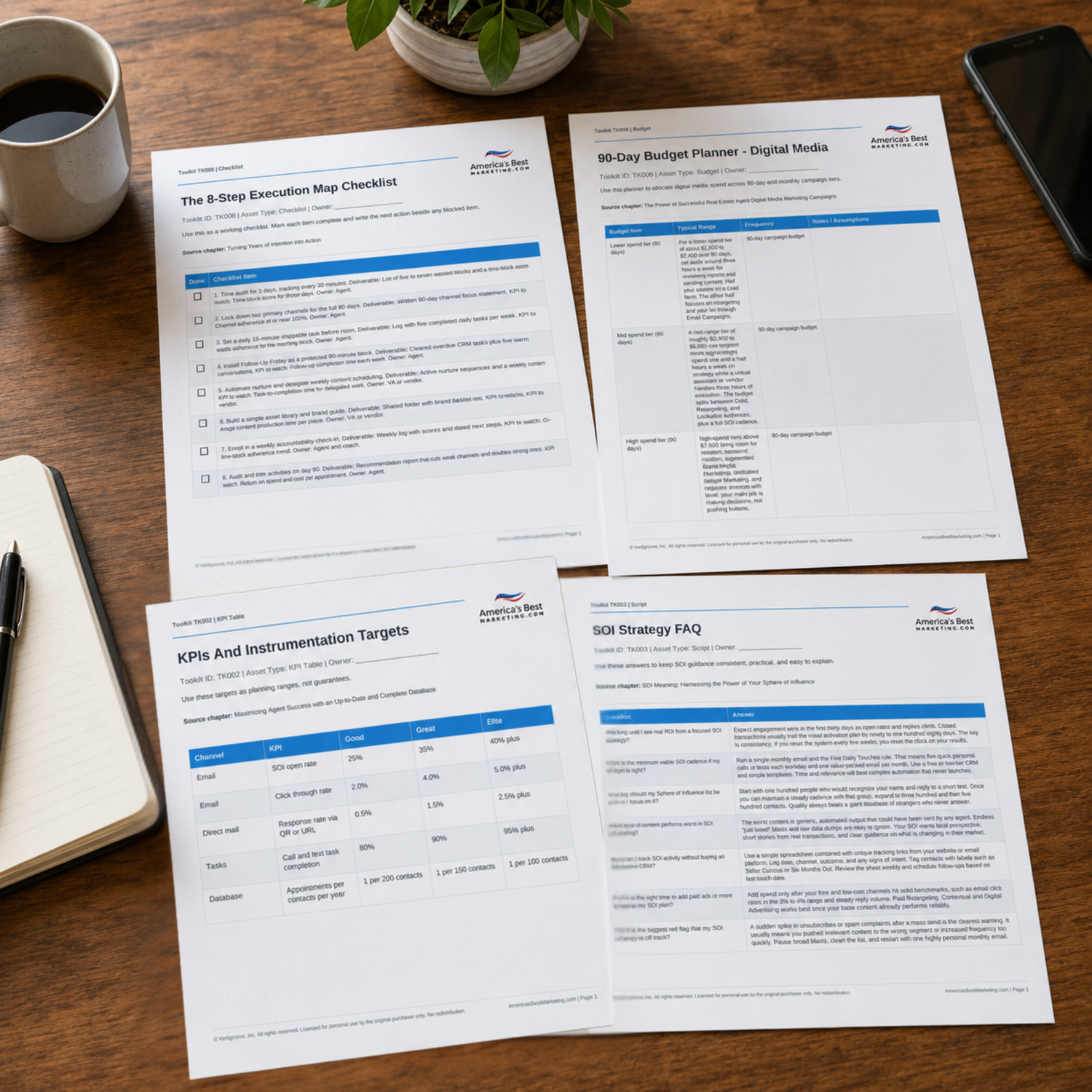
Download The Lead Capture Page Implementation Toolkit
Use the companion Toolkit to review your offer, form friction, trust signals, traffic budget, conversion KPIs, follow-up path, and ten-point launch audit before you increase campaign spend.
Download the Toolkit ZIPRecommended reads
Recommended Reads for Real Estate Agents
These articles help agents connect follow-up discipline, database habits, client communication, and marketing execution into a repeatable system.

Maximize Your Business Growth with High-Impact Marketing Solutions
Build a cleaner system for maximize your business growth with high-impact marketing solutions, with better timing, clearer messaging, and a next step people can act on.
Read article
How to Choose the Right Real Estate Agent
Make “How to choose the right real estate agent” more useful by turning the topic into a clear buyer-and-seller education resource with a defined audience, message, and next step.
Read article
SEO for Real Estate: How Agents Can Dominate Local Search and Generate More Leads
Build a cleaner system for SEO for real estate, with better timing, clearer messaging, and a next step people can act on.
Read article
Best Real Estate Lead Generation Companies for Real Estate Agents
Make real estate lead generation companies more useful by tying the message, audience, and next step together.
Read articleReal Estate Lead Capture Page Questions
How fast can I reach a fifteen percent conversion rate on my real estate lead capture page?
That target depends on traffic quality and how tight your offer is. With warm email traffic and a clear magnet, many agents see double digit conversion within the first month of focused testing. Hitting fifteen percent or higher on colder paid traffic usually takes a few rounds of headline and layout tweaks backed by real data.
What is the minimum time commitment needed for split testing my capture page?
Plan for at least thirty to sixty minutes each week. Use that block to review conversion rate by traffic source, turn off clear losers, and launch one new variant at a time. Simple tests on headlines, button copy, and form length often deliver the biggest gains without forcing a full redesign of the page.
Should I use a real estate lead capture page only for farm areas or also for my full sphere?
You can run both, but keep them separated. Build one page that speaks directly to your farm with local language, photos, and guidance, then build a more general page for your sphere and past clients. Segmenting your offers this way keeps copy sharp and lets you see which audiences are most likely to convert.
Which lead magnets usually convert worst on capture pages?
Generic, vague offers tend to perform the worst. Free newsletter invites, broad market reports with no angle, or thin content that feels like a sales brochure will rarely earn strong conversion. Offers that win are specific, local, and clear, such as a pricing roadmap for sellers on one side of town or a buyer shortlist for a single school district.
What is the easiest way to calculate my capture page conversion rate?
Start with two simple numbers. Count unique visitors to the page and count successful form submissions over the same time frame. Divide submissions by visitors and multiply by one hundred for a clean percentage. Track that number by traffic source so you can see which channels are truly pulling their weight.
What conversion rate benchmark should I hit before I increase my ad spend?
For warm email and sphere traffic, many agents aim for at least twenty percent conversion before they raise budgets. For colder paid traffic, a range between eight and fifteen percent can be healthy if cost per lead lines up with your average commission and close rate. Always judge conversion rate together with cost per lead, not in isolation.
What is the single biggest design mistake that kills real estate lead capture page performance?
The most damaging mistake is treating the page like a mini home page instead of a focused offer. Navigation menus, extra links, and long walls of text give visitors endless escape paths. Strip the layout down to one promise, one form, strong social proof, and a clear next step so every part of the page points toward conversion.
Next step
Build the System Behind the Conversion
Continue from one high-performing page into the larger ABM ecosystem: the book series for strategic depth and the full marketing program for done-for-you execution.

View the Book Series
Explore the America’s Best Real Estate Agent Marketing System books for a deeper strategic framework around visibility, referrals, listings, lead generation, and growth.
View the Book Series
See Full Marketing Program
See how AmericasBestMarketing.com runs real estate blog writing, social media, listing marketing, email, direct mail, and retargeting as one managed system.
See Full Marketing Program