Monthly Real Estate Email Newsletter Ideas: A 90-Day Launch Plan
Monthly Real Estate Email Newsletter Ideas
A 90-Day Launch Plan
A practical system for cleaning your list, building a mobile-first template, planning three useful sends, and tracking the replies that lead to real conversations.

How to launch a monthly real estate newsletter in ninety days
Start with a clean permission-based list, segment contacts by relationship and intent, build one mobile-first template, and plan three monthly sends before the first email goes out. Each newsletter should deliver one local market insight, one homeowner or buyer takeaway, one community connection point, and one clear invitation to reply, request a value update, or schedule a conversation.
- One useful monthly send is more valuable than bursts of activity followed by silence.
- Warm, permission-based contacts protect deliverability and create better conversations than purchased lists.
- A stable four-part content structure makes the newsletter easier to produce and easier to read.
- Replies, appointments, and signed business matter more than open rate alone.
Why A Monthly Newsletter Still Earns Attention
A real estate email newsletter is one of the few marketing channels an agent can control. Social posts fade quickly, platform algorithms change, and paid ads stop when the budget stops. A useful email remains in the inbox where it can be searched, forwarded, reread, and answered when a move becomes real.
The operating principle is simple. Earn attention with useful information before asking for business. Keep most of the send focused on market insight, homeowner education, local context, and decision support. Reserve the final portion for one clear referral, valuation, event, search, or appointment invitation.
When the email feels like a local briefing instead of a pitch, readers are more likely to reply. That reply may begin with a tax question, a renovation decision, a move-up timeline, or a request to watch inventory. Each response gives the agent a legitimate reason to continue the relationship.
- Consistency keeps past clients and homeowners close enough to remember who to call.
- Local context makes the agent harder to replace with a generic national newsletter.
- A clear call to action turns passive readership into a measurable next step.
- Useful emails strengthen every other channel by giving social, direct mail, and retargeting a shared message.
The Core 90-Day Newsletter Framework
Treat the launch like a short operating project. The deliverables are straightforward: one clean list, one authenticated sender domain, one mobile-first template, three planned topics, tracked links, and a fifteen-minute review after every send.
Clean the list and protect deliverability
Export contacts, correct names, remove hard bounces, delete obvious junk records, and keep people who know you and would reasonably expect to hear from you.
Tag contacts as past clients, homeowners, active buyers, potential sellers, investors, vendors, or local partners. Authenticate the sender domain before the first serious send.
Build the template and message calendar
Create a reusable mobile-first layout with a short opening, one market insight, one practical tip, one local connection point, and one primary call to action.
Plan the first three sends before writing copy. Save reusable blocks for market updates, maintenance tips, local spotlights, saved searches, and appointment invitations.
Send, measure, and segment
Commit to one fixed monthly send day. Test the email on desktop and phone, click every link, and repair spacing, image, typo, or button issues before launch.
Review opens, clicks, replies, unsubscribes, and appointments. Use the results to sharpen subject lines, clarify the call to action, and segment the audiences producing real conversations.
Open rate measures attention, but replies are the strategic signal. A reader who answers with a question about value, timing, taxes, repairs, or inventory has moved from passive audience member to active relationship. Track replies beside unsubscribes every month and ask whether the send made it easier or harder for someone to start a real conversation.
Three Newsletter Frameworks You Can Reuse
You do not need twelve unrelated newsletter concepts. You need a small rotation of useful themes that mirror the questions people ask before they buy, sell, renovate, refinance, relocate, or refer someone.
The monthly market snapshot
Subject and body rhythm
Subject lineValues on your street moved this month.
OpeningLead with one local price, inventory, or days-on-market signal.
ExplanationTranslate the number into timing, equity, or search behavior in plain language.
CTAInvite the reader to reply with an address or timeline question.
Add one chart or compact table only when it reads cleanly on a phone. Link to IDX Real Estate Websites when saved searches or current inventory are part of the next step.
The homeowner playbook
Subject and body rhythm
Subject lineThree repairs local buyers quietly value this season.
OpeningLead with a homeowner problem that appears in real client conversations.
ExplanationGroup three projects by cost, effort, timing, and likely buyer interest.
CTAInvite readers to send a photo or question before spending money.
Group tasks by quick fix, weekend project, and pre-listing decision. This positions the agent as an advisor well before the listing conversation begins.
The offer or event invitation
Subject and body rhythm
Subject lineQuick home value snapshot for your address.
OpeningState the offer in the first line and explain who it is for.
ExplanationShow how long the value check, coffee chat, or workshop takes.
CTASpell out one simple way to claim the offer or reserve a spot.
Place the primary booking link high enough that mobile readers see it quickly, then include a reply option for people who are interested but not ready to schedule.
Across the year, rotate themes without redesigning the newsletter every month. Use winter for planning and financial readiness, spring for preparation and tune-ups, summer for local events and outdoor living, and fall for maintenance, pricing patterns, and next-year planning.
Build a subject-line bank before you schedule the first send. Useful options include what changed with home values on your street this month, three projects buyers keep asking about, how fast a home like yours would sell, what your property tax letter means, a school-year move timetable, and how many buyers searched in your neighborhood this week.
Choose The Right Production Model
Email can run lean or fully managed. The strategic question is not whether email is expensive. The question is who owns list cleanup, calendar planning, copywriting, design, testing, sending, reporting, and follow-up every month.
Do-it-yourself for the first ninety days
Plan for up to four hundred fifty dollars across the first three sends. Use a free or low-cost platform, write your own copy, and reserve one focused work block each month to build, test, and schedule the newsletter.
The largest time investment comes during setup because list hygiene, domain authentication, and template creation take longer than the ongoing monthly send.
Buy structure while retaining strategy
Plan for roughly four hundred to two thousand two hundred fifty dollars across the first three sends. Pay for a stronger platform, template setup, design help, or outside copy support while keeping audience decisions in your hands.
A fully managed program makes sense when Email Marketing for Real Estate Agents is already part of the pipeline and the agent wants to protect selling time while improving consistency.
KPI Table For A Monthly Real Estate Newsletter
Focus on the numbers that show whether the newsletter is earning attention and creating action. Opens show subject-line strength. Clicks show whether the content and layout move readers back to your site. Replies show whether the send is strong enough to start a conversation.
| KPI metric | What it measures | Working target | Management response |
|---|---|---|---|
| Open rate | Share of delivered recipients who open. | Twenty-two to twenty-eight percent | Test sender name, subject line, preview text, and send time. |
| Click rate | Share of delivered recipients who click. | Three to five percent | Clarify the offer, reduce competing links, and improve mobile layout. |
| Reply rate | Share of recipients who answer directly. | One to one and a half percent | Strengthen local relevance and ask a question that is easy to answer. |
| Unsubscribe rate | Share of recipients who opt out. | Below one-half percent | Review permission, frequency, audience fit, and subject-line accuracy. |
| Appointments | Conversations that become scheduled meetings. | Track by send and segment | Connect email replies to CRM stages so revenue impact is visible. |
Tag links that return traffic to your website so analytics can separate email sessions from search, social, and direct visits. Watch what happens when email is paired with Direct Mail Marketing in the same neighborhoods. Repeated exposure across inbox and mailbox can make referral and listing conversations easier to start.
Compliance Guardrails That Protect The Channel
Your sender reputation is an asset. Protect it by sending to people with a real relationship to you, making unsubscribe easy, and avoiding subject lines that imply urgent news when the email is only a sales pitch.
- Include your name, brokerage information, physical mailing address, and a working unsubscribe link.
- Honor unsubscribes quickly and do not move those contacts into another mass list.
- Clean inactive addresses at least twice a year.
- Remove people who bounce repeatedly or never had clear permission.
- Pause and investigate when the first send produces high bounces or spam complaints.
Ethical email at scale comes down to respect for the inbox. If a send would annoy you, it will annoy your list. If it is timely, useful, and easy to act on, you are building the right habit.
What Progress Can Look Like In Ninety Days
Consider a small team with a neglected Sphere of Influence list. They clean the file, segment by city and stage, send one monthly newsletter, and review replies after each send. The first win may not be a signed listing. It may be a past buyer asking about a move-up timeline, a homeowner clicking into a saved search, or a vendor forwarding the email to a friend.
The compounding value comes from making the list useful again. When the email points readers back to relevant searches, helpful articles, and simple appointment paths, the database becomes an active relationship channel instead of a dormant spreadsheet.
The operating lesson is straightforward. Do not judge the program only by the first month's revenue. Judge whether the list is cleaner, the send is consistent, more people are replying, and the follow-up system is capturing those signals before they disappear.
Your Next Two Moves
A predictable real estate email newsletter gives you quiet leverage. While other agents chase the newest channel, you keep showing up in the inbox with useful local context and one clear invitation.
- Choose your platform, authenticate the sender domain, and lock in one send day for the next three months.
- Map one topic and one primary call to action for each send before you begin designing the first email.
- Use the 12 Monthly SOI Email Templates for Real Estate Agents as a backbone, then adapt each message to your market and client base.
- Track replies, appointments, and signed business in the same place you review opens and clicks.
The newsletter wins when it makes the next conversation easier. Clean data, useful local context, one clear invitation, and disciplined follow-up turn a monthly send into a relationship system that compounds.
How This Becomes A Multi-Channel Marketing Asset
A monthly newsletter should not operate as an isolated task. Its market insight can become a blog section, short social post, direct-mail message, retargeting theme, client-event invitation, and follow-up prompt. One strong editorial idea can produce a month of coordinated visibility.
Use the same core message across Social Media Marketing, Listing Marketing, Email Campaigns, Direct Mail, and Digital Retargeting. The format changes, but the promise stays consistent. You help clients understand what is happening locally and what to do next.
When a managed system carries the same useful message across channels, the newsletter stops being another monthly obligation. It becomes the editorial center of a visible, accountable marketing program.
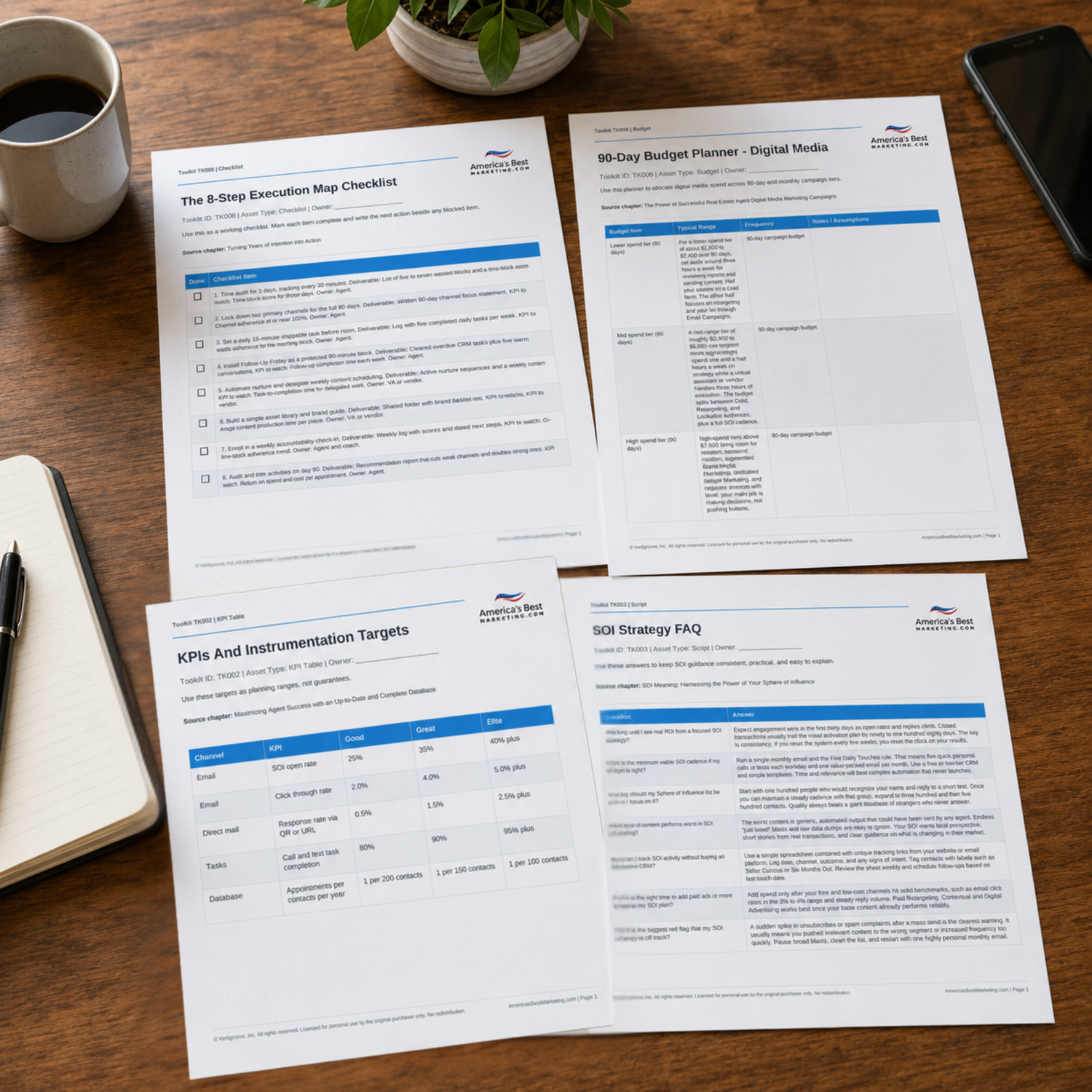
Download The 90-Day Newsletter Launch Toolkit
Use the companion Toolkit to clean and segment your list, map the first three sends, plan budget and resources, track practical KPIs, and build market snapshot, homeowner playbook, and offer or event emails.
Download the Toolkit ZIPRecommended reads
Recommended Reads for Real Estate Agents
These articles help agents connect follow-up discipline, database habits, client communication, and marketing execution into a repeatable system.

High-Converting Real Estate Email Marketing Campaigns Every Agent Needs for Predictable Lead Flow
Give email campaigns a clearer role in the marketing system instead of treating the work as a one-off idea.
Read article
Pre-Approved vs Pre-Qualified: Real Estate Agent Talking Points + Email Templates
Build a cleaner system for pre-approved vs pre-qualified, with better timing, clearer messaging, and a next step people can act on.
Read article
Title Insurance Explained: Real Estate Agent Talking Points to Prevent Last-Minute Surprises
Keep the database warmer with email ideas that feel useful, timely, and easy to answer.
Read article
How to Re-Engage Cold Real Estate Leads with Email & Retargeting
Use smarter email timing and segmentation to restart conversations without sounding pushy.
Read articleMonthly Real Estate Newsletter Questions
How long does it take to see real results from a newsletter?
You can usually see clear changes in opens and clicks within the first month. Replies and real conversations often show up between ninety and one hundred twenty days as people see you consistently and begin to treat your messages as a trusted resource rather than another blast.
What is the minimum viable cadence for a real estate email newsletter?
One high-quality send per month is the floor if you want your name to stick in memory. Less than that usually feels random and forgettable. If you have more capacity, layer short segmented follow-ups powered by Real Estate Drip Campaigns That Actually Convert rather than sending extra mass newsletters.
How big does my list need to be before this is worth the effort?
A clean list of five hundred people who know you is enough to justify a structured newsletter. The quality of the relationship matters more than the count. A small engaged list can drive more warm conversations and referrals than a large group of cold strangers who rarely open or click.
Should I add my social profiles and other links to every send?
Yes. Add social profiles in the footer so they support your brand without distracting from the main call to action. The primary goal is to drive readers to your site or to reply, not to send them wandering across Social Media Marketing channels that you do not fully control.
What type of content usually performs worst in a newsletter?
Long walls of text with no clear structure tend to underperform. So do generic national news clips that feel like they came from a canned feed. Readers want local context, simple explanations, and next steps that relate to their own timeline, not a recycled article they already saw somewhere else.
How can I track conversions if I use simple tools?
Start by counting replies and tracking how many turn into appointments or signed agreements. Pair that with basic link tagging so you can see which emails drove visits to your site. You can layer more advanced reporting later once consistent email sends prove they are pulling their weight.
What is the biggest red flag when launching a new cadence?
The most serious warning sign is a mix of high bounce rate and spam complaints on the first send. That usually means the list is cold or permission was never clear. Pause, clean the list again, and focus on warm contacts so you do not burn your sender reputation for future campaigns.
Next step
Build the System Behind the Newsletter
Continue from one useful article into the larger ABM ecosystem: the book series for strategic depth and the full marketing program for done-for-you execution.

View the Book Series
Explore the America’s Best Real Estate Agent Marketing System books for a deeper strategic framework around visibility, referrals, listings, lead generation, and growth.
View the Book Series
See Full Marketing Program
See how AmericasBestMarketing.com runs real estate blog writing, social media, listing marketing, email, direct mail, and retargeting as one managed system.
See Full Marketing Program