Real Estate Drip Campaigns That Actually Convert
Real Estate Drip Campaigns That Actually Convert
A Ninety Day Nurture System for Buyer, Seller, and Past Client Leads
A practical operating brief for agents who want segmented email sequences, clearer CTAs, healthier lists, and more booked consultations without manual follow-up every day.

How Real Estate Drip Campaigns Turn Leads Into Appointments
Real estate drip campaigns convert when each buyer, seller, or past client enters a sequence built around one clear goal. Segmentation makes the message relevant, scheduled follow-up keeps the agent visible, and one focused CTA gives the reader an easy next step such as replying, booking a consultation, or requesting a saved search.
- Build separate buyer, seller, and past client sequences instead of sending one general campaign to everyone.
- Define the conversion goal before writing the first email so every subject line and CTA supports the same action.
- Use a ninety day cadence, then move colder leads into a lighter monthly nurture track rather than abandoning them.
- Track opens, clicks, replies, booked consultations, unsubscribes, and list quality by segment so improvements stay measurable.
Why Consistent Email Nurture Produces More Qualified Conversations
Real estate drip campaigns are scheduled sequences that move leads from curious to committed while you stay in showings, listing appointments, and client conversations. The system sends the right message at the right time for each list segment so your database hears from you consistently instead of only when you remember to broadcast an update.
Strong drip strategy rests on clear segmentation and clear intent. Buyers, sellers, and past clients need different stories, proof, and timing. When your CRM groups contacts by goal and timeline, each sequence can feel personal even though you write it once and let automation handle the delivery.
Useful email also compounds the value of your broader content. Pair the sequence with topics from Monthly Email Newsletter Ideas for Real Estate Agents, then reuse the strongest ideas across your website, social posts, direct mail, and retargeting. The campaign becomes an operating asset instead of a string of isolated sends.
- Segmentation separates buyers, sellers, and past clients while timeline tags identify hot, nurture, and long term contacts.
- Lead nurturing blends education, proof, and soft offers so contacts feel guided instead of chased.
- Time on system keeps slower leads in your orbit through the full research cycle.
Build The Ninety Day Drip System In The Right Order
Most agents do not struggle with sending email. The real drag on conversion comes from sending the same tired template to every contact regardless of source, price point, or timeline. That turns automation into noise and trains readers to ignore the next message.
The fix does not require a complicated technology stack. It requires one contact system, clear tags, three starter sequences, reliable form connections, and a monthly review rhythm. Run the work in order so every new lead enters the correct path automatically.
- Choose one primary system for contacts and email so every lead enters a single source of truth.
- Tag the existing list into buyers, sellers, and past clients with an extra tag for hot, nurture, and long term.
- Write a four email buyer sequence covering expectations, local education, proof, and a clear invitation to book a call.
- Write a four email seller sequence covering pricing truth, preparation, proof, and a path to request a home value review.
- Write a four email past client sequence blending gratitude, market updates, homeowner value, and a light referral prompt.
- Map timing so active buyers and sellers receive at least one useful message each week for ninety days, with softer pacing for past clients.
- Connect website forms and lead sources to the correct list so every new contact triggers the right sequence without manual work.
- Sync engaged audiences to Digital Retargeting so email clicks can support matching messages around the web.
- Set up simple A and B subject line tests on the first two emails in each sequence.
- Review results once each month, update one element at a time, and promote the best performing email to a broader send.
Match the path to the lead
Do not place a valuation request, an open house sign in, a portal inquiry, and a past client into one generic sequence. Their questions, urgency, and proof needs are different.
Use source and timeline tags so each sequence can open with a specific expectation and move toward one meaningful next step.
Write for one conversion
Decide whether the sequence should create a reply, a booked consultation, a saved search, or a home value review before you write the first subject line.
Every paragraph should move the reader closer to that action without turning useful education into a constant sales pitch.
Protect deliverability
Remove hard bounces and contacts who remain inactive for several months. A smaller responsive list is more valuable than a large database filled with dead addresses.
Keep unsubscribe language, identity, and mailing information clear so every send respects the reader and protects trust.
The biggest drip mistake is writing emails before defining the one conversion you want for that segment. Decide first whether the sequence should create a reply, a booked consultation, or a saved search. Then judge every subject line and paragraph by one question: does this move the reader closer to that action?
Three Drip Campaign Frameworks You Can Build First
Start with the first seven to ten days because early response speed shapes the entire relationship. These frameworks keep the message focused, useful, and easy to automate for each core segment.
Buyer sequence: speed to value in the first seven days
Subject line and timing framework
Day oneHere is the truth about new listings in your price range.
Day threeThree moves that help you win the right home.
Day sevenWant a custom search built around your must haves?
Send the first email within one hour of the inquiry. Send the second after the first open or forty eight hours later. Send the third after a link click or on day seven, then move any reply into a live conversation and pause automated pitches.
Seller sequence: education first, invitation second
Subject line and timing framework
Day oneHere is what buyers pay close attention to in your area.
Day fourReal pricing ranges in your neighborhood right now.
Day tenWant a simple preparation list that reduces market stress?
Send the first email within twenty four hours of a valuation request. Use local proof in the second email and a direct offer to review the property in the third. Email Marketing for Real Estate Agents can support the branded content and execution behind the sequence.
Past client sequence: protect referrals through steady value
Subject line and timing framework
Week oneA quick thank you and a short update on your market.
Week fourSmall homeowner habits that protect your property value.
Week eightWant a fast check on your current equity position?
Use a lighter monthly cadence and add one physical touch each quarter through Direct Mail for Real Estate Agents. Invite questions about value so the sequence feels useful before it ever asks for an introduction.
Cadence, Budget, And Build Time That Make Sense
You do not need an enterprise tool stack to run sharp automation. A list of a few hundred contacts, a dependable email platform, and clear content will outperform a bloated system that nobody inside the business understands. Match the spend to your production level and the time you can realistically maintain.
Plan for a basic CRM, a simple email platform, and a few hours of setup. A realistic starter range is about one hundred to two hundred dollars per month for software plus three to four focused hours to tag contacts, load sequences, and connect forms. This level works for a solo agent who wants consistent nurture without adding staff.
Plan for a more advanced CRM with lead scoring, deeper reporting, and synced IDX Real Estate Websites audiences. Expect about two hundred to four hundred dollars per month in tools and four to six hours for build and review time. This level supports a small team with multiple lead sources and higher reporting needs.
When you want to move faster, use coaching or a managed partner to prioritize the sequences and segments that should be built first. The target is not a perfect map. The target is a lean system that frees the calendar while creating more qualified conversations.
The Ninety Day Drip Campaign Dashboard
Once the sequences run, your job shifts from constant writing to watching a short set of numbers. Focus on delivery, open rate, click rate, reply volume, unsubscribe rate, booked consultations, and list quality. These signals show whether the copy fits the segment and whether the timing matches the way leads actually plan a move.
| Phase | Focus | Target Metric | How To Read It |
|---|---|---|---|
| Week one | Check delivery and opens | 95 percent sent and 35 percent open | When open rate sits under 20 percent, rewrite the first subject line and test it with a small group before changing the rest of the sequence. |
| Week four | Watch clicks and replies | 10 percent click and 5 percent reply | When clicks stay low, tighten the email around one offer and use one clear CTA instead of several competing next steps. |
| Week twelve | Measure booked calls | 3 percent consultation and 1 percent client | When consultations remain light, add one direct invitation email that asks the reader to reserve a short planning call. |
Build one dashboard in the CRM or email platform that shows these numbers by segment. Check it once a month and adjust one element at a time. That rhythm protects you from reacting to one unusual send while still giving you enough data to keep the list healthy and productive.
Compliance, List Hygiene, And Respect For The Reader
Email can drive a large share of the pipeline, yet it can also damage trust when basic list hygiene and reader expectations are ignored. Every message should make it easy for someone to leave the list, understand who sent it, and know why they are receiving it.
Include a clear unsubscribe link, a physical mailing address, and a short reminder about how the contact joined the list. Remove hard bounces and contacts who remain inactive for several months. When in doubt, send fewer high value messages rather than a constant stream of low effort content. This article addresses execution, not legal advice, so confirm the specific email rules that apply in your region before scaling volume.
- Do not buy random lists or place unrelated contacts into automated sequences.
- Do not hide the unsubscribe process or make the sender identity difficult to understand.
- Do not judge list health by list size alone. Engagement and deliverability matter more.
- Do document source, consent context, segment, and the last meaningful engagement for each contact.
Case Study: More Consultations Without More Prospecting Hours
Jordan runs a small team and used to follow up manually with portal leads and open house sign ins. Over ninety days, Jordan moved every new buyer lead into a four email sequence and added one seller path for valuation requests.
Initial consultation bookings rose from fifteen to twenty one during the same window, and the share of calls that came directly from email clicks grew by forty percent. The team did not add prospecting hours. The improvement came from consistent useful touches, faster response, and a clear next step in every sequence.
The lesson is operational. Automation does not replace the live conversation. It creates more of the right moments for that conversation to begin.
Ninety Day Launch Checklist
Use this rollout to build the system without trying to perfect every email before launch. The first objective is dependable coverage. The second is measured improvement.
- Week one: clean the database, define the three primary segments, and document the one conversion goal for each sequence.
- Week two: write the first four buyer emails and connect buyer inquiry forms to the correct automation.
- Week three: write the first four seller emails and connect valuation requests to the seller path.
- Week four: write the past client sequence and schedule the lighter monthly cadence.
- Month two: test the first two subject lines, review reply quality, and connect engaged audiences to digital retargeting.
- Month three: compare results by segment, prune inactive contacts, and add one direct consultation invitation where conversion is weak.
Automation works when it creates consistency without erasing judgment. Let the system handle timing, reminders, and repeatable education. Let the agent handle replies, context, negotiation, and the live decisions that require trust.
Turn The Drip Campaign Into A Multi-Channel Follow-Up System
Email becomes more effective when it does not operate alone. Use the same buyer, seller, and past client themes across blog content, short-form video, direct mail, and retargeting so every channel reinforces the same promise and next step.
When you are ready to extend the operating rhythm, connect the campaign to Five Client-Winning Habits. The daily actions in that article help the agent respond to the opportunities that the automated system creates.
AmericasBestMarketing.com can manage Email Marketing for Real Estate Agents and connect it with social media, listing marketing, direct mail, and digital retargeting so the nurture strategy runs as one coordinated system while the agent stays focused on clients.
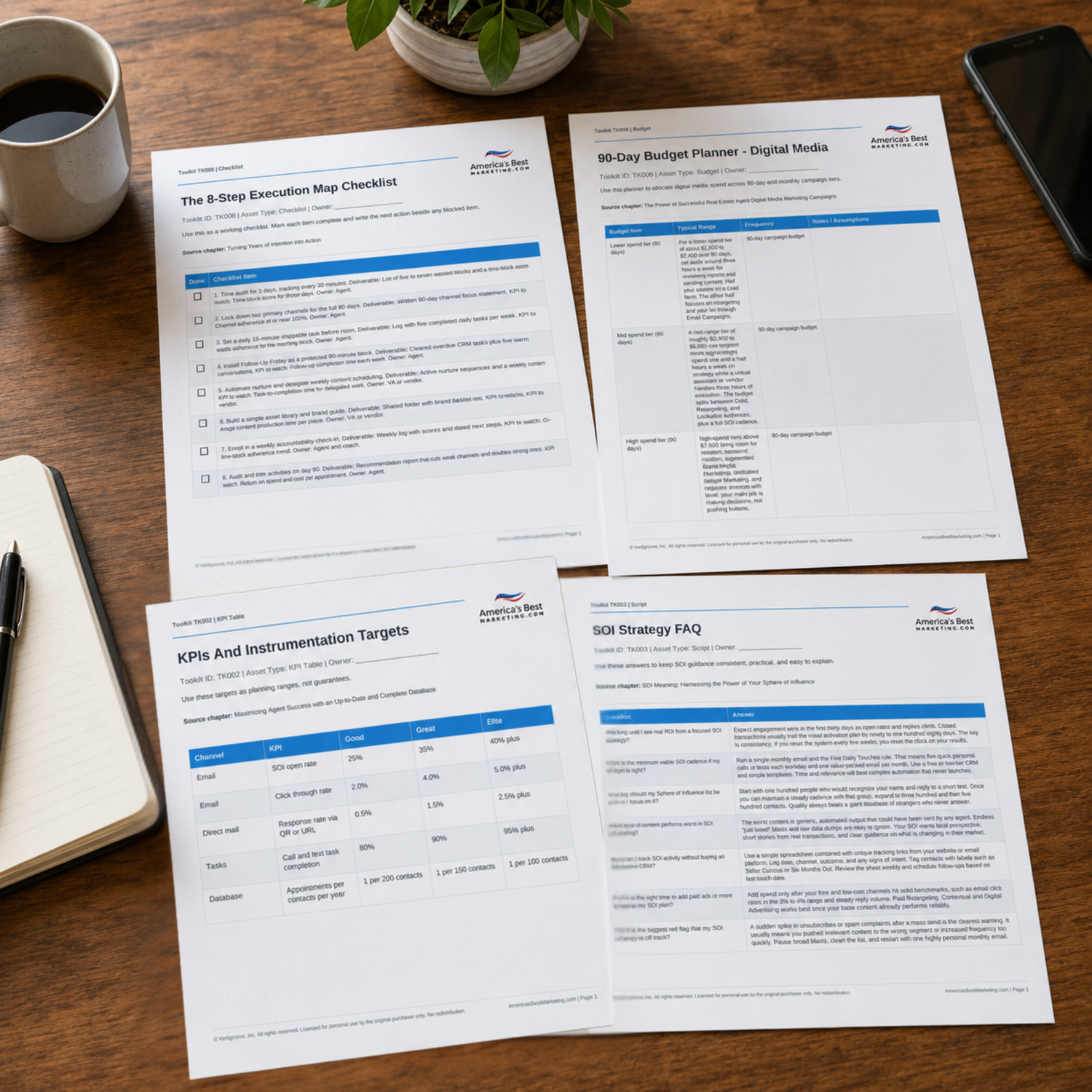
Download The Real Estate Drip Campaign Toolkit
Use the companion Toolkit to map buyer, seller, and past client nurture paths, pressure test campaign timing and spend, track opens, clicks, replies, consultations, and list quality, and launch the ninety day system with ready-to-use scripts and planning worksheets.
Download the Toolkit ZIPRecommended reads
Recommended Reads for Real Estate Agents
These articles help agents connect follow-up discipline, database habits, client communication, and marketing execution into a repeatable system.

The Top 7 Things to Look For in a Real Estate Marketing Program
Give the top 7 things to look for in a real estate marketing program a clearer role in the marketing system instead of treating the work as a one-off idea.
Read article
HOA Navigation for Real Estate Agents: Red Flags, Document Requests, and Buyer Scripts
Give hoa navigation a clearer role in the marketing system instead of treating the work as a one-off idea.
Read article
Short-Form Video Marketing for Real Estate Agents: Strategy + Calendar
Give short-form video marketing a clearer role in the marketing system instead of treating the work as a one-off idea.
Read article
The Power of Successful Real Estate Agent Digital Media Marketing Campaigns
Create more leverage from digital media campaigns with a clear path from attention to follow-up.
Read articleReal Estate Drip Campaign Questions Agents Ask Most
How long until real estate drip campaigns produce closed transactions?
Most agents see clear movement in booked consultations inside the first ninety days once a full sequence is active. Closed transactions tend to lag behind by another one or two cycles because buyers and sellers need time to make decisions. Treat the first quarter as a build and tune period and judge success by replies and meetings first.
What is the minimum viable email sequence length?
A practical starter sequence has at least four emails per segment. That gives you room for a welcome email, a teaching email, a proof email, and a clear invitation to meet. You can add more touches later. The priority is to ship a short, tight set of messages that runs every time a new lead enters your database.
What is a major red flag in my open rate?
If your open rate drops under 15 percent across several sends, you likely have a mix of tired subject lines and a stale list. Start by pruning bounced and never opened contacts, then refresh the first subject line in each sequence with stronger curiosity and clarity. Watch the next three sends before you decide on deeper changes.
What content performs worst in a seller drip sequence?
Pure market hype with no grounding in real numbers or local examples tends to fall flat. Sellers respond better to real timelines, clear pricing ranges, and specific preparation steps. When every email sounds like a broadcast advertisement, expect low replies and higher unsubscribes. Shift toward honest education and simple offers to review their situation.
Should I stop emailing cold leads after ninety days?
You rarely need to stop entirely. After ninety days of heavier nurture, move cold leads into a lighter long term track with one high value message each month. Continue to remove contacts who never open. That balance keeps you present for slower timelines without wasting sends on people who clearly have no interest.
How do I track lead attribution from email?
At a minimum, log every booked consultation with a simple source field that includes email. Use unique links in key emails that route to your IDX Real Estate Websites and track visits from those links. Watch reply tags, link clicks, and lead source notes together so you can see which sequences push people toward real conversations.
What is the minimum viable cadence when my budget is tight?
When tools and time are limited, send one strong email per week to active buyers and sellers and one per month to past clients. Make every message specific to your local market. Use the patterns inside 12 Monthly SOI Email Templates for Real Estate Agents to keep topics relevant without writing from scratch each time.
Should every email include a link to my IDX Real Estate Websites?
Not every email needs a click, yet most sequences benefit from regular visits back to your site. Use links to IDX Real Estate Websites when you invite a search, share a listing, or offer a valuation tool. Mix in simple reply based CTAs so readers who dislike clicking still have an easy way to raise a hand.
Next step
Build The System Behind The Follow-Up
Continue from one useful article into the larger ABM ecosystem: the book series for strategic depth and the full marketing program for done-for-you execution.

View the Book Series
Explore the America’s Best Real Estate Agent Marketing System books for a deeper strategic framework around visibility, referrals, listings, lead generation, and growth.
View the Book Series
See Full Marketing Program
See how AmericasBestMarketing.com runs real estate blog writing, social media, listing marketing, email, direct mail, and retargeting as one managed system.
See Full Marketing Program