Hyper-Local Market Report Template: The Agent’s Guide to Local Authority
Hyper-Local Market Reports That Win Leads
What to include, data sources, and posting cadence
Use a 30-day local market report cadence to turn neighborhood data, MLS signals, and plain-English analysis into valuation requests, seller conversations, and buyer planning calls.

Turn Neighborhood Data Into Seller Conversations
A useful hyper-local market report covers one defined neighborhood, tracks the same inventory and demand signals every month, explains what changed in plain English, and routes each reader to one logical next step. The goal is not to publish more market commentary. The goal is to give homeowners, buyers, and relocation prospects enough local clarity to request a valuation, ask a timing question, or book a short strategy call.
- A hyper-local report should focus on one zip code, neighborhood, school-zone slice, or tight farm area instead of citywide averages.
- The monthly scorecard should track active inventory, months of inventory, pending count, price drops, and one forward-looking demand signal.
- Local MLS data should anchor pricing and inventory while public sources can support permits, school updates, and commute context.
- The strongest cadence is one flagship report each month, then smaller social, email, mail, and retargeting assets cut from that report.
Why This Pays Off
Generic market updates are noise. A hyper-local market report turns you into the person buyers and sellers trust for decision-level clarity, and it compounds traffic when you support it with proven SEO strategies for real estate websites.
Generic national market updates do not sell local homes. A hyper-local market report helps you move from generalist to neighborhood authority by sourcing granular data, spotting sub-market trends that matter to homeowners, and distributing the report through your site, email, direct mail, and retargeting.
Hyper-local means a zip code, a neighborhood, or a tight cluster of subdivisions. Citywide averages blur the signal. Your job is to publish insights a homeowner can verify by looking out their front window.
- You give sellers a recurring reason to ask whether their equity, timing, and pricing range have changed.
- You give buyers a cleaner way to compare inventory, pending demand, and price pressure by neighborhood.
- You create a durable content asset that can be reused through search, email, social media, mail, and retargeting.
Build the 30-Day Market Report Cycle
Market reports win when they run as a system. Use a 30-day loop so data, writing, and distribution stay predictable, then slice the report into smaller assets for the rest of the month.
Harvest the data
Pull active, pending, sold, price drop, and withdrawn counts from the Local MLS. Add one external change that affects perception, then log it in a simple notes file.
Build the report
Drop the numbers into the same sections every time: scoreboard, what changed, what it means, and what to do next. Keep commentary tied to action.
Launch the report
Send the full report to your database through email marketing for real estate agents and mail a one-page version to your farm.
Run the retargeting loop
Pull three micro-stats from the report and turn each into a short post. Keep the report in front of visitors using retargeting and contextual ads.
Days on market is a lagging metric that often tricks sellers when the market is shifting. Track showings per listing as a leading signal of demand so you get a three to four week head start on pricing and messaging.
Format The Report So It Scans In Forty Seconds
A homeowner will not read a wall of text about interest rates. They will scan for proof that you know their street, their price band, and current buyer behavior. Build your report like a dashboard, not a newsletter.
- Top box scoreboard: inventory, months of inventory, median price, pending count, and price drops.
- One chart or one table: show the trend over three time windows so readers see direction.
- Two sentences of interpretation: explain why the change matters and what it suggests.
- Call to value: invite the reader to request a hyper-local valuation for their address.
Make the report live on your site first, then distribute it out. Your site is the archive. Social is the trailer. Email and mail are the delivery trucks. That is why your IDX real estate website should house a clean report library that is easy to browse by neighborhood.
Write headlines that sound like a local briefing, not a headline from a national outlet. Your reader wants to know why their neighborhood is behaving differently than the city average.
Headlines, Angles, And A Clean CTA Ladder
Use a simple CTA taxonomy so you can publish the same report to different audiences without sounding repetitive. The soft CTA invites readers to download a one-page market cheat sheet. The mid CTA points readers to live neighborhood inventory. The hard CTA invites an address-specific valuation during a short consult.
Monthly spend: $250 to $450. Publish one report per month for one farm. Send one email blast and one non-opener resend. Run retargeting at $5 to $8 per day with a frequency cap target of 6 to 10 per week.
Monthly spend: $650 to $1,200. Publish one report per month for two farms. Send one email blast, one non-opener resend, and one mid-month micro update. Mail a one-page report to 500 to 1,000 homes.
If you need more top-of-funnel volume, pair the report with online real estate lead generation guidance so each post has a clear capture point.
Distribution Benchmarks To Track Each Cycle
Track the report as a lead magnet, not as a vanity post. Your job is to measure attention, intent, and follow-up speed. Treat these as target benchmarks, then adjust the next cycle by tightening headlines and making the call to value easier.
| Metric | What it is | Benchmark | Why it matters |
|---|---|---|---|
| Open rate | Percent who open the email. | 28% to 42% | Signals subject line and sender trust inside your farm. |
| Click rate | Percent who click the report. | 1.8% to 4% | Shows the headline and preview copy created real intent. |
| Lead asks | Valuation or consult requests. | 3 to 12 | Proves the report is producing conversations, not just views. |
Keep The Data Tight And Defensible
Use the Local MLS for pricing and inventory. Use public sources for permits, demographics, and school updates. Never guess. When a data point is thin, say so and use a longer time window.
| Data point | Primary source | Backup source | Why it matters |
|---|---|---|---|
| Median list price | Local MLS | Title partner | Frames seller expectations and supports pricing range talk. |
| Inventory count | Local MLS | Broker dashboard | Sets urgency and explains leverage shifts between buyers and sellers. |
| Pending count | Local MLS | Office reports | Shows demand now, not after closings catch up. |
| Price drops | Local MLS | Listing alerts | Signals friction and helps you coach on condition and pricing. |
| Permits trend | City permits | County records | Hints at supply growth and construction noise near key corridors. |
| School updates | District site | Board minutes | Changes buyer demand patterns and affects relocation decisions. |
Source: Local MLS for pricing and inventory rows.
The 10-Point Market Report Safety Audit
- Define boundaries with a zip code or neighborhood map so readers know what is included.
- Label data tables with Source: Local MLS and note any public record sources.
- Avoid steering language and never describe neighborhoods using demographic or protected-class signals.
- Focus on housing stock, commute, amenities, and market behavior.
- Separate opinion from data by tying interpretation to a metric you can show.
- Avoid guaranteed sale price language and exact value predictions.
- Use the same 30-day and 90-day windows each cycle.
- Call out thin data when sales are sparse and explain why the window was widened.
- Invite address-specific valuation requests without making public pricing claims for a single home.
- Archive every edition so your authority builds over time.
How A Market Report Becomes A Lead Magnet
Agent Julian works a competitive coastal market and used to send a generic monthly newsletter. He switched to a structured hyper-local market report for three farm areas and published each report as a permanent page on his site.
In one campaign cycle, Julian saw stronger relocation inquiries, higher email engagement, and more listing conversations after tightening subject lines and leading each report with a five-number scoreboard.
A market report is not just a content asset. It is a trust asset. When the same neighborhood data shows up on your website, in email, through direct mail, and in retargeting, the agent becomes the local voice people remember before they raise their hand.
How This Becomes Marketing
Need a done-for-you system that turns local data into appointments? Build your report cadence, publish it on your site, and route every edition into email, mail, and retargeting with AmericasBestMarketing.com.
For agents who want a repeatable funnel instead of one-off content, connect the report to a multi-channel real estate lead generation system. The report becomes the proof, and the follow-up system becomes the conversion engine.
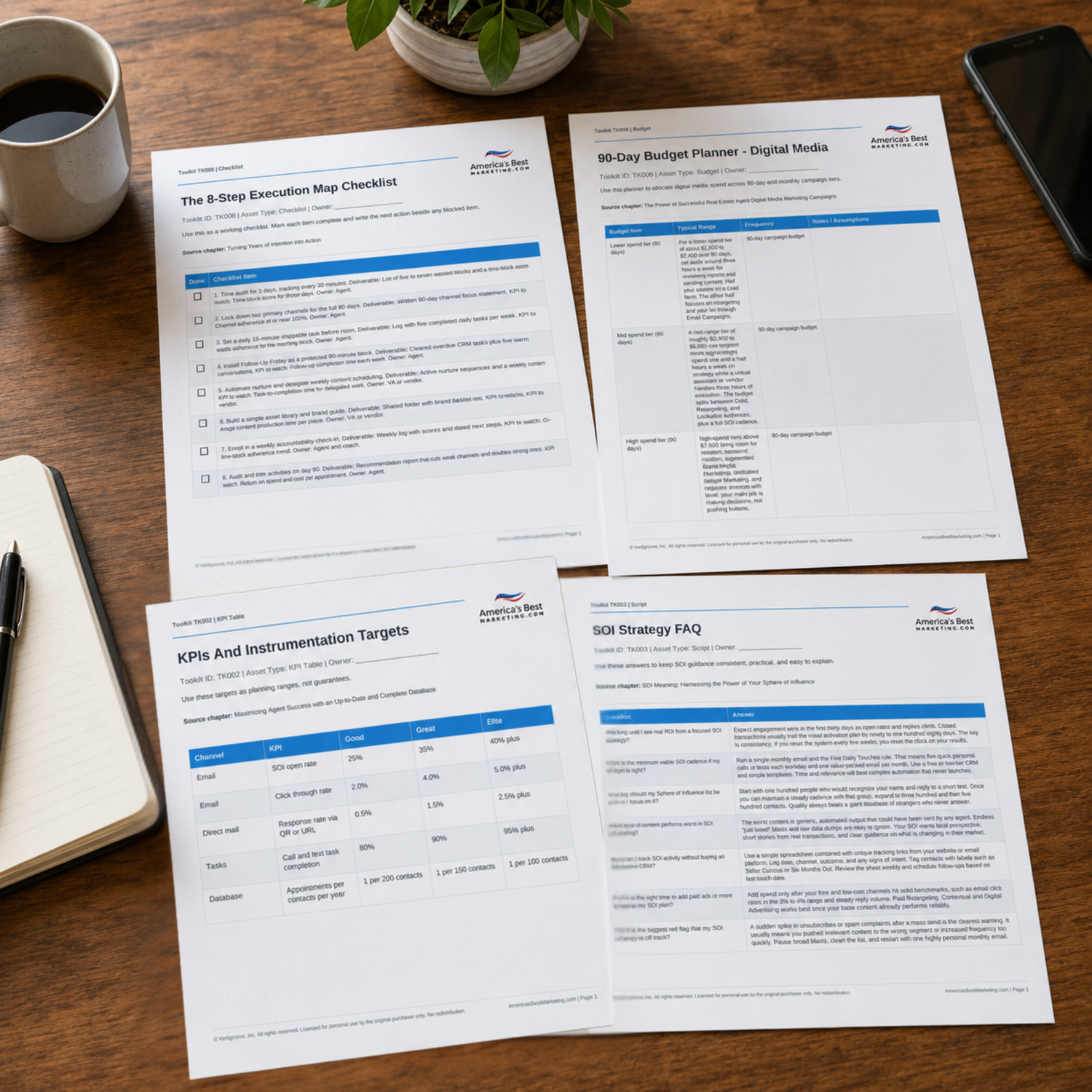
Download The Market Report Toolkit
Use the companion Toolkit to build the worksheet, KPI table, data-source checklist, planning outline, safety audit, and FAQ script behind a repeatable monthly market report cadence.
Download the Toolkit ZIPRecommended reads
Recommended Reads for Real Estate Agents
These articles help agents connect follow-up discipline, database habits, client communication, and marketing execution into a repeatable system.

Agent Spotlight Templates Real Estate Agents Can Publish Fast
Build authority with content topics that are easier to plan, promote, and connect to follow-up.
Read article
Best Real Estate Content Marketing Ideas
Turn local knowledge into searchable content buyers, sellers, and relocation prospects can actually use.
Read article
Real Estate Blogging Made Simple: How Agents Can Attract Leads and Boost Their Online Presence
Make real estate blogging easier to plan, publish, and measure as part of a weekly marketing rhythm.
Read article
REITs Explained for Real Estate Agents: Talking Points + Content Angles for Investor Clients
Build authority with content topics that are easier to plan, promote, and connect to follow-up.
Read articleHyper-Local Market Report Questions Agents Should Be Ready To Answer
How often should I publish a neighborhood market report?
Monthly is the best starting cadence because it is frequent enough to build a habit and stable enough to avoid thin data. If you have high-volume farms, add a mid-month micro update with one chart and one paragraph. Keep the flagship report consistent and use shorter posts for the rest of the month so the system stays realistic.
Where can I find data for a neighborhood without a lot of recent sales?
Widen the time window to 90 or 180 days, then lean more on active listings, pending count, price drops, and withdrawn listings. Use price-per-square-foot ranges and list-to-sale ratio when available, but label the sample size clearly. You can also add permits, school updates, and commute changes so the report still gives useful local signals.
What is the minimum viable cadence if my budget is tight?
Publish one report per month for one farm and do not skip months. Distribute it by email once, post three micro stats as social posts over the next two weeks, and keep the report pinned on your site. If you only do one paid action, run low-cost retargeting to keep report visitors coming back until they raise their hand.
How big should my target audience or farm be for these reports to work?
Pick a farm you can touch consistently and that has enough turnover to produce signals. Many agents start with 500 to 1,500 homes or one tight zip code slice with clear boundaries. If your farm is too big, the report becomes generic. If it is too small, the sales sample gets thin and the analysis starts to feel guessy.
What should I include in the first report if I am starting from zero?
Start with a five-number scoreboard: active inventory, months of inventory, median list price, pending count, and price drops. Add one short section titled what changed and one section titled what it means. End with a call to value that invites a valuation request for a specific address. Keep the whole report tight so you can publish again next month.
How do I avoid Fair Housing issues when I write neighborhood reports?
Write about housing and market behavior, not about who lives there. Avoid describing neighborhoods with demographic labels, religious references, or language that implies who a place is for. Stick to objective items like home styles, school district boundaries published by the district, commute access, amenities, and price bands. When in doubt, describe features and link to public sources.
How do I turn readers into leads without sounding salesy?
Make the call to action a useful next step that fits the data. After a price-drop section, invite an address-specific pricing check. After an inventory shift, invite a short plan call for buyers. Use one clear call to action per report and repeat it across channels so it feels normal. If you want more traction, keep a simple landing path that asks for name, email, and address.
Next step
Build the System Behind the Report
Continue from one useful article into the larger ABM ecosystem: the book series for strategic depth and the full marketing program for done-for-you execution.

View the Book Series
Explore the America’s Best Real Estate Agent Marketing System books for a deeper strategic framework around visibility, referrals, listings, lead generation, and growth.
View the Book Series
See Full Marketing Program
See how AmericasBestMarketing.com runs real estate blog writing, social media, listing marketing, email, direct mail, and retargeting as one managed system.
See Full Marketing Program