The Pros and Cons of All-Cash Offers: An Agent’s Guide to Financial Strategy
Pros and Cons of All-Cash Offers
An Agent’s Guide to Financial Strategy
A cash-offer briefing for real estate agents who want buyers and sellers to understand proof of funds, seller risk, liquidity trade-offs, and the follow-up content that turns financial clarity into better conversations.

Cash Offers Win When Proof, Terms, and Timing Match Seller Priorities
The best all-cash offer is not always the highest offer. It is the offer a seller believes will close with the least friction. Agents should verify funds, compare net proceeds, inspect contingencies, and explain opportunity cost before recommending a cash strategy to either side of the transaction.
- Cash offers create leverage when the proof of funds, closing timeline, and contingency structure are clean.
- Sellers should compare certainty, net proceeds, contingencies, and close date before assuming cash is the strongest offer.
- Buyers need to understand liquidity risk, opportunity cost, and tax or legal implications before moving too much capital into one property.
- Cash-offer education can become a useful marketing filter when agents distribute it through email, IDX, social, direct mail, and retargeting.
Why Cash Offer Strategy Pays Off
Cash offers are not magic. They are negotiation tools. A seller hears cash and thinks speed, certainty, and fewer moving parts. A buyer hears cash and thinks leverage, control, and a cleaner path through multiple offers. The agent’s job is to slow that optimism down just enough to test the offer against the facts.
Understanding the pros and cons of all-cash offers is now a client-education advantage. Cash can deliver speed, certainty, and cleaner terms, yet it can also reduce liquidity and create opportunity cost when buyers move too much capital into one property. Serious agents need a repeatable way to explain where cash creates real leverage and where financing can still compete.
Use this conversation as more than transaction advice. Package it into practical education through Email Marketing for Real Estate Agents, support buyer search on IDX Real Estate Websites, and keep useful cash-offer lessons visible with Retargeting and Contextual Ads.
- You reduce seller risk by verifying the money before recommending acceptance.
- You protect buyers from draining reserves just to feel competitive.
- You create a strong content theme that separates serious clients from casual browsers.
Build The Cash Offer Verification System
A cash offer means the buyer can close without a new purchase loan. That does not always mean the buyer has idle money sitting in a checking account. Your first job is to define what kind of cash you are looking at, how quickly it can move, and what must be proven before the seller treats the offer as secure.
Liquid funds are the cleanest form of cash. This usually means money in a bank account or brokerage account that can be converted quickly. Some buyers use hard money, bridge funds, or cash-advance structures, then refinance later. Those structures can still look strong to a seller, but they change fees, timelines, funding conditions, and the level of documentation required.
Define the funding source
Ask whether the buyer is using bank funds, brokerage funds, trust funds, business funds, hard money, bridge financing, or another liquidity source.
If the buyer will refinance later, separate the current offer strength from the future financing plan so the seller understands what is guaranteed now.
Verify access and ownership
Proof of funds needs to match the buyer name, clear the purchase price plus closing costs, and show money that can move on the contract timeline.
A vague statement is not a strategy. It is a risk signal until the owner, balance, document date, and transfer path are confirmed.
Compare risk before price
Cash can lose to financing when the financed offer has cleaner underwriting, stronger price, and better evidence that the buyer can close.
Compare net proceeds, contingencies, inspection terms, appraisal risk, title timing, close date, and the probability of re-trade before recommending a winner.
Most agents miss that an all-cash offer is often a psychology move, not only a math move. A short close and clean terms can beat a slightly higher financed price because sellers buy peace of mind. Ask what the seller fears most, then structure the offer to remove that fear first.
Three Cash Offer Scripts You Can Use Today
The best scripts make the trade-off plain without pretending to give tax, legal, or financial advice. Your job is to frame the decision, identify the unknowns, and send the client to the right licensed professional when the question moves outside brokerage guidance.
Cash versus leverage
“Cash buys certainty. Financing buys leverage. Which one are we paying for in your offer?”
Use this when a buyer wants to remove financing without thinking through reserves, liquidity, or the opportunity cost of moving money out of other investments.
Verified versus attractive
“This offer looks clean, but we should treat it as unverified until the proof of funds matches the buyer name, amount, and timeline.”
Use this when a seller is excited by the word cash but has not yet seen the evidence that the buyer can wire on time.
Education that invites replies
“If you are comparing cash against financing, the right answer depends on timing, proof, contingencies, and how much liquidity you want left after closing.”
Use this in email, short video, and direct follow-up after a buyer or seller asks whether cash is always the stronger move.
Cash Offer Education Plans You Can Repeat
Cash-offer content works when it is specific and local. A generic post that says cash is strong does nothing. A post that explains what wins in a multiple-offer situation in your market earns replies because it sounds like real guidance.
Publish one cash-versus-financing post, one proof-of-funds checklist, and one seller-focused explanation of why certainty sometimes beats a slightly higher price. Send the same idea to your list through email so the lesson does not depend on social reach alone.
Turn cash strategy into a monthly campaign across blog, email, social media, buyer follow-up, listing consultation materials, and retargeting. Tie the content to a clear call to action such as a cash-offer review, proof-of-funds checklist, or negotiation session.
Use a three-level CTA ladder so you can match the ask to the audience’s intent. Soft CTAs collect future clients. Mid-level CTAs create browsing sessions you can retarget. Hard CTAs create appointments.
- Soft: Download the cash proof-of-funds request checklist.
- Mid: View investment-ready listings and cash-friendly opportunities on your IDX site.
- Hard: Book a session to tighten offer strategy and negotiation scripts.
To streamline the publishing process, connect the workflow to Use AI to Cut 10+ Hours/Week: The Agent’s Revenue-First Tech Stack Guide. For campaign structure, review The Power of Successful Real Estate Agent Digital Media Marketing Campaigns.
Cash Versus Financing Comparison
This table is built for fast client conversations. Use it to show where cash is truly stronger, where financing can still compete, and where the buyer needs to think about long-term liquidity.
| Factor | Cash edge | Typical range | What it changes |
|---|---|---|---|
| Close time | Fewer steps to fund | 7 to 21 days | Short closes reduce seller anxiety and cut re-trade risk when proof of funds is verified. |
| Term strength | Cleaner contingencies | 0 to 2 major contingencies or buyer outs | Fewer outs can improve acceptance odds, but inspection and title details still need review. |
| Opportunity cost math | No new loan costs | 3% to 7% annual planning assumption | Shows whether speed and certainty are worth reduced liquidity and lost investment flexibility. |
Do not overpromise. Cash increases the probability of a smooth close when the offer is verified and the timeline is real. It does not guarantee acceptance. Price, terms, and seller priorities still run the show.
Compliance And Ethics When Explaining Cash
You are not a tax professional or attorney. Clients should confirm tax and legal details with a CPA and counsel. You can explain the transaction mechanics, identify the decision points, and make the trade-offs visible. You should not calculate tax consequences, draft legal strategy, or tell a client how to liquidate assets.
Cash conversations can create false confidence when the client hears speed but misses risk. Keep the distinction clear: you are testing whether the money can close the deal, whether the terms match the seller’s priorities, and whether the client understands the cost of using cash instead of financing.
- Do not treat unverified proof of funds as verified because a buyer sounds credible.
- Do not present tax, legal, lending, or investment advice as brokerage guidance.
- Do document the proof date, source type, buyer name, amount, and access assumptions.
- Do encourage buyers and sellers to get qualified tax, legal, lending, or financial advice when the question requires it.
Mini Case Pattern You Can Reuse
Agent Sarah represented a buyer who was tired of losing bidding wars on suburban homes. Sarah reframed the choice as the pros and cons of all-cash offers, then coordinated timing after the buyer, with financial-advisor input, decided to liquidate a brokerage position to make a clean cash bid with no financing contingency.
The offer came in five thousand dollars below the highest financed offer, yet the seller accepted because Sarah’s buyer could close in fourteen days and provided credible proof of funds the same day. Sarah turned that outcome into an email lesson about certainty, terms, and verification, then attracted two more cash-ready investor conversations in the same quarter.
The lesson is simple. Do not publish cash stories as brag posts. Publish them as decision frameworks that teach clients what to verify, what to compare, and when to ask for professional advice.
The 10-Point Cash Offer Verification Audit
Use this checklist before you advise a seller to sign. You are not being suspicious. You are protecting the seller’s timeline and leverage.
- Confirm proof of funds matches the buyer name on the offer.
- Confirm the stated funds exceed price plus a closing-cost buffer.
- Confirm documentation is recent enough to be credible.
- Confirm funds are accessible on the contract timeline.
- Confirm whether the source is bank, brokerage, trust, business, or another account type.
- Confirm key fields are not hidden, redacted, or missing.
- Confirm who will wire and what institution will send funds.
- Confirm title can meet the stated close date.
- Confirm what is waived, what is retained, and what deadlines remain.
- Confirm what happens if liquidation or transfer is delayed.
Cash is a strategy tool. Your edge is not telling people cash is strong. Your edge is explaining the trade-offs, verifying the funds, and structuring terms that match what the seller values most.
How This Becomes Marketing
A cash-offer system is more than a transaction aid. It is a positioning asset. It gives you a credible reason to talk about money without sounding salesy. It also creates practical content for your website, email list, direct mail program, social channels, and listing presentation.
When you publish cash strategy education, do not leave it stranded. Send one email to your list, publish one post to your feed, and send one short follow-up message to recent buyers and sellers who asked financing questions. Serious buyers and sellers often research quietly before they raise their hand. Your job is to keep the next step obvious.
If you want this education system deployed as a monthly engine, use cash content as the lead filter and let your follow-up do the heavy lifting. Build the distribution around done-for-you real estate marketing so your best explanations keep working after the call ends.
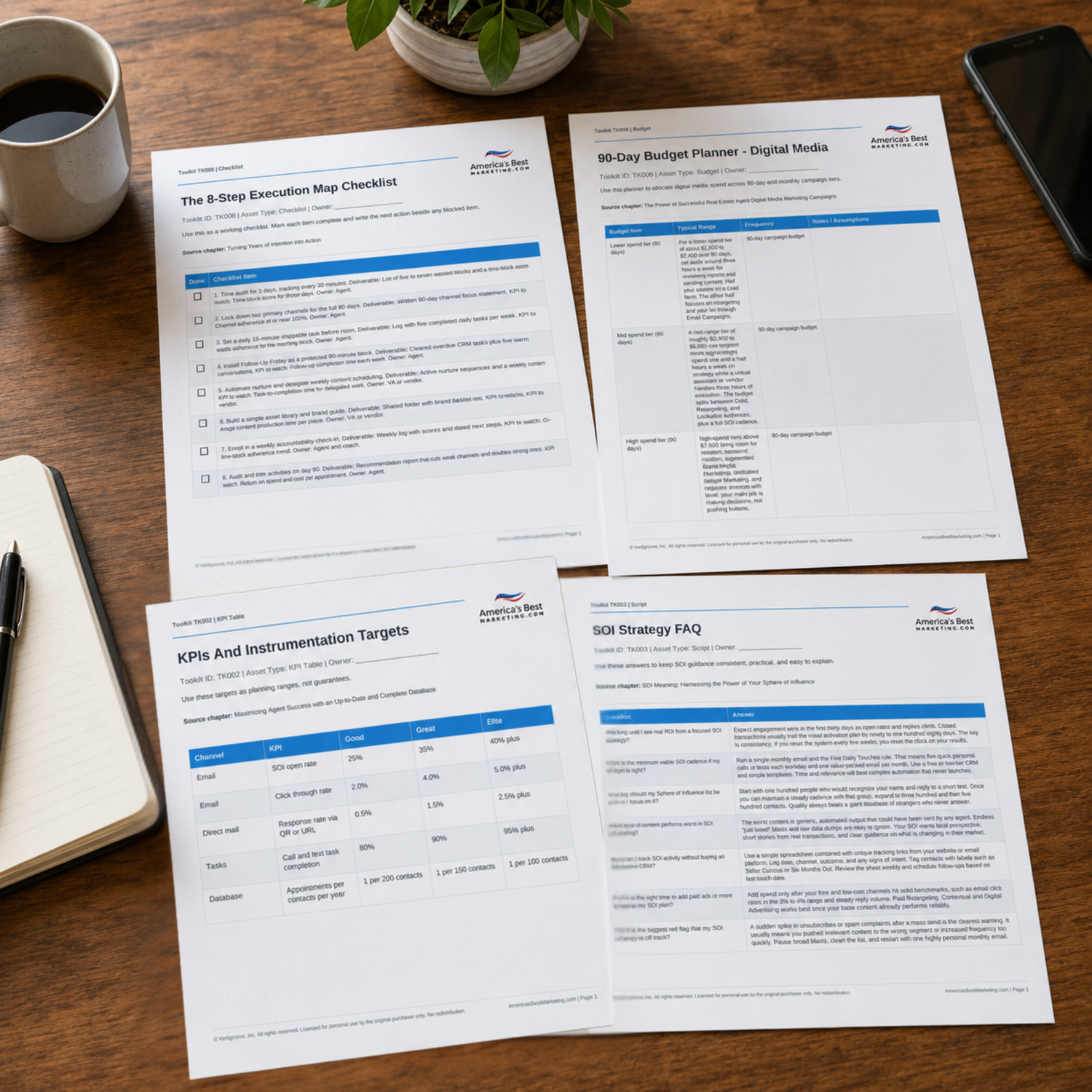
Download The Cash-Offer Verification Toolkit
Use the companion Toolkit to tighten proof-of-funds review, compare cash against conventional financing, and turn common buyer and seller questions into cleaner consultation, follow-up, and content workflows.
Download the Toolkit ZIPRecommended reads
Recommended Reads for Real Estate Agents
These articles help agents turn client questions, local guidance, marketing channels, and follow-up into a more useful content system.

Pre-Approved vs Pre-Qualified: Real Estate Agent Talking Points + Email Templates
Build a cleaner system for pre-approved vs pre-qualified, with better timing, clearer messaging, and a next step people can act on.
Read article
Winning the Rental Market: Strategies for Converting Renters into Homebuyers
Bring more structure to renter-to-buyer strategy so every touchpoint supports visibility and trust.
Read article
Building Your Personal Brand with Video Content
Use video to explain value, show proof, and stay visible without chasing every trend.
Read article
The Art of Listening: Discovery Questions Real Estate Agents Can Use to Find the Real Need
Turn scattered contacts into a workable pipeline with scripts, tags, reminders, and response routines.
Read articleCash Offer Questions Agents Should Be Ready To Answer
Is a cash offer always better for a seller?
No. Cash can reduce timeline risk and simplify terms, yet sellers still weigh net proceeds and certainty. A strong financed offer with clean underwriting can beat weak cash if the cash is unverified, the close date is unrealistic, or the price gap is meaningful.
Can you still get an appraisal with an all-cash offer?
Yes. Appraisals are optional unless a lender requires one. Some cash buyers order an appraisal for their own pricing confidence or future refinance planning. If a buyer plans to finance later, confirm with their lender what appraisal rules may apply at that stage.
What is the major red flag to avoid when accepting a cash offer?
Vague proof of funds. A screenshot with no name, an undated letter, or a statement that does not clear the purchase price is not proof. Treat it as unverified until you confirm owner name, accessible balance, and the ability to wire on the contract timeline.
Do cash offers remove inspection risk?
Not automatically. Cash removes the financing contingency, not the inspection decision. Some cash buyers waive inspections, others keep them. Review deadlines and scope, and make sure the seller understands what is waived versus what still allows a renegotiation.
How should agents explain opportunity cost without giving tax advice?
Keep it simple: cash tied up in a home cannot be used elsewhere, and selling investments can have tax implications. Explain the concept, then advise clients to confirm specifics with a CPA. Your role is to map trade-offs and timing, not to provide tax guidance.
How long does it take to see measurable ROI from financial-based content?
It depends on consistency and distribution. A practical benchmark is seeing higher-quality conversations after several sends and posts, then seeing repeat traffic from the same audience as the topic compounds. Track replies, site revisits, and consultation requests instead of chasing vanity metrics.
What should a seller do if multiple cash offers arrive?
Run the verification audit, then compare terms and close dates before price. Ask which offer has the cleanest path to wiring funds and the fewest chances to re-trade. If needed, use a short counter to tighten deadlines and confirm proof of funds in writing.
Next step
Build the System Behind the Advice
Continue from one useful article into the larger ABM ecosystem: the book series for strategic depth and the full marketing program for done-for-you execution.

View the Book Series
Explore the America’s Best Real Estate Agent Marketing System books for a deeper strategic framework around visibility, referrals, listings, lead generation, and growth.
View the Book Series
See Full Marketing Program
See how AmericasBestMarketing.com runs real estate blog writing, social media, listing marketing, email, direct mail, and retargeting as one managed system.
See Full Marketing Program