Leveraging AI in Real Estate Marketing and Automation for Lead Generation
Leveraging AI in Real Estate Marketing
Automation for Lead Generation
A practical operating brief for agents who want faster routing, cleaner follow-up, better content workflows, and human oversight at every high-stakes decision.

Where AI Creates the Most Leverage in Real Estate Marketing
AI helps real estate agents most when it improves lead routing, follow-up, lead scoring, content drafting, and reporting inside a marketing system they already trust. Start with one workflow, measure time saved and qualified appointments, and keep final judgment with a human before messages, ads, listing copy, or client advice go live.
- AI is an efficiency layer, not a substitute for strategy, clean data, local judgment, or a recognizable agent voice.
- The highest-value use cases sit inside lead scoring, routing, follow-up, call summaries, and campaign reporting.
- Automation should nurture low-intent contacts while a human handles price, timing, terms, compliance, and serious client decisions.
- Measure hours saved, response speed, qualified appointments, and cost per appointment before adding more tools or budget.
Why AI Works Best as an Efficiency Layer
AI in real estate marketing is not a magic button. It is an efficiency layer that makes a strong system run faster. The agents who win use AI to sharpen targeting, speed up follow-up, and protect their calendar. They do not use it to replace their own voice or judgment.
Most practical uses fall into two categories. Automation completes repeatable tasks such as ad bidding, confirmed appointment reminders, lead routing, and CRM updates. Augmentation helps an agent think faster by drafting subject lines, outlining articles, summarizing calls, or suggesting response options.
Both categories depend on real strategy, clean data, and a consistent multi-channel plan. Human oversight sets the targets, defines the brand voice, and decides which leads earn time on the calendar. AI becomes powerful when it keeps the agent focused on negotiation, pricing, and real conversations with real people.
- Unedited AI listing descriptions and emails tend to sound generic, which weakens trust over time.
- Predictive seller scores without disciplined follow-up become an expensive dashboard instead of a business system.
- Automated first responses without a strong Email Marketing for Real Estate Agents sequence leave cold leads without a useful next step.
- AI-generated content cannot compensate for a thin website. An IDX Real Estate Website still needs useful local pages, clear conversion paths, and consistent publishing.
- Chatbots need clear escalation rules so serious buyers and sellers reach a human when price, timing, or terms become specific.
AI should feel like a smart assistant that never sleeps, not like a stranger who borrowed your name. Wired into a working plan, it opens hours in the week, reduces manual errors, and keeps the pipeline moving while the agent is in showings or listing appointments.
The Ten-Step AI Integration Plan
The fastest route to measurable value is to layer AI onto channels that already exist in the business. Website, social content, lead capture, CRM discipline, and email follow-up come first. AI then handles repetitive work so the calendar fills with higher-intent conversations.
The most valuable use of AI sits inside behavior data, not captions. Score leads based on meaningful actions such as repeat site visits, valuation requests, saved searches, and email clicks. Until a lead crosses the behavior threshold, the system nurtures the contact instead of consuming the agent’s day.
- Harden the foundation. Confirm that the IDX website, social presence, CRM, and email platform are active. Clean tags and lead sources so every contact has a clear origin and stage. KPI: share of leads with a documented source and pipeline stage.
- Turn on predictive seller targeting. Use a seller prediction platform to rank homeowners in the farm by likelihood to list. Route the strongest segment into focused prospecting and Direct Mail Marketing. KPI: high-intent seller records generated each month.
- Use AI bidding in retargeting and contextual campaigns. Launch Digital Retargeting against site visitors and approved audience lists. Let the platform automate bidding and budget reallocation within defined guardrails. KPI: cost per qualified lead compared with the prior campaign baseline.
- Generate subject-line and preheader variants. Create several options for every core email, then test them in pairs until a clear winner appears. KPI: open-rate lift across nurture tracks.
- Score leads inside the CRM. Assign points for website visits, valuation requests, saved searches, email clicks, and other signal-rich actions. Move contacts into hot, warm, and nurture segments. KPI: appointments booked from the hot segment as a share of total appointments.
- Use AI for research and outlines, then write the final copy. Generate title ideas, question lists, and structural outlines. Add local facts, client language, and the agent’s judgment before publishing. KPI: pages earning visibility for geographic and intent-driven searches.
- Deploy a smart chatbot with a human handoff. Let the bot answer basic questions about scheduling, price range, and neighborhoods, then escalate when the visitor shows real buying or selling intent. KPI: qualified conversations booked from chatbot sessions.
- Wire high-intent signals into the daily schedule. Trigger alerts when a contact passes the lead-score threshold or repeats a meaningful action. Require same-day human outreach. KPI: speed to first human response.
- Summarize calls and update records. Use transcription and AI summaries to draft notes and next steps. Review the summary before it enters the CRM. KPI: administrative time saved per call and completeness of client records.
- Review performance every week. Inspect where the tools saved time, misread intent, or created unnecessary noise. Adjust scoring rules, prompts, and escalation thresholds. KPI: quarter-over-quarter movement in lead conversion rate.
This plan turns AI from a collection of subscriptions into a control panel. Every tool has a defined position, outcome, owner, and review cadence.
Three AI-Assisted Script Frameworks
AI works best when it creates more versions of messages that already fit the agent’s voice. Use these frameworks as structured prompts for video, email, social posts, or chatbot replies. Feed the tool the market, price band, audience, and desired next step, then edit until the final wording sounds natural across a kitchen table.
The fast listing spotlight tour
Agent dialogue
Hook lineThis is the part of the house buyers rush toward first on every showing.
Build lineYou get light, storage, and a layout that feels right from the moment you walk in.
CTA lineSend me the word spotlight and I will send you the full tour and pricing sheet.
Open with an exterior wide shot, cut to the strongest room, show storage and finishes, then close on the best wide angle with a clean call to action.
The problem-and-solution message
Agent dialogue
Hook lineTired of online leads who never answer, yet still want more closings this year?
Build lineI stopped chasing every click and started focusing on leads who showed real behavior on my site and email list.
CTA lineComment filter if you want the same scoring checklist I use inside my CRM.
Show the noisy inbox first, cut to a small group of high-score contacts, then finish with a personal call or video message that demonstrates the human follow-up.
The hidden insight from your data
Agent dialogue
Hook lineI learned something surprising from the last thousand clicks on my listings.
Build lineAI showed me that buyers who check school information and commute time first tend to book showings faster.
Reveal lineSo I now highlight that information in every tour and every email.
CTA lineMessage me the word insight and I will show you how this works for your neighborhood too.
Use a simple analytics screen, a map view, objective local information, and a final frame that invites the viewer to request a market-specific insight summary.
Production Plans and Budgets You Can Repeat
AI does not require a huge software budget. It requires a disciplined mix of managed marketing, focused tools, and human review. The goal is not to subscribe to every platform. The goal is to fund a lean stack that makes the existing system faster and more precise.
Protect one workflow
Use a managed multi-channel partner plus one AI tool such as an email subject-line assistant or basic chatbot. Spend the hour reviewing suggestions, approving campaigns, and recording one personal video that can support the nurture sequence.
Connect scoring, chat, and copy support
Fund Social Media Marketing, Listing Marketing, digital advertising, and a focused AI stack for lead scoring, chatbot handoffs, and copy support. Use the review window for high-value calls and performance decisions.
Fund one useful AI layer
Support email or chat first. Measure hours saved each week and confirm that those hours move into live client work.
Layer scoring and bidding
Add predictive scoring and AI bidding to core channels. Track how quickly high-intent leads move from first touch to appointment.
Connect the full stack
Support ads, website, CRM, reporting, and content workflows. Monitor cost per qualified appointment and document which rules drive improvement.
Tie every AI expense to time saved, appointments generated, response speed, and cost per qualified lead. When the numbers show a shorter sales cycle, scaling becomes a business decision instead of a guess.
KPI Table for AI Marketing Performance
Instrumentation matters as much as the software. Use the CRM to log lead scores, response times, touch counts, and booked appointments. Confirm that third-party tools connect cleanly to the website and email platform so the business does not create isolated data no one uses.
| Metric | Baseline | Review Cadence | Decision Rule |
|---|---|---|---|
| Lead-source coverage | Document the current share | Weekly | Do not trust predictive scoring until most active contacts have a source, stage, and recent activity record. |
| High-intent response time | Measure current median | Weekly | Require same-day human outreach when a contact crosses the behavior threshold. |
| Hot-segment appointment rate | Compare with total leads | Monthly | Raise or lower scoring thresholds when the hot segment does not materially outperform the full database. |
| Cost per qualified appointment | Compare with prior campaigns | Monthly | Scale only when appointment quality improves and acquisition cost remains sustainable. |
| Administrative time saved | Track hours before automation | Weekly | Keep the tool when saved time moves into client conversations, pricing work, or prospecting. |
| Human correction rate | Log material edits and errors | Weekly | Tighten prompts, data, or approval rules when AI repeatedly misreads intent or creates compliance risk. |
Compliance and Human Review Guardrails
Review AI-generated listing descriptions, emails, chatbot answers, and ad copy for accuracy, tone, and compliance before publication. Faster production is useful only when the final message remains factual and aligned with the agent’s obligations.
- Never use automated targeting to exclude protected groups or neighborhoods.
- Do not send automated emails or texts without the required permission and a clear operational basis for the contact.
- Keep a working unsubscribe process and honor removal requests without delay.
- Use objective local information and avoid claims about schools, safety, future appreciation, rates, or legal outcomes that the system cannot verify.
- Require a human decision for pricing, offer strategy, contract terms, escalation, and client-facing advice.
A weekly review meeting should inspect what the tools produced, where they misread intent, and which rules need adjustment. AI should accelerate the standard of care, not lower it.
The First Ninety Days
Roll out the system in controlled stages. Each month should produce a working improvement that can be measured before another layer is added.
Clean the foundation
Audit CRM tags, lead sources, pipeline stages, email permissions, website forms, and response ownership. Choose one workflow for the first automation.
Connect scoring and follow-up
Turn on behavior scoring, define the hot-lead threshold, create the nurture route, and set the human escalation rule.
Optimize and document
Compare response time, appointment quality, time saved, and correction rate. Keep what works, remove duplicate tools, and document the operating rules.
The first move is simple. Audit the CRM and note where scoring, tags, summaries, and follow-up can move from manual work to reviewed automation. Then commit to implementing one AI feature in one channel over the next thirty days.
How AI Supports the Multi-Channel Engine
AI creates leverage when it connects channels rather than creating another isolated task. Use it to identify the right audience, draft controlled variants, route responses, and report on the next action across the system.
An IDX Real Estate Website captures behavior. Email Marketing for Real Estate Agents nurtures contacts. Direct Mail Marketing reinforces local recognition. Digital Retargeting keeps the agent visible after a site visit. Social Media Marketing and Listing Marketing create proof of work. AI helps the information move between those channels with less manual friction.
Used well, AI makes serious leads easier to spot, follow-up faster to send, and client conversations more focused. The durable advantage still comes from the full marketing system and the human who makes the final call.
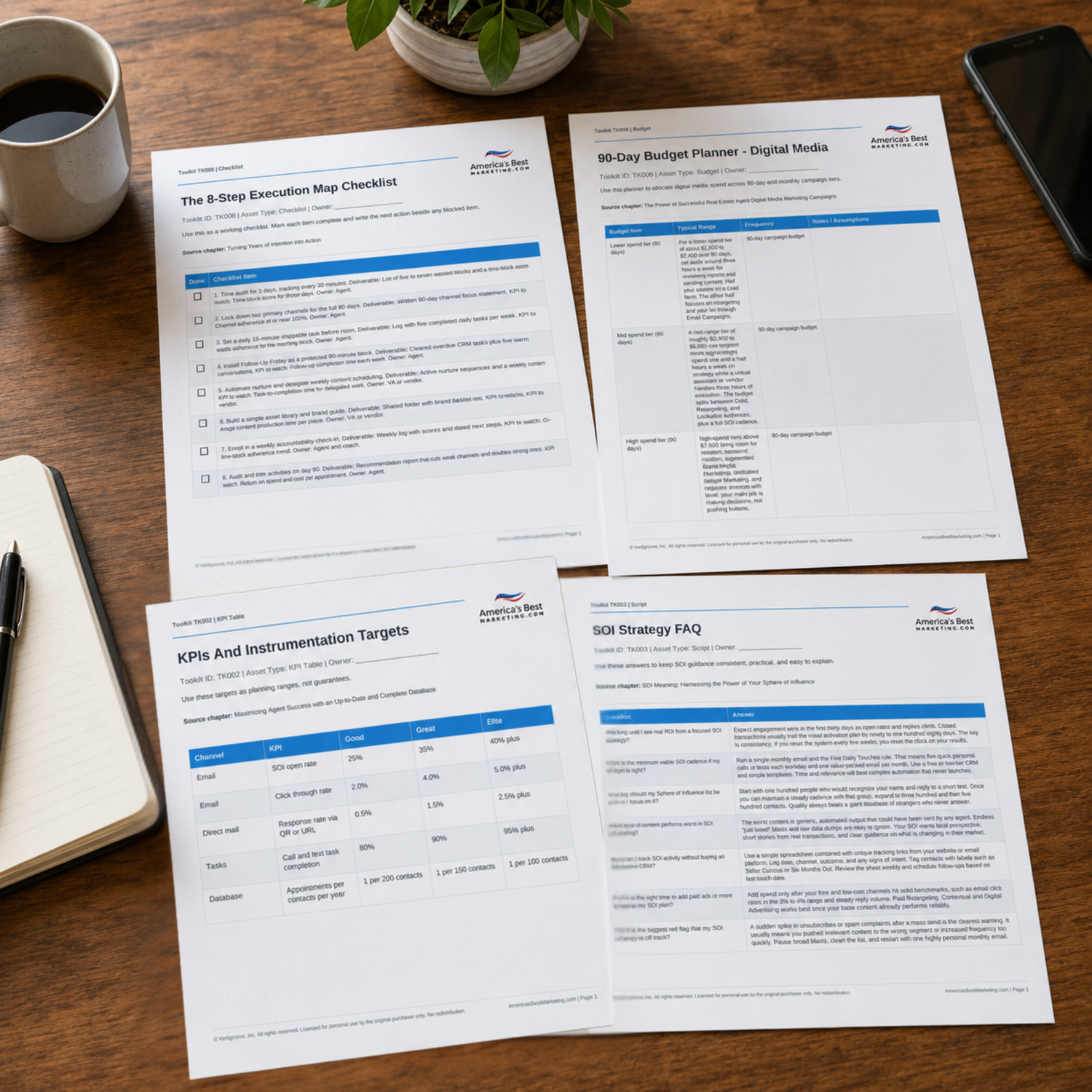
Download the AI Marketing and Automation Toolkit
Use the companion Toolkit to plan AI budget tiers, audit integrations, track KPIs, apply compliance guardrails, and turn the script frameworks into repeatable video and follow-up workflows.
Download the Toolkit ZIPRecommended reads
Recommended Reads for Real Estate Agents
These articles help agents connect follow-up discipline, database habits, client communication, and marketing execution into a repeatable system.

AI Beyond Lead Generation: Using AI to Boost Real Estate Agent Productivity
Turn automation into cleaner workflows for content, follow-up, and weekly execution.
Read article
AI for Real Estate SEO: What to Automate, What to Avoid, and How to Measure Impact
Turn search visibility into a clearer publishing system for neighborhoods, services, and client decisions.
Read article
Leveraging Hyper-Local SEO for Real Estate Success
Make hyper-local SEO for real estate success easier to plan, publish, and measure as part of a weekly marketing rhythm.
Read article
AI Chatbots for Real Estate Agents: Best Use Cases, Setup Checklist, and Compliance Guardrails
Adopt AI where it reduces friction, not where it weakens trust or adds noise.
Read articleAI Marketing Questions Real Estate Agents Ask
How long does it take to see ROI from AI marketing tools?
Most agents see early signs within the first thirty days when AI controls ad bidding or basic lead routing. The bigger payoff shows up once your full sales cycle completes, usually inside a ninety day window. That is when you can compare cost per lead, cost per appointment, and time saved against your previous baseline.
What is the minimum viable setup for AI on a tight budget?
Start with one high-impact tool that plugs into a channel you already own. A smart chatbot on your IDX site or an AI subject line assistant linked to Email Marketing for Real Estate Agents often delivers the fastest return. Keep the rest of your system simple until that first tool is clearly paying for itself in time or appointments.
How large should my farm or audience be for predictive AI to work?
Predictive AI performs best when it has enough records and activity signals to study. Larger direct mail lists and digital farms usually give the model more variation to spot patterns. Smaller lists can still benefit, but the scores should be treated as directional until your own results prove the signal.
What type of content tends to perform worst with AI tools?
The weakest content is usually unedited AI text that could describe any city, any listing, or any agent. It might be factually correct yet still feel lifeless because it ignores local details and your story. AI in real estate marketing should handle structure and speed while you add the human details that make clients trust you.
How can I track the value of AI without advanced dashboards?
Start by tracking time. Log how long you used to spend writing listings, pulling lists, or sending follow-ups, then compare that number after AI support. Next, track two simple outcome numbers each month: appointments set and new clients signed. If those rise while your hours drop, AI is doing its job.
When should I increase my spend on AI and automation tools?
Scale spend once your AI-driven lead scoring or ad optimization consistently flags prospects who actually meet, sign, and close with you. Look for a clear improvement in appointment quality, response speed, and cost per appointment before adding more tools or budget. At that point, extra spend fuels a proven engine instead of another experiment.
What is the biggest red flag when choosing AI partners?
A major warning sign is any company that claims its AI replaces the need for social media, email marketing, or human follow-up. AI in real estate marketing should run inside a multi-channel plan, not pretend to be the entire plan. If the pitch sounds like magic, walk away.
Next step
Build the System Behind the Automation
Continue from one useful article into the larger ABM ecosystem: the book series for strategic depth and the full marketing program for done-for-you execution.

View the Book Series
Explore the America’s Best Real Estate Agent Marketing System books for a deeper strategic framework around visibility, referrals, listings, lead generation, and growth.
View the Book Series
See Full Marketing Program
See how AmericasBestMarketing.com runs real estate blog writing, social media, listing marketing, email, direct mail, and retargeting as one managed system.
See Full Marketing Program