What the Best Real Estate Marketing Companies Do Differently
What the Best Marketing Companies Do Differently
For Real Estate Agents
A practical operating standard for comparing strategy, production, channel coordination, reporting, and follow-up before you trust a company with your growth.

The Best Companies Operate One Coordinated Marketing System
The best real estate marketing companies connect audience strategy, message development, weekly production, channel distribution, lead routing, and reporting into one repeatable operating cadence. They do not sell isolated posts or disconnected campaigns. They show what will publish, who it targets, what offer it supports, how responses are handled, and which business outcomes will be measured.
- Strong marketing partners begin with a business goal and a defined audience, not a random deliverables list.
- Every channel should reinforce the same message and move the prospect toward one clear next step.
- A useful scorecard connects visibility and engagement to conversations, appointments, and signed clients.
- The right company owns production and improvement so the agent is not forced to become the project manager.
The Core Difference Is Operator, Not Order Taker
Most agents do not need a larger collection of tools. They need a partner who can translate a growth goal into weekly execution without handing the work back to the agent. That is the difference between a real marketing operator and a task vendor.
A generalist agency may understand design and advertising but miss the nuance of listings, local proof, referral databases, farming, and seller timing. A freelancer may create strong assets but wait for the agent to decide what to publish and when. A software platform can report clicks but will not build the monthly rhythm. The best real estate marketing companies combine strategy, production, distribution, and reporting into one operating cadence.
Choose a focused market
They select a real farm, database segment, buyer group, or seller audience that can be reached often enough to build recognition. One focused audience creates stronger learning than one weak message spread everywhere.
Plan the month before it starts
They know what will publish across social, email, direct mail, web, and advertising before the agent becomes busy. The system keeps moving because the production calendar is already defined.
Measure pipeline outcomes
They track leading indicators and real business movement, not screenshots from disconnected dashboards. The report should connect activity to inquiries, conversations, appointments, and signed clients.
Ask the company to show what will publish, who it targets, what offer it supports, and how it will be measured. A vague answer usually means you are buying tasks instead of an operating system.
Build One Marketing System Instead Of Random Campaigns
A useful partner maps the pipeline from first impression to live conversation. Each channel gets a defined job. Social Media Marketing keeps expertise visible. Email Marketing for Real Estate Agents warms people who already know the agent. Direct Mail Marketing gives a farm or database a tangible reminder. IDX Real Estate Websites provide a clear destination, and Digital Retargeting keeps warm prospects from disappearing after one visit.
The sequence below is the practical operating plan stronger companies use during the first 90 days.
- Clarify one growth priority. Decide whether the first push is listing appointments, database reactivation, relocation buyers, move-up buyers, or farm visibility.
- Choose the primary audience. Select a farm, database segment, or lead pool that can be reached with enough frequency to create recognition.
- Define one or two core offers. Use specific offers such as home value reviews, listing preparation calls, move planning checklists, or local market briefings.
- Lock the weekly social rhythm. Publish education, proof, local insight, and calls to action on a schedule that does not depend on the agent remembering.
- Send email with a purpose. Use market stories, useful prompts, and direct response opportunities instead of filler newsletters.
- Use mail as a physical anchor. Make the direct mail piece support the same campaign theme and audience rather than acting as a one-time postcard.
- Connect the website and IDX path. Give every campaign a specific landing point and a clear inquiry action.
- Retarget warm behavior. Reinforce the message for people who visit, click, or engage but do not respond immediately.
- Review one scorecard monthly. Track activity, response, conversations, appointments, and business outcomes in one place.
- Improve from real signals. Adjust subject lines, hooks, offers, and audience segments based on behavior rather than preference.
How To Interview And Compare Marketing Companies
A polished portfolio proves creative capability. It does not prove that a company can run the week-to-week system your business needs. Make the interview operational and ask the company to walk through the first 90 days in order.
Force the operating model into the open
- What happens first? The answer should begin with the business goal and audience.
- Who owns production? Identify who writes, designs, schedules, sends, tracks, and adjusts the work.
- How do the channels connect? Social, email, mail, web, and ads should reinforce one message.
- What does the scorecard include? Look for a bridge from impressions and clicks to conversations and appointments.
- What will you stop doing? Strong operators cut weak offers, tired hooks, and low-value tasks when the data is clear.
Look beyond the portfolio
- A 90-day calendar with audiences, offers, channels, and owners.
- A sample monthly report that includes pipeline outcomes.
- A clear approval process that does not make the agent rebuild every asset.
- Examples of how one message was adapted across several channels.
- A response workflow showing what happens when a prospect replies or submits a form.
For a deeper evaluation framework, review How to Choose the Right Marketing Company for Real Estate Agents. The distinction is simple: a vendor completes assignments, while an operator protects the rhythm and improves the system.
Messaging Must Sound Local, Specific, And Useful
Real estate marketing fails when it could belong to any agent in any city. Strong companies turn market knowledge, listing processes, client stories, and neighborhood patterns into repeatable content. The goal is not cleverness. The goal is to make a homeowner, buyer, or past client recognize that the agent understands the situation.
The strongest creative systems separate content into four lanes: education, proof, local insight, and action.
Answer a real question
Example: Three pricing mistakes that make a good listing look stale.
Show how the work gets done
Example: How we prepare a listing before the sign goes in the yard.
Demonstrate market context
Example: Why two nearby streets can produce different buyer behavior.
Give the reader a next step
Example: Reply with VALUE and request a custom review of your current position.
Those messages can appear on social, inside email, in direct mail, on landing pages, and in retargeting creative. A specialist partner keeps the language aligned so each channel reinforces the others.
Three Campaign Systems Strong Companies Can Run
The Listing Launch Sprint
Purpose and execution
Campaign goalCoordinate attention across social, email, direct mail, and retargeting instead of relying on the MLS alone.
Core assetsUse social teasers, property story posts, one database email, and a direct mail piece for the farm or nearby owners.
Operating ruleScript, design, schedule, and track the launch from one brief so every listing follows the same professional rhythm.
Connect the launch to Listing Marketing so every property also becomes proof for the next listing conversation.
The Database Nurture Series
Purpose and execution
Campaign goalTurn past clients, sphere contacts, and quiet leads into warmer conversations with useful market stories and simple action prompts.
Core assetsSend a monthly equity or market story email, publish a short companion post, and retarget people who click or visit.
Operating ruleRoute replies into a defined follow-up process so interest becomes a live conversation instead of an unread notification.
The marketing company keeps the campaign moving while the agent focuses on the conversations only the agent can have.
The Local Expert Campaign
Purpose and execution
Campaign goalProve that the agent’s advice goes beyond generic city averages by showing street-level context and decision guidance.
Core assetsPublish local education posts, route readers to a focused IDX or inquiry page, and send a follow-up email with one clear next step.
Operating ruleMake the offer specific enough that a serious owner or buyer knows exactly what to request.
The campaign should produce a direct conversation, not just a passive page view.
Budget And KPI Plans You Can Actually Manage
Budget should be tied to work, frequency, and expected learning. Strong companies explain what they will run, how often it will run, and what the first 90 days are designed to prove. A starter plan creates baseline visibility. A growth plan increases reach and response from one or two audiences. A larger plan should scale only after the agent can handle more opportunity.
Build consistency before complexity
Use consistent weekly visibility, one useful email touch, light direct mail, and basic listing support without overbuilding the channel mix.
Increase frequency around proven audiences
Expand social, email, direct mail, and retargeting after the first campaign cycle shows which messages create quality conversations.
| Tier | Plan Focus | 90-Day Spend | Key Outcome |
|---|---|---|---|
| Starter system | Prove one clear pipeline with simple creative. | $1,800 to $3,000 | Baseline engagement across social, email, and mail plus early listing or buyer conversations from warm leads. |
| Growth system | Increase volume from one or two core audiences. | $3,000 to $6,000 | Noticeable lift in branded impressions, campaign replies, and booked appointments from the farm and database. |
| Aggressive scale | Enter new segments with higher frequency. | $6,000 to $12,000 | High market visibility and clearer data on which offers generate the most profitable conversations. |
Reporting should be readable in one sitting. Watch social reach and link clicks, email opens and replies, website form fills, search alerts, direct mail response timing, and cost per lead. More importantly, track which activity leads to appointments and signed clients.
Compliance And Ethics Belong Inside The System
A serious marketing partner protects the brand and the risk profile. Fair housing, email compliance, data hygiene, and advertising platform rules should be reviewed before creative goes live.
- Fair housing awareness: Avoid language or targeting that implies preference, limitation, or exclusion around protected classes.
- Email compliance: Use clear sender information, unsubscribe access, and responsible list hygiene.
- Data quality: Work from clean lists and avoid purchased cold lists with no permission trail.
- Platform rules: Respect special advertising category limitations and avoid targeting shortcuts that create account risk.
What A Specialist-Led First Quarter Can Look Like
Imagine an agent who closes steady business but has no consistent marketing rhythm. A specialist partner chooses one farm, one database segment, and one listing-focused offer. Over 90 days the agent publishes weekly education and proof content, sends four useful emails, mails two clean pieces to the same audience, and retargets people who click or visit.
The win is not more activity for its own sake. The win is a repeatable system the company can keep running while the agent stays focused on conversations and appointments. That is the standard a strong marketing company should be able to explain before the engagement begins.
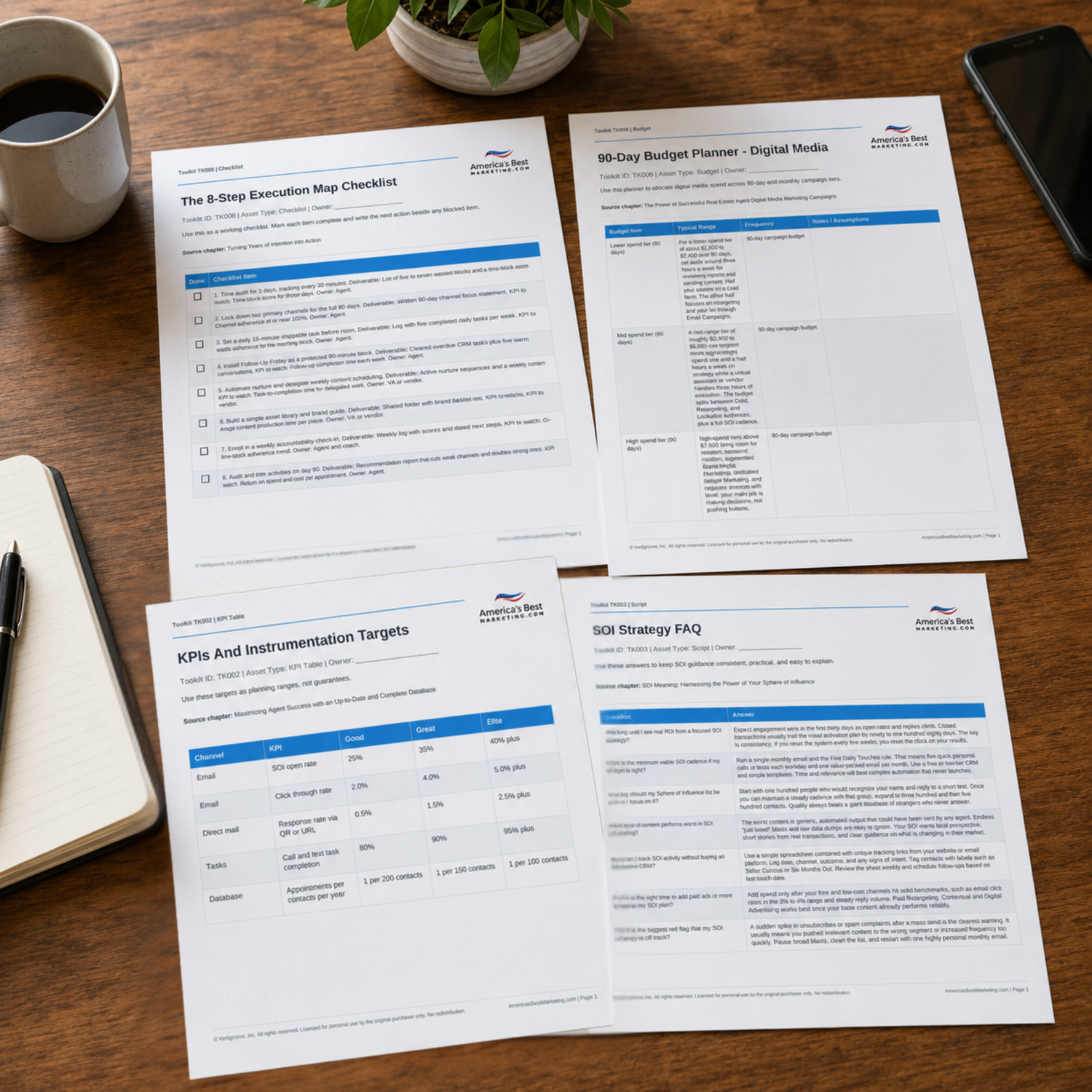
Download The Marketing Company Evaluation Toolkit
Use the companion Toolkit to compare specialist partners, map a 90-day channel plan, set practical budget and KPI targets, and organize listing launch, database nurture, and local expert campaign execution.
Download the Toolkit ZIPRecommended reads
Recommended Reads for Real Estate Agents
These articles help agents connect follow-up discipline, database habits, client communication, and marketing execution into a repeatable system.

Done-for-You Real Estate Marketing: What It Is & Why It Works
Make done-for-you real estate marketing easier to plan, publish, and measure as part of a weekly marketing rhythm.
Read article
How to Choose the Right Real Estate Agent
Make “How to choose the right real estate agent” more useful by turning the topic into a clear buyer-and-seller education resource with a defined audience, message, and next step.
Read article
Real Estate Agent Video Marketing: Boost Conversions and Engage Clients with Effective Videos
Create video content with clearer scripts, simpler formats, and a cadence agents can actually maintain.
Read article
Best Real Estate Lead Generation Companies for Real Estate Agents
Make real estate lead generation companies more useful by tying the message, audience, and next step together.
Read articleQuestions To Ask Before Hiring A Real Estate Marketing Company
How long does it take to see results from a real estate marketing company?
Most agents should look for leading indicators within 60 to 90 days: stronger engagement, more replies, more website activity, and better conversations from the target audience. Closed business can take longer because real estate decisions depend on timing, inventory, pricing, and follow-up.
What should a marketing company handle for a real estate agent?
A strong partner should help with strategy, content, email, direct mail, website or IDX routing, retargeting, reporting, and campaign improvement. The key is not the number of services. The key is whether those services operate as one coordinated system.
What is the minimum useful marketing cadence if my budget is tight?
Start with weekly social content, one useful email per month, a focused direct mail rhythm, and a clear landing or inquiry path. Consistency matters more than a large channel list. A smaller plan that runs every week usually beats a larger plan that starts and stops.
How should I compare real estate marketing companies?
Ask each company to explain the audience, campaign cadence, channel mix, offer, reporting scorecard, and follow-up path for the first 90 days. If they cannot show how the pieces connect, you may be buying tasks instead of an operating system.
What content performs worst for real estate agents?
Generic tips, vague market quotes, and template graphics tend to underperform because they do not prove local expertise. Stronger content is specific to your market, your listings, your client questions, and the decisions buyers and sellers are actually making.
When should I increase my marketing budget?
Increase budget once the system shows a clear relationship between activity and quality conversations. If a 90-day cycle creates appointments and you have the capacity to follow up well, scaling frequency or audience size can make sense.
What is the biggest red flag when hiring a marketing company?
The biggest red flag is a promise of easy results without a clear operating plan. Serious companies talk about audience, cadence, offers, compliance, reporting, and improvement. They do not rely on mystery tactics or vague claims.
Next step
Build The System Behind Your Growth
Continue from one evaluation framework into the larger AmericasBestMarketing.com ecosystem: the book series for strategic depth and the full marketing program for done-for-you execution.

View the Book Series
Explore the America’s Best Real Estate Agent Marketing System books for a deeper strategic framework around visibility, referrals, listings, lead generation, and growth.
View the Book Series
See Full Marketing Program
See how AmericasBestMarketing.com runs real estate blog writing, social media, listing marketing, email, direct mail, and retargeting as one managed system.
See Full Marketing Program