How To Choose The Right Real Estate Marketing Company As A True Partner
Choose the Right Real Estate Marketing Company
A three-phase vetting plan for real estate agents
Compare strategy, execution, budget, reporting, and data ownership before you trust a marketing company with your pipeline.

What The Right Marketing Partner Should Deliver
Choose a real estate marketing company that can connect your audience, message, channels, budget, follow-up, and reporting into one accountable system. The right partner should understand your market, protect your time, preserve your data ownership, and show how marketing activity becomes qualified conversations, appointments, referrals, and listing opportunities.
- A vendor sells activity. A marketing partner builds a system around pipeline goals, sales cycle, and follow-up.
- Run a qualification audit before the proposal stage, then pressure-test strategy, reporting, and ownership before signing.
- Judge the relationship through a ninety day launch window with clear milestones, decision metrics, and shared responsibilities.
- Protect your brand, logins, contact lists, pixels, audiences, creative files, and lead data before the first campaign goes live.
Why Agents Need A Marketing Partner Instead Of A Vendor
Choosing the right real estate marketing company is not about finding the prettiest posts or the cheapest monthly package. It is about finding a partner that understands your market, protects your time, connects channels, and can explain how marketing activity turns into qualified conversations.
A vendor sells activity. A partner builds a system. Most agents do not need more disconnected tasks. They need marketing that supports listings, database follow-up, local visibility, lead capture, and appointment setting without forcing the agent to become the project manager.
A strong partner starts by learning your price range, lead sources, team structure, follow-up habits, database quality, listing flow, and market position. Their questions should feel operational, not decorative. They should want to know where business is already coming from, where opportunity is leaking, and which channels can realistically move the pipeline in the next ninety days.
- Vendors talk first about posts, templates, and platforms. Partners talk first about sales cycle, pipeline gaps, and measurable outcomes.
- Vendors avoid responsibility when results are soft. Partners review the data and recommend specific adjustments.
- Vendors compete on price and volume. Partners compete on strategy, reporting cadence, and fit with your business model.
- Vendors push long commitments before proof. Partners earn trust by making each ninety day cycle clearer than the last.
Study the operating model in Done-for-You Real Estate Marketing: What It Is & Why It Works before you compare providers. It gives you a practical baseline for what a real partnership should take off your plate.
Run A Qualification Audit Before You Request A Proposal
The first filter is simple: remove agencies that only dabble in real estate. You want a team that understands listings, seller appointments, database marketing, lead response, IDX websites, direct mail, email, retargeting, and the way buyers and sellers actually choose an agent.
A good qualification call should feel similar to the questions in The Top 7 Things to Look For in a Real Estate Marketing Program. You are not asking for a sales pitch. You are looking for proof of process.
- Ask what share of current clients are solo agents, teams, and brokerages, and which group the company serves best.
- Request examples of integrated campaigns that supported listings, buyers, and sphere at the same time.
- Confirm which services the company executes directly, including Social Media Marketing, Email Marketing for Real Estate Agents, Direct Mail Marketing, Digital Retargeting, and IDX Real Estate Websites.
- Ask whether you get a named strategist who stays with the account through launch and review.
- Request references from agents with similar price ranges, market conditions, and production levels.
- Ask what the company considers a realistic minimum budget and what it would refuse to attempt below that number.
- Confirm how your brand voice will stay consistent across emails, social posts, listing promotions, and mailers.
- Ask who owns your logins, pixel data, contact lists, ad audiences, website leads, and creative files if you leave.
- Ask which metrics the team watches weekly and which ones require a longer ninety day review window.
- End with one fit question: What concerns would you have about working with me based on what you heard today?
The biggest mistake agents make is judging a marketing company by surface activity counts. Ten posts, two emails, and a flyer do not matter unless they support one pipeline goal. Ask how every channel connects to qualified leads, appointments, referrals, listing conversations, or database engagement.
Pressure-Test Strategy Alignment Before You Sign
Once a company passes the first filter, pressure-test how the team thinks. You are looking for a partner that can connect audience, offer, message, channel, budget, and follow-up. If the company cannot explain that sequence in plain English, execution will get messy fast.
Goals And Fit
Questions to ask
ProcessWalk me through a recent campaign for a solo agent from first idea to final report.
IntegrationHow did social, email, the website, and follow-up work together?
LaunchWhat would my first thirty days look like from your side and from mine?
Listen for a clear discovery, build, launch, and review process, plus a written recap that names goals, channels, owners, and first milestones.
Offers, Funnels, And Budget
Questions to ask
OfferWhich offers usually work best for agents at my price point and in my market?
ChannelsHow would you pair social media, direct mail, and a lead capture page?
BudgetShow me a starter and mid-range budget and what you would include or exclude.
Listen for budget ranges tied to a goal, honesty when a paid tactic needs more spend, and a simple funnel map that you can understand on one page.
Reporting And Improvement
Questions to ask
ReportShow me a sample monthly report and walk me through it line by line.
MetricsWhich metrics should I watch, and which stay in your internal dashboard?
ResponseDescribe a time results were soft and what changed in the next cycle.
Listen for a small set of decision-making numbers, clear next steps for both sides, and a repeatable rhythm for stopping, adjusting, or scaling tactics.
Vet Creative By The Decision It Should Produce
Creative review is where many agents default to personal taste. You like the design or you do not, and the decision ends there. A better test asks whether the company can explain why a headline, subject line, caption, or offer should move the right prospect to the next step.
Make the audience and problem specific
Ask for three subject lines written for your database and have the team explain why each should earn attention from the intended audience.
Change the message by relationship
Past clients, farm prospects, online leads, and active buyers should not receive the same copy. The partner should show how tone and next steps change by audience.
Use performance to improve the next version
Ask for an example where the team rewrote a headline or offer because response data showed that the first version was weak.
Keep every channel recognizably yours
Listing Marketing, social media, email, and direct mail should sound like one business, not four unrelated vendors.
Also look for call-to-action discipline. Soft calls invite value steps such as a market update, seller guide, or local checklist. Mid-level calls invite warm actions such as requesting a home value range or answering a short survey. Hard calls invite direct appointments. A smart partner knows when each level belongs in the funnel.
Match The Service Tier To Your Budget And Calendar
Your budget and calendar are the two hard constraints in any marketing relationship. A serious company will tell you what can work at each level and where your expectations need to change.
Expect roughly five hundred to nine hundred dollars per month. This level usually supports social media, email campaigns to your database, and light listing marketing support. Plan on regular approvals and a short check-in so you can report what happened with calls, replies, showings, and appointments.
Expect roughly one thousand two hundred to two thousand five hundred dollars per month. The plan may add direct mail, retargeting, contextual advertising, landing pages, and IDX support. Strategy and reporting should become more structured at this level.
Higher investment tiers above three thousand dollars per month usually fit teams, higher price points, or markets where paid media and direct mail require more volume. At that level, the company should reduce your execution burden, not create more management work.
Judge The First Ninety Days By Milestones
The first ninety days are not about perfection. They are about proving that the company can launch, measure, and adjust while you keep pace with follow-up. If a proposal cannot explain this window clearly, it is not ready for your budget.
| Phase | What Happens | Timing | Success Signal |
|---|---|---|---|
| Week one | Brand intake, goal setting, offer selection, and channel planning. | Day one to seven | You leave with a one-page plan that lists channels, budget, assets, and task owners. |
| Weeks two to six | Build and launch campaigns across social, email, website, direct mail, or ads where needed. | Weeks two to six | Core assets go live, tracking is checked, and every lead source has a follow-up path. |
| Weeks seven to twelve | Review performance, tune creative, and shift budget toward the strongest opportunities. | Weeks seven to twelve | You can identify which sources produced conversations, replies, appointments, or useful pipeline movement. |
Track Decisions, Not Decorative Metrics
After launch, accountability lives in the numbers. A reliable real estate marketing company does not hide behind impressions, likes, or vague awareness. The team translates activity into decisions.
Track cost per qualified lead, lead-to-appointment rate, source of each conversation, database engagement, website conversion rate, response time, and listing appointment volume. A simple dashboard is enough if it shows spend, leads, appointments, creative tests, and next actions by month.
Marketing cannot fix every sales issue. Slow response, weak follow-up, poor offer clarity, or an outdated database can make good campaigns look weak. A strong partner will say that directly and help you close the operational gaps.
Every monthly report should answer four questions: What moved, why did it move, what will change next, and who owns the next action?
Protect Compliance, Ethics, And Data Ownership
Real estate marketing lives under real rules. Any partner you hire should understand Fair Housing risk in ad copy, targeting, imagery, and audience selection. The team should avoid demographic shortcuts and keep language neutral around protected characteristics.
Data ownership is just as important. Confirm where contact information, website leads, ad audiences, tracking pixels, forms, creative files, and campaign history will live. With IDX websites, make sure leads flow into a system you actually use. Your brand, database, and lead data are long-term business assets, not vendor leverage.
- Your business should control primary logins, domains, contact lists, pixels, and advertising accounts.
- Your agreement should explain what files and campaign history you retain if the relationship ends.
- Your partner should document compliance review, audience rules, approval responsibility, and record retention.
One Agent, Ninety Days, Better Control
Consider an agent who closes steady business but feels trapped by random peaks and valleys in the pipeline. She chooses a marketing partner only after comparing process, budget fit, reporting, data ownership, and first ninety day milestones. Instead of asking for more activity, she asks for one coordinated system: SEO content, email marketing, direct mail to a priority farm, and a clean follow-up path for every lead.
The first win is not a miracle spike. It is control. By the end of the first cycle, she can see which channel created each qualified conversation, which offers earned replies, and which weak tactics should be trimmed before more money is spent. That is the standard to demand from a real estate marketing company.
The Bottom Line
A real estate marketing company should feel like an experienced operations partner, not a creative hobbyist. Use the three phases in this brief to filter vendors, run structured strategy calls, and stage a ninety day launch that proves how the team thinks and executes.
Before you decide, write down your primary goal for the next ninety days and list five non-negotiable services you expect a partner to handle. Then compare your short list with Full-Service vs DIY Marketing: What Works in Real Estate so you know which work belongs with a partner and which work should stay on your desk.
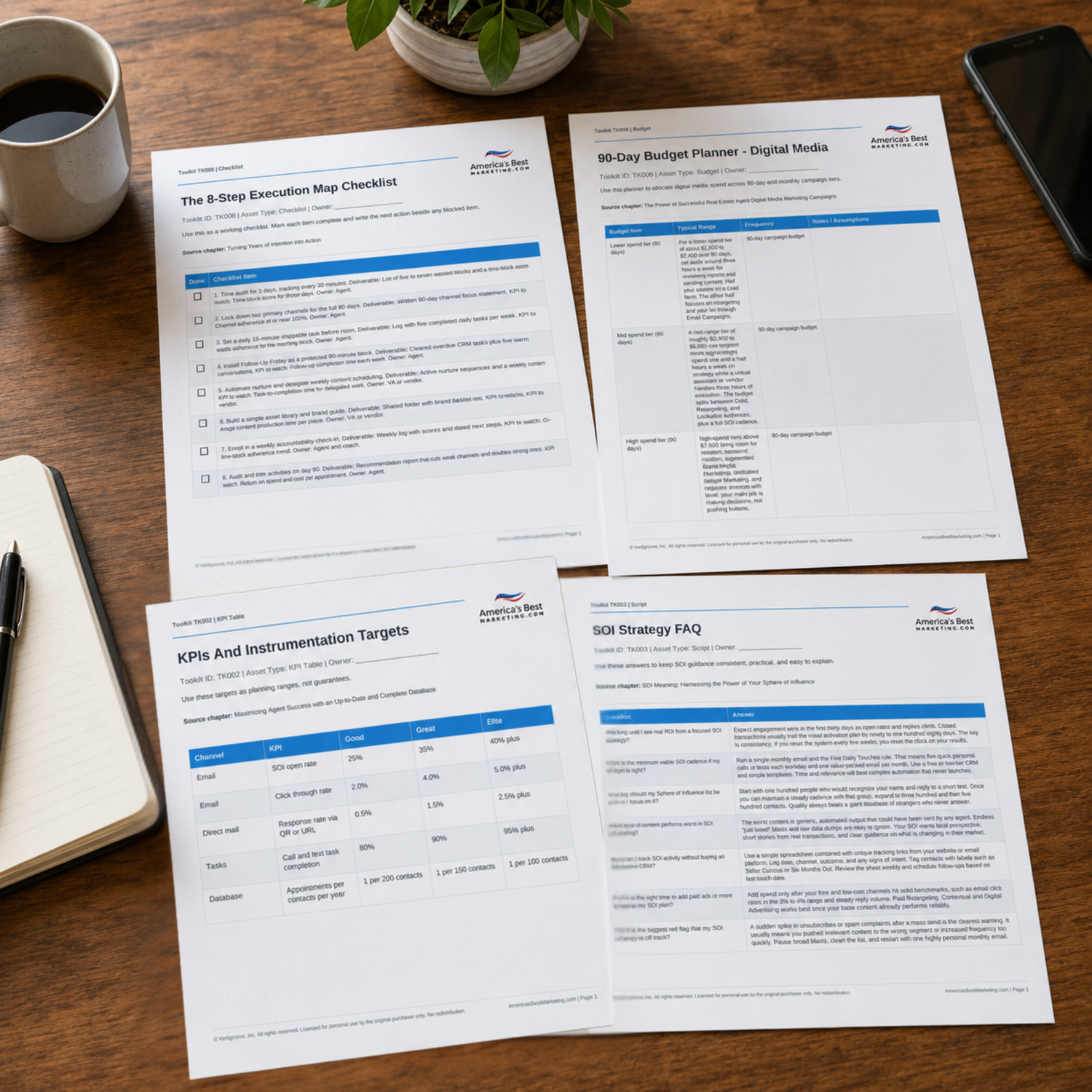
Download The Marketing Partner Vetting Toolkit
Use the companion worksheets to compare qualification standards, budget tiers, strategy calls, creative samples, reporting expectations, data ownership, and the first ninety days with a new marketing partner.
Download the Toolkit ZIPRecommended Reads for Real Estate Agents
These articles help agents connect follow-up discipline, database habits, client communication, and marketing execution into a repeatable system.

The Best Real Estate Marketing Agency: Why Real Estate Agents Choose AmericasBestMarketing.com
Bring more structure to the best real estate marketing agency so every touchpoint supports visibility and trust.
Read article
How to Choose the Right Real Estate Agent
Make “How to choose the right real estate agent” more useful by turning the topic into a clear buyer-and-seller education resource with a defined audience, message, and next step.
Read article
Short-Form Video Marketing for Real Estate Agents: Strategy + Calendar
Give short-form video marketing a clearer role in the marketing system instead of treating the work as a one-off idea.
Read article
Best Marketing for Real Estate Agents: Strategies That Actually Work
Use marketing strategy to strengthen visibility, follow-up, and client conversations without adding more random tasks.
Read articleQuestions To Ask Before You Hire A Marketing Company
How long should I commit to a marketing company before I judge results?
Plan on at least one ninety day cycle before making a major decision. The first month is usually setup, the second month shows early performance, and the third month gives you a more useful pattern. You should still expect communication, launch progress, and cleaner reporting much sooner.
What is the minimum viable budget for full service help?
In many markets, a serious starting point is roughly five hundred to nine hundred dollars per month for social, email, and light listing support. If you want direct mail, landing pages, retargeting, contextual ads, or broader execution, expect the budget to rise.
Should I pick a general agency or a real estate specialist?
A real estate specialist usually ramps faster because the team already understands listings, referrals, local lead sources, database marketing, and common seller objections. A general agency can still work, but it needs strong direct response skill and a willingness to learn your sales process quickly.
What is the biggest red flag on an initial strategy call?
The biggest red flag is a company that talks only about design, posting frequency, or content volume and never asks about your sales process. Another warning sign is pressure to sign a long agreement before you see a clear ninety day plan.
How can I track results without advanced tools?
Use tagged links in emails, ask every new lead how they found you, and log each lead source in your CRM or spreadsheet. Compare monthly spend by channel against qualified conversations and appointments. The goal is not perfect attribution. The goal is better decisions.
When should I consider switching partners or changing my spend?
If you have given a partner clear goals and a fair ninety day window and the team still cannot explain results in simple numbers, it may be time to change. Before leaving, review your own follow-up, speed to lead, and database quality because weak sales habits can hide strong marketing work.
What kind of support does one-to-one marketing coaching include?
One-to-one coaching usually focuses on strategy, review, and decision making rather than implementation. A coach helps you choose markets, shape offers, read reports, prioritize channels, and hold vendors accountable so your marketing stays connected to real business goals.
Next step
Build the System Behind the Decision
Move from one hiring decision into the larger ABM ecosystem: the book series for strategic depth and the full marketing program for done-for-you execution.

View the Book Series
Explore the America’s Best Real Estate Agent Marketing System books for a deeper strategic framework around visibility, referrals, listings, lead generation, and growth.
View the Book Series
See Full Marketing Program
See how AmericasBestMarketing.com runs real estate blog writing, social media, listing marketing, email, direct mail, and retargeting as one managed system.
See Full Marketing Program