Done-for-You Real Estate Marketing: What It Is and Why It Works
Done-for-You Real Estate Marketing
What It Is and Why It Works
A practical operating brief for agents who want social, email, direct mail, advertising, web support, and follow-up working as one managed system.

What done-for-you real estate marketing actually includes
Done-for-you real estate marketing is a managed operating system in which a specialist team plans, creates, schedules, launches, tracks, and improves the agent’s marketing across several channels. The agent provides business goals, local context, approvals, and client-facing follow-up. The partner handles the recurring execution that keeps the brand visible and the pipeline moving.
- A true done-for-you program replaces scattered tools and vendors with one calendar, one operating cadence, and one accountable team.
- The highest-value result is not more content. It is consistent visibility that protects the agent’s time for appointments, negotiations, and closings.
- A four-week cycle should connect database work, social, email, direct mail, digital advertising, web updates, follow-up support, and reporting.
- The practical test is simple. If the program still requires hours of weekly production work from the agent, it is not fully done-for-you.
Why Done-for-You Marketing Works
Real estate marketing often fails for operational reasons, not creative reasons. Agents buy design software, email tools, advertising dashboards, and scheduling platforms, then try to connect them between client meetings and active transactions. The tools may be capable, but the system remains dependent on spare time. When business becomes busy, marketing slows down. When the pipeline becomes quiet, the agent scrambles to restart it.
A done-for-you partner removes that stop-and-start cycle. The team plans and ships the work every week while the agent stays focused on income-producing activity. Social posts maintain visibility. Email and direct mail create repeated contact with the sphere. Digital advertising extends reach and brings previous visitors back. Website and landing page updates give campaigns a place to convert. Follow-up prompts make it easier to respond quickly when someone raises a hand.
The strategic advantage is coordination. One message can become a social post, email, mailer, landing page, and retargeting concept without five vendors interpreting the assignment differently. That creates stronger brand recall and a more coherent client journey. The comparison in Full-Service vs DIY Marketing: What Works explains the broad tradeoff. The operating model below shows what should happen after an agent chooses managed execution.
- You protect selling time by moving recurring production, scheduling, vendor coordination, and reporting off the agent’s calendar.
- You create continuity across social, email, direct mail, advertising, and web instead of letting every channel tell a different story.
- You build a reusable asset library that compounds over time instead of paying repeatedly for isolated one-off pieces.
- You gain one performance view that connects marketing activity to replies, consultations, signed clients, and closed business.
The Foundation of a Done-for-You System
A true managed program is not a template subscription with a nicer dashboard. It is a production team with defined ownership. The agent approves direction, supplies local intelligence, and handles the conversations that require personal judgment. The partner owns the calendar, copy, design, campaign assembly, scheduling, list coordination, routine quality control, and performance reporting.
The best way to evaluate the system is to look for recurring failure points. If content appears only around new listings, visibility depends on transaction timing. If every channel uses different language, the brand never becomes easy to recognize. If leads enter a form and receive no follow-up, campaign activity creates leakage instead of pipeline. If vendors report independently, no one owns the full result.
Every channel supports the same business priority
The monthly calendar starts with one or two goals, such as more listing consultations in a target farm or more conversations with past clients.
Social, email, mail, advertising, and web content then reinforce those goals instead of competing for attention.
Creative sounds like the agent, not a template library
The partner develops a working voice guide from the agent’s client conversations, market point of view, proof stories, and preferred offers.
That voice should remain recognizable whether the audience sees a caption, mailer, email, landing page, or advertisement.
Approvals are fast and production ownership is clear
The agent should approve direction and high-stakes claims without becoming the project manager for every image, link, and deadline.
Roles, review windows, revisions, and publishing responsibilities should be documented before the first campaign launches.
Reporting connects activity to business outcomes
A useful report shows what shipped, what generated response, where leads entered, and what the next month will improve.
The report should be readable in minutes and support decisions without requiring the agent to reconcile ten dashboards.
Agents often compare partners by creative samples and monthly price while overlooking the revision burden. The stronger measure is how much hidden work returns to the agent. If the program needs more than about ninety minutes a week of hands-on production, file chasing, or technology repair, it is not delivering the time leverage promised by a done-for-you model.
A Four-Week Done-for-You Marketing Cycle
A reliable partner runs a visible monthly cycle. The details change with market conditions, inventory, audience, and budget, but the operating sequence stays stable enough for the agent to forecast what will happen next.
Strategy, audience, and conversion infrastructure
The team reviews the prior month, chooses current priorities, refreshes the campaign calendar, cleans database segments, and confirms who should receive mail, email, or advertising.
Landing pages and lead forms are checked so inquiries reach the right inbox or CRM stage. When the agent uses IDX Real Estate Websites, key community and listing pages are aligned with current campaigns.
Social and email production
The team writes and schedules branded social content that mixes education, proof, local relevance, listings, and soft offers. Social Media Management should include captions, creative, platform preparation, and scheduling.
The same campaign theme becomes one or two substantive messages through Email Marketing for Real Estate Agents, with subject lines, body copy, calls to action, links, testing, and scheduling handled by the partner.
Direct mail and digital advertising
A targeted mailer moves into production for a farm, past-client list, or priority segment. Direct Mail Marketing should include design, print coordination, postage handling, and list documentation.
The team also refreshes Digital Retargeting and contextual campaigns, confirms budgets and audiences, and makes sure traffic reaches an intentional conversion path.
Follow-up support, reporting, and next-cycle decisions
The partner prepares email templates, text prompts, call outlines, and campaign-specific response language so the agent can contact new leads quickly without starting from a blank screen.
The month closes with a concise scorecard, a review of bottlenecks, and decisions for the next cycle. Creative, copy, and campaign files are then organized in the shared asset library.
Three Campaign Scripts a Partner Can Deploy Across Channels
Done-for-you execution becomes more efficient when the partner develops reusable message frameworks. Each core message can be adapted for email, social, landing pages, short video, and direct follow-up while preserving one clear offer.
The sphere email that revives past-client conversations
Campaign copy
Hook lineMost owners in our area do not know the silent number that shapes their next move.
Middle lineI track that number every month for clients so they can spot the right window instead of reacting to headlines.
CTA lineReply report and I will send a simple update on your home value and options.
Use the same idea in a quarterly sphere email, a market-update caption, a landing page teaser, and a short video opening. The partner adapts the format while the offer stays consistent.
The seller lead follow-up text
Response copy
Hook lineThanks for requesting information about selling in our market.
Middle lineMost owners ask two questions first: what could I net and how long would it likely take?
CTA lineWould you prefer a quick range or a detailed plan so I send the right next step?
This can become an automated first response, a manual text before a pricing call, or the closing line in a short seller video. The language offers two useful choices without pressuring the lead.
The social proof post that invites a planning call
Caption copy
Hook lineThree weeks ago this family thought they needed to wait a full year.
Build lineWe walked through their numbers, set clear guardrails, and found a plan that felt safe and workable.
CTA lineIf you want the same style of quick review, send a message that says plan and I will follow up.
One client story can support a social post, short video, email highlight, and case-study section. The partner should make proof travel instead of leaving it trapped in one channel.
Calls to Action That Respect the Agent’s Brand
A managed program should document a small offer ladder rather than invent a new call to action every week. Soft offers build reach and recognition. Mid-level offers exchange useful information for a reply or form submission. Direct offers ask warm prospects to schedule a conversation.
- Soft call to action: Save this for later or share it with someone who is thinking about moving. Use this with educational and local content.
- Mid-level call to action: Reply with value for a custom update or download the seven-step listing launch plan. Use this with email, landing pages, and campaign content.
- Direct call to action: Schedule a fifteen-minute pricing call or request a strategy session this week. Use this with warm leads, follow-up sequences, and retargeting.
The offer ladder should connect to the services the agent wants to sell. For example, a listing-preparation resource can lead naturally into Listing Marketing conversations, while a market report can support sphere nurture and long-term seller follow-up.
Budget Tiers and Time Leverage
Budget should align with transaction goals, target audience, current production, and the amount of execution being transferred. The numbers below are planning examples from the source article, not universal pricing. They provide a practical way to compare proposals over a ninety-day cycle.
| Tier | Audience and Focus | Monthly Spend | Execution Coverage |
|---|---|---|---|
| Starter tier | One core farm plus the agent’s database | $900 to $1,500 | Basic social, email, and one recurring mail drop with a narrow campaign focus. |
| Growth tier | Two farms plus website and retargeting audiences | $1,800 to $3,000 | Adds targeted advertising and more frequent content without pushing production back into nights and weekends. |
| High-leverage tier | Multiple markets with consistent full-funnel campaigns | $3,500 to $6,000 | Supports broader channel coverage so the agent can stay focused on appointments, negotiations, and client service. |
The goal is six additional listings this year in one core farm. The working budget is about one thousand two hundred dollars a month for social, email, and one recurring mailer. The audience is the sphere plus two thousand homes in a tight radius. The partner runs two coordinated campaigns each month and reports lead volume, lead quality, and appointments booked.
The goal is to defend the existing base and expand into a second farm. The working budget is about two thousand four hundred dollars a month across social, email, direct mail, and digital advertising. The audience includes the full database, four thousand targeted homes, and retargeting traffic. The partner builds a quarterly promotion plan and manages the path from click or response to consultation.
KPIs That Show Whether the System Is Working
A useful scorecard stays close to business outcomes. Channel metrics help diagnose performance, but the management conversation should eventually reach replies, consultations, signed clients, and closed transactions.
| Measurement Area | Primary Signal | Review Cadence | Management Question |
|---|---|---|---|
| Social visibility | Saves, shares, profile visits, and direct messages | Monthly trend | Is the content useful and specific enough for people to keep, forward, or respond to? |
| Email performance | Delivery, opens, clicks, replies, and unsubscribes | Three-to-six-send trend | Which subjects and offers create meaningful conversation instead of short-lived spikes? |
| Web conversion | Form submissions, valuation requests, and resource downloads | Monthly by source | Which pages and traffic sources move visitors into a trackable next step? |
| Direct mail response | Calls, QR scans, tracked visits, and campaign mentions | By drop and rolling quarter | Is repeated exposure improving response in the target farm or database segment? |
| Pipeline contribution | Consultations, signed clients, and closed transactions | Monthly and quarterly | Which channels start relationships that become real appointments and revenue? |
The partner should also maintain monthly data hygiene by removing bounced email addresses, checking broken links, refreshing audience segments, and confirming that forms and tags still route correctly. Clean data makes each new cycle more efficient.
Compliance and Data Hygiene Basics
Managed marketing should reduce risk as well as workload. Copy and creative must respect fair housing standards by focusing on property features, objective location information, and service value rather than language that excludes or targets protected groups.
Email campaigns should use honest subject lines, a visible unsubscribe method, an appropriate physical address, and lists supported by a valid relationship or clear permission. Client and lead data should remain in controlled systems with documented access. Lists should not be shared or sold, and the partner should be able to explain storage, access, and removal procedures.
Approval systems matter too. The agent remains responsible for market-specific claims, listing facts, testimonials, and regulated language. A good partner makes those approvals easy to see and complete without shifting the full production burden back to the agent.
From Fifteen to Twenty-Five Closings
Consider the source article’s planning scenario: an agent closes fifteen homes a year while handling all marketing alone. The agent hires a done-for-you team to run social, email, direct mail, advertising, and website updates under a growth-tier plan. Over the next twelve months, the agent recovers about fifteen hours a month and redirects that capacity into follow-up, consultations, showings, and negotiations.
If annual production rises to twenty-five closings, the lesson is not that marketing created talent. The system removed operational drag so the agent could apply existing skill to more client conversations. That is the central value proposition of done-for-you execution: consistent market visibility on one side and protected selling capacity on the other.
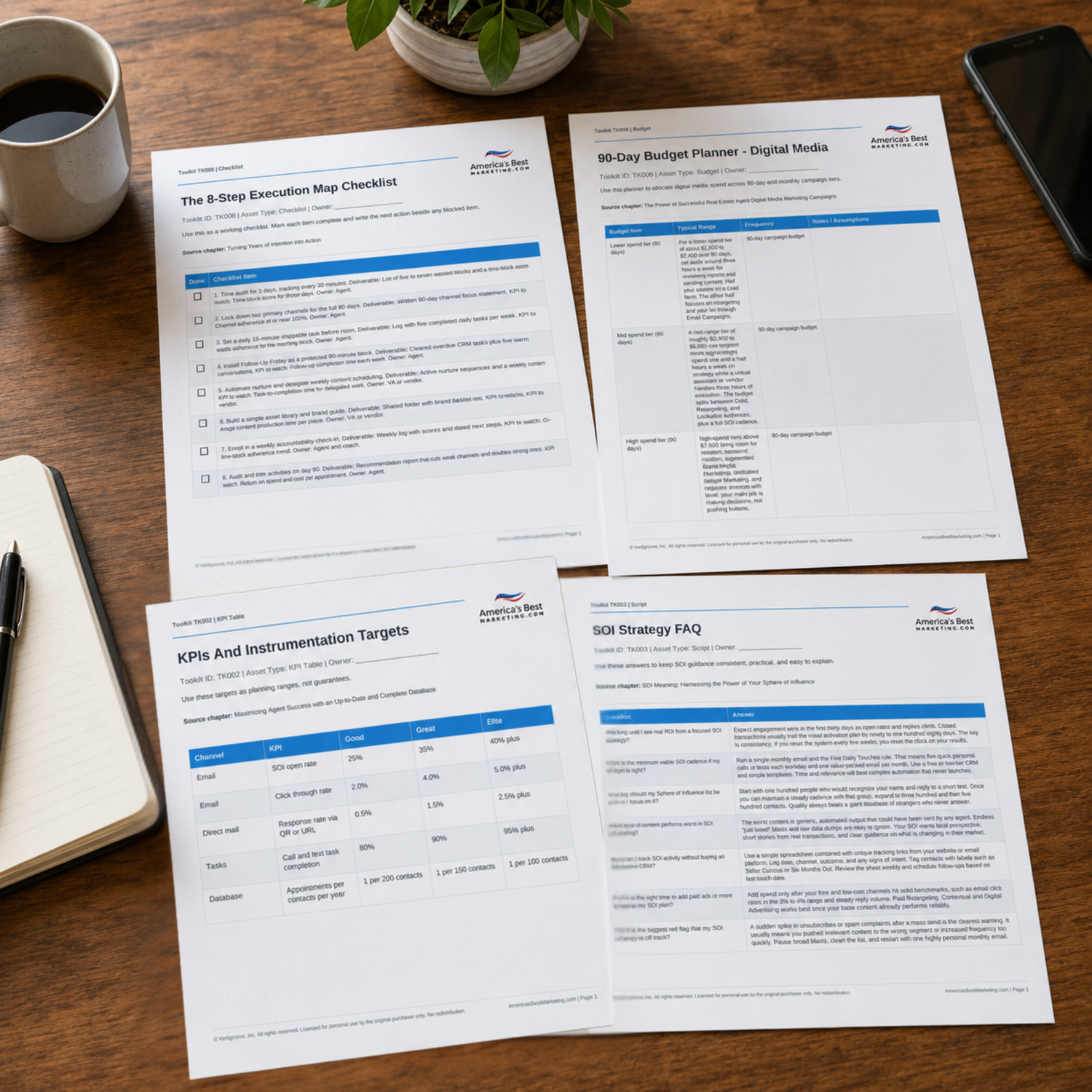
Download the Done-for-You Marketing Toolkit
Use the budget worksheet, four-week cycle checklist, KPI scorecard, and copy-ready sphere email, seller follow-up, and social proof scripts to turn this brief into a working monthly execution plan.
Download the Toolkit ZIPRecommended Reads for Real Estate Agents
Four related articles selected from the ABM Recommended Reads matrix for practical follow-up, buyer guidance, content planning, and seasonal execution.

Real Estate Syndication: A Guide to Group Investing
Make real estate syndication easier to plan, publish, and measure as part of a weekly marketing rhythm.
Read article
HOA Navigation for Real Estate Agents: Red Flags, Document Requests, and Buyer Scripts
Give hoa navigation a clearer role in the marketing system instead of treating the work as a one-off idea.
Read article
Investor Content for Real Estate Agents: Build a Real Estate Investment Portfolio Series That Attracts Clients
Make investor content easier to plan, publish, and measure as part of a weekly marketing rhythm.
Read article
25 Proven Fall Real Estate Marketing Ideas for Real Estate Agents
Make 25 proven fall real estate marketing ideas easier to plan, publish, and measure as part of a weekly marketing rhythm.
Read articleDone-for-You Real Estate Marketing Questions
How long does it take to see measurable ROI from done-for-you real estate marketing?
Most agents start to see clear signals inside sixty to ninety days once a full cycle has run several times. Early wins often appear as better engagement, more replies, and stronger appointment activity before closed-deal numbers grow. The key is to keep the budget and cadence steady long enough for repetition to compound. Your partner should review progress monthly and adjust creative without switching channels on and off too quickly.
What is the minimum viable marketing cadence when the budget is tight?
A lean yet effective cadence usually includes one strong email, one direct mail drop to a tight farm, weekly social posting, and simple retargeting ads. Start with your sphere and one neighborhood. The point is consistency, not volume. A good partner will reduce channel count before reducing the quality of the work.
How large should a target farm be before a done-for-you plan makes sense?
Many agents see value once a farm reaches about one thousand to three thousand homes and they commit to at least four to six touches a year. Below that size, done-for-you support can still work, but the emphasis should shift toward past clients, active prospects, and your current pipeline. A partner can combine sphere, farm, and digital audiences into one coordinated plan.
What types of content tend to perform worst for real estate agents?
Random market memes, jargon-heavy posts, and pure listing blasts with no client value tend to underperform. They feel disposable and do not show how you think or serve. A done-for-you team should emphasize education, proof, local relevance, and clear offers. Every asset should teach something, demonstrate a result, or invite a sensible next step.
How can I track marketing performance without advanced tools?
Use a simple monthly scorecard. Record total leads, appointments, signed clients, and closed deals, then note which channel started each relationship. Combine those outcomes with basic statistics from your email platform, advertising accounts, social channels, and website. A strong partner should consolidate the information into one readable summary instead of sending a collection of screenshots.
When should I increase marketing spend with a done-for-you partner?
Increase spend when two conditions are true. First, the current plan produces leads and appointments at a sustainable cost. Second, you have capacity to serve more clients or a clear plan to add support. At that point, adding budget to proven campaigns is usually more disciplined than launching unrelated campaigns.
What is the biggest red flag when interviewing a marketing partner?
Be cautious with a partner that talks mostly about tools and tactics but rarely discusses your calendar, follow-up process, and ownership of weekly tasks. When a proposal does not show who handles each step and how much time you must contribute, hidden work usually returns to your desk. Ask to see sample calendars, reports, approval workflows, and client operating routines, not only graphics.
Next step
Build the System Behind the Strategy
Continue from one operating brief into the larger ABM ecosystem: the book series for strategic depth and the full marketing program for managed, multi-channel execution.

View the Book Series
Explore the America’s Best Real Estate Agent Marketing System books for deeper frameworks around visibility, referrals, listings, lead generation, and scalable growth.
View the Book Series
See Full Marketing Program
See how AmericasBestMarketing.com manages real estate blog writing, social media, listing marketing, email, direct mail, and digital retargeting as one coordinated system.
See Full Marketing Program