Testimonial Content That Books Appointments: The Objection-First System
Testimonial Content That Books Appointments
Real Estate Agent Templates
A testimonial content system for agents who want client stories to answer objections, build trust, support follow-up, and turn proof into consult requests.

Testimonial content books appointments when proof answers objections
Testimonial content books appointments when each client story answers one buying or selling objection, shows the agent process behind the result, and gives the next prospect an easy way to start a conversation.
- Generic praise is weak proof. Appointment-oriented testimonials should name the fear, show the process, and make the next step feel safe.
- The strongest testimonial library is organized around objections such as cost, communication, local expertise, and deal complexity.
- Every strong story should become several assets: a short video, a carousel, a caption, an email, and a follow-up prompt.
- Track consult requests that mention a specific story so testimonial content becomes measurable pipeline support, not decoration.
Why Testimonial Content Pays Off
Most agents treat testimonials like decoration. They paste polite lines on a website and hope trust appears. The real leverage comes from testimonial content that attacks the objections that keep people from reaching out in the first place.
A seller who worries about commission does not need another quote that says you were professional. That seller needs a story about someone who almost chose the lowest-cost option, compared the net proceeds, followed a smarter plan, and felt the fee made sense after closing. A buyer who fears poor communication needs a story about the update rhythm that kept another client calm through inspection, appraisal, and closing.
This is where testimonial content becomes appointment infrastructure. It makes past clients part of your future sales conversation. When the stories are tied to clean database tags and weekly publishing habits, they support Social Media Management for Real Estate Agents, Email Marketing for Real Estate Agents, listing presentations, direct mail, and warm follow-up without forcing you to invent new proof every week.
- You reduce trust friction before the first call by showing the exact concern a prospect already has.
- You give past-client proof a job inside your sales process instead of leaving it stranded on review platforms.
- You build a content library that supports buyers, sellers, sphere contacts, and warm leads at different stages of intent.
Build The Objection-First Testimonial System
In this system, a testimonial is not just kind words. It is a short story that names a problem, shows how you worked, and ends with a result that matches the prospect goal. Generic praise might feel flattering. It rarely moves anyone to click a calendar link.
Start with an objection map. Pull your last twenty to thirty closed clients into one sheet or CRM view. Add columns for cost and commission, communication and time, local expertise and niche, and complexity and problem solving. Mark one primary objection for each client. The point is not to admire your reviews. The point is to see which concerns you already solve well and where you still need proof.
Strong testimonial content also depends on a usable contact base. If your names, emails, closings, neighborhoods, and tags are scattered, clean them up before you build the library. The process inside Maximizing Agent Success with an Up-to-Date and Complete Database gives the testimonial system a stronger foundation.
Turn fee concern into net confidence
Use stories where pricing, prep, negotiation, or marketing protected more value than the cheaper path would have delivered.
Show the rhythm that reduced stress
Highlight update schedules, decision points, and moments where clear communication kept clients calm and moving.
Prove you know the market beyond portals
Use neighborhood, street, school-zone, timing, and buyer-pattern stories that demonstrate judgment a search filter cannot provide.
Make complexity visible
Capture appraisal saves, inspection recoveries, repair negotiations, difficult timelines, and deals that stayed together because you had a plan.
The most powerful testimonials rarely sound polished on the first pass. The gold hides inside messy details about doubt, family stress, tradeoffs, and the moment relief finally arrived. Strip filler, keep the turning point, and protect one concrete result a future client can picture for their own move.
Scripts And Templates That Turn Stories Into Assets
The strategic testimonial outreach window is narrow. Reach out between twenty four and seventy two hours after a closing, repair win, price change win, appraisal success, or major client relief moment. Clients still feel the emotion. That is when they remember the story with detail.
Ask for raw language, not a perfect review. Text, email paragraph, voice note, or quick selfie video all work. Your job is to shape the story without changing meaning, then get approval before publishing.
Strategic testimonial outreach
Subject line Your story will help future buyers and sellers.
Message Hi {first name}. I am so glad we got you to {outcome in simple words}. People who are in your shoes often feel stuck and do not know who to trust. If you are open to it, I would love a short story about what worried you before we started, what felt different as we worked together, and the moment you knew this was going to work. You can text it back or send a voice note. I will shape it into a short quote and make sure you are comfortable with it before I share anything.
Cost objection social caption
Use when You want to reframe commission conversations before the first meeting.
Copy {Client first name} started our call worried about every dollar on the net sheet. We walked through pricing, smart prep, and a marketing plan that pulled in stronger buyers. By the time we closed, they kept more in their pocket than they expected and said the fee felt like a trade that made sense.
Communication and time follow-up
Use when You are following up with warm leads who fear slow updates or uncertainty.
Message Quick story from this month. A busy couple in {neighborhood} needed clear updates more than anything. We set a simple communication plan and stuck to it through inspection and closing. If you want a copy of that update plan to use on your own sale, reply with update and I will send it over.
Problem solving short video
Hook line This file looked dead on Thursday.
Middle line By Friday afternoon we had a new deal that worked for everyone.
Closing line If your move feels stuck, message me the words stuck file and I will share three paths that often rescue deals like this.
For every strong story, build three versions. A short vertical video that opens with the objection line. A carousel that walks through the problem, plan, and payoff. A caption and email that share the same beats for people who read more than they watch.
Hooks should be specific enough to make the right prospect stop. Use lines like: they almost listed with a discount broker until this happened; inspection day nearly blew up this deal until we changed the plan; or here is how one small pricing shift protected more equity at closing.
Budget Ranges And Publishing Plans
You can run this system on sweat equity alone or pair it with ad spend. The key is to match your budget and time to your volume goals. A solo agent in a tight farm will not need the same spend as a small team that wants steady inbound consults across several zip codes.
Low range looks like simple tools and no ads. Use free survey links, basic transcription, and your existing design platform. Expect one to two hours per week and roughly one hundred to three hundred dollars over ninety days for tools and light creative support.
Use time instead of media spend
Spend zero to fifty dollars each month on a recording app, simple survey, and current design account. Publish one story per week as a post, email snippet, and follow-up prompt.
Add warm-audience promotion
Spend three hundred to six hundred dollars per month promoting the best stories to people who already know you. Pair the content with Retargeting & Contextual Ads and list-based email.
Higher-volume teams can pair testimonial production with design support, editing, ongoing coaching, and full-channel management. That is where one story can support organic social, Listing Marketing, Direct Mail for Real Estate Agents, and website proof without fragmenting the message.
KPI Table For Testimonial Content
You cannot improve what you do not measure. The goal is not to build a complex dashboard. You need a short list of indicators that tell you whether testimonial content is moving from nice-to-have proof into appointment engine territory.
| Ninety day phase | Stories shipped | Appointment mentions | Benchmark notes |
|---|---|---|---|
| Month one | 4 | 2 to 3 | Prove the workflow. Aim for one story per week and log any consult that mentions a testimonial or review by name. |
| Month two | 6 | 3 to 5 | Increase outreach volume and ship at least two assets per story. Watch which objection bucket pulls the most consult requests. |
| Month three | 8 | 4 to 7 | Layer in warm retargeting and email marketing. Track how many new appointments start with someone referencing a specific story. |
At a minimum, track four numbers: stories collected per month, assets shipped per story, reply rate to your outreach script, and appointment requests that mention a specific story, client name, or piece of content. Update the counts once per week.
Compliance And Ethics That Keep The Proof Clean
Testimonial content is powerful, so it must stay clean. Always gain written permission before you share names, faces, or property details. Make it clear how and where you plan to use the story. Offer clients the choice to keep names and addresses light or anonymous.
Respect fair housing rules. Do not highlight or target stories based on protected classes. Focus on service quality, process, and outcomes tied to the property itself rather than who the clients are. Avoid language that implies you welcome or exclude certain groups.
Email and SMS outreach must honor consent and opt-out rules. Include a clear way to stop messages. Do not blast testimonial content to people who never agreed to hear from you. When in doubt, keep records and speak with a local attorney or broker leadership before launching larger campaigns.
Case Pattern: The Review Library That Changed Consults
Maya was a mid-volume agent stuck at ten to twelve closings per year. She had kind reviews scattered across portals but almost no one mentioned them on consult calls. She mapped her last thirty clients into objection buckets, sent the outreach script, and collected ten strong stories in thirty days.
Each story became a short video, a carousel, and an email feature. In the following ninety days, more consult conversations opened with lines like, I saw that story about the appraisal fix. Maya still did the same core work. Her past clients simply started telling the story for her.
This Week Testimonial System Sprint
Use this sprint to move from good intentions to a real client-proof asset library.
- Define the four objection buckets that matter most in your farm and price band.
- Pull your last twenty closed clients into one sheet or CRM view.
- Tag each client to one primary objection bucket.
- Highlight six clients with clear wins that feel repeatable.
- Block thirty minutes and send the outreach script to those six people.
- Set follow-up reminders two days later for each person who has not replied.
- Transcribe any voice notes and mark the before, action, and after moments.
- Create one short video and one carousel from the strongest story.
- Post one testimonial asset and save it to a highlight that features client success stories.
- Add one quote line from that story into your next list email footer.
Testimonial content works hardest when it is built on purpose. Map your objections, collect stories on a clear timeline, and spin each one into social, email, site, and follow-up assets. That is how client proof moves from idea to system.
How This Becomes Marketing
One strong testimonial story can become a trust-building sequence across multiple channels. The social post makes the story visible. The email version gives your list a reason to reply. The website version supports prospects who research you. The follow-up prompt gives warm leads a safer path back into conversation.
Your next two moves are simple. Build the objection map for your last twenty clients and send the outreach script to six of them today. Once you have your first story back, plug it into this system or hand it to AmericasBestMarketing.com so we can fold it into done-for-you real estate marketing and 1:1 Marketing Coaching.
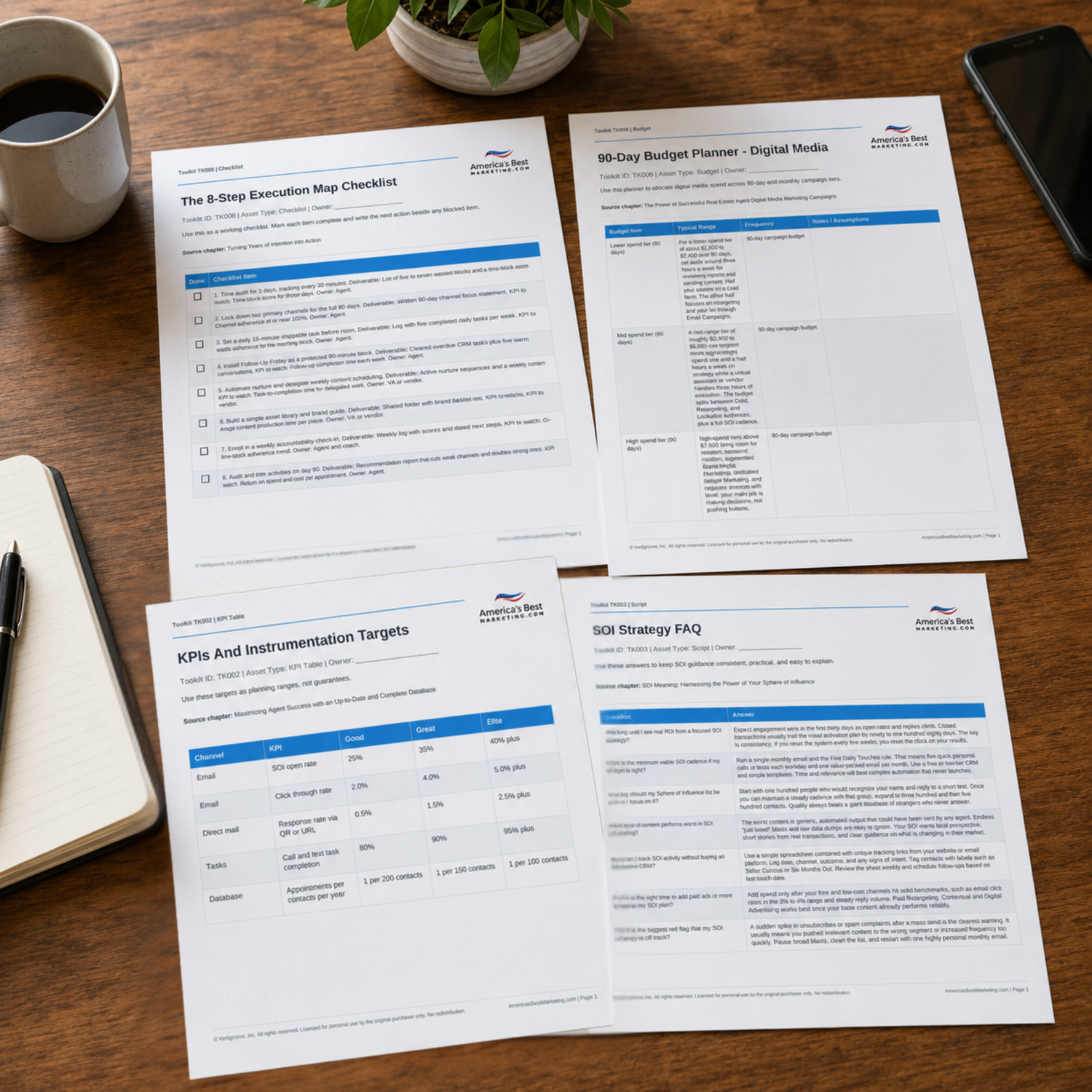
Download The Testimonial Content Toolkit
Use the companion Toolkit to plan testimonial outreach, map client objections, build the weekly sprint, track appointment mentions, and turn raw client stories into social posts, emails, and follow-up prompts.
Download the Toolkit ZIPRecommended reads
Recommended Reads for Real Estate Agents
These articles help agents connect follow-up discipline, database habits, client communication, and marketing execution into a repeatable system.

Family-Friendly Content That Converts: Activity Guide + Lead Capture Ideas for Real Estate Agents
Publish content that answers local questions, supports lead capture, and gives future conversations a reason to start.
Read article
Best Real Estate Content Marketing Ideas
Turn local knowledge into searchable content buyers, sellers, and relocation prospects can actually use.
Read article
Real Estate Blogging Made Simple: How Agents Can Attract Leads and Boost Their Online Presence
Make real estate blogging easier to plan, publish, and measure as part of a weekly marketing rhythm.
Read article
REITs Explained for Real Estate Agents: Talking Points + Content Angles for Investor Clients
Build authority with content topics that are easier to plan, promote, and connect to follow-up.
Read articleTestimonial Content Questions Agents Should Be Ready To Answer
How often should a real estate agent post testimonial content?
Aim for at least one testimonial touch each week across your channels. Some weeks that might be a Reel and a Story highlight. Other weeks it can be a carousel and a short email feature. The key is to show fresh stories on a steady rhythm so new leads always see proof that matches their situation.
What is the best way to ask a past client for a testimonial without sounding needy?
Lead with gratitude and a clear reason. Tell them their story will help people who feel the same fears they had. Ask for three simple parts: what worried them before you started, what changed during the process, and how life looks now. Offer to draft a short quote from their words and send it back for approval.
Do short video testimonials perform better than written quotes?
Both can work. Video adds facial expression and tone, which builds trust fast on social feeds. Written quotes are easier to repurpose into Email Marketing for Real Estate Agents and site pages. A smart mix uses video for hooks and written lines for captions, carousels, and long-form assets.
Can I use testimonials that mention price or time on market without creating problems?
You can reference numbers as long as you stay honest, keep context clear, and avoid promises. Frame results as one example, not a guarantee. Add simple language that explains market conditions and effort. When in doubt, reduce detail on price and focus on process and feelings such as clarity, confidence, and reduced stress.
How many testimonials do I need before this system starts to work?
You do not need a wall full of reviews. Four to six strong stories across the core objection buckets can change your pipeline. Start with one story that speaks directly to your most common objection. Publish it across channels and track consults. Then add more stories until each objection has at least two solid examples.
What should I track to know whether testimonial content is actually booking appointments?
Add a field on your intake form that asks what made them reach out. Listen for mentions of specific stories, clients, or posts. Track how many consults per month point to testimonial content. Combine that with counts of stories collected, assets shipped, and reply rates to outreach. Those numbers tell you whether this system is paying off.
Is it risky to use AI tools to polish testimonial stories?
You can use AI tools to tighten grammar and shorten long sentences. The danger comes when you change meaning or add claims the client never made. Keep the client voice, keep the real facts, and always get final approval on the version you will publish. Think of tools as a line editor, not a ghostwriter.
Next step
Build the System Behind the Advice
Continue from one useful article into the larger ABM ecosystem: the book series for strategic depth and the full marketing program for done-for-you execution.

View the Book Series
Explore the America’s Best Real Estate Agent Marketing System books for a deeper strategic framework around visibility, referrals, listings, lead generation, and growth.
View the Book Series
See Full Marketing Program
See how AmericasBestMarketing.com runs real estate blog writing, social media, listing marketing, email, direct mail, and retargeting as one managed system.
See Full Marketing Program