Maximizing Agent Success with an Up-to-Date and Complete Database
CRM Database Cleanup for Real Estate Agents
A 90-Day System for Follow-Up, Tags, and Contact Hygiene
A practical operating plan for agents who want cleaner records, stronger segmentation, better follow-up, and fewer missed relationship opportunities.

CRM database cleanup for real estate agents
A real estate agent's database is the operating system for follow-up, referrals, repeat business, and long-term client value. A strong 90-day cleanup consolidates every contact source, removes duplicate and bad records, applies simple relationship tags, installs follow-up workflows, and creates a weekly maintenance rhythm so the CRM stays useful after the initial cleanup is finished.
- A CRM is not just storage. It should show who the contact is, where the relationship came from, what stage they are in, and what should happen next.
- The best database overhaul starts with consolidation and hygiene before automation, campaigns, or advanced segmentation.
- A simple tag set usually beats a complicated tag library that nobody uses consistently.
- Database quality affects email, direct mail, calls, texts, events, IDX leads, retargeting, and every SOI campaign that depends on accurate relationship context.
Why a Complete Real Estate CRM Database Matters
Real estate is a relationship business, but relationships only compound when they are remembered, organized, and followed up with on purpose. A clean CRM gives an agent one place to see contact details, source, stage, note history, last touch, next action, and likely business opportunity.
That is why database quality affects almost every marketing channel. Better records make Email Marketing for Real Estate Agents more relevant, make call blocks more productive, and make direct mail less wasteful. Bad data does the opposite. It creates duplicate contacts, dead emails, missing notes, weak segmentation, and follow-up that depends on memory instead of process.
The database also protects the value of the agent's sphere of influence. When contacts are scattered across phones, email accounts, spreadsheets, open house apps, and old CRMs, the business has fragments instead of an asset. A real database centralizes the relationship map so an agent can show up at the right time with the right message.
- Clean data reduces duplicates, bad emails, stale records, and confused reporting.
- Complete data gives every meaningful contact a source, tag, stage, note history, and next action.
- Current data makes it easier to know who needs a call, who needs a market update, and who should move into slower nurture.
The Four Data Standards Every Agent Should Use
A useful CRM does not need to be complicated. It needs consistent standards. Every record should be judged against four basic questions: Is it clean? Is it accurate? Is it up to date? Is it complete enough to support the next right action?
One trustworthy record per person
Clean means one record per person, correct spelling, no duplicates, and a verified primary email or phone number whenever possible.
Relationship truth, not guesswork
Accurate means the record reflects what is actually true, including relationship status, property interest, stage, and notes from real conversations.
Activity visible inside the CRM
Current means recent calls, texts, emails, event attendance, and stage changes are visible instead of trapped in memory or separate apps.
Enough context to act
Complete means the record includes contact details, source, relationship tag, stage, key dates, and transaction history when available.
Agents often think the CRM problem is software. Usually, it is operating discipline. If one contact is in your phone, another is in an email platform, and another is on a paper sign-in sheet, the business does not have a real database. It has fragments. The first job is consolidation. The second job is segmentation. The third job is ongoing maintenance.
Common Database Failure Modes
Most database problems are predictable. They show up when the agent has enough contacts to need a system, but not enough process to keep that system trustworthy.
- Failure to centralize: contacts sit in phones, past CRMs, email accounts, open house apps, spreadsheets, and paper notes.
- Generic batch messaging: everyone receives the same communication, even when buyers, sellers, past clients, vendors, and referral partners need different context.
- Missing activity logs: calls and texts happen, but the CRM never knows they happened, so the follow-up schedule gets disconnected from reality.
- Tag sprawl: tags multiply until nobody uses them consistently. A simpler tag set usually creates better execution.
The fix is not to add fifty new tags or buy the most expensive platform. Start with five to seven broad categories: SOI, Past Client, Buyer Prospect, Seller Prospect, Vendor, Agent Referral, and Hot Contact. Once those are consistently applied, you can add more nuance without making the system unusable.
The Database Overhaul Framework
Treat the database overhaul like a revenue project, not a someday cleanup task. The goal is to end the 90 days with one centralized database, a practical segmentation model, automated follow-up for new leads, and a daily maintenance routine that keeps the system clean.
Consolidate and sanitize
Export contacts from phones, email accounts, past CRMs, open house systems, and spreadsheets. Create one master CSV, clean the formatting, run duplicate detection, manually merge missed duplicates, and verify email addresses where possible.
Standardize and segment
Apply the core tag set to at least 80 percent of usable records. Record lead source on every new contact and on every existing contact where the source is known. Segment past clients by close date so home anniversary and equity check-in campaigns can be scheduled.
Automate, nurture, and maintain
Build a simple seven-touch follow-up sequence for new leads from open houses and IDX Real Estate Websites. Schedule a monthly SOI email and a quarterly print touch through Direct Mail Marketing for high-value segments. Set tasks for birthdays, home anniversaries, annual check-ins, and 90-day re-engagement contacts.
90-Day Database Overhaul Checklist
Use this checklist as the production lane. It can be handled by the agent, an assistant, or a marketing partner, but one person should own the final quality of the CRM.
- Export every known contact source into one master spreadsheet.
- Normalize names, emails, phone numbers, mailing addresses, and obvious formatting issues.
- Merge duplicates until the duplicate rate is under one percent.
- Verify email addresses and remove hard bounces from active sending lists.
- Create a simple tag system for SOI, Past Client, Buyer Prospect, Seller Prospect, Vendor, Agent Referral, and Hot Contact.
- Apply tags to at least 80 percent of usable records.
- Assign lead source to every new record going forward.
- Build one new-lead follow-up sequence and one past-client nurture cadence.
- Create an A-list of 50 to 100 high-value relationships for monthly personal outreach.
- Block 15 minutes daily to log calls, texts, notes, and stage changes.
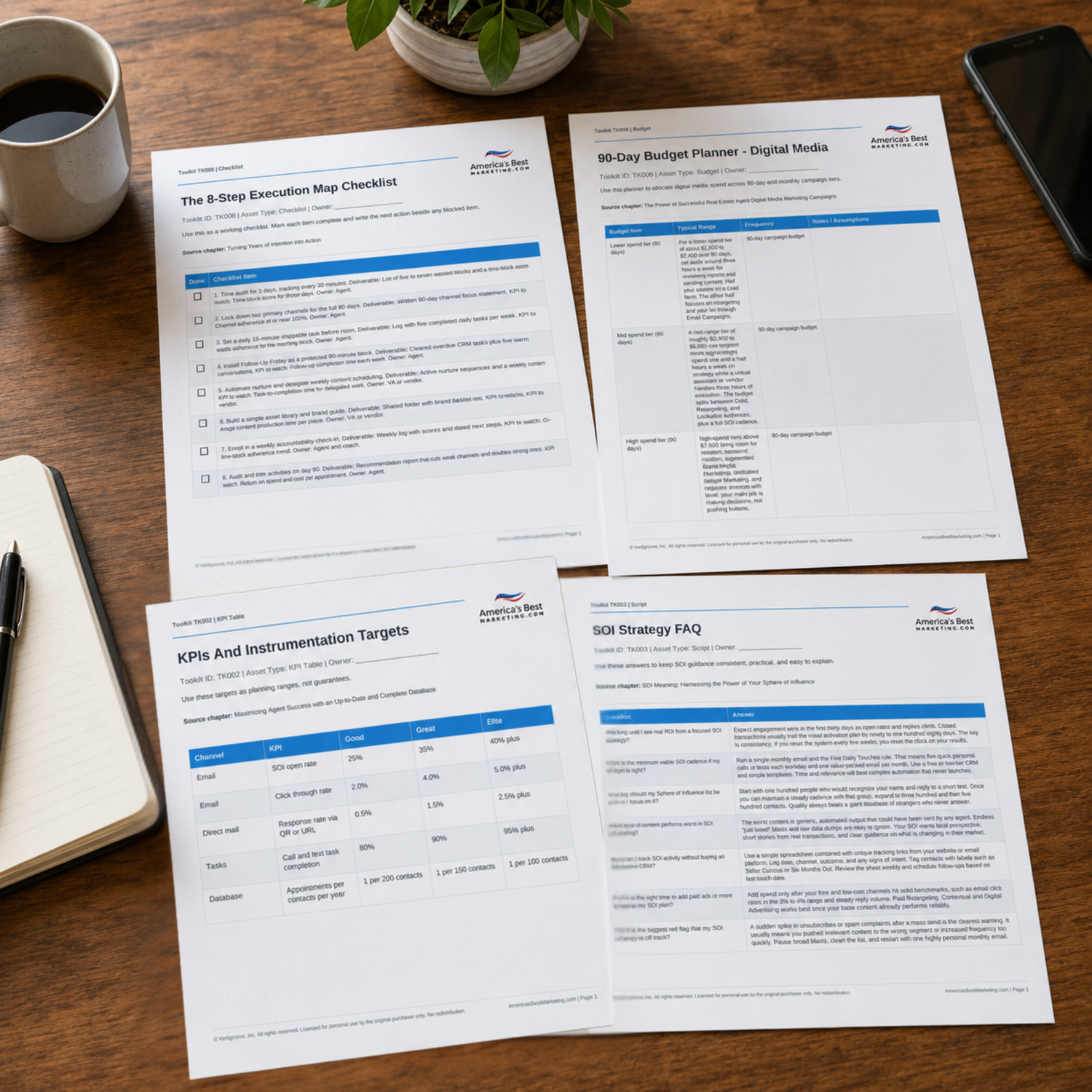
Download The CRM Database Overhaul Toolkit
Use the TK002 Toolkit ZIP to turn this 90-day database plan into an execution system with budget support, checklist files, a plan and framework document, and KPI tracking for CRM cleanup, segmentation, follow-up, and database performance.
Download the Toolkit ZIPMessaging That a Cleaner CRM Makes Possible
A cleaner CRM changes the quality of your marketing because it changes the context of your outreach. Instead of sending everyone the same generic update, you can write to the relationship, stage, and likely next decision.
Send home anniversary notes, equity check-ins, neighborhood value snapshots, and referral reminders tied to real relationship history.
Send net proceeds examples, preparation checklists, and local listing-performance updates based on timing and readiness.
Send saved-search updates, financing reminders, and neighborhood-specific education based on area interest and active timeline.
Send cash-flow notes, tax-angle reminders, and market opportunity alerts without mixing them into ordinary consumer nurture.
Your CRM should also inform offline and digital campaigns. When you plan events, pull invite lists based on tags and past engagement, then use the follow-up structure from Client Events for Real Estate Agents: Plans, Budgets, and Follow-Up That Earn Referrals. When you run ads, use engagement data to build smarter audiences and sequences, as outlined in The Power of Successful Real Estate Agent Digital Media Marketing Campaigns.
Budgets Agents Can Actually Stick To
The database overhaul does not require a massive software stack. It does require realistic time, a basic technology budget, and a commitment to consistent maintenance. The ranges below are planning examples, not guarantees.
Spend roughly $150 to $450 over the quarter for a practical CRM subscription, list verification, and basic email sending. Plan for about three hours of agent time per week plus one hour of assistant support. Use one monthly SOI email, weekly call blocks, and a manageable contact frequency.
Spend roughly $750 to $1,800 over the quarter if you add outside help for cleanup, Social Media Marketing, print touches through Direct Mail Marketing, and campaign planning. Plan for two hours of agent time per week plus three to four hours of assistant or vendor time.
Larger teams can add dedicated CRM administration, more advanced automation, and Retargeting. The strategic point is the same at every tier: spend should support a clean system, useful segmentation, and measurable follow-up, not random activity.
KPIs That Show Whether the Database Is Working
The database should be measured like a business asset. Do not judge the project only by how many names are in the CRM. Judge it by whether the database can produce clean campaigns, completed tasks, conversations, and appointments.
| Channel | KPI | Good Target | Great Target | Elite Target |
|---|---|---|---|---|
| SOI open rate | 25 percent | 35 percent | 40 percent plus | |
| Click-through rate | 2 percent | 4 percent | 5 percent plus | |
| Direct mail | Response rate via QR or URL | 0.5 percent | 1.5 percent | 2.5 percent plus |
| Tasks | Call and text task completion | 80 percent | 90 percent | 95 percent plus |
| Database | Appointments per contacts per year | 1 per 200 contacts | 1 per 150 contacts | 1 per 100 contacts |
Use simple instrumentation. Create unique URLs or UTM parameters for campaigns. Tag replies by campaign source. Review hard bounces monthly. Move non-responders into a slower cadence before removing them. The goal is not to make the CRM perfect. The goal is to make it reliable enough to guide decisions.
Compliance and Data Protection Still Matter
A better CRM is also a data responsibility. Marketing emails should include a clear physical address and an unsubscribe link. Opt-outs should be respected quickly. Segmentation should stay focused on relationship history, property interest, geography, and engagement rather than protected-class assumptions.
Treat CRM access like a key to the office. Use two-factor authentication, limit user permissions, avoid storing sensitive financial information, and review vendor access when roles change. Clients expect their information to be handled carefully, even when follow-up work is delegated.
Your Next Two Moves
First, stop the leak. From today forward, every new lead from open houses, web forms, referrals, sign calls, and conversations should be entered into the CRM, tagged correctly, and assigned a lead source. Second, start the cleanup. Block time this week to export every contact source into one master spreadsheet and begin the consolidation phase.
Third, install a weekly review rhythm. Look at new records, missing lead sources, overdue tasks, bounced emails, and top-contact follow-up before the week gets away from you. This is where most agents lose the database again. The system does not fail all at once. It drifts one missed note, one untagged lead, and one skipped call block at a time.
A clean CRM makes every future touch more efficient. It gives your email, direct mail, social content, events, and retargeting campaigns a better foundation. If you would rather have a marketing partner manage the content, campaign planning, and measurement while you stay in front of clients, AmericasBestMarketing.com runs a complete done-for-you system for real estate agents.
Recommended Reads
Recommended Reads for Real Estate Agents
These articles help agents connect follow-up discipline, database habits, client communication, and marketing execution into a repeatable system.

Database Hygiene for Agents: The 3-Week Cleanup Sprint
Make follow-up easier to run before leads, past clients, or prospects go quiet.
Read article
AI for Real Estate SEO: What to Automate, What to Avoid, and How to Measure Impact
Turn search visibility into a clearer publishing system for neighborhoods, services, and client decisions.
Read article
Leveraging Hyper-Local SEO for Real Estate Success
Make hyper-local SEO for real estate success easier to plan, publish, and measure as part of a weekly marketing rhythm.
Read article
Client Follow-Up Systems That Create Lifetime Value
Turn scattered contacts into a workable pipeline with scripts, tags, reminders, and response routines.
Read articleCRM Database Questions Real Estate Agents Should Answer
Do I really need a CRM if I only have a few hundred contacts?
Yes. A few hundred organized contacts can still drive referrals, repeat business, and local conversations. You do not need an enterprise platform, but you do need one reliable place for names, notes, tags, tasks, and follow-up history.
What should a real estate agent clean first in the database?
Start with duplicates, bad emails, missing phone numbers, missing lead sources, and contacts with no useful relationship tag. Those issues create the most immediate drag on marketing quality and follow-up consistency.
What is the simplest tagging structure for a solo agent?
Start with SOI, Past Client, Buyer Prospect, Seller Prospect, Vendor, Agent Referral, and Hot Contact. That structure is simple enough to use daily and useful enough to support better emails, calls, direct mail, and event invitations.
How often should I audit my CRM database?
Run a light hygiene pass every quarter and a deeper audit once a year. Quarterly, remove hard bounces, correct obvious errors, and review cold segments. Annually, revisit tags, lead sources, and automation rules.
Which metrics show that my database work is paying off?
Watch email open rate, click-through rate, call and text task completion, reply volume, appointments per contact, and active contacts as a percentage of the total database. Those numbers show whether the system is producing real engagement.
What should I do with cold or unresponsive contacts?
Move them into a slower cadence before deleting them. Send occasional value-first content and watch for opens, clicks, replies, or calls. If there is no engagement after six to twelve months, consider removing them to protect list quality.
Next step
Build the System Behind the Advice
Continue from one useful article into the larger ABM ecosystem: the book series for strategic depth and the full marketing program for done-for-you execution.

View the Book Series
Explore the America’s Best Real Estate Agent Marketing System books for a deeper strategic framework around visibility, referrals, listings, lead generation, and growth.
View the Book Series
See Full Marketing Program
See how AmericasBestMarketing.com runs real estate blog writing, social media, listing marketing, email, direct mail, and retargeting as one managed system.
See Full Marketing Program