Hyper-Local Content Kit for Real Estate Agents: Parks, Events, and Map Posts
Hyper-Local Content Kit
Parks, Events, and Map Posts
A four-week neighborhood takeover system for real estate agents who want one local market to see their name repeatedly before they need help buying or selling.

Hyper-local content for real estate agents, explained
A real estate agent can build hyper-local visibility by choosing one tight neighborhood, mapping the parks and everyday amenities residents already use, filming short field clips, publishing three to five useful posts per week, and tracking saves, shares, link clicks, and direct messages tied to that neighborhood.
- Hyper-local content should focus on one neighborhood, school zone, route, or two-mile lifestyle loop, not the whole metro.
- Parks, trails, dog areas, coffee shops, and weekend events create practical content residents want to save and share.
- A four-week takeover works best when mapping, field shooting, distribution, and weekend event content are treated as one campaign.
- The right performance signals are saves, shares, link clicks, and direct messages tied to the neighborhood, not vanity likes.
Why Hyper-Local Content Works Better Than City-Wide Noise
Hyper-local content turns you into the familiar name for one neighborhood, not a forgettable face across the whole city. This kit gives you a four-week system built around parks, events, and map posts so ideal clients keep seeing you every time they plan their weekend. It pairs naturally with Achieving Top-of-Mind Awareness and takes that idea down to the street level.
Hyper-local does not mean “in this city.” It means “within this school zone,” “around this lake,” or “inside this two-mile loop of parks and coffee shops.” You are designing content so specific that residents glance at a thumbnail and immediately know you are talking about their daily life, not a generic skyline.
This level of focus builds real familiarity. When someone who walks that trail or uses that playground keeps seeing your name on useful posts, they start framing you as part of the neighborhood infrastructure. That is when you see messages like “I feel like I already know you from your posts, can you come look at our house?”
- Pick one neighborhood or zip-plus pocket, not the whole metro.
- Center the content on amenities and routines, not statistics.
- Make every piece feel like a useful local reference, not a brochure.
What Counts As Hyper-Local
For this system, hyper-local means a defined patch where people share daily patterns. Think one HOA plus the nearby dog park, three blocks around a village green, or the walkable area around a transit stop. If it is too big to drive in ten minutes, it is too big for this play.
The biggest mistakes agents make are simple. They grab generic stock images instead of real parks and shops their clients actually use. They post in random bursts instead of on a predictable schedule. They also forget to tag locations, which means the algorithm cannot connect their posts to the people who live nearby.
Most agents think they have a content problem when they really have a relevance problem. Ten posts about the exact dog park locals already love will beat fifty random city views because they land in a tighter interest graph. A simple rule of thumb: if a stranger across town would enjoy it, narrow it until they would not care.
Neighborhood Takeover: Your Four-Week Execution Plan
Run a four-week Neighborhood Takeover that you can repeat each quarter. Every week has a clear job, one main deliverable, and one primary KPI. Keep it simple and treat it like a campaign, not random posting.
Audit and Map
Pick one neighborhood and list the parks, trails, playgrounds, schools, coffee shops, and dog spots locals actually use. Build a quick map in Canva or Google My Maps and drop pins for each location. Add notes on shade, parking, restrooms, and what kids, dogs, or remote workers care about.
The deliverable is one Best Of map graphic and a simple blog post on your site that expands those pins into short descriptions. Watch clicks to that blog from your social posts and bio link.
Boots-on-the-Ground Shoot
Block a two-hour window to drive, walk, or bike the route. Capture vertical phone clips and stills of each park, path, and street-level view. Film short spoken lines about what locals love and where each spot belongs in daily life.
The deliverable is a labeled folder of footage and screenshots tied to the map. Watch total usable clips captured and how many locations you cover.
Distribution and Light Boosting
Schedule three to five posts built around your Week One map and Week Two footage. Lead with an overview map post, then follow with short one-park clips and simple carousels. Use location tags, save-friendly hooks, and one DM MAP style call to action.
The deliverable is a week of posts that all point back to the same neighborhood map or guide. Watch saves and shares because those actions signal reference value.
Weekend Event Guide
Publish a simple Friday What’s On This Weekend post for the neighborhood. Pull in park events, farmers markets, and low-key happenings inside your footprint. Pair it with a Story sequence and a caption that invites locals to message you for the full map.
The deliverable is one event guide post, one Story sequence, and one pinned comment with the next step. Watch direct messages and replies that mention the neighborhood or specific amenities.
Use this checklist to keep yourself honest:
- Pick one neighborhood and define a tight boundary you can drive in under ten minutes.
- List at least ten hyper-local amenities such as parks, trails, playgrounds, coffee shops, and dog areas.
- Build a Best Of map graphic and a matching blog page on your site.
- Schedule a two-hour field session and capture at least three clips per location.
- Organize footage into labeled folders that match your map pins.
- Create three to five posts for Week Three that all point back to your map or guide.
- Use location tags plus one primary call to action on each post.
- Publish a Friday event guide that focuses only on your chosen neighborhood.
- Track saves, shares, and DMs in a simple spreadsheet once a week.
- Repeat the cycle next quarter with updated events and new angles from the same spots.
Captions And CTAs That Make Locals Take Action
You do not need fancy copy. You need simple hooks that match how residents talk about their weekends. Write like you are texting a neighbor, not submitting ad copy to a committee.
Here are caption ideas you can drop straight into Instagram or Facebook:
- The three best playgrounds in [Neighborhood] ranked by shade cover and coffee access.
- Dogs of [Park Name]: why every local pup ends up here after 5pm.
- Got ninety minutes this weekend? Here is a zero-stress trail loop in [Neighborhood].
- Remote workers in [Neighborhood], these are the three patios with strong wifi and quiet corners.
- Moving to [Neighborhood]? Screenshot this park map before you sign anything.
- One stroller-friendly loop, three playgrounds, zero parking drama in [Neighborhood].
CTA taxonomy keeps you from always shouting “call me.” Use a soft prompt when you are building reach, a mid prompt when you want replies, and a hard prompt when you want appointments.
Save this post for the weekend so you do not forget these spots.
Share this with the friend who always plans your park days.
DM me MAP and I will send you the full [Neighborhood] guide.
Comment DOG and I will send you the dog park checklist we use with buyers.
Thinking of moving to [Neighborhood]? Book a fifteen-minute walking tour and we will hit three parks together.
Planning to sell in [Neighborhood] this year? Message me for a quick pricing check within that school zone.
Creative Brief Cards You Can Copy
Goal: position yourself as the go-to guide for parents in one neighborhood. Audience: local families within a two-mile radius of the main park. Creative: one carousel with a simple map slide plus three photo slides from your field session. Headline: One stroller-friendly loop that hits three playgrounds in [Neighborhood]. CTA: Save this and DM me LOOP for the full map.
Goal: attract remote workers and commuters who care about daily routines. Audience: renters and owners who live near a transit stop or freeway entrance. Creative: a Reel that stacks quick clips of three coffee spots with on-screen text about outlets and parking. Headline: Three coffee spots in [Neighborhood] that will not wreck your commute. CTA: Comment COFFEE and I will send you the weekly guide.
Three Ready-to-Use Script Frameworks
The Quick Park Tour Reel
Dialogue for agent
Hook Here is the fastest way to hit three playgrounds in [Neighborhood] without moving your car.
Build Start at this lot, walk past the splash pad, then wrap back through the shaded loop so kids are not in direct sun.
CTA Save this for the weekend and DM me MAP if you want the full route.
Shot list and B-roll
Opening shot Quick shot of the parking area and trailhead sign.
Middle beat Short clips of the playground, benches, and shaded path under trees.
Closing frame Final clip from the last playground with a simple map overlay.
Keep every clip under one and a half seconds and cut on the music beat. Put the most visually interesting playground at the hook, the shaded path in the middle, and the wide neighborhood view at the end under your CTA.
The Weekend Problem And Solution Reel
Dialogue for agent
Hook Tired of driving all over town to entertain kids for one hour?
Build In [Neighborhood], this tiny loop gives you a playground, flat path for scooters, and a coffee stop in under ninety minutes.
CTA Comment WEEKEND and I will send you the full [Neighborhood] guide we give to our buyers.
Shot list and B-roll
Problem frame Short clip of a car queue or busy road to frame the weekend hassle.
Solution frame Cut to a calm path with trees, walkers, the playground, and the nearby coffee sign.
Guide frame End on a simple map or screenshot of your route graphic.
Tie this to a value piece buyers care about. Mention your neighborhood guide and route viewers toward your site blog where they can see the full map and contact you when they are ready for a tour.
The Hidden Local Gem Reel
Dialogue for agent
Hook Most people in [City] have never heard of this pocket park in [Neighborhood].
Build It is tucked behind this street, has full shade after four o’clock, and usually feels half as busy as the main playground.
Reveal That is why nearby households use it for quick after-dinner runs.
CTA Save this spot and message me if you want the full [Neighborhood] park list before you buy.
Shot list and B-roll
Entrance POV walk from the main street into the tucked-away entrance.
Texture Wide shot of the play area, trees, benches, picnic tables, and path back toward nearby homes.
Production Plans You Can Repeat
You do not have to run a full studio to look consistent. Pick a lane that matches your time and budget, then repeat the same pattern each month until it feels boring. Boring to you usually means familiar to the neighborhood, which is the goal.
Shoot everything on your phone in a single weekly block. Post three times per week with one park clip, one map slide, and one Story sequence. Spend zero on ads and focus on tagging locations and using consistent CTAs. This lane suits solo agents who are proving the system before committing more resources.
Batch field shooting twice a month, then spend about five dollars per day boosting your best park or map posts to a tight radius. Use a virtual assistant to help schedule posts and log saves, shares, and DMs. This is where Retargeting & Contextual Ads can reinforce your organic work and keep you in front of the same households.
Budget Ranges And Time Requirements
The table below gives you concrete ranges so you can choose a lane without overthinking it. Treat these as target benchmarks, not rules. The numbers are built for one neighborhood campaign at a time.
| Tier | Ad spend per month | Agent hours per week | VA or assistant hours per week |
|---|---|---|---|
| Low budget • DIY organic | $0 | 1 to 1.5 | 0 |
| Mid budget • light boosting | $150 to $250 | 1.5 to 2 | 1 to 1.5 |
| High budget • heavier targeting | $400 to $600 | 2 to 3 | 2 to 3 |
At the low tier, your only cost is time and a simple content calendar. At mid tier, your spend focuses on boosting park and map content inside a two to three mile radius plus using Retargeting & Contextual Ads to stay visible for people who engage. At the high tier, you combine consistent content with stronger targeting and more help on scheduling and reporting.
What To Measure So You Know It Is Working
Treat this system like a small lab. Each week you are looking at a handful of simple metrics, not a massive dashboard. The point is to see whether the neighborhood is treating your content as practical and worth revisiting.
On social, saves and shares sit at the top of the stack. Those actions tell you people want to reference the content later or send it to someone who lives nearby. Likes are nice, but they are a lighter signal. Track ratios instead of chasing absolute numbers so you can compare posts fairly.
On your site, the primary metric is clicks to your neighborhood Best Of blog post and time on page once visitors land there. Every social caption that mentions parks or events should give them a simple path to that page. This is where a strong website and local search content matter because the blog can also rank when someone searches parks in [City] [Neighborhood] and pull in new visitors over time.
On the conversion side, your main metric is the number of direct messages, comments, or emails that mention the neighborhood by name. Log those in a basic spreadsheet along with which post they came from. Over a few months you will start to see patterns in which topics move people toward valuations and walk-throughs.
Staying Compliant While You Go Micro-Local
Hyper-local does not give you permission to steer. Stay focused on amenities, routines, and physical features, not the people who live there. Talk about shade, trail length, playground surfaces, dog rules, traffic patterns, and public events. Do not describe schools or areas with coded language about who belongs there.
Fair Housing law takes issue with content that pushes or pulls certain groups toward particular neighborhoods. Keep your language neutral and informational. If you ever catch yourself writing about the type of family that likes a park, pause and rewrite that line to describe features of the park instead. The goal is to empower buyers and sellers with clear information, not to sort people.
On the visual side, only use photos and clips you have taken yourself or assets that the property owner or city has given you permission to share. Do not pull images from Google search or random blogs. When in doubt, reshoot the scene on your own phone and move on.
Quick Win: Agent Sarah And The Dog Park Farm
Sarah is a real estate agent who works a mixed single family and townhome neighborhood that has one big draw, a popular dog park with a small parking lot and great shade. Instead of trying to cover her entire city, she built a Dogs of [Neighborhood] content series around that park and the surrounding blocks.
She filmed one field session on a Tuesday morning, gathering clips of the entrances, shaded benches, water stations, and the quiet side path that most people missed. She posted three short Reels per week for a month plus a Friday Dog Weekend guide featuring local pet-friendly patios. She boosted her best clip five dollars per day to a two mile radius around the park.
Within sixty days, she had a modest but meaningful lift. Her saves and shares on dog park content beat her city-wide posts by more than double, and she logged eight direct messages from dog owners asking about upcoming listings nearby. Two of those conversations turned into listing appointments and ultimately closed, all tied back to content about one park.
After you have run this play a couple of times, add a light layer of reputation content on top. Use the same channels to highlight reviews from clients who moved into that neighborhood and talk about how they use the parks and trails in their daily life. You can use the playbook from Impactful Client Appreciation, Reviews, and Reputation Management to make those stories feel natural instead of forced.
If you want to roll this out to a second or third neighborhood later, start by mapping your own business goals. Decide where you want more listings over the next twelve to eighteen months and build your next takeover there. The growth plan from Charting Your Course: How Real Estate Agents Can Navigate a Strategic Growth Plan for Long-Term Success pairs well with that decision so you are not just chasing whichever park looks pretty on camera.
What To Do In The Next 48 Hours
First move, pick one neighborhood and commit to it for the next four weeks. Name it, define the boundary, and list the parks, trails, playgrounds, and coffee shops that actually matter to residents. This takes half an hour and gives you a clear sandbox.
Second move, schedule your Week Two field session right now. Put a ninety minute block on your calendar and treat it like a listing appointment with yourself. When that calendar block fires, show up and shoot, even if the weather or light is not perfect. Consistency beats perfection here. Over time, this is exactly the kind of system that supports the brand work you are already doing across email, events, and other channels.
Hyper-local content works when it becomes a repeatable neighborhood operating system. Choose the patch, map the routines, document the amenities, publish consistently, and let useful local visibility compound before clients need an agent.
How This Becomes Managed Marketing
A hyper-local content kit should not live as a one-off social idea. It should become a repeatable marketing asset across your website, email list, social channels, direct mail, retargeting, and listing conversations. One useful neighborhood map can feed a blog, multiple Reels, a weekend email, a direct message prompt, and a listing presentation proof point.
If you want this kind of hyper-local system running every month without living inside Canva and Meta Ads yourself, AmericasBestMarketing.com supports real estate agents with Social Media Management, Retargeting & Contextual Ads, Real Estate Blog Writing Services, and Email Marketing for Real Estate Agents built around your neighborhood maps and guides.
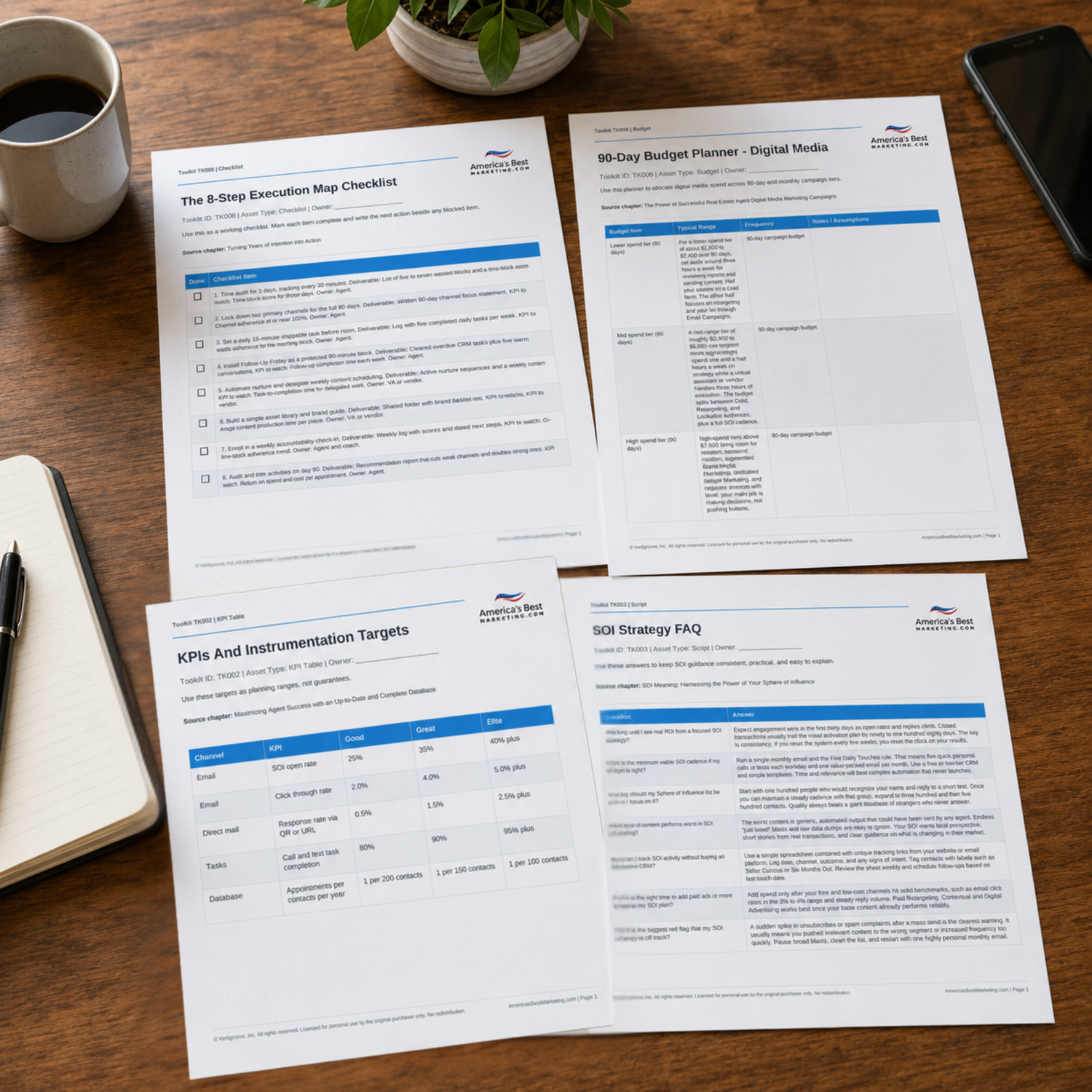
Download The Parks, Events, And Map-Post Toolkit
Use the companion Toolkit to put the four-week neighborhood takeover into motion with budget ranges, a mapping checklist, an execution plan, FAQ support, and short-form video scripts for hyper-local Reels.
Download the Toolkit ZIPRecommended reads
Recommended Reads for Real Estate Agents
These articles help agents turn client questions, local guidance, marketing channels, and follow-up into a more useful content system.

Best Real Estate Content Marketing Ideas
Turn local knowledge into searchable content buyers, sellers, and relocation prospects can actually use.
Read article
Hidden Gems Content: How Real Estate Agents Create Local Guides That Generate Relocation Leads
Turn local knowledge into searchable content buyers, sellers, and relocation prospects can actually use.
Read article
Investor Content for Real Estate Agents: Build a Real Estate Investment Portfolio Series That Attracts Clients
Make investor content easier to plan, publish, and measure as part of a weekly marketing rhythm.
Read article
Hyper-Local Market Report Template: What to Include, Data Sources, and Posting Cadence
Build authority with content topics that are easier to plan, promote, and connect to follow-up.
Read articleHyper-Local Content Questions Agents Should Be Ready To Answer
How long does it take to see measurable ROI from hyper-local content?
Most agents see signals in thirty to sixty days if they post consistently for one neighborhood. Early wins show up as higher saves and shares plus a few direct messages that mention specific parks or streets. Listings usually follow after several months of being visible, so treat the first quarter as a build phase and keep your expectations grounded.
What is the minimum viable cadence if my budget and time are tight?
You can start with three posts per week as long as they all point to the same neighborhood map or guide. One map post, one park clip, and one weekend event post is enough to build familiarity. When your schedule or budget opens up, add Stories and light boosting instead of trying to jump straight to daily posting.
How large should my list, farm, or audience be before I run this?
A small, focused audience is fine. A few hundred people who live inside a two to three mile radius can produce results if your content is specific and useful. Start where you already know the streets and amenities well. You can layer this onto an existing geographic farm or use it to test a new one before you commit to heavier spends.
What kind of content performs worst in a hyper-local strategy?
Generic city skyline shots, templated quote graphics, and vague lifestyle content usually perform poorly here. Those posts do not help a local decide what to do this weekend or where to walk their dog. Anything that could apply to any neighborhood or any city will dilute your results. Keep your posts anchored to specific parks, routes, and routines.
How do I track performance without advanced tools or a full CRM?
Use a simple spreadsheet or notes app. Once a week, log how many saves, shares, link clicks, and direct messages you received from posts tied to your neighborhood map. Add one quick note about which topics drove messages or questions. Over time you will see which parks or themes deserve more attention without needing a complex reporting stack.
When should I scale my spend or expand into a new territory?
Wait until you have run at least two full four-week cycles in one neighborhood and your saves, shares, and DMs are trending up. Then increase your ad spend gradually in that same area before opening a second location. When the original neighborhood feels stable and repeatable, you can extend the model to a nearby area with similar patterns and track the two separately.
What is the biggest red flag to avoid with this strategy?
The major red flag is drifting into steering by talking about who should or should not live in a given neighborhood. Focus on features, public amenities, and logistics such as shade, distance, and traffic, not on the types of people who live there. When in doubt, rewrite any line that feels like it is describing residents instead of parks, paths, or public spaces.
Next step
Build The System Behind The Neighborhood Visibility
Continue from one useful article into the larger ABM ecosystem: the book series for strategic depth and the full marketing program for done-for-you execution.

View the Book Series
Explore the America’s Best Real Estate Agent Marketing System books for a deeper strategic framework around visibility, referrals, listings, lead generation, and growth.
View the Book Series
See Full Marketing Program
See how AmericasBestMarketing.com runs real estate blog writing, social media, listing marketing, email, direct mail, and retargeting as one managed system.
See Full Marketing Program