AI Chatbots for Real Estate Agents: Best Use Cases, Setup Checklist, and Compliance Guardrails
AI Chatbots for Real Estate Agents
Best Use Cases, Setup Checklist, and Compliance Guardrails
A controlled chatbot operating model for agents who want instant response, cleaner qualification, safer escalation, and stronger follow-up without making the brand feel robotic.

Turn Instant Replies Into Qualified Handoffs
AI chatbots help real estate agents improve speed-to-lead by greeting visitors immediately, asking a short qualification sequence, capturing contact permission, and routing ready-now prospects to a human with context attached. The winning setup is not a free-form robot. It is a controlled intake layer with scripts, escalation rules, transcript review, Fair Housing guardrails, and measurable KPIs.
- The best first chatbot use case is after-hours website and listing-page triage where response delay is costing appointments.
- A chatbot should create instant reply, useful micro-conversion, and fast escalation to a human when intent is strong.
- Compliance guardrails matter more than clever answers because pricing, negotiation, legal, tax, and Fair Housing-sensitive questions need controlled routing.
- Transcript data can improve content planning, email follow-up, retargeting creative, and search visibility when reviewed every week.
Why Chatbots Matter For Speed-To-Lead
Lead decay is brutal. A visitor can move from curious to gone in minutes, which is why Use AI to Cut 10+ Hours/Week: The Agent’s Revenue-First Tech Stack Guide is built around one priority: respond instantly, then route the right people to a human.
AI chatbots for real estate agents are useful when they are deployed as operating systems, not novelty widgets. The chatbot’s job is to respond instantly, qualify intent, protect the agent’s calendar, and create a clean handoff when the conversation becomes high value or sensitive.
This workflow can also support SEO strategies for real estate websites, because visitor questions reveal the language buyers and sellers already use. Those questions can become better page copy, email topics, local content, and retargeting creative.
- Use the bot as the first response layer, not as the final authority on complex client decisions.
- Keep the first sequence short enough for mobile users who want fast answers, not a survey.
- Route strong intent to a human while the prospect still remembers why they reached out.
What A Chatbot Is Really Doing
A chatbot is not here to replace your judgment. Its job is to greet everyone instantly, collect intent signals, and hand off cleanly when a real person should take over.
That handoff matters more than any clever answer. If your bot cannot move from chat to contact, it is a shiny distraction that inflates your inbox and wastes your time.
Combine natural language with hard limits
Generative bots can write natural responses, but they still need a controlled knowledge base and escalation rules. The right setup feels conversational while staying inside approved boundaries.
Sort intent before the inbox fills up
A short sequence should sort visitors into ready now, warming up, or research mode. Ask timeline, location, budget range, and preferred next step without making the chat feel like paperwork.
Extract meaning from messy questions
Natural language processing helps the system understand common phrasing. Use that signal to tag questions, improve answers, and identify new content opportunities.
Move the right chats to a human
The handoff protocol defines the moment a conversation becomes human-led, plus the context that should travel with it. A clean handoff includes transcript, intent tags, lead score, and next best action.
The Failure Modes That Burn Trust
Most bot disasters look the same. Someone installs a widget, writes two greetings, and calls it done. Then the bot guesses. It invents details, misstates boundaries, or gives advice it should never give.
That is how you lose the lead and create a compliance problem in one shot. The bot should disclose it is AI, avoid guessing, and route pricing, negotiation, legal, tax, and Fair Housing-sensitive questions to controlled responses or a human.
- Naked bots with no approved training data may improvise market details, policy, or property facts without a reliable source.
- No clear path to a human makes high-intent visitors feel trapped and turns the brand into a dead end.
- No transcript review loop lets the same failure repeat because nobody is tuning the workflow weekly.
- Compliance gaps show up when sensitive questions are answered with improvisation instead of routing rules.
Most agents think the value is answering questions. The real value is extracting intent through micro-conversions like timeline, commute constraints, price range, must-have features, and preferred follow-up. Use those signals to trigger tighter follow-up and sharper audiences.
Best Use Cases Mapped To ROI
Pick one primary use case first. A bot that tries to do everything will do nothing well. Start where you have the most lead volume and the slowest response, which is usually after-hours browsing on your site and listing pages.
| Use case | Automation potential | User friction | Estimated weekly hours saved | Best setup notes |
|---|---|---|---|---|
| Lead qualification | High | Low | 3 to 6 | Ask timeline, budget range, and location preference. Escalate when ready-now signals appear. |
| Showing coordinator | High | Medium | 2 to 5 | Offer time windows, confirm address, and capture contact permission. Hand off with context. |
| After-hours FAQ | Medium | Low | 1 to 3 | Use controlled answers for process questions and route anything sensitive to a human. |
| Recruiting screen | Medium | Medium | 1 to 2 | Capture intent and experience level, then route to a specific follow-up workflow. |
Do not treat hours saved as a promise. Treat them as instrumentation targets so you can validate that the workflow is doing its job.
The 60-Day AI Integration Playbook
This timeline keeps you out of the install-and-pray trap. Your bot earns trust by being predictable, transparent, and quick to hand off.
Audit the current lead path
Map website forms, chat, portal inquiries, social DMs, calls, texts, and open-house follow-up. Track current time-to-first-response by channel, then list the top 25 questions prospects already ask.
Select and train the tool
Choose a platform that exports transcripts, supports a controlled knowledge base, and routes a conversation to a human with context. Feed it approved process answers, safe local information, and escalation triggers.
Connect the bot to property search
Deploy it on IDX Real Estate Websites to help visitors refine criteria, save searches, request updates, and ask property questions safely.
Review, tag, and optimize
Read transcripts twice per week, tag failure categories, refine micro-conversions, and improve handoff quality. Pair the data with Retargeting, Contextual & Digital Advertising so return visitors see follow-up that matches their intent.
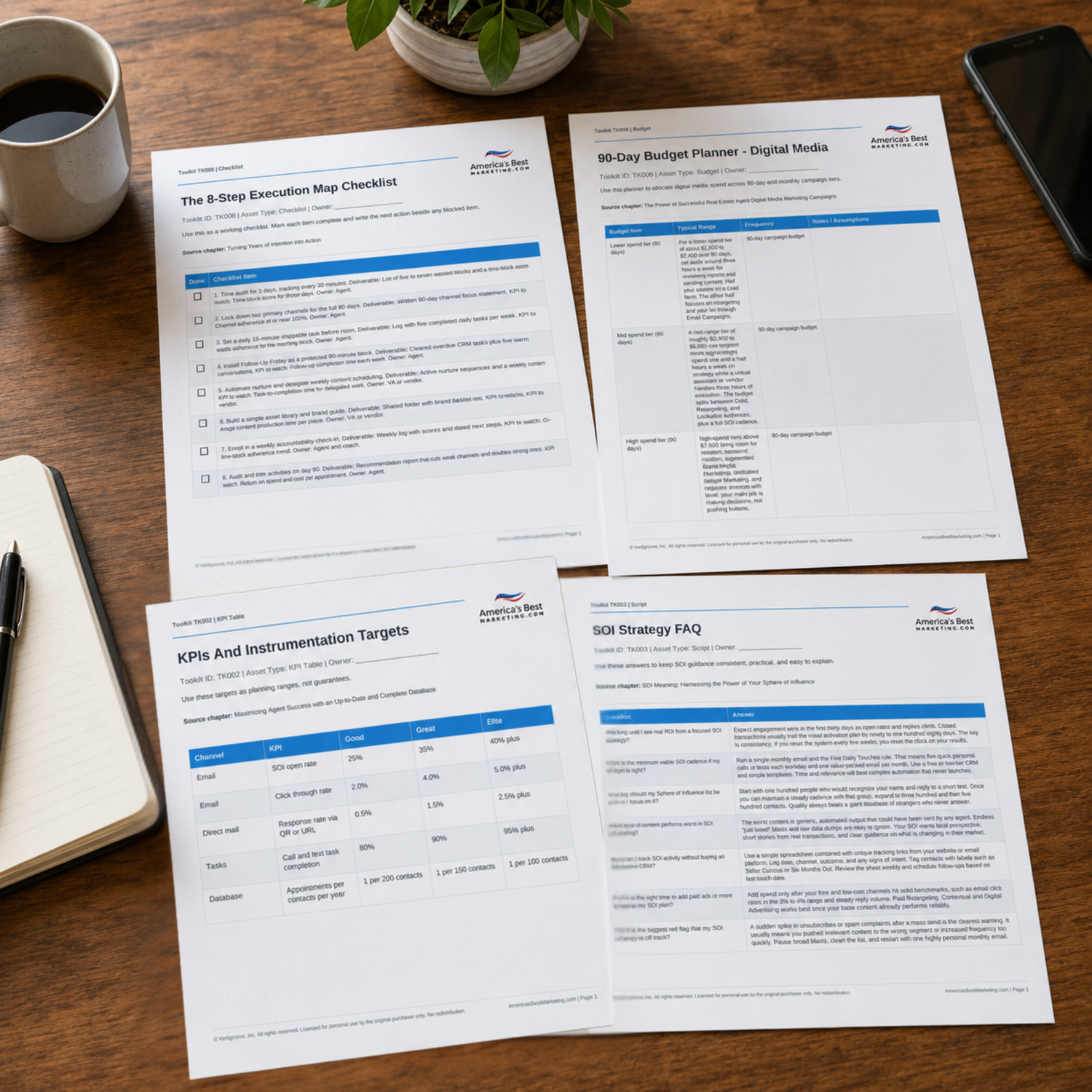
Download The AI Chatbot Toolkit
Use the companion Toolkit to audit your chatbot use case, plan the 60-day rollout, review compliance guardrails, benchmark KPIs, and tighten the scripts before scaling traffic.
Download the Toolkit ZIPSetup Checklist That Prevents Hallucinations
Your bot should identify itself as AI, then offer two fast paths: ask a question, or request a call. Transparency is not optional.
- Define the handoff rule: Decide exactly when a human takes over, including showing requests, timeline under 30 days, financing questions, pricing conversations, or negotiation requests.
- Write the first five prompts: Keep qualification short and skimmable. Ask one preference at a time.
- Build a controlled knowledge base: Include only facts you can verify. Avoid information that changes weekly unless you can maintain it weekly.
- Force uncertainty behavior: When the bot does not know, it says it does not know and routes to the agent. Never allow guessing.
- Capture market language: Store exact visitor questions, then turn them into page copy, email topics, and content improvements.
- Attach context to the handoff: Include the last five messages, a simple lead score, and the next best action so the first human reply has momentum.
The 12-Point AI Compliance And Safety Audit
Compliance is not only about avoiding bad answers. It is about proving you have controls. Run this list before you go live and after every major update.
| Control | Required operating standard |
|---|---|
| AI disclosure | The bot identifies itself as AI in the first message. |
| Human escape hatch | Every chat offers an obvious way to reach a human, including after hours. |
| Fair Housing controls | Sensitive questions route to controlled answers or to a human, with no improvisation. |
| No guessing policy | If the bot is not sure, it escalates instead of inventing an answer. |
| Property facts policy | The bot never states property facts unless pulled from a controlled source. |
| Advice policy | The bot avoids legal, tax, and negotiation advice and routes to the agent or a licensed professional. |
| Privacy notice | The bot discloses that chats may be stored and used for service improvement. |
| Consent capture | The bot asks permission before texting or adding someone to email follow-up. |
| Data minimization | The bot avoids collecting sensitive personal data unless required for next steps. |
| Retention window | You set a retention window and can delete transcripts on request. |
| Prompt attack test | You test for users trying to override rules with tricks or fake instructions. |
| Hallucination testing | You run a structured test suite and confirm the bot answers or escalates correctly. |
Creative And Messaging That Makes The Bot Feel Human
Most bots fail because the greeting is vague. Give people a reason to type, not a blank wall of small talk. Lead with what they want, then route to action.
Prompt the action before the form
Try focused openers such as, “Want the private remarks for this listing?” or “Want a list of homes hitting the market this week?” The question should make the next action obvious.
Offer soft, mid, and hard paths
Soft CTAs invite a question. Mid CTAs offer a new-listings list, home value range, or saved search. Hard CTAs request a 15-minute call or showing window.
Budgets And Briefs You Can Actually Run
A bot needs traffic. The goal is to drive qualified clicks into a conversation funnel, not to rack up impressions.
Push return visitors into chat
Spend 450 to 750 dollars per month with an always-on cadence refreshed every 14 days. Split 60 percent retargeting and 40 percent contextual to capture contact permission from warmer visitors.
Scale appointment triggers
Spend 900 to 1,600 dollars per month with weekly creative refreshes. Split 50 percent retargeting, 30 percent contextual, and 20 percent lookalike to push more showing and consultation requests.
Convert warm site traffic
Audience is visitors to listing pages and valuation pages. Headline: Get answers fast, then talk to a human when you are ready. CTA: Start chat.
Qualify without forcing a form
Audience is contextual traffic researching schools, neighborhoods, commute, or price range. Headline: Share budget and timeline, and I will send a short list. CTA: Get my list.
KPI Benchmarks That Keep The System Honest
These KPIs are guardrails. If you miss them, fix the workflow before you spend more. The goal is not more chats. The goal is more qualified handoffs.
| Benchmark | Where | Target range | What to do if low |
|---|---|---|---|
| First reply speed | Website chat | 0s to 10s | Shorten the greeting. Remove form-like questions from message one. Offer a quick-options button set. |
| Conversation completion | Triage flow | 35% to 60% | Cut question count. Move contact permission later. Offer the useful deliverable earlier. |
| Contact capture | All chats | 15% to 35% | Ask permission in exchange for something useful, such as a shortlist, showing times, new listings, or a value range. |
| Ready-now handoff | High-intent chats | 8% to 18% | Define ready-now signals more clearly and escalate faster when those signals appear. |
| Human response after handoff | Agent follow-up | Under 5 minutes | Use a dedicated notification channel. Attach transcript context so the first human message is relevant. |
Mini Case Pattern You Can Steal
The Sterling Team was losing roughly 40 percent of portal leads because their response time averaged two hours. They implemented AI chatbots on their website and Facebook page and created a zero-delay first response for every inquiry.
The bot pre-qualified prospects by asking timeline and budget, then alerted a human agent only when a ready-now signal was detected. Within 90 days, the team saw a 22 percent lift in appointment sets and used the time saved to improve follow-up and coaching for junior agents.
Use the case pattern carefully. The point is not to promise a specific result. The point is to show the operating logic. The AI greets everyone instantly, but only the right conversations reach your phone.
For deeper strategy on blending automation into your lead engine, read Leveraging AI in Real Estate Marketing and Automation for Lead Generation.
How This Becomes Marketing
A chatbot workflow is more than a website utility. It is a positioning asset. It lets you show prospects that your response system is organized, your follow-up is intentional, and your automation has guardrails.
Turn the workflow into recurring content across Real Estate Blog Writing Services, Social Media Marketing, Listing Marketing, Email Campaigns, Direct Mail, and Digital Retargeting. Each channel should tell the same story: you respond fast, qualify intelligently, and escalate when judgment matters.
If you want a chatbot that qualifies leads, stays compliant, and hands off cleanly, build it into a full multi-channel system. AmericasBestMarketing.com can set the workflow, tracking, and guardrails so your phone rings for ready-now conversations. Learn more about done-for-you real estate marketing for agents.
Recommended reads
Recommended Reads for Real Estate Agents
These articles help agents connect follow-up discipline, database habits, client communication, and marketing execution into a repeatable system.

Leveraging AI in Real Estate Marketing and Automation for Lead Generation
Use AI and automation to save time while keeping strategy, compliance, and client judgment intact.
Read article
AI for Real Estate SEO: What to Automate, What to Avoid, and How to Measure Impact
Turn search visibility into a clearer publishing system for neighborhoods, services, and client decisions.
Read article
SEO-Friendly Blog Titles for Real Estate Agents: Templates + A/B Testing Checklist
Build organic reach with pages and posts that are easier to find, trust, and act on.
Read article
AI Beyond Lead Generation: Using AI to Boost Real Estate Agent Productivity
Turn automation into cleaner workflows for content, follow-up, and weekly execution.
Read articleAI Chatbot Questions Agents Should Be Ready To Answer
Will an AI chatbot make my brand feel impersonal?
Not if you set it up as a fast greeter and a clean router. Use your tone, keep answers short, and offer a human option early. The bot should never argue, lecture, or overshare. The default experience should feel like speed and clarity, not like being trapped in a script.
What is the best AI chatbot for a single agent on a budget?
Pick a tool that exports transcripts, supports a controlled knowledge base, and routes to phone, text, or email with context. Fancy features matter less than control. If the bot cannot say it does not know and escalate, it is not ready. Keep scope tight to one use case and one channel.
How long does it take to see measurable ROI from automation?
Process wins show up first: faster first reply, fewer dead-end chats, and cleaner notes. Many teams can validate those signals within 30 days if they review transcripts twice per week. Appointment lift comes later and depends on traffic volume. Track benchmarks, then adjust greeting and handoff rules before you increase spend.
What is the major red flag to avoid when setting up an AI bot?
A bot that guesses. If it can invent answers, it can invent problems. Lock down facts, Fair Housing responses, and anything that resembles advice. Force uncertainty behavior so it escalates instead of improvising. Accuracy beats personality every time.
How do I keep the bot compliant with Fair Housing rules?
Do not allow free-form answers to sensitive topics. Use controlled scripts and routing rules. A safe pattern is to answer at a high level, then offer a human conversation for specifics. Also avoid collecting sensitive personal data in chat. When a question feels like it could steer, escalate and document the handoff.
Should my chatbot answer pricing or negotiation questions?
Let it set expectations and route, not advise. The bot can explain process and what factors affect outcomes, but it should not recommend offer terms or make predictions. Treat it as a co-pilot that gathers context and schedules time with you. When money shows up in the chat, that is usually the handoff moment.
Can I use chatbot transcripts to improve SEO and content planning?
Yes. Transcripts capture the exact words your market uses. Export questions weekly, group them by intent, then turn them into short answers on key pages. This also sharpens retargeting creative because you can mirror real questions. The bot becomes a listening post, not just a responder, which compounds your marketing over time.
Next step
Build the System Behind the Automation
Continue from one useful article into the larger ABM ecosystem: the book series for strategic depth and the full marketing program for done-for-you execution.

View the Book Series
Explore the America’s Best Real Estate Agent Marketing System books for a deeper strategic framework around visibility, referrals, listings, lead generation, and growth.
View the Book Series
See Full Marketing Program
See how AmericasBestMarketing.com runs real estate blog writing, social media, listing marketing, email, direct mail, and retargeting as one managed system.
See Full Marketing Program