AI Beyond Lead Generation: Using AI to Boost Real Estate Agent Productivity
AI Beyond Lead Generation
A Productivity Operating System for Real Estate Agents
A practical AI workflow for faster follow-up, sharper market summaries, cleaner transaction preparation, consistent content, and measurable weekly execution.

How AI Improves Real Estate Agent Productivity
AI improves real estate agent productivity when it handles the first draft, summary, organization, and task preparation inside work the agent already owns. The highest-value use is not another lead form. It is a dependable operating layer that shortens follow-up, turns market data into client-ready explanations, prepares transaction notes, and creates usable content while the agent protects time for judgment and live conversations.
- Treat AI as an operations assistant that drafts, summarizes, and prepares work while the agent retains judgment and approval.
- Build reusable prompts for communication, market data, transaction administration, and content instead of reinventing every task.
- Connect AI activity to completed CRM tasks, client touches, appointments, and listing preparation so the gain is measurable.
- Start with one stable weekly rhythm, then add integrations and reporting only after the core workflow becomes reliable.
Why AI Pays Off Beyond Lead Generation
The largest productivity loss in a real estate business often sits in the messy middle of the day. Warm lead replies wait for personalization. MLS exports need interpretation. Inspection notes have to become action items. Listing descriptions, client updates, captions, and email drafts remain half-finished because every task starts with a blank screen.
AI changes that operating pattern. It creates a fast first version from the notes, data, and instructions the agent provides. The agent then edits for accuracy, local nuance, voice, compliance, and the next useful step. That shift from writing everything to reviewing prepared drafts protects the time that should be spent on consultations, pricing strategy, negotiations, and relationship development.
Pair the system with the lead workflow in How to Get Real Estate Leads Online, and AI becomes a practical assistant instead of a shiny distraction. Leads still require a disciplined routing and follow-up process. AI simply removes friction from the words, summaries, and preparation surrounding that process.
- Use AI to create drafts and summaries, not to replace final professional judgment.
- Give the model current MLS numbers, local context, CRM notes, and a defined output format.
- Review every client-facing result before it is sent or published.
- Measure completed work and recovered time instead of counting prompts or tool logins.
The Four-Pillar AI Productivity Model
AI works best when it is assigned to clear operating lanes. Communication, data synthesis, transaction administration, and content creation each remove a different bottleneck. The agent remains responsible for the advice and the final decision, while AI accelerates the preparation required to reach that decision.
Communication
Draft warm lead replies, past-client check-ins, open house follow-up, referral thank-you notes, appointment confirmations, and simple nurture messages from CRM notes.
Give the prompt a lead stage, recent interaction, relevant property detail, tone, word limit, and one next step. The output becomes a personalized first draft instead of a generic blast.
Data Synthesis
Turn MLS exports, showing feedback, neighborhood notes, and price changes into short seller updates, buyer summaries, and weekly market briefs.
AI should identify patterns and organize facts. The agent must verify the data, explain what matters locally, and make the final pricing or timing recommendation.
Transaction Administration
Summarize dense documents, organize meeting notes, prepare negotiation concerns, and convert inspection or association material into a reviewable action list.
Use secure tools and limit sensitive uploads. AI can structure the information, but legal interpretation, brokerage policy, negotiation judgment, and client promises remain human responsibilities.
Content Creation
Draft captions, email snippets, listing highlights, educational posts, short video outlines, and content variations from one approved source asset.
Connect that work to Email Marketing for Real Estate Agents, Social Media Management, and Listing Marketing so output supports a coordinated visibility system.
The overlooked gain is the shift from writing to editing. When AI creates the rough draft, the agent spends less time fighting the blank screen and more time improving the message, checking the facts, and moving the client to the next useful step.
Three Reusable AI Prompt Frameworks
A productive prompt is not a clever sentence. It is a reusable operating instruction. Strong prompts define the role, source material, audience, required format, tone, guardrails, and next step. Save the structure, then replace only the client or market details.
Personalized follow-up without the blank screen
Prompt structure
Role lineAct as a real estate follow-up assistant preparing a concise message for my review.
Context lineDraft a 120 word check-in email to a warm buyer who viewed two homes and asked about updated kitchens.
Detail lineMention the school zone, updated counters, and open layout in one short sentence.
CTA lineEnd with one specific next step that invites a reply or a new tour time.
Use this framework for CRM tasks, open house follow-up, private tour recaps, and one-to-one messages between larger campaigns. Save three versions by lead stage so ten tailored drafts can be reviewed in one focused block.
A one-page market snapshot for a seller
Prompt structure
Source lineUse only the attached MLS export and the neighborhood notes below.
Trend lineIdentify three trends that matter for price, time on market, and list-to-sale ratio.
Format lineOrganize the response under prices, market time, competition, and practical timing.
Guardrail lineDo not invent data, make a pricing decision, or present an estimate as a guarantee.
Use the same structure each week so fresh MLS data produces a consistent seller brief. Review the numbers, tighten the language, and pair the summary with a current Listing Marketing plan.
Content that does not consume the morning
Prompt structure
Source lineUse these approved listing notes and this market fact as the only source material.
Output lineDraft three social captions under 80 words, one email snippet, and one short video outline.
Style lineKeep the tone clear, direct, locally specific, and free of exaggerated claims.
CTA lineGive each item one invitation to tour, reply, or ask for the local market summary.
Save the best approved outputs as examples of your voice. Repurpose them through social, email, and Digital Retargeting without asking AI to invent new facts.
Weekly AI Production Plans You Can Repeat
The workflow only creates value when recovered time is redirected into higher-value activity. Put the production block on the calendar, define which CRM tags or active clients need attention, generate the drafts, complete the human review, and record what moved forward.
Reserve one hour each week for one ninety day sprint. Use AI to draft ten follow-up messages and one market summary. Approve every message, log the completed CRM tasks, and spend the saved time calling warm contacts or preparing client consultations.
Reserve ninety minutes each week to combine communication, data synthesis, and one content move. Open the CRM, export the needed notes or data, create the drafts in one controlled session, review them, and schedule only the useful pieces.
A strong sequence begins with the smallest stable system. Do not add complex automations while prompts remain inconsistent or the team has not defined who reviews the output. Reliability matters more than novelty. Once the weekly block produces clean drafts and completed tasks, expand into CRM integrations, saved prompt libraries, and reporting.
KPI Table For AI Productivity
Track metrics that connect AI to time, quality, and completed work. Tool usage is not a business outcome. The operating question is whether the workflow reduces preparation time and creates more client-facing execution.
| Tier | Tool Focus | Ninety Day Spend | Productivity Goal |
|---|---|---|---|
| Low tier | Use free AI entry tools. | $50 to $200 | Build the habit of drafting emails and summaries with AI several times each week. |
| Mid tier | Add paid AI inside the CRM. | $300 to $800 | Automate nudges and listing copy so every warm contact receives consistent, reviewed follow-up. |
| High tier | Run a controlled AI workflow stack. | $1,500 to $3,000 | Use AI for first drafts across the day so agent time shifts into live consultations and strategy. |
Drafting and synthesis speed
Compare the minutes required for follow-up drafts, MLS summaries, listing copy, and meeting preparation before and after AI support.
Follow-up compliance
Measure the percentage of CRM tasks completed on or before the due date and the number of client touches finished each week.
Appointments and prepared work
Track AI-supported threads that lead to calls, tours, strategy sessions, listing preparation, or another defined revenue-producing step.
Compliance And Ethics You Still Own
AI can draft faster than an agent, but it does not understand the full Fair Housing risk, brokerage policy, client context, or lived impact of its language. The objective is to speed up the mechanics of preparation while keeping tight human control over accuracy, risk, tone, and promises.
- Review every generated post and listing description for protected-class references, steering, unequal treatment, or unsupported claims.
- Limit sensitive uploads to approved secure tools, especially for identity information, financial records, transaction documents, and association material.
- Ground market claims in current MLS data, verified public information, or direct client-service experience.
- Ask the broker before using AI on transaction documents, negotiation summaries, client records, or advertising copy with compliance exposure.
- Document the source, prompt purpose, reviewer, and approval process for recurring high-risk workflows.
A practical rule is simple. Let AI hold the high-volume words and organization while the agent holds the judgment, promises, professional advice, and final call to action.
Mini Case: How Sarah Recovered Three Hours A Week
Sarah was a solo agent who spent four hours each week writing thirty personalized follow-up emails and two listing descriptions from scratch. Her pipeline contained active online leads, but the volume of small writing tasks made every response feel late.
She created one approved prompt for each lead tag, including warm seller, first-time buyer, past client, and recent open house visitor. She exported only the notes needed for each group and used AI to prepare all thirty follow-up drafts plus two pieces of listing copy in fifteen minutes. Sarah then spent thirty minutes tightening introductions, correcting local details, adjusting pricing nuance, and personalizing each sign-off.
The edit-first workflow recovered more than three hours of administration time each week. Sarah redirected that block into fifteen focused calls, past-client strategy sessions, and listing preparation. The result was not a magical AI lead source. It was a cleaner operating system that moved more existing opportunities toward a live conversation.
Launch The Workflow In Seven Steps
- Choose one repetitive, text-heavy task that is easy to review.
- Record the current time required and the quality standard the output must meet.
- Build one prompt with role, source, audience, format, tone, guardrails, and next step.
- Test the prompt on real but appropriately protected source material.
- Review every output for facts, voice, compliance, local nuance, and client value.
- Save the approved prompt and examples in one shared operating library.
- Run the workflow for ninety days and measure time saved, tasks completed, and conversations created.
Start with a weekly market update, a follow-up batch, or a content repurposing task. Once the routine is reliable, connect it to the broader conversion work in Turning Real Estate Leads into Loyal Clients.
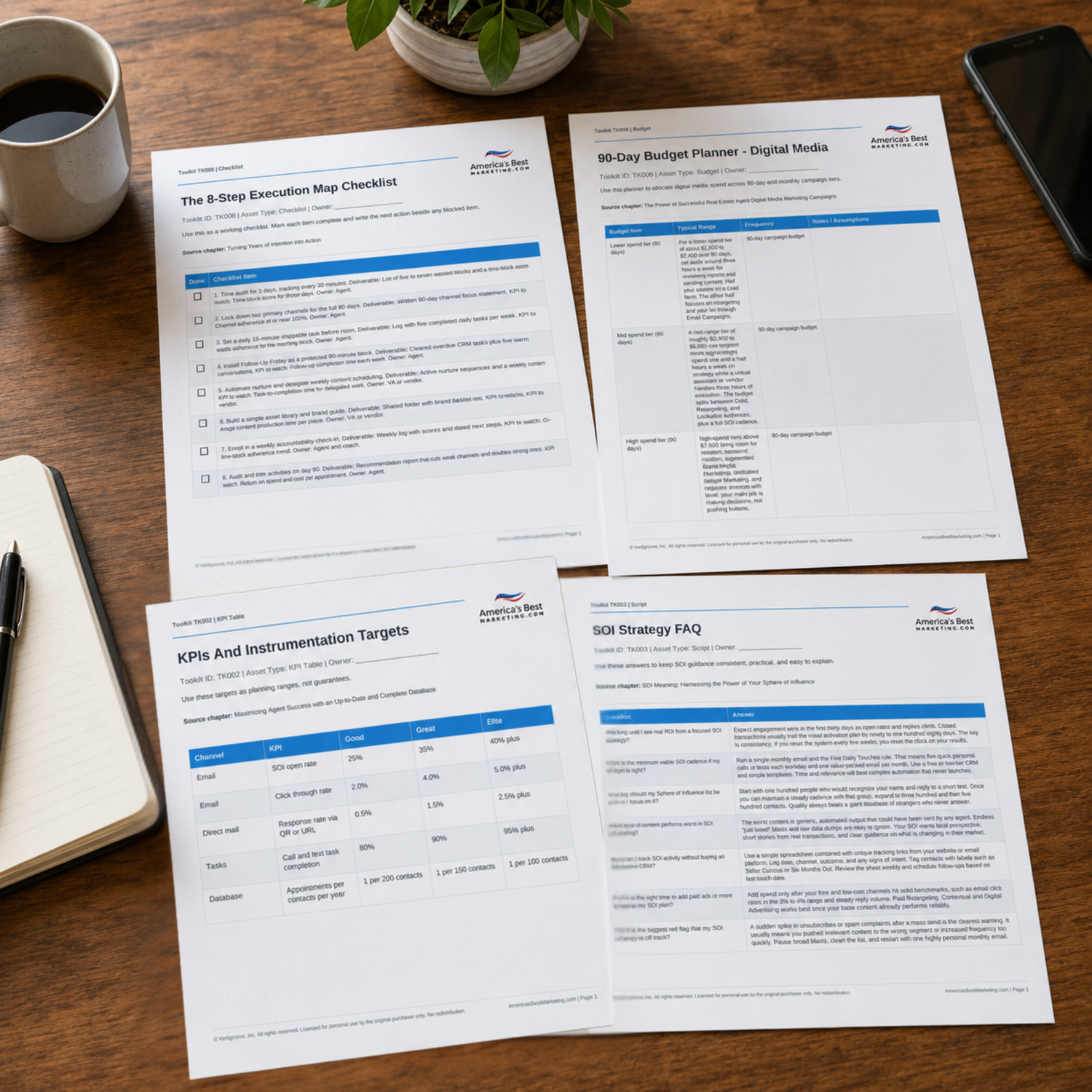
Download The AI Productivity Workflow Toolkit
The six-resource Toolkit ZIP includes an AI workflow execution checklist, an investment-tier KPI table, a productivity FAQ, and three reusable prompt scripts for follow-up, market snapshots, and content creation.
Download the Toolkit ZIPRecommended Reads for Real Estate Agents
These articles help agents connect follow-up discipline, database habits, client communication, and marketing execution into a repeatable system.

Leveraging AI in Real Estate Marketing and Automation for Lead Generation
Use AI and automation to save time while keeping strategy, compliance, and client judgment intact.
Read article
AI for Real Estate SEO: What to Automate, What to Avoid, and How to Measure Impact
Turn search visibility into a clearer publishing system for neighborhoods, services, and client decisions.
Read article
Evergreen Content for Real Estate Agents: Build Posts That Rank for Years (and Compound Leads)
Build organic reach with pages and posts that are easier to find, trust, and act on.
Read article
AI Chatbots for Real Estate Agents: Best Use Cases, Setup Checklist, and Compliance Guardrails
Adopt AI where it reduces friction, not where it weakens trust or adds noise.
Read articleAI Productivity Questions Real Estate Agents Ask
How long does it take to see real productivity gains from AI?
Time savings can show up in the first week because AI removes the blank screen for emails, reports, captions, and summaries. Business impact takes longer because saved time has to be redirected into live prospecting, appointment setting, and client strategy. A ninety day sprint is a practical window for judging whether the workflow is creating cleaner follow-up and more completed work.
What is the minimum viable AI workflow if my budget is tight?
Start with one daily move and one weekly move. Each day, have AI draft five client emails or texts from CRM notes. Each week, paste fresh MLS data into AI and request a short market summary. Those two habits protect time, keep your expertise visible, and give you a measurable starting point before you add more tools.
How do I keep AI content from sounding generic?
Give AI examples of your best emails, listing notes, and market commentary. Ask it to match your tone, sentence length, and level of directness. Then edit the first line, the local details, and the closing ask yourself. AI should supply the draft, but your judgment should make the message feel specific and trustworthy.
What should real estate agents never delegate fully to AI?
Do not delegate pricing judgment, compliance judgment, Fair Housing review, negotiation nuance, or final client promises to AI. Use AI to summarize information, organize options, and draft support material. The agent still owns the advice, the risk, the tone, and the final call to action.
Which real estate tasks are best for AI first?
The best first tasks are repetitive, text-heavy, and easy to review. Examples include follow-up emails, listing caption drafts, weekly market summaries, call prep notes, inspection summary outlines, CRM task recaps, and content repurposing. Avoid starting with complex automations until the basic prompt routine is reliable.
How can I measure AI return on investment without a complex dashboard?
Run a two week baseline before AI and a two week test after AI is added. Track minutes spent on follow-up, market reports, listing copy, and social posts. Then track whether the saved time turns into calls, appointments, client touches, or listing prep. The return is not only time saved. It is the completed revenue-producing work that time makes possible.
Is AI useful if I only focus on social media presence right now?
Yes. AI can turn listing notes, buyer questions, market data, and client stories into caption drafts, short video outlines, email snippets, and ninety day content themes. The agent should still approve every post, but AI can reduce the heavy lift of getting from idea to usable first draft.
Next step
Build The Marketing System Around The Workflow
Continue from a productive AI workflow into the larger ABM ecosystem: the book series for strategic depth and the full marketing program for managed execution.

View the Book Series
Explore the America’s Best Real Estate Agent Marketing System books for a deeper framework around visibility, referrals, listings, lead generation, and scalable execution.
View the Book Series
See Full Marketing Program
See how AmericasBestMarketing.com runs blog writing, social media, listing marketing, email, direct mail, and retargeting as one managed system.
See Full Marketing Program