Working With Investor Clients
How agents find, qualify, and serve capital-ready buyers
An investor-client operating system for real estate agents who want clearer buy boxes, faster proof of funds, stronger deal summaries, and a repeatable acquisition cadence.

Working with investor clients, in plain English
Working with investor clients becomes scalable when you stop acting like a listing sender and start acting like an operator. Define the buy box, verify capital early, send one-page deal summaries, and keep investor communication on a fixed rhythm. The agents who win this niche make decisions easier with numbers, not louder with sales pressure.
- Investor clients do not buy houses first. They buy risk, return, time, and control.
- The buy box should define property type, price band, location, condition, strategy, and minimum return threshold before any property is sent.
- Proof of funds should happen before showings, hot deal alerts, and long underwriting conversations.
- Direct mail, IDX filters, email, retargeting, and follow-up work best when they support one investor acquisition system.
Why Investor Clients Can Change The Shape Of Your Business
Investor clients can create a different business rhythm than retail buyers. They move faster when the math works, they can transact repeatedly, and they often care more about process clarity than emotional reassurance. That creates leverage for the agent who brings structure.
The catch is that investors punish vague marketing. A pretty property post is not enough. The conversation must show return, condition, risk, financing readiness, and the next action. That means your marketing cannot be a random collection of listings. It needs to operate as a pipeline that attracts, qualifies, and nurtures people who can act.
Start by tightening speed-to-lead and task discipline with Turning Real Estate Leads into Loyal Clients. Then use Email Marketing for Real Estate Agents to deliver deal math, market yield notes, and clean next steps to the people most likely to buy again.
- You create repeat potential because one qualified investor can buy more than once in a year.
- You reduce emotional friction because the conversation revolves around criteria, assumptions, and numbers.
- You improve marketing accountability because every channel can be measured against verified investors and deal summaries sent.
The Investor Buying Loop
Investor clients do not need another inbox full of listings. They need a decision workflow. The loop is simple: define the buy box, source inventory, run a quick screen, present a deal summary, verify proof of funds, then move to offer fast when the assumptions hold.
The Buy Box is the investor’s filter set: price band, property type, location, condition, strategy, and minimum return target. You should be able to state it in one breath and document it on one page. If you cannot write it down, you cannot market to it.
Cap Rate Compression happens when prices rise faster than net operating income, pushing cap rates down. Investors respond by tightening acquisition criteria, demanding better terms, or shifting asset types. Your value rises when you notice this early and adjust sourcing before weak deals waste the investor’s time.
Gross Rent Multiplier is a fast screen: purchase price divided by gross annual rent. It is not full underwriting, but it helps you kill obvious misses quickly before spending time on comps, renovation assumptions, and financing details.
Proof Of Funds Velocity is the speed and reliability of capital verification. Serious investors can produce current proof quickly and without drama. Slow proof of funds is not a harmless quirk. It is an operational risk that can weaken offers and burn seller trust.
Define the rules before the search
Collect target area, property type, budget, strategy, hold period, condition tolerance, financing plan, and minimum return threshold before you send property options.
Tag the investor by strategy in your CRM so future messages can match rental income, fix-and-flip, small multifamily, or light value-add goals.
Verify ability before activity
Ask for proof of funds or lender documentation early. Frame it as a service standard, not a barrier. You want to write stronger offers when the right property appears.
Reserve deeper underwriting and showing time for investors who have a clear buy box and the capital readiness to move.
Send math instead of noise
Replace raw MLS links with a one-page summary showing price, rent range, rehab notes, basic return assumptions, location logic, and a clear yes-or-no next step.
Every summary should make the decision easier. If the investor must rebuild your analysis from scratch, the system is too thin.
Most agents overlook that professional investors are not searching for a house. They are searching for a predictable return on time and capital. High-performance operators stop sending listings and start sending deal summaries that reduce the analytical work before the investor opens the link.
Three Investor Scripts You Can Use Today
Investor communication should be direct. Avoid hype, avoid decoration, and avoid asking them to decode your message. Lead with the constraint they care about, then ask for the next decision.
The buy box intake script
Agent dialogue
Hook lineI only want to send deals that match your criteria, so let’s define the buy box first.
Middle lineI need area, budget, strategy, condition tolerance, return target, and timeline before I start filtering inventory.
CTA lineSend me those six inputs today and I will translate them into a one-page acquisition profile.
Use this before adding an investor to a hot deal list. The goal is fewer leads with better intent.
The proof of funds script
Agent dialogue
Hook lineWhen the right property appears, speed and credibility will matter as much as price.
Middle lineBefore I send deal summaries and request showings, I need current proof of funds or lender documentation on file.
CTA lineSend that over and I can move you into the verified investor group.
This protects your calendar and strengthens your offers. Serious investors understand the standard.
The deal summary follow-up script
Agent dialogue
Opening lineI sent the one-page deal summary with price, rent range, rehab notes, and the assumptions I used.
Explain lineThe numbers are close to your stated threshold, but the condition risk needs a quick review.
CTA lineDo you want a 10-minute underwriting call today, yes or no?
Binary follow-up reduces drift. Investors appreciate a fast yes, a fast no, or a sharper revised buy box.
The 12-Week Investor Acquisition Playbook
This playbook has one job: create qualified investor conversations every week. Each phase covers infrastructure, sourcing, and follow-up. Skipping steps creates noise. Investors reward clean inputs.
Weeks 1 to 4 focus on infrastructure and sourcing. Build investor-specific landing pages and saved searches through IDX Real Estate Websites. Create a buy box intake, an off-market buyer list signup, and a market yield report signup. Then build sourcing lists around absentee owners, inherited property, code violations, tired rentals, and long-hold owners.
Weeks 5 to 8 focus on nurture and authority. Send one weekly market yield report that reads like an operator memo: rent ranges, days on market, price cuts, and one short deal teardown. Support the trust layer with review and reputation habits from Impactful Client Appreciation, Reviews, and Reputation Management.
Weeks 9 to 12 focus on scale. Turn high-intent pages into a retargeting audience using Digital Retargeting. Tighten your qualification script, your proof-of-funds rule, and your follow-up timing. The goal is not more raw leads. The goal is higher intent and faster decision cycles.
Spend $650 per month. Cadence is one yield report per week, two hot deal alerts per week, and one direct mail drop per month. Audience split is 60 percent investor list growth and 40 percent off-market seller targeting. Frequency cap is 6 to 9 retargeting impressions per week for site visitors. Confirm list size before using this budget.
Spend $1,500 per month. Cadence is one yield report per week, three hot deal alerts per week, and two direct mail drops per month. Audience split is 50 percent investors and 50 percent off-market inventory. Frequency cap is 8 to 12 impressions per week for high-intent visitors. Confirm mail volume and retargeting budget before launch.
Creative That Sounds Like An Operator Memo
Investor marketing fails when it sounds like retail marketing. Your creative should signal underwriting, sourcing, and follow-up discipline. Make every headline feel like a memo, not a pitch.
- Off-market alert: neighborhood cash flow opportunities.
- New deal summary: rent, rehab, and exit math in one page.
- Buy box workshop: define your criteria in 10 minutes.
- Rental yield snapshot: what cash flow looks like by zip code.
- Landlord exit plan: sell as-is with a clear timeline.
A soft call to action can offer a cap rate calculator and a deal summary worksheet. A mid-level call to action can invite prospects to join the VIP off-market list with buy box intake and proof of funds. A hard call to action can invite the agent to book 1:1 Marketing Coaching to audit the investor funnel.
For sellers who may feed your investor pipeline, use Direct Mail to reach tired landlords, inherited-property decision-makers, and long-hold owners. Then use Listing Marketing and Social Media Marketing to show that your investor process is organized, visible, and market-aware.
KPI Table For Investor Lead Quality
Use benchmarks as instrumentation, not guarantees. The purpose is to spot leaks, compare channels, and decide where to spend the next hour. If a number drifts outside range, fix the process before buying more traffic.
| Metric | Channel | Target | Benchmark Notes |
|---|---|---|---|
| Cost per investor lead | Digital ads | $25 to $45 | Controls list growth pace and keeps acquisition spend from drifting into vanity traffic. |
| Email open rate | 35% to 45% | Signals whether investors trust your market yield reports and hot deal alerts enough to keep watching. | |
| Buy box intake conversion | Website and IDX | 2% to 5% | Shows whether your offer is clear enough for prospects to share criteria before a call. |
| Repeat transactions | Database | 1 to 2 per active investor client per year | Confirms that the investor niche is becoming a compounding relationship system, not a one-off lead source. |
The 10-Point Investor Specialist Audit
This audit forces clarity. Investors respect speed, but they trust consistency. Treat it as your weekly reset until every point becomes automatic.
- Define one buy box per strategy and keep each one to one page.
- Require proof of funds before sending deal summaries or booking showings.
- Build a deal summary worksheet with purchase, rehab, rent, and exit assumptions.
- Set up IDX filters that match the buy boxes you actually want to serve.
- Track GRM and cap rate ranges by neighborhood, not just by city.
- Run one off-market sourcing channel weekly and log responses.
- Send a market yield report on a fixed day and time every week.
- Tag investor leads by strategy in your CRM for clean segmentation.
- Use a two-step follow-up rule: day-one call, day-two email summary.
- Review funnel numbers weekly and repair the biggest drop-off first.
Working with investor clients pays when the niche becomes a system: clear criteria, clean qualification, predictable communication, and deal summaries that make decisions easier. Investors reward operators who reduce friction. They punish randomness.
How This Becomes Marketing
Your investor process can become a content engine. Every buy box, yield report, deal teardown, and seller options grid can become a blog post, email, social video, direct mail piece, or retargeting message that demonstrates competence before a prospect talks to you.
Use Real Estate Blog Writing Services, Email Campaigns, Direct Mail, and retargeting as one market presence system. Each channel should reinforce the same operating promise: you help investor clients make clearer decisions with less wasted motion.
If you want support turning the investor engine into a repeatable acquisition system, AmericasBestMarketing.com can build the content, campaign rhythm, follow-up assets, and channel stack around the way serious investors actually make decisions.
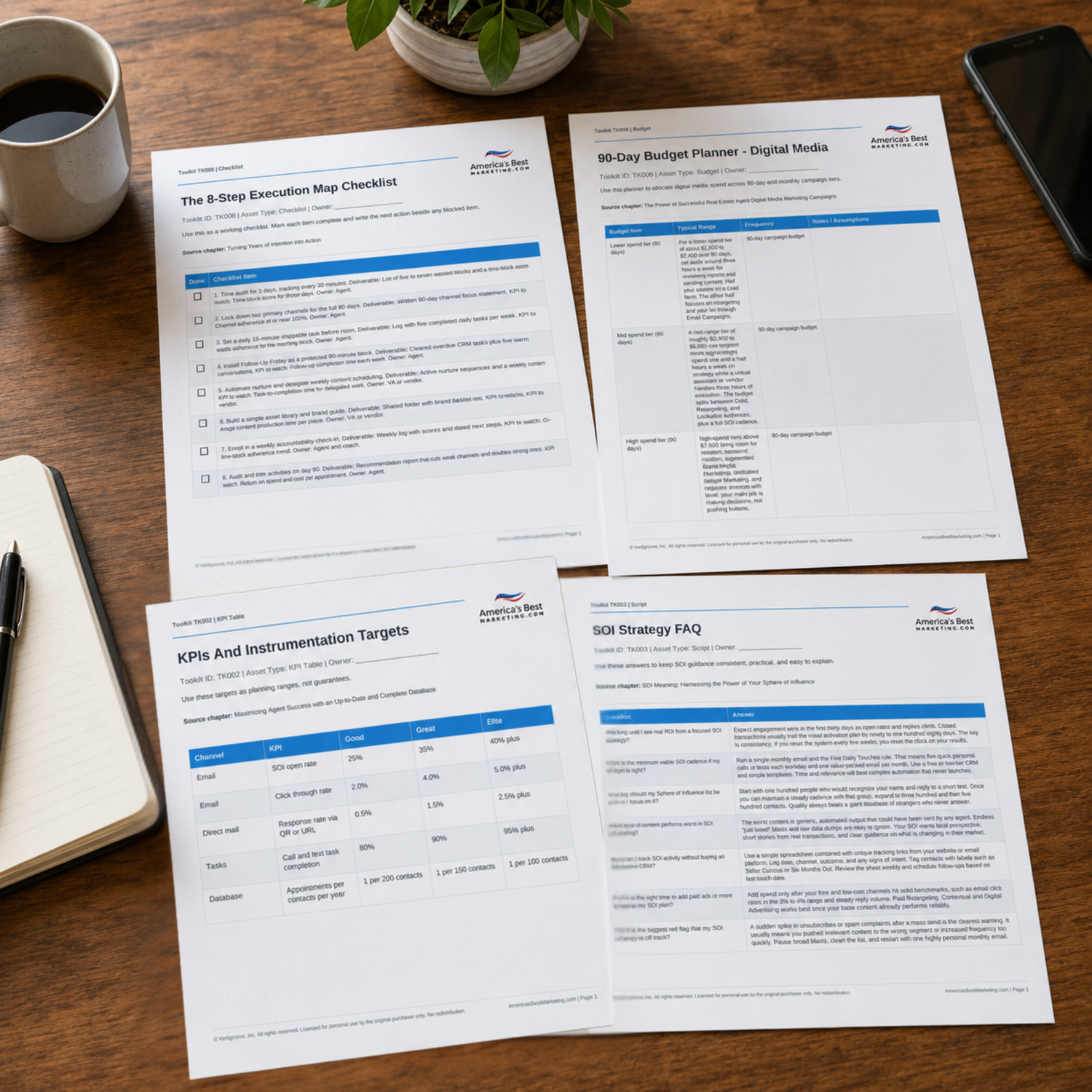
Download The Investor Client System Toolkit
Use the companion Toolkit to tighten your buy box intake, proof-of-funds workflow, deal summary process, KPI tracking, 12-week acquisition cadence, and investor specialist audit.
Download the Toolkit ZIPRecommended reads
Recommended Reads for Real Estate Agents
These articles help agents connect follow-up discipline, database habits, client communication, and marketing execution into a repeatable system.

Investing in Commercial Real Estate: What to Know
Use investing in commercial real estate to create a stronger bridge between client education and real conversations.
Read article
Fixer-Upper Clients: How Real Estate Agents Market, Price, and Close Renovation Deals
Turn fixer-upper marketing into a repeatable workflow that supports trust, listings, and future conversations.
Read article
Building a Trusted Brand: The Key to Attracting Target Audiences Over Paid Leads and Mass Marketing
Turn personal brand work into a system clients can notice, remember, and trust.
Read article
Commercial Real Estate for Real Estate Agents: How to Break In and Market Your First Deal
Bring more structure to commercial real estate so every touchpoint supports visibility and trust.
Read articleInvestor Client Questions Agents Should Be Ready To Answer
How long does it take to see ROI from investor marketing?
Expect the early phase to feel like infrastructure work: buy box clarity, intake, and list building. Many agents see the first qualified conversations within a few weeks once lead capture and follow-up cadence stays consistent. ROI usually shows up as repeatability: the second and third deal with the same investor, plus faster offers because proof of funds and criteria stay on file.
What is the biggest red flag in a new investor lead?
The biggest red flag is vague criteria paired with slow capital verification. Serious investors can state a buy box in plain language and produce proof of funds quickly. If a lead wants dozens of showings before sharing strategy, budget, and timeline, they will drain your calendar. Require criteria and proof of funds before you send deal summaries.
How do I find off-market properties for my investors?
Start with motivated owner segments: tired landlords, inherited property decision-makers, long-hold owners, and deferred-maintenance homes. Use direct mail to create a simple response path, then route every reply into a property options call. Add a landing page that offers a clear as-is exit and capture form submissions. Track responses weekly and double down on the segments that produce conversations.
How do I qualify an investor without sounding pushy?
Frame qualification as service. Tell them you only send deals that match their buy box, so you need five inputs: area, budget, strategy, minimum return target, and timeline. Then ask for proof of funds so you can write strong offers when the right deal appears. Serious investors respect the structure because it saves time for both sides.
What should I send instead of a raw MLS link?
Send a one-page deal summary. Include purchase price, rent range, rehab notes, a quick GRM screen, and a simple cash-on-cash estimate with assumptions stated clearly. Attach three photos and a short location note, then ask one binary question: do you want a 10-minute underwriting call, yes or no? This keeps decisions fast and measurable.
Do I need to specialize in multifamily to work with investors?
No. Many investors start with single-family rentals, small duplexes, or light value-add projects. The specialization is not asset type. The specialization is your process: buy box clarity, underwriting discipline, and consistent sourcing. When you run the same steps every week, you can serve investors across property types without losing control of your schedule.
How do I keep investor clients loyal after the first closing?
Turn the relationship into a cadence: a weekly yield report, hot deal alerts that match their criteria, and a quarterly portfolio review that updates goals and return targets. Save their proof of funds and strategy notes so they never have to repeat themselves. Then run post-close follow-up like an operator: clear timelines, simple check-ins, and a referral ask tied to results and trust.
Build The Investor Engine Before You Scale It
Start with two actions. First, create a buy box worksheet for your top three neighborhoods and set minimum return thresholds you can defend. Second, schedule a 1:1 Marketing Coaching call to audit your investor lead gen funnel, intake rules, follow-up timing, and deal summary workflow.
Next step
Build the System Behind the Advice
Continue from one useful article into the larger ABM ecosystem: the book series for strategic depth and the full marketing program for done-for-you execution.

View the Book Series
Explore the America’s Best Real Estate Agent Marketing System books for a deeper strategic framework around visibility, referrals, listings, lead generation, and growth.
View the Book Series
See Full Marketing Program
See how AmericasBestMarketing.com runs real estate blog writing, social media, listing marketing, email, direct mail, and retargeting as one managed system.
See Full Marketing Program