Commercial Real Estate for Real Estate Agents
How to break in and market your first deal
A 12-week commercial launch plan for agents who want to move from residential relationships into owner outreach, investor conversations, underwriting, and listing opportunities.

How real estate agents can break into commercial real estate
The fastest path into commercial real estate is not random prospecting. Start with the residential database that already trusts you, identify business owners and investors, choose one commercial niche, and run a 12-week owner outreach cadence tied to underwriting, meetings, and tours.
- Your first commercial opportunity is most likely hiding inside your existing sphere, not inside a cold lead list.
- Pick one sub-sector and one tight footprint for 12 weeks so your message sounds specific instead of aspirational.
- Commercial prospects respond to numbers, risk notes, lease terms, and operational implications more than lifestyle language.
- Track owner conversations, qualified meetings, underwriting requests, and tours before judging revenue performance.
Why Commercial Rewards The Agent Who Brings A System
Commercial real estate looks intimidating because the vocabulary changes. Instead of bedrooms, curb appeal, and lifestyle motivation, the conversation turns to cash flow, lease quality, tenant demand, expense ratios, exit risk, and return. That shift is exactly why a prepared residential agent can stand out quickly.
Commercial fees are larger, timelines are longer, and clients expect a more disciplined advisory process. A buyer or owner wants to know how a property performs, what could go wrong, and how the marketing plan will reach qualified capital. If your brand already earns trust in residential, the upgrade is not a new personality. It is a better operating system.
The strongest first step is to borrow trust from people who already know you. Review your database for business owners, landlords, franchise operators, small investors, and clients who have mentioned rentals or business expansion. Then connect that list to a content rhythm, direct outreach, and practical market notes.
- Use a database audit to tag commercial intent before you spend money on new lead sources.
- Translate commercial terms into plain language so owners and investors feel guided, not tested.
- Build one repeatable launch cadence before expanding into multiple property types.
Build The First-Deal Pipeline From Existing Trust
Start with four working definitions. Cap rate is the return ratio buyers use to compare assets. NOI, or net operating income, is property income after operating expenses and before debt service. A triple net lease shifts taxes, insurance, and maintenance to the tenant. Commercial lead velocity is the number of qualified owner or investor conversations created each week.
Commercial deals usually fall into three lanes: owner-user, investor, and tenant representation. Owner-users care about total occupancy cost and operational advantage. Investors care about NOI durability and exit risk. Tenant reps care about concessions, term structure, and speed. Pick one lane for the first 90 days so every message reinforces the same specialty.
Once the lane is clear, connect the launch to practical ABM service channels: Direct Mail for owner outreach, Listing Marketing for investor-ready property promotion, Email Marketing for Real Estate Agents for database segmentation, and Digital Retargeting for repeat exposure after a prospect visits your market report.
Find commercial intent first
Review occupations, entity names, rental ownership, investor comments, and business addresses inside your sphere. Tag contacts who own space, rent space, or want to buy income property.
Choose one lane
Start with small multi-family, neighborhood retail, flex industrial, or owner-user office only if you can explain the local economics in plain language.
Show the numbers
Build a one-page model with rent roll fields, expense buckets, lease term notes, NOI, and a cap rate range. The model becomes your credibility tool.
Market beyond the sign
Create an investor list, owner list, landing page, and follow-up sequence before you pitch. Owners need proof that your plan reaches qualified buyers or tenants.
Your first commercial deal should come from focus, not variety. The narrower the property type and footprint, the sharper your outreach, content, scripts, and proof become.
Use Short Scripts That Open A Business Conversation
Owners and investors do not need a generic pitch. They need a reason to believe you are tracking the specific economics that matter to them. Lead with a local data point, offer one useful asset, and ask for a small next step.
I track sales and lease activity on this corridor for owners in your property type. Would you like the quick snapshot I use to compare rent, vacancy, and recent pricing?
I underwrite small deals locally and compare cap rate ranges by tenant quality, lease term, and location risk. Would you like my one-page model before you look at the next opportunity?
I watch concessions, vacancies, and space availability in this area each week. If you are planning a move or renewal, I can send the current shortlist that matches your use.
Keep the cadence simple. Send the direct mail piece, make the call, send the email follow-up, log the objection, and schedule the next touch. The agent who tracks the conversation beats the agent who only makes the first contact.
The 12-Week Commercial Launch Plan
Treat the first 12 weeks as a focused market entry sprint. You are not changing your entire business. You are proving whether one niche, one footprint, and one message can produce qualified conversations.
Data and niche selection
Pick one sub-sector, audit your database for commercial intent, build a target list of 60 owners, and create a one-page underwriting cheat sheet with rent, expenses, lease notes, and value range assumptions.
Authority and outreach
Publish a local cap rate snapshot, send 20 owner letters per week, make 10 follow-up calls, and use email to invite tagged contacts into the commercial conversation.
Listing acquisition
Build a five-slide pitch deck that covers market snapshot, underwriting view, marketing plan, buyer or tenant distribution, and next steps. Request three listing or advisory meetings.
Pipeline discipline
Track owner conversations, qualified meetings, underwriting requests, tours, and next actions. If week six is not producing five qualified conversations, narrow the niche or tighten the list.
Commercial content should be useful before it is persuasive. Publish practical angles such as cap rate ranges, rent trend notes, NNN lease risk, small multi-family pricing, industrial flex demand, and how owners should prepare documents before valuation.
Commercial Lead Velocity Comes From Repetition
The budget supports the cadence. It does not replace the cadence. Your job is to create enough owner and investor conversations every week that underwriting opportunities keep moving.
| Tier | 90-Day Focus | Monthly Spend | Target KPI |
|---|---|---|---|
| Starter | Owner direct mail and phone follow-up. | $500 to $1,500 | One percent or better reply rate, plus five qualified owner conversations per week by week six. |
| Mid-range | Retargeting, market guide, email, and direct mail. | $2,500 to $5,000 | Score each inquiry on a 10-point quality scale and review leads scoring seven or higher every week. |
| High commitment | Commercial SEO buildout and investor distribution. | $7,500+ | Month-over-month growth in organic visits to commercial pages plus rising underwriting requests. |
Use one dashboard. Track outreach sent, replies, meetings, underwriting requests, tours, and next actions. If those numbers are scattered across notes, texts, and memory, the system is not ready.
Fix These Gaps Before You Pitch Owners
A commercial owner will sense preparation quickly. Before you ask for a listing meeting, prove that you can speak the language of data, process, and market execution.
- Tag commercial intent inside your CRM and set follow-up tasks for every commercial touch.
- Maintain a rent roll template and an expense checklist you can reuse.
- Know local lease norms for your niche, including term length, bumps, concessions, and tenant improvement expectations.
- Build a buyer profile list with 20 investors, 10 owner-users, and 10 tenants to call.
- Create one underwriting one-pager for every deal you evaluate.
- Prepare a marketing timeline that includes data points, distribution, follow-up, and reporting.
- Practice three conversations: owner outreach, pricing discussion, and buyer objection handling.
Case Pattern: The Strip Center Listing
A residential agent in a growing suburb noticed that a zoning change increased allowable retail density on a main corridor. Instead of announcing a new commercial specialty, the agent pulled parcel data, built a short owner list, and sent a corridor sales and lease snapshot.
Ten owners responded. Three asked for pricing opinions. The agent prepared a simple pitch deck with NOI assumptions, tenant risk notes, recent lease comps, and a marketing timeline. After rehearsing the pricing conversation, the agent won a $2.4 million strip center listing.
The lesson is not that every zoning change produces a listing. The lesson is that commercial trust forms when the agent brings a relevant local observation, a disciplined owner list, and a clear next step. That is a marketing system, not a lucky conversation.
How This Becomes Marketing
Your first commercial campaign should create reusable proof. The cap rate snapshot becomes a blog post. The owner letter becomes a direct mail sequence. The underwriting checklist becomes a download. The investor summary becomes an email campaign. The listing timeline becomes your presentation.
That is where the agent’s marketing starts to compound. A commercial prospect who does not respond today can still see the same advisory point through social media, email, retargeting, direct mail, and local search. The message stays steady: you help owners and investors understand the numbers before they make a move.
If you want help building the marketing engine around this commercial launch, AmericasBestMarketing.com can turn the article, direct mail, email, listing plan, retargeting, and reporting into one managed system.
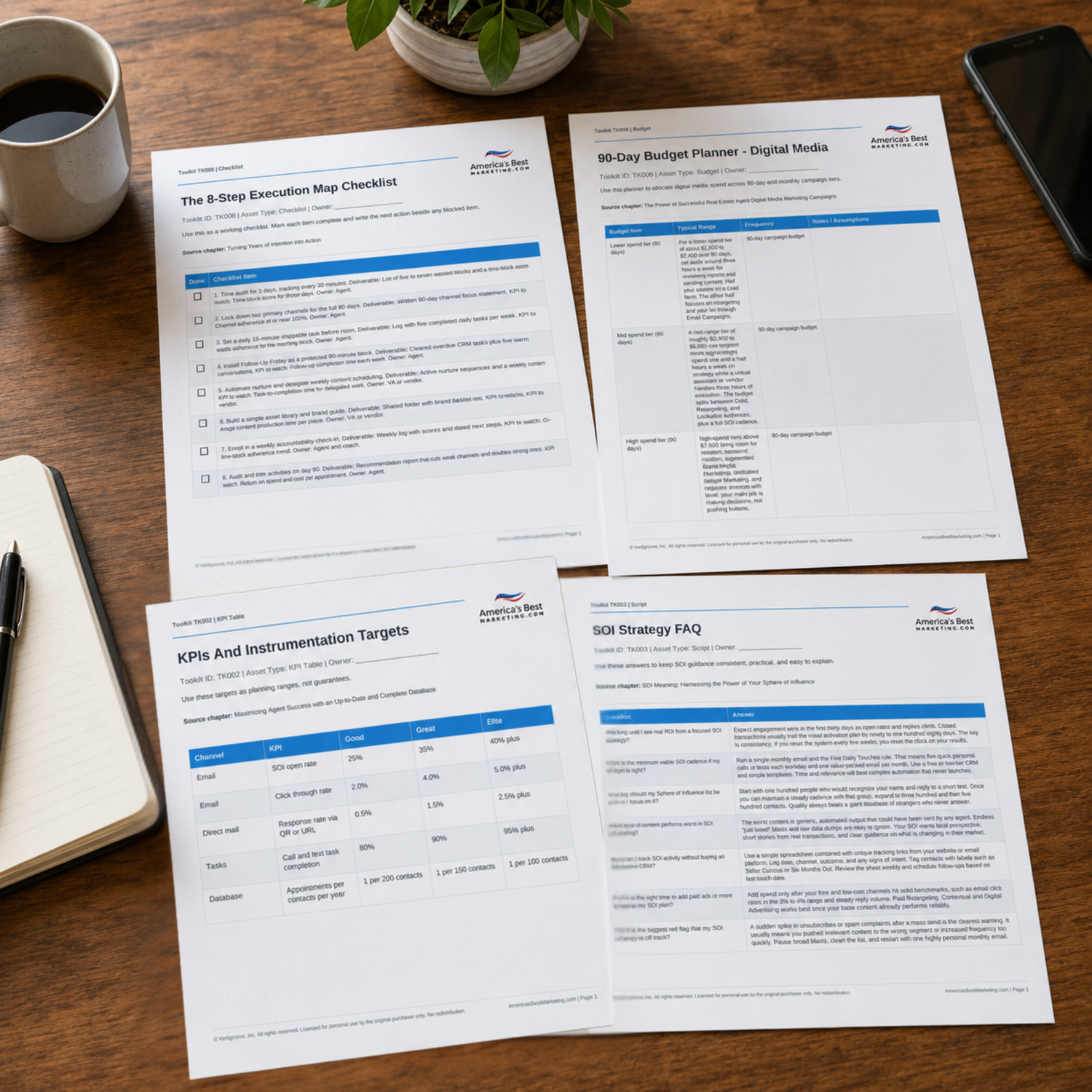
Download The Commercial Launch Toolkit
Use the companion Toolkit to audit commercial readiness, map the first 12 weeks, build owner and investor scripts, plan outreach cadence, and track the KPIs that show whether your first-deal pipeline is working.
Download the Toolkit ZIPRecommended reads
Recommended Reads for Real Estate Agents
These articles help agents connect follow-up discipline, database habits, client communication, and marketing execution into a repeatable system.

Investing in Commercial Real Estate: What to Know
Use investing in commercial real estate to create a stronger bridge between client education and real conversations.
Read article
The First-Time Homebuyer's Guide to Navigating the Market
Turn the first-time homebuyer's to navigating the market into a steady operating habit, not another item that waits for a quiet week.
Read article
Tax Benefits of Investment Property: Real Estate Agent Talking Points + Investor Content Angle
Make tax benefits of investment property more useful by tying the message, audience, and next step together.
Read article
Flipping Houses Profitability for Real Estate Agents: Deal Analyzer + Marketing Plan
Build a cleaner system for flipping houses profitability, with better timing, clearer messaging, and a next step people can act on.
Read articleCommercial Real Estate Questions Agents Should Be Ready To Answer
How long does it take to see measurable ROI in commercial prospecting?
Plan on 90 days to see clean activity signals: owner responses, meetings, and underwriting requests. Most deals take longer to close, so track weekly inputs first. If you are not generating five qualified conversations a week by week six, tighten your niche and your outreach list.
Do I need a separate license for commercial real estate?
In most states, the same real estate license covers both residential and commercial work, but rules vary. Check your state licensing board and your brokerage policy before you market services. Also confirm required disclosures and any training standards your broker expects.
What content performs worst for commercial audiences?
Generic market updates and lifestyle posts usually flop because they do not help with a decision. Commercial readers want numbers, risk notes, and clear next steps. If a piece does not answer pricing, lease risk, tenant demand, or financing friction, it will not earn trust.
What is the fastest way to find my first commercial listing opportunity?
Start with your existing database and tag commercial intent. Look for business owners, landlords, and investors you already know. Then run a tight owner outreach list in one corridor so your message feels specific and credible.
How do I talk about cap rates without sounding like I am guessing?
Use ranges and comps, not a single number. Explain what drives the range: tenant quality, lease term, expense ratios, and location risk. Offer to underwrite the specific property so your estimate becomes a documented model instead of a vibe.
Should I specialize before I close my first deal?
Yes, pick one niche for 12 weeks. Specialization makes your marketing easier and your scripts sharper. After you close, you can expand, but your first win should come from focus, not variety.
What KPIs should I track weekly so I know the system is working?
Track owner conversations, qualified meetings, underwriting requests, and tours. Track response rate on direct mail and follow-up speed on inbound replies. When these inputs rise for six straight weeks, closings usually follow on a lagging timeline.
Next step
Build the System Behind the Advice
Continue from one useful article into the larger ABM ecosystem: the book series for strategic depth and the full marketing program for done-for-you execution.

View the Book Series
Explore the America’s Best Real Estate Agent Marketing System books for a deeper strategic framework around visibility, referrals, listings, lead generation, and growth.
View the Book Series
See Full Marketing Program
See how AmericasBestMarketing.com runs real estate blog writing, social media, listing marketing, email, direct mail, and retargeting as one managed system.
See Full Marketing Program