The Role of User Experience in Real Estate SEO
Faster pages, clearer paths, stronger organic conversion
A practical UX engine for real estate agents who want search traffic to stay longer, move cleaner, and turn into more real conversations.

UX improves Real Estate SEO when every click feels obvious
User experience improves Real Estate SEO by making pages faster, easier to navigate, more useful on mobile, and more likely to turn organic visitors into leads. The highest-leverage workflow is simple: audit Core Web Vitals, fix mobile friction, clarify internal links and CTAs, then track session quality and lead rate every week.
- Real Estate SEO is not only a keyword project. It is a page-experience and conversion-path project.
- The first UX wins usually come from image cleanup, mobile navigation, tap targets, and a clearer first next step.
- Neighborhood guides, property search pages, and service pages need internal links that guide intent instead of trapping visitors.
- Weekly tracking should connect Core Web Vitals, session behavior, scroll depth, form starts, and completed leads.
Why UX Is Now A Ranking And Revenue Lever
Real Estate SEO can stall even when the writing is strong. The problem is often not topic depth. It is the page experience around the topic. A buyer lands on a neighborhood guide and cannot find property filters. A seller clicks a market article and never sees a valuation path. A mobile visitor waits too long for the hero image and returns to search before your expertise has a chance to work.
That is the UX to SEO loop. Search earns the click, user experience decides whether the visitor stays, and visitor behavior gives you practical evidence about whether the page satisfied intent. When pages load quickly, hold visual stability, and make the next action obvious, the same organic traffic has more commercial value.
Start with the same local intent foundation used in Leveraging Hyper-Local SEO for Real Estate Success, then remove the mechanical friction that keeps people from moving. A strong search page should feel like a concierge path, not a filing cabinet.
- Faster pages protect impatient mobile visitors before they abandon the visit.
- Cleaner navigation helps Google and humans understand the local structure of the site.
- Sharper CTAs convert search sessions into calls, form fills, and follow-up opportunities.
The UX Signals Real Estate Agents Should Watch
Core Web Vitals, dwell time, and mobile-first indexing all point toward the same operating truth: the mobile visitor is the product test. If a page is slow, visually jumpy, hard to tap, or unclear about the next step, the content has to work uphill.
Core Web Vitals metrics focus on loading speed, visual stability, and responsiveness. Track Largest Contentful Paint, Interaction to Next Paint, and layout shifts, then prioritize fixes on pages that already bring search traffic or lead opportunities.
Dwell time is the practical user-behavior clue. When visitors land, read, click deeper, and do not immediately return to search, you have a stronger signal that the page is serving the task.
Search intent alignment is the conversion layer. A seller who searches for neighborhood pricing needs a path to valuation, market proof, and seller guidance. A buyer who searches for a neighborhood needs filters, map context, and a way to save or request details.
Mobile-first experience is the baseline. Treat the phone view as the primary page. If the desktop page is polished but the mobile path hides proof, filters, or forms, the page is not ready for serious search competition.
The 12-Week Real Estate SEO UX Engine
This is not a redesign mandate. It is a disciplined operating cadence. Diagnose the highest-friction pages, repair the obvious blockers, then measure whether organic visitors move farther through the site.
Technical audit and speed
Run Core Web Vitals reports on top entry pages and top lead pages. Compress oversized images, reduce unused scripts, limit font weights, and keep the first meaningful interaction available fast on mobile.
Content UX and navigation
Rebuild the click path around intent. Every neighborhood page should link to one related local page, one proof pathway, and one conversion step that matches what the visitor came to do.
Conversion and instrumentation
Add heatmaps, scroll-depth tracking, form-start events, and call tracking. Use the evidence to move proof, buttons, filters, and lead capture where visitors already show intent.
Speed work needs a business lens. Start with pages tied to high intent: market update pages, neighborhood guides, listing pages, and IDX Real Estate Websites. If the IDX search path is slow or buried, the visitor may never reach the point where your local expertise matters.
Navigation work needs the same discipline. Connect community pages to Listing Marketing content when seller intent is present, and connect buyer content to usable search filters when property intent is present.
Two UX Improvement Levels You Can Actually Run
These are execution budgets and cadence guardrails, not outcome promises. The real goal is consistent measurement, consistent fixes, and consistent learning.
Use free tools and one fix per week
Spend zero to three hundred fifty dollars per month. Schedule one weekly diagnostic block and one weekly repair block. Focus on the top five organic landing pages, then assign one friction fix every week.
- Compress the heaviest image on each priority page.
- Make the first CTA visible before mobile scroll depth drops.
- Repair broken internal links and dead-end pages.
Add heatmaps and conversion tests
Spend five hundred to fifteen hundred dollars per month. Add heatmaps, light A/B tests for CTA placement, and paid traffic only when you need a faster read on conversion friction.
- Review top twenty pages as a product portfolio.
- Rotate creative and proof points every three to four weeks.
- Measure lead rate by page type, not only by total traffic.
The 10-Point UX For Search Audit
Run this audit on your top five landing pages and your top two conversion pages. Fix the highest-friction items first, then re-check in seven days. Do not make the mistake of rewriting everything before the site mechanics can support the traffic.
- Confirm the main page becomes usable in under two seconds on a phone.
- Compress all images and remove any image that loads larger than its display size.
- Keep fonts readable on mobile with clear line spacing and predictable heading hierarchy.
- Make every primary button easy to tap with a thumb and give it breathing room.
- Keep navigation consistent across pages so visitors do not re-learn the site each time.
- Expose property filters clearly and avoid hiding them behind extra taps.
- Link every neighborhood page to one next step and one related local page.
- Place one proof element above the fold: reviews, local stats, or a trust statement.
- Track form starts and form completions so you know where intent drops.
- Fix broken internal links and remove dead-end pages that end the journey.
Pro Insight
Most agents miss that visitor behavior can expose page friction faster than a rank report. Ask one question on every key page: can a visitor tap a filter, proof point, internal link, or lead form in under two seconds on a phone?
Make The Next Click Obvious
UX improvements work best when the message is equally clear. Write headlines that tell the visitor what the page helps them do, then pair each page with a CTA that matches the stage of intent.
Run a speed test on your top three pages and screenshot the results before you make another content plan.
Download the UX audit and assign the next five fixes to a weekly operating slot.
Book 1:1 Marketing Coaching to audit your conversion path, internal links, and mobile navigation.
Keep service references simple. A fast site is wasted if returning visitors do not get a consistent nurture path through Email Marketing for Real Estate Agents. The site earns the click; the follow-up system turns the click into a relationship.
Weekly SEO UX KPIs That Tie To Revenue
Track the metrics that connect search visibility to business outcomes. Organic traffic matters, but stable rankings and stronger sessions only matter when more visitors become conversations.
| Metric | Tracking Tool | Target Benchmark | Business Impact |
|---|---|---|---|
| LCP | Search Console | Under 2.5 seconds | Reduces load friction on competitive local entry pages. |
| Session Time | Analytics | Over 2 minutes 30 seconds | Shows whether local content keeps visitors moving through the site. |
| Lead Rate | CRM dashboard | 2 percent to 5 percent | Turns organic visits into calls, form fills, and follow-up opportunities. |
| Form Start To Completion | Analytics and CRM | Reduce drop-off each month | Identifies whether the conversion path is creating friction. |
When Content Is Not The Problem
A small team in a competitive metro market published consistently, but rankings plateaued and bounce stayed high. The pages answered reasonable questions. The problem was the mobile experience around those answers. Property search loaded slowly, neighborhood links were scattered, and lead capture sat below the point where most visitors stopped scrolling.
The team shifted focus from more publishing to better movement. They tightened load time on property search, made neighborhood navigation clearer, and placed one visible CTA per page. They used heatmaps to move lead capture higher without breaking the reading flow. Within the next operating cycle, organic sessions became more useful because more visitors clicked deeper, returned, and started conversations.
The executive lesson is simple: ranking is not the finish line. Real Estate SEO should create a commercial path. When UX improves, the site stops leaking traffic you already earned.
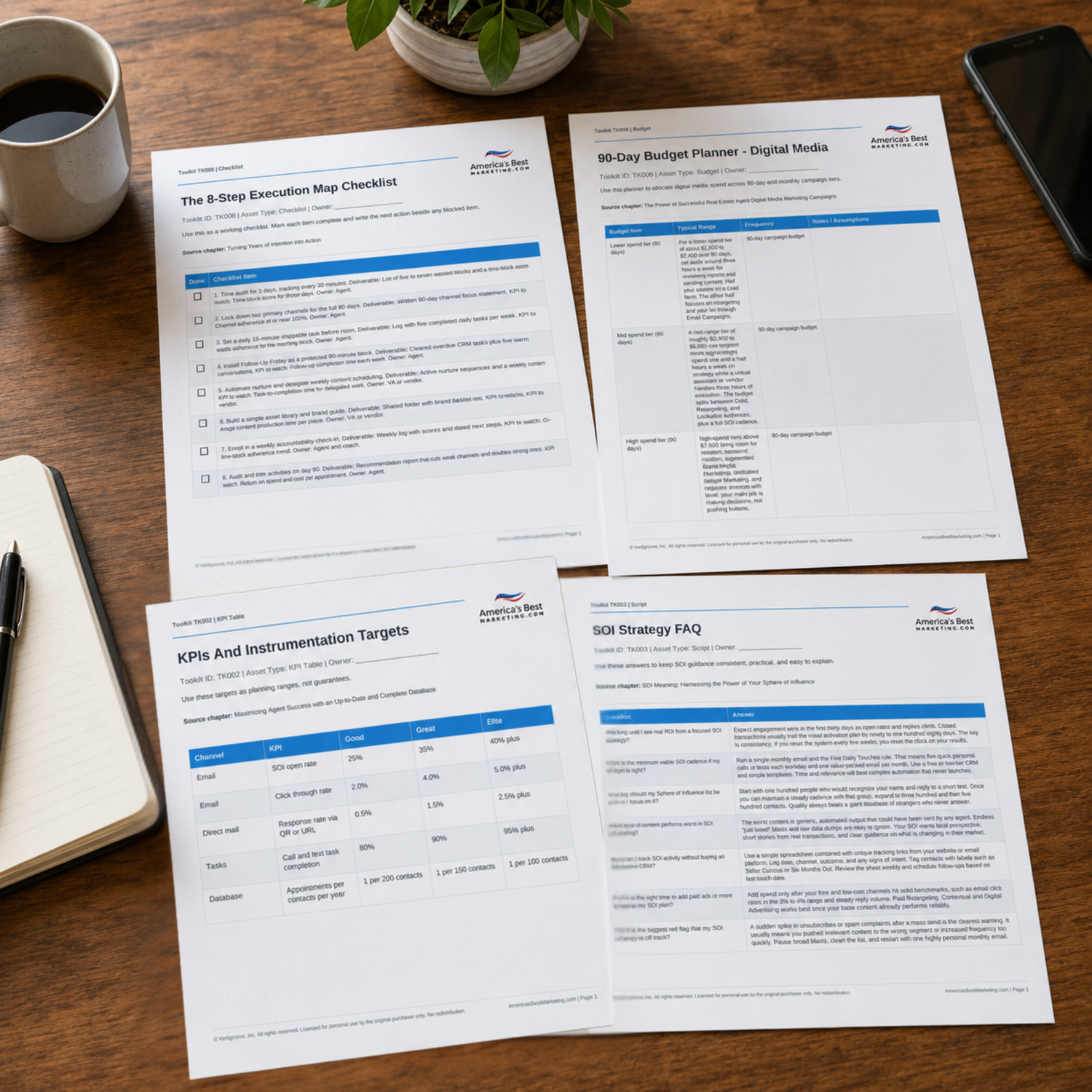
Download The UX SEO Engine Toolkit
Use the companion Toolkit to run the 12-week UX plan, weekly KPI table, budget guardrails, search audit, and FAQ blocks that help turn search traffic into measurable real estate conversations.
Download the Toolkit ZIPTreat UX Like A Weekly Search System
Real Estate SEO gets easier when the site feels fast, obvious, and useful on a phone. Run a Core Web Vitals report for your main site and top entry pages. Then schedule 1:1 Marketing Coaching to audit your conversion path, internal links, and mobile navigation so you stop bleeding traffic you already earned.
If you want help turning this into an operating rhythm, AmericasBestMarketing.com can connect real estate blog strategy, site UX, Social Media Marketing, Email Campaigns, and retargeting into one managed visibility system.
Recommended reads
Recommended Reads for Real Estate Agents
These articles help agents connect local visibility, useful content, channel strategy, and follow-up into a stronger search-friendly marketing system.

SEO-Friendly Blog Titles for Real Estate Agents: Templates + A/B Testing Checklist
Build organic reach with pages and posts that are easier to find, trust, and act on.
Read article
Proven SEO Strategies for Real Estate Websites to Increase Leads
Turn search visibility into a clearer publishing system for neighborhoods, services, and client decisions.
Read article
SEO for Real Estate: How Agents Can Dominate Local Search and Generate More Leads
Build a cleaner system for SEO for real estate, with better timing, clearer messaging, and a next step people can act on.
Read article
Real Estate Agent Website Must-Haves: From Header to Footer (Checklist)
Turn website must-haves into a steady operating habit, not another item that waits for a quiet week.
Read articleReal Estate SEO UX Questions Agents Should Be Ready To Answer
Does UX really affect Real Estate SEO rankings?
Yes. UX can affect Real Estate SEO because speed, stability, mobile usability, and visitor behavior all influence whether a page satisfies search intent.
What is the fastest UX fix that improves mobile performance?
Start with images. Resize them to the actual display size, compress them, remove heavy top-of-page assets, and reduce unused scripts and font weights.
How does mobile-first indexing change what I should prioritize?
Treat the mobile page as the primary product. Prioritize one-thumb navigation, visible property filters, clear tap targets, fast loading, readable type, and above-the-fold proof.
How long does it take to see ROI from UX improvements?
Engagement and conversion changes can show up within weeks. Ranking movement usually takes longer because Google needs repeated crawl and behavior evidence.
What should I track besides Core Web Vitals metrics?
Track scroll depth, property filter clicks, internal link clicks, form starts, form completions, calls, returning visitors, branded search growth, and CRM source data.
Are heatmaps worth using for SEO work?
Yes. Heatmaps expose rage clicks, dead zones, ignored CTAs, and scroll drop-offs that keep a page from satisfying intent.
How many internal links should a neighborhood page include?
Use enough internal links to guide the visitor without choice overload: one next-step link, one related local page, one proof pathway, and one service or valuation pathway when seller intent is present.
Next step
Build the System Behind the Advice
Continue from one useful article into the larger ABM ecosystem: the book series for strategic depth and the full marketing program for done-for-you execution.

View the Book Series
Explore the America’s Best Real Estate Agent Marketing System books for a deeper strategic framework around visibility, referrals, listings, lead generation, and growth.
View the Book Series
See Full Marketing Program
See how AmericasBestMarketing.com runs real estate blog writing, social media, listing marketing, email, direct mail, and retargeting as one managed system.
See Full Marketing Program