SEO for Real Estate: How Agents Can Dominate Local Search and Generate More Leads
SEO for Real Estate Win Local Search Generate More Leads
A local visibility operating system for real estate agents
Build a search presence that connects Google Business Profile, city and neighborhood pages, useful local content, reviews, and follow-up into one measurable lead-generation system.

The four-part local SEO system that produces leads
SEO for Real Estate works when an agent aligns four assets: a complete Google Business Profile, technically sound city and neighborhood pages, useful local content, and a clear follow-up path that turns search traffic into appointments. Build those assets around the places and client questions that matter in your market, then review search reach, organic visits, lead rate, and signed-client source every month.
- Local search visibility grows when your Google Business Profile, website, reviews, and neighborhood content repeat the same market signals.
- City and neighborhood pages should target specific intent, present original local proof, and lead to one clear next action.
- Useful local articles become durable assets when social media, email, and retargeting bring the right audience back to them.
- SEO becomes a business system only when rankings are connected to calls, forms, appointments, and signed clients.
Why Local SEO Becomes Predictable Revenue
SEO for Real Estate turns your online presence into a compounding asset that buyers and sellers discover every day. Instead of chasing cold lists, you build a system where searchers arrive with a clear intent and a problem you can solve. The practical target is not every real estate keyword. It is the set of city, neighborhood, property-type, and seller-intent phrases that lead to real conversations.
National portals can own broad phrases. A focused agent can still own the local questions that matter before a buyer schedules a tour or a seller requests a valuation. Use Local SEO for Real Estate Agents as a companion strategy for translating neighborhood knowledge into search visibility.
Strong organic traffic behaves like recurring revenue. Once your Google Business Profile, city pages, and hyper-local content are aligned, those assets can keep producing discovery even when paid media is reduced. The return compounds because each review, guide, internal link, and local mention strengthens the same authority system.
- Target phrases that include your city, neighborhoods, price bands, property types, and seller questions.
- Use original photos, reviews, local examples, and clear contact details to prove that the page belongs to a real local expert.
- Give every page one conversion path such as a call, valuation request, saved search, guide download, or appointment.
Build The Google Profile, NAP, And Review System
Local SEO lives or dies on visible trust signals. Your Google Business Profile influences whether you appear when someone searches for an agent near them. Google also cross-checks your business details across the web and evaluates the quality, recency, and context of client reviews. Treat the profile as an active landing page, not a one-time directory listing.
Complete the local landing page
Claim and verify the profile. Confirm the service area, choose the primary category that matches your work, write a concise city-focused description, and add current photos of you, your team, listings, and recognizable local settings.
Post at least once each week with listings, sold stories, client education, and links to deeper resources on your website.
Remove contradictory business data
Make your business name, address, and phone number match across your website, Google profile, social profiles, and major directories. Small inconsistencies create uncertainty for search engines and for people trying to contact you.
Audit old office addresses, duplicate profiles, stale phone numbers, and outdated team names before publishing more content.
Turn client experience into local proof
Give every closing, referral, and satisfied past client a direct review link within twenty-four hours. Reply to every review with gratitude and enough context to reinforce the type of service and area involved.
Consistency matters more than a short burst. A steady review rhythm signals an active business with current local relationships.
The edge is not review count alone. It is the alignment between your Google Business Profile, website, and content. A stranger should be able to identify the neighborhoods you serve, the clients you help, and the next step you want them to take without guessing.
Create City And Neighborhood Pages That Convert
Your website is the home base for every SEO effort. Each core page needs enough depth and clarity for search engines to understand the topic and for people to feel safe reaching out. Thin pages with vague claims rarely convert, even when they earn impressions.
Start with a site that supports local search, mobile usability, and lead capture. IDX Real Estate Websites can connect live listing data with neighborhood resources and inquiry forms. Your responsibility is to layer local expertise, original evidence, and a clean conversion path on top of that technical foundation.
Give every page one purpose. A seller page should answer pricing, preparation, timing, and net-proceeds questions before inviting a valuation request. A neighborhood page should cover lifestyle, housing patterns, access, local landmarks, and the path to view relevant listings or book a tour.
Budget three hundred to five hundred dollars each month for hosting, essential tools, and one new long-form local page. Aim for one topic, one location, original proof, and one conversion goal on every page.
Budget seven hundred to twelve hundred dollars each month for stronger research, copy support, regular updates, schema implementation, and one new local guide each month. Refresh at least two existing pages with better headings, internal links, and calls to action.
Write title tags that name the service and location in clear language. Use meta descriptions to explain the payoff and invite a click. Structure headings around client questions rather than repeating raw keyword phrases. Preserve listing pages that earned traffic by converting closed-property pages into sold stories or neighborhood resources instead of deleting them.
Publish Local Content That Starts Conversations
Content for SEO for Real Estate should answer one clear question for one clear person in one clear place. Generic buyer tips are easy to ignore. Specific guidance about a subdivision, property type, commute pattern, closing timeline, school boundary, or seller decision can earn attention because it reflects the way people actually search.
Build a simple calendar of buyer and seller topics. Pair neighborhood pros and cons with seller-focused articles about preparation, pricing, and timing. Add authority pieces such as school guides, commute breakdowns, local business roundups, market explanations, and community event coverage. Each article should lead to a next step that matches the reader's intent.
Use Social Media Management for Real Estate Agents to circulate the strongest pages where your sphere already spends time. Use Retargeting & Contextual Ads to bring prior visitors back to high-value guides and lead forms. Then use Email Marketing for Real Estate Agents to nurture people who request a guide, saved search, or valuation.
The article itself is only one layer. The complete asset includes the search query, page promise, local proof, internal links, conversion path, distribution plan, and follow-up sequence. When those pieces are connected, content stops being a publishing task and becomes a pipeline asset.
Protect Speed, Crawlability, And Mobile Usability
Technical SEO is the quiet work that keeps your site easy to load, crawl, and understand. Buyers and sellers may never name these tasks, yet they feel the impact the moment a page stalls, breaks, or becomes difficult to use on a phone.
- Compress images and test priority pages on a standard mobile connection.
- Confirm that navigation, forms, buttons, and listing search tools work with one thumb on a small screen.
- Repair or redirect broken links so visitors and search engines never reach dead ends.
- Link every priority page from at least two relevant pages so crawlers can discover and revisit it.
- Organize internal links by city, neighborhood, client type, and topic so the information architecture is clear.
- Keep closed listing pages when they have earned traffic, then update them with sold context and links to active resources.
Three Local SEO Scripts For Reviews, Guides, And Partners
Local search improves faster when the operational language is simple enough to repeat. These scripts give agents a direct opening, a clear value statement, and a specific next step.
The fast Google review request
Agent dialogue
Hook lineYou have been a dream client, and I want more people just like you.
Value lineWhen you leave a quick Google review, it tells local buyers and sellers that I am worth a call.
CTA lineCan I text you the link right now while we are together?
Save the direct review link as a phone text snippet. Ask while the experience is fresh, send the link during the conversation, and follow up once if the review does not appear.
The local guide invitation
Agent dialogue
Hook lineMost people start online and get lost in generic advice that ignores this side of town.
Value lineI publish a local guide with housing patterns, commute notes, and the questions clients ask most often.
CTA lineWould you like the link to the guide that matches your move?
Build one flagship guide for each priority neighborhood, feature it in your site navigation and Google posts, and tag guide requests for relevant email follow-up.
The local partner link outreach
Agent dialogue
Hook lineYour business is already a trusted stop for people who live and work nearby.
Offer lineI manage a local living page that highlights a short list of businesses that treat clients well.
CTA lineI would like to feature you and connect our sites so local customers can move easily between the resources.
Keep the partner page selective. Feature businesses your clients already trust, ask for one relevant link back to your city page, and record the relationship in your CRM.
Track The Numbers That Connect Search To Revenue
SEO rewards patience and consistency. Impressions and rankings often move before calls and forms do. Use analytics and search-console data as an instrumentation panel, then connect that information to CRM source notes so visibility can be evaluated as a business channel.
| KPI | What It Tracks | Directional Range | How To Read It |
|---|---|---|---|
| Keyword reach | Priority phrases appearing in top search results | 30 to 80 | Shows how broadly your brand appears for local searches that can lead to a conversation. |
| Organic visits | Website sessions arriving from unpaid search | 1,500 to 3,000 | Signals whether search engines trust the site enough to send a steady stream of visitors. |
| Lead rate | Visitors who call, email, or complete a form | 1.5% to 3% | Confirms whether the pages turn search intent into direct conversations. |
| Signed-client source | Clients who name Google, the website, or a guide | Track monthly | Connects organic visibility to appointments, agreements, closings, and revenue. |
Treat the ranges as directional benchmarks, not promises. Market size, competition, domain history, publishing volume, and conversion design affect performance. The critical practice is to record the same measures each month and make the next content decision from evidence.
One agent focused on five seller-heavy neighborhoods, built one city page and five neighborhood guides, updated Google Business Profile weekly, and requested reviews that referenced neighborhood experience. By month ten, her main listing phrase reached page one, twenty-two organic leads requested a valuation during the following quarter, and four became signed listings. The lesson is not the exact result. It is the alignment of pages, reviews, content, and conversion.
Put The SEO Plan Into Action
The fastest path to productive SEO is a monthly operating rhythm. Do not wait for a perfect site rebuild. Improve the assets search engines already see, publish one useful local page, and measure whether the right people are reaching out.
- Week 1: Audit Google Business Profile, NAP consistency, review links, service categories, and the priority city page.
- Week 2: Improve one seller page and one neighborhood page with stronger local proof, clearer headings, and one conversion path.
- Week 3: Publish one high-intent article that answers a real buyer or seller question in a specific area.
- Week 4: Review keyword reach, organic visits, lead rate, and CRM source notes before choosing the next topic.
Over time, move budget toward assets that compound. Deeper guides, better city pages, consistent reviews, and stronger follow-up create durable market visibility. The result is a search system that keeps working while you stay focused on conversations, appointments, and clients.
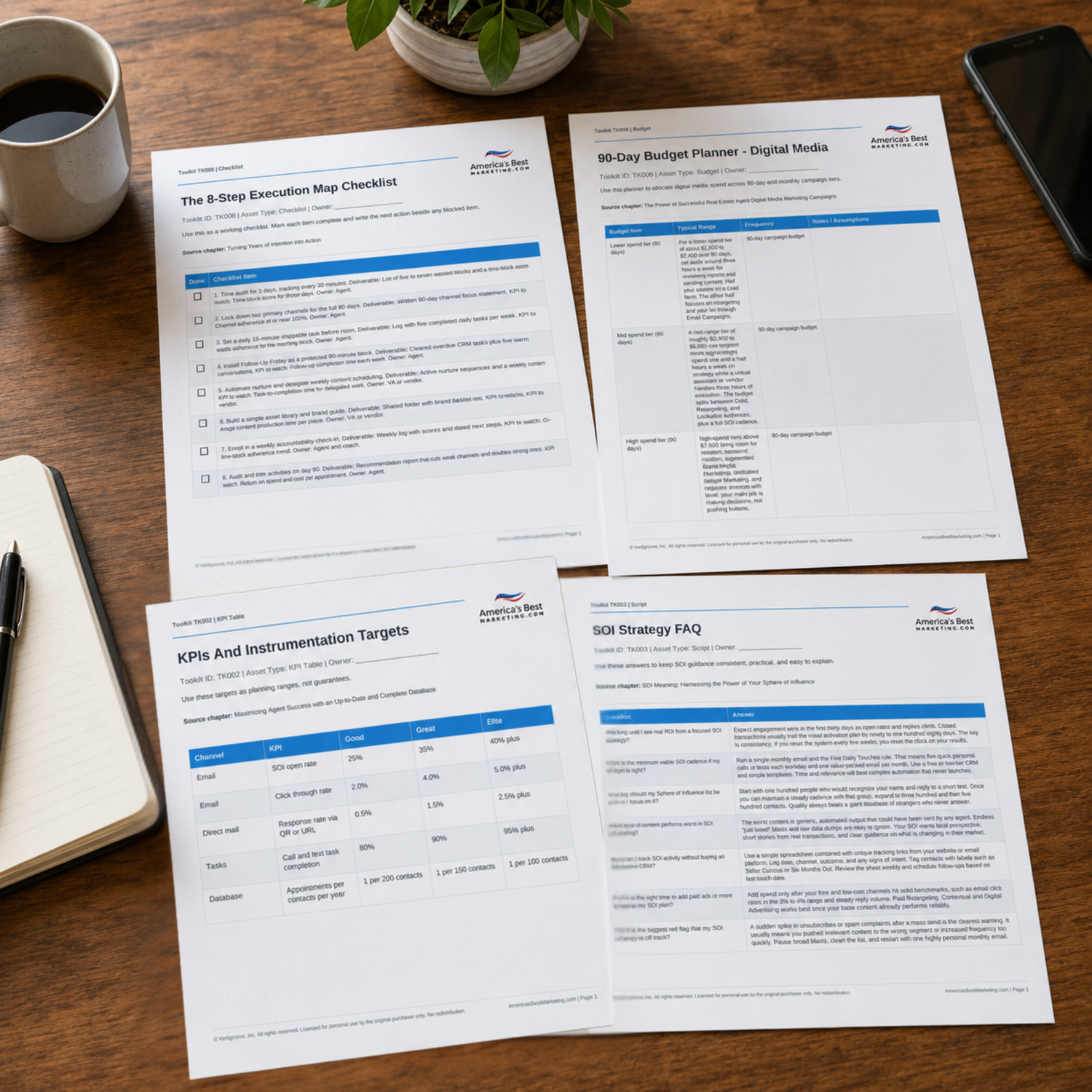
Download The SEO For Real Estate Toolkit
The Toolkit ZIP includes an on-page optimization budget planner, organic growth KPI targets, local SEO scripts, and FAQ support material that turns this article into a repeatable monthly workflow.
Download the Toolkit ZIPRecommended Reads for Real Estate Agents
These articles help agents connect local visibility, useful content, channel strategy, and follow-up into a stronger search-friendly marketing system.

Leveraging Hyper-Local SEO for Real Estate Success
Make hyper-local SEO for real estate success easier to plan, publish, and measure as part of a weekly marketing rhythm.
Read article
Local SEO for Real Estate Agents: How to Dominate Search in Your Neighborhood
Make local search work harder with content that answers real questions and leads to a next step.
Read article
SEO-Friendly Blog Titles for Real Estate Agents: Templates + A/B Testing Checklist
Build organic reach with pages and posts that are easier to find, trust, and act on.
Read article
Local Restaurant Guides That Generate Leads: A Real Estate Agents-Friendly Where to Eat Framework
Publish content that answers local questions, supports lead capture, and gives future conversations a reason to start.
Read articleSEO For Real Estate Questions Agents Ask Most
How long does SEO for Real Estate usually take to work?
You can often see small shifts in impressions and rankings within four to six months if you publish consistently. Most agents begin to feel real pipeline impact between nine and twelve months when city pages, reviews, and guides start working together.
Should I chase broad keywords like homes for sale?
No. Broad phrases are dominated by national portals and franchise sites. Your best leverage comes from long-tail local phrases such as sell a condo in a named neighborhood or best time to list in a named subdivision, where intent is clearer and competition is lower.
How many local pages does a strong SEO for Real Estate plan need?
Most agents start with one city hub page, three to five neighborhood guides, and one seller-focused page with a valuation form. From there, add one new high-intent article per month until your priority neighborhoods each have several pieces of content that answer different questions.
Do I need a blog if I already use social media?
Yes. Social posts create awareness, yet they are short lived and difficult for search engines to index deeply. Your blog gives those ideas a permanent home where they can rank, earn links, and send visitors into email sequences and appointment calls long after publication.
What is the biggest mistake agents make with Google Business Profile?
Many agents treat it as a static listing instead of a living profile. They forget to post updates, never reply to reviews, and leave old phone numbers active. Google sees that neglect and rewards competitors who keep profiles clean, current, and supported by real conversations.
Can I handle SEO for Real Estate myself without hiring an agency?
Yes, as long as you treat it as a regular part of your lead generation plan. Block time each week to publish content, request reviews, and review search data. Many agents start on their own, then bring in support once they prove that organic leads close at a healthy rate.
How should I measure success beyond search rankings?
Track how many leads mention Google, your blog, or local guides in their first call. Watch how often organic leads move to signed agreements compared with other channels. The real win is not one ranking. The real win is a steady flow of clients who already trust your expertise.
Next step
Build The System Behind The Search Strategy
Continue from one useful article into the larger ABM ecosystem: the book series for strategic depth and the full marketing program for done-for-you execution.

View the Book Series
Explore the America’s Best Real Estate Agent Marketing System books for a deeper strategic framework around visibility, referrals, listings, lead generation, and growth.
View the Book Series
See Full Marketing Program
See how AmericasBestMarketing.com runs real estate blog writing, social media, listing marketing, email, direct mail, and retargeting as one managed system.
See Full Marketing Program