Post-Closing Touchpoints: A 12-Month Stay-in-Touch Plan That Earns Referrals
Post-Closing Touchpoints That Earn Referrals
A 12-Month Stay-in-Touch Plan
A practical retention system for agents who want every closing to become a documented year of useful client contact, clean review timing, and measurable referral opportunity.

Turn Every Closing Into A Referral System
A strong post-closing touchpoint plan gives every past client a predictable year of useful contact after the transaction ends. Combine light automated marketing touches with personal check-ins, review requests, vendor help, value reminders, and CRM task ownership so referrals are engineered through consistency instead of left to memory.
- Most referral leakage starts after closing, when client goodwill is high but the agent’s follow-up becomes random.
- A 12-month plan should separate broad marketing touches from one-to-one relational touches so both visibility and trust are protected.
- Review timing, tax assessment season, home maintenance, vendor needs, and equity updates create better reasons to reconnect than generic check-ins.
- CRM tags, task compliance, reply rate, review pace, and referral conversations turn past-client follow-up into a measurable operating system.
Why This Pays Off
The biggest retention leak in most real estate businesses opens the moment a transaction closes. The client is happy, the relationship is warm, and the agent has earned trust. Then the follow-up becomes inconsistent. A 12-month post-closing touchpoint plan closes that leak by giving every past client a predictable cadence of useful contact.
The business case is straightforward. Better past-client retention lowers acquisition cost, protects referral equity, and keeps your name visible before a competitor becomes the default advisor. The plan works because it replaces vague good intentions with named touches, named owners, and calendar-based accountability.
The referral gap is the dead space between a happy closing and the next moment your client has a reason to talk about you. Goodwill helps, but goodwill alone does not create a referral system. Referrals need reminders, useful triggers, and enough confidence for the client to say your name.
- You reduce orphan client syndrome by making follow-up part of the closing process, not an afterthought.
- You earn reciprocity by solving practical homeowner problems before asking for referrals.
- You turn your CRM from a pile of names into a managed retention asset with clean tasks and measurable outcomes.
Marketing Touches Versus Relational Touches
Marketing touches are broad touches. They can be automated and sent to many clients at once. They keep you visible when life gets busy and when your client is not actively thinking about real estate.
Relational touches are one-to-one. They prove you remember the person, not just the transaction. Calls, handwritten notes, quick texts, personal check-ins, event invitations, and milestone messages create the emotional durability that makes referrals easier.
The right system automates low-friction visibility and protects your time for high-value conversations. That is how you avoid orphan client syndrome without living on the phone. It is also how email marketing for real estate agents supports the relationship without replacing the relationship.
Keep the database operational
Confirm closing date, move-in date, email, phone, communication preference, review status, neighborhood, property type, and service needs before the transaction file goes quiet.
Tag clients by property type, communication preference, and likely next need so market notes feel relevant instead of generic.
Use broad and personal touches
Send light automated value through market notes, maintenance reminders, homeowner education, and local resources.
Reserve personal outreach for review requests, tax assessment moments, vendor needs, life updates, appreciation touches, and referral conversations.
Measure the conversations
Track replies, reviews, vendor introductions, market report requests, and referral conversations before counting closed deals.
Early signals show whether the system is creating relationship momentum before the pipeline produces measurable revenue.
Home anniversaries feel polite, but they rarely create urgency. Tax assessment season does. When new valuations land, your client is suddenly paying attention to equity, budgets, and property value. Reach out with a short value defense note and you become the default advisor instead of a name from a closing folder.
Step-By-Step: The 12-Month Stay-In-Touch Plan
This calendar is built to run on autopilot, then get personal at the moments that matter. Each month has one required touch and one optional touch for weeks when you have capacity. Your job is not to invent follow-up every month. Your job is to execute follow-up every month.
Month 1: The transition. Call to check in and confirm the basics: mail forwarding, utilities, vendor needs, and any immediate issues. Then request a Google Business review while the experience is fresh. Follow with a short email that includes a move-in checklist and your vendor list. Every email should include a clear opt-out line.
Months 2 to 4: The utility phase. Remove friction from homeownership. Send a hidden gems guide, a seasonal maintenance reminder, and a short list of trusted vendors. Keep it tight. One idea per message. Useful content earns attention because it feels like help, not a pitch.
Months 5 to 8: The equity phase. Become the person who protects equity. Send a mid-year market update for homeowners. Offer a personalized value range report and clearly state that it is an estimate, not an appraisal. Then use the tax assessment period as a high-utility trigger: explain what the notice means and what the homeowner should watch.
Months 9 to 12: The referral harvest. Create one strong story moment and one appreciation moment. Invite them to a simple client event or pop-by plan. If you want a clean event framework, review Client Events for Real Estate Agents: Plans, Budgets, and Follow-Up That Earn Referrals. Then send a high-quality mail piece and a gratitude gift during the holidays.
Spend $90 to $180 per month for email software, cards, and a small mailer batch. Run two emails per month, one call task, and one light personal touch. Keep the audience focused on past clients and warm leads, with a one-touch-per-week frequency cap per person.
Spend $250 to $450 per month for quarterly mailers, small gifts, and a simple appreciation event. Run two emails per month, one call task, and one mailer touch, then include partners and vendors who can create new referral paths.
Messaging That Sounds Useful Instead Of Salesy
Your messaging should sound like you: short, specific, and useful. The fastest way to lose attention is to send vague check-ins that are really disguised sales asks.
Use a CTA ladder. Soft CTAs earn replies. Mid CTAs create conversations. Hard CTAs create appointments when timing is right. This gives past clients a small next step before they are ready for a major decision.
Earn replies first
Use lines such as: Reply YES and I will send my local vendor list. This invites a small interaction and gives you a clean reason to follow up personally.
Create a useful conversation
Use lines such as: Want a net equity estimate? I can run a current range for your address. Always state that value ranges are estimates, not appraisals.
Invite a planning call
Use lines such as: Want to talk through whether this is a smart year to move, refinance, remodel, or hold? Save this for clients showing stronger timing signals.
The 12-Month Touchpoint Matrix
This matrix is your operational map. Build these as tasks and templates in your CRM so the plan runs even when your month gets busy. Costs are estimates per past client.
| Month | Touch Type | Content Theme | Estimated Cost Per Client |
|---|---|---|---|
| 1 | Call, Email | Settling-in check, review request, move-in checklist, clear opt-out line | $0 to $3 |
| 2 | Local hidden gems guide, seasonal maintenance reminder | $0 to $1 | |
| 3 | Text, Email | Vendor list, quick problem-solver check, capture needs in CRM | $0 to $1 |
| 4 | Home systems checklist, filter schedule, warranty reminder | $0 to $1 | |
| 5 | Mid-year market update, offer value range, state not an appraisal | $0 to $1 | |
| 6 | Call, Email | Tax assessment value defense report, what to watch, timing notes | $0 to $2 |
| 7 | Email, Social | Success story request, review nudge, permission note in CRM | $0 to $1 |
| 8 | Neighborhood upgrade guide, local changes, useful links | $0 to $1 | |
| 9 | Call | Life update question, listen for moves, jobs, family changes | $0 |
| 10 | Email, Social | Appreciation invite, pop-by plan, simple RSVP ask | $2 to $8 |
| 11 | Market snapshot postcard plus handwritten note | $1 to $4 | |
| 12 | Mail, Text | Gratitude gift, clean referral ask, keep it human | $3 to $12 |
For mail cadence, borrow the core logic from SOI Marketing: The Power of Direct Mail Campaigns. The play is consistent value, consistent visibility, and a handwritten note that feels like a real person wrote it.
The Post-Close Data Check
Run this audit at every closing. The goal is clean data, correct dates, and clear permissions so your stay-in-touch plan runs without scrambling.
- Confirm primary email, backup email, mobile number, and preferred communication channel.
- Capture closing date and move-in date as separate CRM fields.
- Capture birthdays and household milestone dates only if you will actually use them.
- Tag property type, neighborhood, price range band, and relevant service needs.
- Log referral source, partner involvement, review status, and Month 1 task owner.
What Changes When The Calendar Is Real
Agent Derek closed twenty deals a year, but his referral rate stayed under five percent because post-close follow-up depended on memory. He implemented the 12-month referral moat framework inside his CRM and ran two emails per month plus one call task per month.
He added quarterly direct mail for real estate agents built around market data and a handwritten note. He also used tax assessment season as a value defense moment, offering a short explanation and an estimated value range that was clearly stated as not an appraisal.
By the end of the first year, his referral rate climbed toward twenty-five percent, adding several transactions without increasing ad spend. The lesson is not that every agent will see the same result. The lesson is that CRM discipline, useful timing, and repetitive exposure create more referral conversations than random check-ins.
KPI Benchmarks For A Past-Client Follow-Up System
These are process benchmarks, not outcome guarantees. They keep execution honest and help you spot drift before your database goes cold.
| Metric | Target Benchmark | Spend | Why It Matters |
|---|---|---|---|
| Reply rate | 2% to 5% per monthly campaign | $0 to $35 | Replies create conversations and future introductions. |
| Review pace | 1 to 3 requests per month, with completions tracked separately | $0 | Reviews protect reputation and support local visibility. |
| Task compliance | 85% to 95% | $0 | Consistency beats creativity in retention systems. |
Compliance Notes That Keep Follow-Up Clean
Randomness is the obvious risk, but sloppy claims are the larger trust problem. If you share estimated home values, say plainly that the number is an estimate and not an appraisal. If you email your database, keep list hygiene clean and include an opt-out line on every email.
Keep gifts reasonable, useful, and sustainable. Expensive gifts can feel transactional. A small local item, a maintenance resource, a handwritten note, or a practical vendor introduction usually carries more relationship value than a showy gesture.
- Do not bunch six months of silence into one aggressive referral ask.
- Do not send market claims without context, dates, and plain-language disclaimers.
- Do document review requests, opt-outs, communication preferences, and follow-up tasks in the CRM.
How This Becomes Marketing
A post-closing touchpoint plan is more than customer service. It is a business development system. Every useful follow-up gives a past client a reason to remember you, reply to you, review you, refer you, or ask for a current market opinion.
Build the system across Email Campaigns, Direct Mail, Social Media Marketing, and Digital Retargeting. Each channel should reinforce the same message: you stay useful after closing, not just during the sale.
If you want this system built and managed, connect the strategy to your broader done-for-you real estate marketing program so follow-up, creative, direct mail, email, and reporting operate as one managed visibility engine.
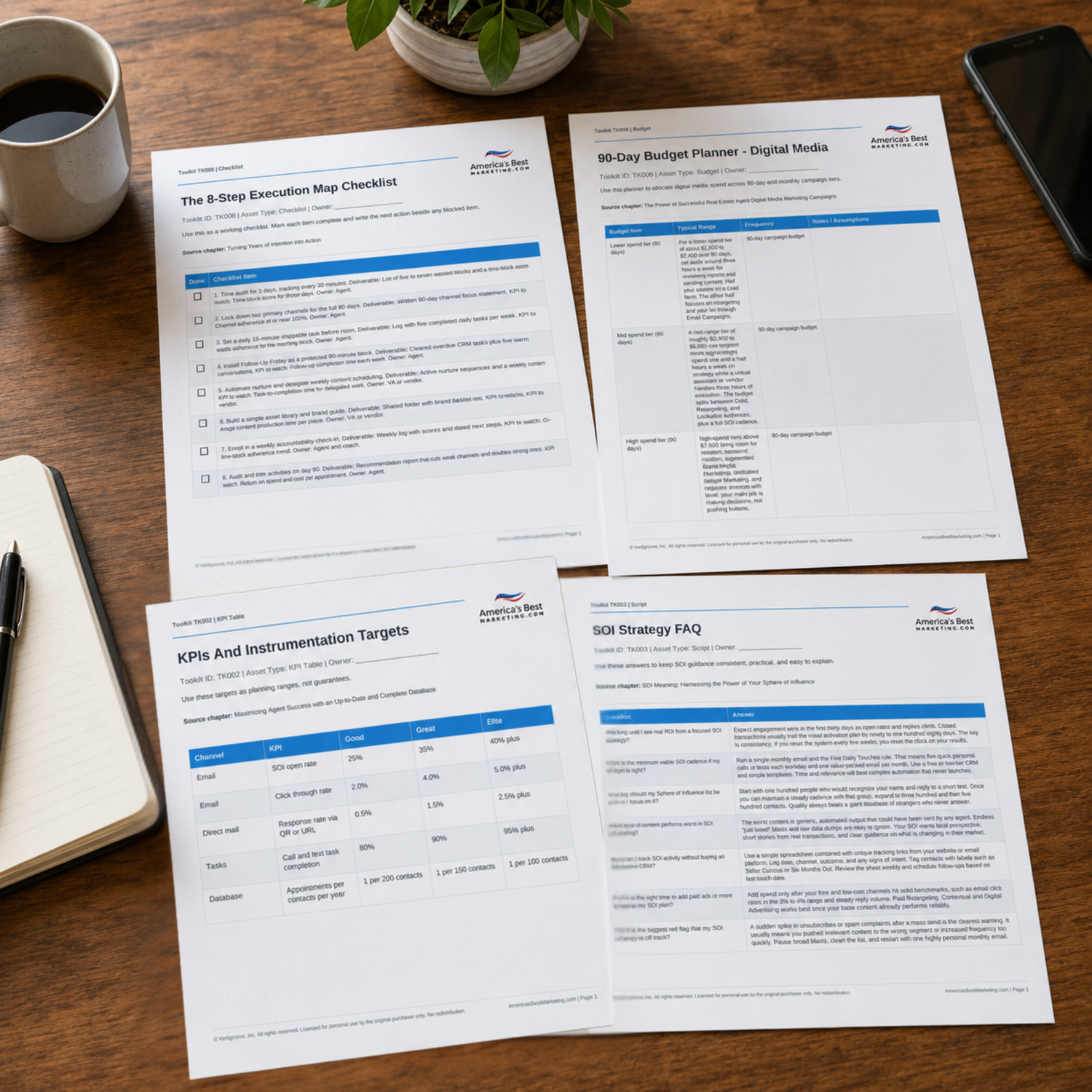
Download The Post-Closing Touchpoint Toolkit
Use the companion Toolkit to build the retention budget planner, post-close onboarding audit, referral KPI tracker, 12-month touchpoint matrix, and past-client follow-up FAQ script into your working CRM routine.
Download the Toolkit ZIPRecommended reads
Recommended Reads for Real Estate Agents
These articles help agents connect relationship marketing, client education, consistent follow-up, and channel strategy into a stronger referral system.

How to Master the Art of Follow-Up with Past Clients
Create referral momentum with relationship content, event ideas, and timely reasons to reconnect.
Read article
Pay Off a Mortgage Early: Real Estate Agent-Friendly Explainer + Content Angle for Homeowners
Make “pay off a mortgage early” more useful as an authority-content topic by tying the homeowner question to a clear audience, message, and next step.
Read article
Your Brand is Built on Every Interaction: Managing Client Touchpoints for Lasting Success
Give client touchpoints a clearer role in the marketing system instead of treating the work as a one-off idea.
Read article
How to Turn a Client into a Raving Fan
Stay remembered by past clients and sphere contacts with better touchpoints and less awkward outreach.
Read articlePost-Closing Touchpoint Questions Agents Should Be Ready To Answer
How often should I contact my past clients?
Aim for two light touches per month plus one personal touch most months. Light touches can be an email guide, a short market note, or a useful homeowner reminder. Personal touches are a call, text, or handwritten note. Track compliance in your CRM so you do not bunch touches into one busy week and then disappear for months.
What is the best gift to give after a closing?
Choose gifts that are useful, local, and repeatable. A local gift card, a handwritten note with a small home item, or a seasonal maintenance kit works well. Avoid expensive gifts that feel transactional. Keep a per-client budget you can sustain for years and treat gifts as part of your retention system.
How long does it take to see measurable ROI from a referral plan?
Most plans show early signals before they show closings. Track replies, reviews, vendor introductions, and market report requests in months one through six, then track referral conversations as they appear in later months. The compounding effect shows up after consistent execution, not after one mailer or one appreciation event.
What is the major red flag to avoid in client follow-up?
Randomness is the red flag. Random follow-up feels self-serving and trains clients to ignore you. Another red flag is sharing value estimates without a clear disclaimer. Always say your value range is an estimate and not an appraisal. Keep list hygiene clean and include an opt-out line on every email.
How do I ask for a review without making it awkward?
Ask while the win is still fresh and keep it specific. Send a short message that names the moment you are proud of and give a direct link to leave the review. Thank them either way. If they do not respond, follow up once with a shorter ask, then move on and keep providing value.
Should I segment past clients or treat everyone the same?
Segment. New clients need higher frequency for the first four months. Long-term clients may prefer monthly touches. Keep a segment for people who dislike email and prefer text or a call. Tag by neighborhood and property type so your market notes feel relevant instead of generic.
Next step
Build the System Behind the Follow-Up
Continue from one useful article into the larger ABM ecosystem: the book series for strategic depth and the full marketing program for done-for-you execution.

View the Book Series
Explore the America’s Best Real Estate Agent Marketing System books for a deeper strategic framework around visibility, referrals, listings, lead generation, and growth.
View the Book Series
See Full Marketing Program
See how AmericasBestMarketing.com runs real estate blog writing, social media, listing marketing, email, direct mail, and retargeting as one managed system.
See Full Marketing Program