The Science of Staying Top-of-Mind: How Direct Mail for Real Estate Agents Drives Referrals
Direct Mail for Real Estate Agents
How Staying Top-of-Mind Drives Referrals
A direct mail execution brief for agents who want postcards, letters, and client appreciation touches to create repeat conversations, referrals, and measurable follow-up.

Direct mail keeps agents remembered when referrals are ready
Direct mail works for real estate agents because it turns a passing marketing touch into a physical reminder that can stay on a counter, desk, or refrigerator. When the message is consistent, useful, and connected to email, social, and follow-up, it builds the familiarity that makes past clients and local homeowners more likely to call, text, or refer when a real estate need appears.
- Direct mail should be measured as a relationship system, not as a one-week ad buy.
- The strongest campaigns separate sphere nurture, geographic farming, and listing or event reinforcement.
- Every mail piece needs one clear response path such as a text prompt, QR code, short link, or dedicated phone number.
- Direct mail performs best when the same message also appears in email, social media, listing marketing, and client follow-up.
Why Direct Mail Still Works for Real Estate Agents
Most digital touches vanish quickly. A social post gets swiped past. An email alert gets muted. A paid impression becomes background noise. Direct mail gives your brand physical dwell time inside the home, which makes it easier for clients, neighbors, and sphere contacts to remember you when a job change, new baby, inherited property, or relocation conversation starts.
The goal is not to force every postcard into an immediate appointment. The goal is steady, quiet familiarity. When a homeowner sees your name repeatedly with useful local information, the contact starts to feel less like advertising and more like ongoing presence. That is why direct mail belongs beside Email Marketing for Real Estate Agents, Social Media Management for Real Estate Agents, and a clean database follow-up system.
Agents lose leverage when they mail once, disappear for half a year, or send generic cards that look like commodity advertising. The leverage appears when the audience, message, cadence, and response path stay consistent long enough for people to recognize the pattern.
- Mail creates a tangible brand touch that can stay visible long after a digital ad expires.
- Consistent mail reinforces your credibility with past clients and homeowners who are not ready today.
- Useful mail gives people a practical reason to call, text, scan, save, or refer you.
The Three Direct Mail Campaign Lanes That Build Your Pipeline
Direct mail for real estate agents works best when you stop treating every piece as a separate idea. Build three lanes instead. Nurture campaigns serve your sphere of influence and past clients with gratitude, seasonal value, homeownership reminders, and simple market insight. Acquisition campaigns target a defined geographic farm and teach local owners that you understand their neighborhood. Reinforcement campaigns support listings, events, and client appreciation moments so your best proof travels beyond the open house sign.
Think of nurture as the loyalty engine, acquisition as the growth engine, and reinforcement as the spotlight. A quarterly market report plus one lighter monthly touch can serve the nurture lane. A tighter farm can start with one strong market snapshot each month. Listing and event mailers can be triggered as needed, especially when paired with Direct Mail for Real Estate Agents support and Listing Marketing.
Stay valuable to people who already know you
Mail your best past clients and sphere contacts with home value prompts, anniversary notes, seasonal checklists, and short local updates.
Keep the voice personal and practical. The best nurture mail feels like a useful note from someone they already trust.
Use names, property context, and simple calls to text back so the relationship feels active instead of automated.
Earn recognition in a specific set of streets
Choose a small enough farm to mail consistently. Three hundred to one thousand homes is often more useful than a giant list you cannot afford to touch well.
Lead with market snapshots, just sold proof, neighborhood statistics, and owner questions that make the piece worth saving.
Track which streets reply first so the farm becomes smarter after each drop.
Make listings and events travel further
Use mail to extend the life of client appreciation events, just listed moments, just sold proof, and milestone updates.
Pair each mailed invitation or proof piece with a matching email and social post so people encounter the same message in more than one channel.
After the event or sale, send a recap card that thanks people and opens the door to a referral conversation.
Most agents judge direct mail too early because they measure it like a short ad campaign instead of a relationship asset. Commit to six to twelve consistent touches before you declare a farm or segment unproductive.
Three Direct Mail Frameworks You Can Use This Quarter
The right mail piece does not need clever copy. It needs a clear audience, one visible promise, and a response path that the reader can act on without working hard. These three frameworks translate the source strategy into repeatable campaign assets.
Past Client Thank You Card
Best use
Audience Past buyers, past sellers, referral partners, and sphere contacts you would gladly work with again.
Front line Your home value report is inside.
Body line Thank them for trusting you, mention one local market shift, and make the note feel personal rather than mass produced.
Call to action Text me your address for a fresh, no-pressure equity update.
Use this when your main objective is repeat business and referral warmth, not cold prospecting.
Farm Market Snapshot Postcard
Best use
Audience Owners in a focused geographic farm with enough turnover to justify consistent mail.
Front line Here is what your neighbors actually sold for this quarter.
Body line Show the number of homes you tracked, the price pattern, and what owners should watch next.
Call to action Scan this code or text me to see where your address lands on the chart.
Use this when you want owners to associate your name with accurate local market intelligence.
Client Appreciation Invite
Best use
Audience Past clients, referral sources, warm prospects, and strong sphere contacts.
Front line You are invited to a local appreciation night created for clients and friends.
Body line Mention the venue, reason for the event, and one simple benefit for anyone thinking about a move.
Call to action Reply with a quick yes or no so we can save seats for you.
Use this when you want the mailbox to reinforce a real-world relationship moment.
The 90-Day Direct Mail Activation Plan
The next ninety days are not about clever ideas. They are about installing one reliable direct mail system that connects to your database and your follow-up routine. Treat the sprint as infrastructure work that will keep paying you after the first campaign is mailed.
Start by segmenting your database into two tiers. Tier one is your sphere of influence and past clients. Tier two is a clean geographic farm, even if that farm starts with only a few streets. Then choose one primary mail type such as a postcard, letter, or simple newsletter so your design, copy, and costs stay predictable.
Build the list and campaign foundation
Clean the database, remove stale addresses, select the farm, and decide whether the first mailer will be a postcard, letter, or market snapshot.
Design two variations with the same offer so you can compare which headline pulls a better response.
Test the piece and connect tracking
Set up a dedicated tracking path such as a unique phone number, short link, or QR code. Send a small batch to confirm print quality, delivery timing, and address accuracy.
Make sure responses flow into your customer relationship manager with a campaign tag and a defined next step.
During the final thirty days, lock the cadence and connect the campaign to Email Marketing for Real Estate Agents and social content. When your postcard, email, and posts share the same message, recall climbs quickly because the audience does not need to decode a new idea in every channel.
Book a strategy block with 1:1 Marketing Coaching if you need another set of eyes on the farm, offer, or creative. A second review can save you from mailing into a low-turnover area or using an offer that does not match your ideal price point.
Budget, Time, and Production Plans You Can Repeat
Your direct mail budget is not just ink and postage. It also includes the time spent pulling lists, writing notes, coordinating print, checking proofs, and logging replies. Set a ninety-day budget and production rhythm before the first drop so every next step is already funded and scheduled.
Low-tier budgets should prioritize smaller, higher-touch lists and more personalization. Mid-tier budgets can support a larger farm and more printer automation. Higher-tier campaigns can move into managed execution, where print, addressing, postage, follow-up tagging, and cross-channel reinforcement are coordinated as one operating system.
| Metric | What It Tracks | Target Range | How To Use It |
|---|---|---|---|
| Response rate | Calls, texts, site visits, and scans that start from the mail piece. | 0.5% to 2% | If results are lower, tighten the list and strengthen the headline and offer before changing formats. |
| Cost per response | Total print and postage spend divided by real replies. | $6 to $18 | Use this to compare mail against other channels instead of chasing raw volume. |
| Referral volume | Repeat deals and referrals that trace back to consistent mail contact. | 2 to 5 | Use this to justify long-term consistency and decide when to expand the farm. |
Use unique tracking numbers and short links on every drop so you never guess which piece generated the call. When response is profitable relative to your average commission, increase frequency or expand the list with confidence. If the numbers fall short, adjust the audience or offer before chasing a new format.
Keep the compliance bar visible. Cards and letters should reflect fair housing guidance in both words and imagery, avoid promising specific price outcomes, and respect anyone who asks to stop receiving mail. That discipline is part of the brand signal.
A clean pattern shows the upside. An agent mails a quarterly market report to five hundred households and supports it with one smaller touch each month. Over six months, seven owners mention the card directly and two listing conversations become signed listings. The print and postage bill can return several times the spend before referral deals are even counted.
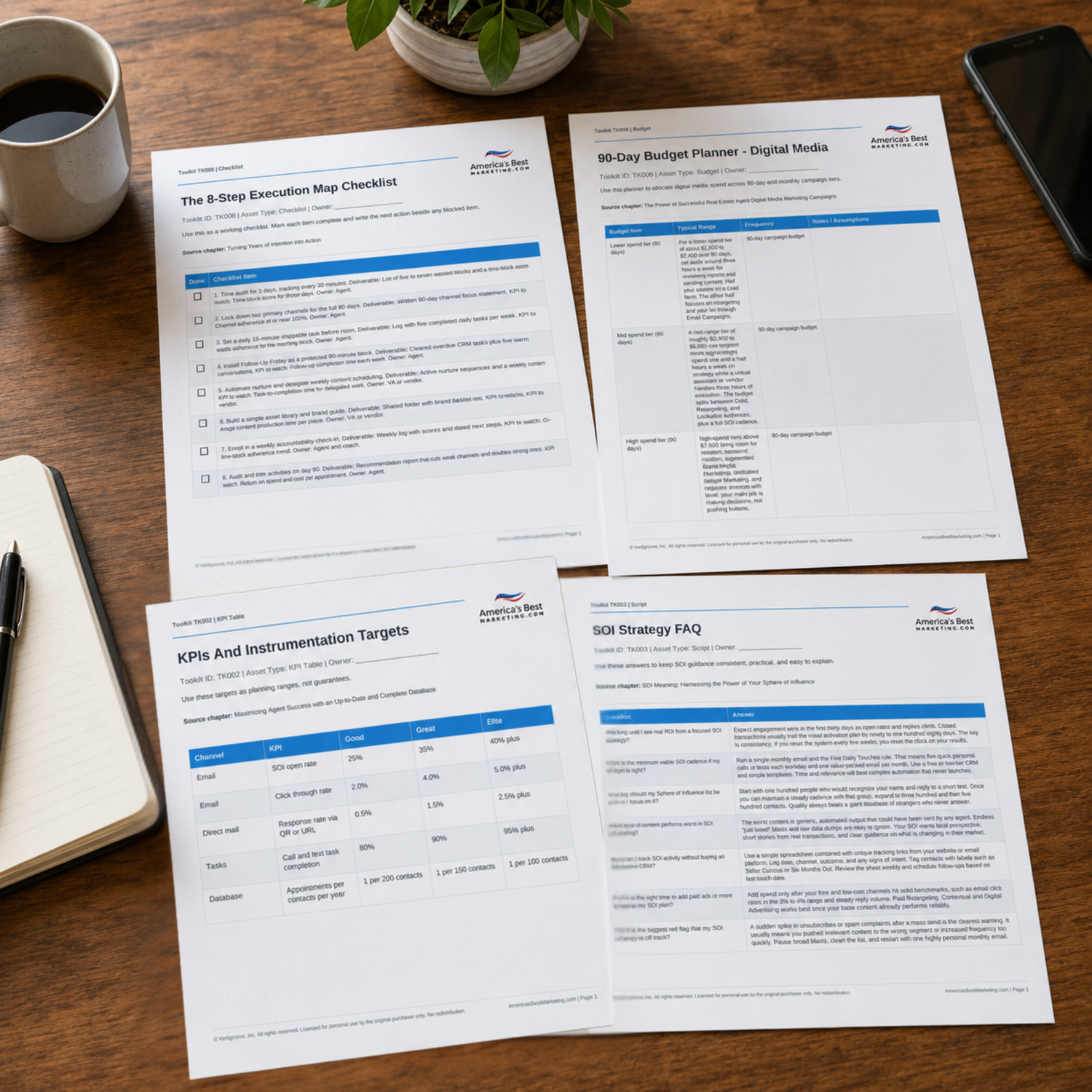
Download The Direct Mail Implementation Toolkit
Use the companion Toolkit to plan a ninety-day direct mail budget, organize sphere and farm lists, track response rate and referral volume, and adapt mail frameworks for nurture, acquisition, and client appreciation campaigns.
Download the Toolkit ZIPRecommended Reads
Recommended Reads for Real Estate Agents
These articles help agents connect relationship marketing, client education, consistent follow-up, and channel strategy into a stronger referral system.

How to Master the Art of Follow-Up with Past Clients
Create referral momentum with relationship content, event ideas, and timely reasons to reconnect.
Read article
Pay Off a Mortgage Early: Real Estate Agent-Friendly Explainer + Content Angle for Homeowners
Make “pay off a mortgage early” more useful as an authority-content topic by tying the homeowner question to a clear audience, message, and next step.
Read article
Blog Topic: Real Estate Agent Brand Kit: Fonts, Colors, and Post Styles That Signal “Pro”
Clarify the message, visuals, and client experience that make an agent feel distinctive.
Read article
How to Turn a Client into a Raving Fan
Stay remembered by past clients and sphere contacts with better touchpoints and less awkward outreach.
Read articleDirect Mail Questions Agents Should Be Ready To Answer
How long should I wait to see measurable ROI from using direct mail for real estate agents?
Plan for at least six to twelve months of consistent mailing before you judge results. Direct mail builds familiarity first, then listings and referrals follow. You may see early calls from just sold cards, yet the real return comes when owners have seen your name enough times to feel safe reaching out. Commit to one full year on a list before you decide to stop.
What is the minimum viable mailing frequency if my budget is extremely tight?
If your budget is strained, start with one high quality touch every quarter for your core sphere and top farm contacts. Add one extra mailing around a key season such as spring or late summer when moves are common in your market. You can scale to monthly once you see that even this lean rhythm produces conversations and referrals.
How big should a geographic farm be to justify the cost of direct mail?
A smart starting farm often lands between three hundred and one thousand homes, depending on price range and turnover. Smaller, tighter farms let you afford higher quality stock and more frequent touches. Larger farms make sense when average price is higher and listings move quickly. Run the math so one closing covers several quarters of print and postage before you expand.
What content performs worst and causes prospects to discard the mailer immediately?
Generic slogans, stock clip art, and walls of text are the fastest route to the trash bin. Owners also tune out pieces that talk only about the agent and never about the reader. Strong mail leads with a clear benefit, one sharp visual, and a single next step. Weak mail buries the message under clutter and leaves the homeowner wondering why they should care.
How do I accurately track leads generated specifically from a direct mail piece?
Assign each campaign its own phone number, short link, or QR code so every response has a clear source. Log each call or form fill in your customer relationship manager with a tag that matches the mail drop. When you follow up, ask how they heard about you and listen for mentions of the card or letter. Over time, this gives you reliable cost per response and referral data.
When should I scale spend by moving from postcards to higher impact mailers?
Consider scaling once your response rate and cost per response are stable and profitable over several drops. If one farm keeps producing listing conversations and your budget can support it, test a larger format or letter package for that audience only. Watch your numbers closely, then decide whether the lift in response justifies the added print and postage.
What is the major red flag to avoid when designing a direct mail piece?
The biggest red flag is a card that feels like spam instead of a personal, local message. Overcrowded layouts, tiny fonts, and vague promises make people distrust the piece before they even see your name. Aim for clean design, one clear idea, and a grounded offer. The card should feel like a helpful note from a neighbor who happens to be an expert.
Next step
Build the System Behind the Advice
Continue from one useful article into the larger ABM ecosystem: the book series for strategic depth and the full marketing program for done-for-you execution.

View the Book Series
Explore the America’s Best Real Estate Agent Marketing System books for a deeper strategic framework around visibility, referrals, listings, lead generation, and growth.
View the Book Series
See Full Marketing Program
See how AmericasBestMarketing.com runs real estate blog writing, social media, listing marketing, email, direct mail, and retargeting as one managed system.
See Full Marketing Program