Postcard vs. Letter vs. Brochure: Choosing the Best Direct Mail Format for Real Estate Agents
Postcard, Letter, or Brochure?
Choosing the Best Direct Mail Format
A format-choice briefing for real estate agents who want every direct mail dollar tied to the right audience, cadence, message, and follow-up system.

Best direct mail format for each real estate goal
Use postcards when the goal is fast awareness and repeated visibility, letters when the goal is trust and relationship depth, and brochures when the reader needs more proof before making a high-value decision. The right format is not the prettiest piece. It is the piece that matches the audience stage, the list quality, the offer, and the follow-up path.
- Postcards are best for farming, short market updates, just listed or just sold activity, and repeated mailbox visibility.
- Letters are strongest for past clients, close sphere contacts, referral partners, and relationship-based conversations.
- Brochures are best reserved for higher-value segments where process, proof, and authority justify the added print cost.
- Direct mail performance improves when each format is paired with a landing page, email follow-up, social reinforcement, and retargeting.
Why Format Choice Drives Response
Most agents judge direct mail by the look of the piece. That matters, but it is not the first decision. The first decision is what the piece is supposed to accomplish with that audience. A postcard, letter, and brochure each create a different kind of interaction at the mailbox.
A postcard is built for speed. The reader can understand the point in seconds. A letter creates a more personal exchange and gives you room for gratitude, market context, story, and a softer invitation. A brochure gives you the depth to explain a premium process when the household is valuable enough, interested enough, or complex enough to justify the extra space and cost.
The waste usually starts when formats are swapped without a clear reason. Agents use postcards to explain complex pricing, send long letters to cold neighborhoods, or drop glossy brochures to broad lists with no equity, income, timing, or life-stage filter. Stronger campaigns start with a simple premise: format follows trust.
- Use postcards when the reader does not yet owe you attention and the message must land quickly.
- Use letters when the relationship already has value and the message should feel personal.
- Use brochures when a serious homeowner needs evidence, process, and positioning before taking the next step.
The Format-To-Goal Matching System
You do not need a massive mail budget to run a smart ninety-day direct mail plan. You need one clear goal for each list, a format that supports that goal, and a schedule that keeps you visible without paying for depth the reader is not ready to absorb.
This system starts with the audience. Segment your database into retention, acquisition, and nurture lists. Retention covers past clients and close sphere. Acquisition covers geographic farms and niche homeowner targets. Nurture covers people who have engaged but are not ready yet. Once the list is clear, the format decision becomes more disciplined.
| Format | Primary goal | Recommended cadence | Budget suitability | Best digital integration |
|---|---|---|---|---|
| Postcard | Brand awareness, short market updates, farming, and fast scan value for a defined audience. | Monthly to a tight farm or quarterly to a wider list. | Low to mid spend with larger print runs. | Send visitors to a focused lead page and follow with Retargeting & Contextual Ads. |
| Letter | Relationship depth, referral growth, and personal communication with past clients and sphere. | Quarterly or twice a year to your best relationships. | Mid spend focused on smaller, higher-value lists. | Pair with Email Marketing for Real Estate Agents for follow-up stories and reminders. |
| Brochure | Authority, proof, and conversion support for luxury listings, downsizing, move-up sellers, and complex moves. | Once a year per key segment or targeted drops by campaign. | Mid to high spend that must be driven by tight targeting. | Feature the same offer on service pages or campaign pages supported by IDX Real Estate Websites. |
Most direct mail waste comes from format mismatch, not from direct mail itself. A postcard is not failing if you asked it to do the work of a brochure. A letter is not inefficient if it is sent to the right relationship list. Before every send, ask where the audience sits in the relationship funnel.
Keep postcards simple
Use one visual, one headline, one proof point, and one call to action. The reader should understand the point before they reach the recycling bin.
Best topics include market shifts, recent local sales, homeowner tips, just listed activity, just sold proof, and neighborhood event reminders.
Make letters feel personal
Use letters when the reader knows you, has worked with you, or could plausibly refer business. The tone should feel like correspondence, not a flyer in paragraph form.
Best topics include equity updates, thank-you notes, referral invitations, client anniversaries, and short market stories that invite a reply.
Save brochures for depth
Use brochures when the segment needs evidence before action. Higher paper quality, stronger photography, and a more polished process story can make sense here.
Best topics include luxury listing strategy, downsizing, relocation, estate situations, move-up planning, and high-equity seller education.
Three Direct Mail Paths You Can Use
Once the list and goal are clear, the campaign path should be obvious. Use these three paths to keep postcards, letters, and brochures from competing with each other.
The awareness-heavy postcard path
Best use case
AudienceA focused farm of roughly one thousand homes with clear price bands, ownership patterns, and neighborhood identity.
CadenceSend a market story, just listed, just sold, or homeowner tip postcard every month for ninety days.
CTAUse one simple next step such as a quick value check by text, short link, or QR scan.
Hold the design system steady long enough for repetition to work. After ninety days, tighten the farm or increase frequency only where response quality justifies the spend.
The retention-focused letter path
Best use case
AudiencePast buyers, past sellers, referral partners, and the fifty to one hundred relationships most likely to create repeat business.
CadenceSend one personal-style letter each quarter or twice a year, depending on relationship strength.
CTAAsk one direct question that invites a reply, referral, review, conversation, or updated home value discussion.
Match each letter to a short follow-up sequence inside Email Marketing for Real Estate Agents so the same relationship message continues after the envelope lands.
The authority-driven brochure path
Best use case
AudienceLuxury, high-equity, relocation, downsizing, or estate-adjacent homeowners where one client can materially change the year.
CadenceMail once per year, or in a short seasonal burst, to tightly selected households.
CTAOffer a planning call, custom value review, listing strategy consult, or move-planning conversation tied to one clear segment.
Host the same story online and support it with Retargeting & Contextual Ads so print depth continues across the browser, inbox, and feed.
Creative And Messaging That Fit Each Format
Once formats and cadence are locked, creative carries the weight. Postcards must hit hard in a few seconds, letters must sound like you, and brochures must feel like a guide that earns a place on the kitchen counter.
Give each format a distinct role in your narrative. Postcards handle short hooks and proof. Letters handle story and invitation. Brochures handle depth, visuals, and process. Use the same visual system across all three so your brand feels familiar as people move from mailbox to screen.
Run a ninety-day starter plan that sends one postcard each month to a tight farm and one personal letter to your top fifty contacts. Keep spend around a few hundred dollars per month by using simple designs, clean lists, and clear offers. The goal is proof of life for your direct mail system, not perfection.
Run a balanced plan that covers a larger farm with postcards, quarterly letters to past clients, and one brochure drop to a high-value list. Spend moves into the low four-figure range with heavier focus on design, copy, and managed support through Direct Mail for Real Estate Agents.
- Postcard headline: Home sale prices on your street are shifting faster than most owners realize.
- Postcard headline: Three simple moves can raise your sale price without heavy renovation.
- Letter headline: A quick thank you and an important update on your home equity.
- Letter headline: How your neighbors are using this market to fund their next chapter.
- Brochure headline: The complete plan for selling your luxury home with less stress and stronger terms.
- Brochure headline: Step-by-step move planning for your next address.
Calls to action should match the space you have. Postcards work best with one clear next step such as a scan or short link. Letters support a brief invitation to reply, text, or call. Brochures can close with a confident appointment request that ties every panel back to one outcome.
How To Measure Whether The Format Worked
To measure direct mail, you need simple instrumentation, not a lab report. Three numbers matter most: cost per piece, attributed response rate, and response quality. Cost per piece tells you what the format really costs after printing, postage, design, and list preparation. Attributed response rate tells you whether the piece generated a measurable signal. Response quality tells you whether those signals turned into real conversations.
| Budget tier | Core focus | Monthly spend | Execution guidance |
|---|---|---|---|
| Low tier | Single farm postcard plus light letter touch. | $100 to $300 | Send one postcard per month to a tight farm and one simple letter to your best clients. Track scans, calls, and replies before expanding. |
| Mid tier | Farm postcards plus quarterly letters. | $300 to $1,200 | Cover a larger farm with postcards and send letters to sphere while you refine list quality, offer clarity, and tracking. |
| High tier | All formats plus select brochures. | $1,200 plus | Add high-quality brochures for luxury or high-equity segments and expand only where response quality justifies the added spend. |
Track attributed response by giving each format its own code, link, QR path, or phone extension. Then track response quality by counting genuine listing conversations, referrals, warm introductions, and appointment requests instead of raw scans alone.
Compliance and ethics matter in print. Use fair housing-friendly images, avoid language that suggests preference for any protected group, and keep claims grounded in your actual track record. Make sure every mailer includes clear brokerage identification and a direct contact path.
The Direct Mail Mistakes That Break ROI
Direct mail fails when the list, message, format, and follow-up system are misaligned. A beautiful brochure cannot rescue a weak list. A clever postcard cannot support a complicated explanation. A personal letter cannot feel personal if it reads like a mass-market flyer.
Before every mailing, run a simple quality check. Confirm that the list still matches the audience. Confirm that the format matches the trust level. Confirm that the offer is clear. Confirm that your website, inbox, phone, and CRM are ready for the response. Direct mail is not a standalone channel. It is a visibility trigger inside a larger real estate marketing system.
- Do not send expensive brochures to broad lists without equity, timing, life-stage, or price-point logic.
- Do not ask a postcard to carry more than one primary idea or one primary call to action.
- Do not let print land without a matching landing page, email sequence, or social reinforcement.
- Do not judge a single drop in isolation when the strategy requires repeated visibility.
How This Becomes A Marketing System
The smartest format choice does more than improve one mailer. It gives your entire marketing stack a clearer job. Your postcard headline becomes a social post. Your letter story becomes an email. Your brochure proof becomes a web page. Your strongest offer becomes a retargeting ad.
Use direct mail as the physical anchor for Social Media Marketing, Email Campaigns, Direct Mail, Digital Retargeting, and Listing Marketing. Each channel should repeat the same market promise so the agent becomes familiar before the client needs to make a decision.
If you want the system managed end to end, AmericasBestMarketing.com can help turn formats, lists, offers, and follow-up into a full campaign plan that supports the way real estate clients actually move from attention to conversation.
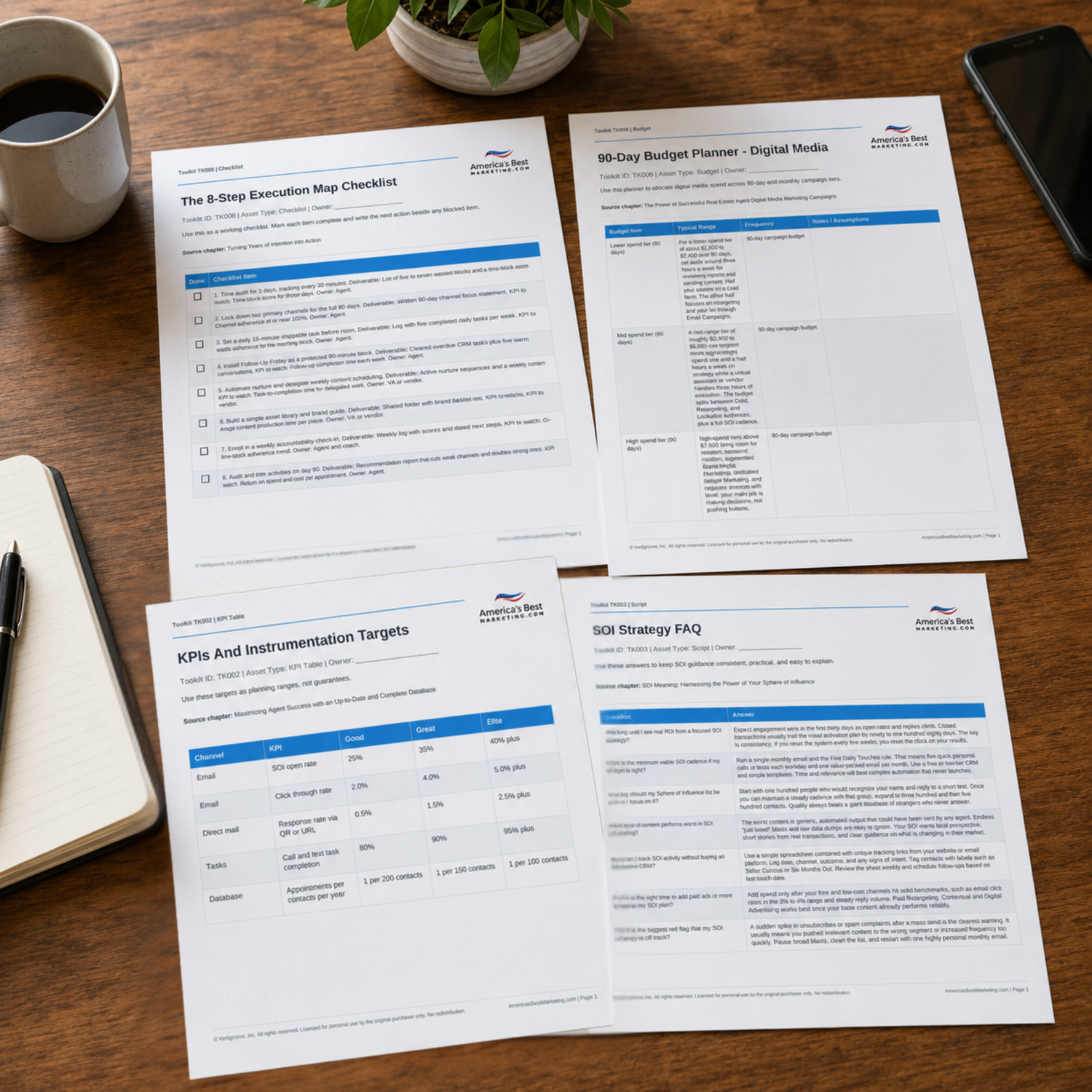
Download The Direct Mail Format Toolkit
Use the companion Toolkit to compare postcard, letter, and brochure strategy with a budget planner, ninety-day checklist, format measurement sheet, campaign tier chart, and client-facing explanation script.
Download the Toolkit ZIPRecommended reads
Recommended Reads for Real Estate Agents
These articles help agents connect follow-up discipline, database habits, client communication, and marketing execution into a repeatable system.

Monthly Direct Mail for Real Estate: The 12-Month Agent Playbook
Turn print into a consistent relationship channel instead of a one-off postcard gamble.
Read article
Local SEO for Real Estate Agents: How to Dominate Search in Your Neighborhood
Make local search work harder with content that answers real questions and leads to a next step.
Read article
Why Every Real Estate Agent Needs an IDX-Integrated Website
Use IDX-integrated websites to create a stronger bridge between client education and real conversations.
Read article
Real Estate Direct Mail Tips That Actually Work: A Guide for Real Estate Agents
Turn print into a consistent relationship channel instead of a one-off postcard gamble.
Read articleDirect Mail Format Questions Agents Should Be Ready To Answer
How long should one direct mail format run before you judge its results?
Give each format at least one full ninety-day cycle before you make big changes. That window lets you send several touches and catch natural movement in and out of the market. Review response rate, reply quality, and list health at the end of the cycle. Adjust cadence or creative before you abandon the format entirely.
What is the minimum viable frequency for personalized letters versus postcards?
Postcards can carry a monthly rhythm to a tight farm because they are quick to scan and simple to print. Personalized letters work best on a slower schedule such as once or twice per year to high-value clients, with quarterly use for your strongest relationships. If you ramp letters too often, costs climb without a matching lift in response.
Which format is best for immediate listing appointments versus long-term referrals?
If you want near-term listing appointments, lead with postcards that feature fresh wins and a direct offer to talk. For long-term referral growth, letters to past clients and close sphere tend to win. Brochures are strongest once someone is already curious and considering a higher-value move. Think of postcards as the spark, letters as the bond, and brochures as the deeper proof piece.
What content should be avoided in high-cost brochures?
Avoid vague promises, crowded bullet lists, and generic claims that any agent could make. Do not fill space with stock tips that appear in every brochure on the shelf. Instead, highlight specific proof points, process visuals, local expertise, and decision support. Every panel should either answer a real question or build confidence in your ability to guide the move.
How can you track website traffic and leads from a physical mailer?
Give each format its own short link, QR code, or phone extension and route those responses into your site and CRM. Use simple analytics to track which links are visited and which forms are completed. Inside your reports, label contacts by mailer format so you can compare cost per lead and cost per appointment across formats and segments.
When should you shift from a budget-friendly postcard to a brochure?
Consider a brochure once you prove that a segment consistently responds to your simpler mailers. Look for signs like repeat scans, replies, listing conversations, or direct questions tied to that list. When those signals are strong and the price point justifies extra spend, step up to a brochure that deepens your story. Keep postcards running so the brochure feels like a natural next step.
What red flag shows that your direct mail format is a poor fit?
The biggest warning sign is when people engage lightly but never move into real conversations. That often shows up as scans or site visits tied to a format but no calls, replies, or booked appointments. Another signal is rising spend with flat response from the same list. In both cases, revisit the match between format, message, and list stage.
Next step
Build the System Behind the Advice
Continue from one useful article into the larger ABM ecosystem: the book series for strategic depth and the full marketing program for done-for-you execution.

View the Book Series
Explore the America’s Best Real Estate Agent Marketing System books for a deeper strategic framework around visibility, referrals, listings, lead generation, and growth.
View the Book Series
See Full Marketing Program
See how AmericasBestMarketing.com runs real estate blog writing, social media, listing marketing, email, direct mail, and retargeting as one managed system.
See Full Marketing Program