Monthly Direct Mail for Real Estate: The 12-Month Agent Playbook
Monthly Direct Mail for Real Estate: The 12-Month Agent Playbook
A Repeatable Mailbox System for Sphere and Farm Visibility
A month-by-month direct mail operating plan for real estate agents who want consistent visibility, useful homeowner content, measurable response, and a clear path from mailbox recognition to real conversations.

How a 12-month direct mail plan works
Monthly direct mail works when one defined audience receives one useful, recognizable piece every month and every piece leads to a trackable next step. Build separate sphere and farm lanes, keep the brand system stable, rotate homeowner value and market proof, and measure calls, replies, scans, landing-page visits, consultations, and signed business over time.
- Protect monthly cadence by shrinking the list before reducing frequency.
- Give sphere contacts a personal relationship message and farm contacts a local homeowner message.
- Use one theme, one call to action, and one response metric for each monthly drop.
- Coordinate direct mail with social, email, listing content, and retargeting so every channel reinforces the same brand story.
Why Monthly Direct Mail Belongs In The Core Marketing System
Direct mail is a consistency channel. It puts your name, face, and message in the one physical channel every homeowner checks. When a useful piece arrives during the same general window each month, your sphere and farm learn to treat you as a steady real estate resource instead of another agent appearing only when business is needed.
The strongest mail pieces do three jobs at once. They build familiarity, invite response, and reinforce the same brand story people see in your email, social feed, listing content, and local marketing. The goal is not to make one postcard carry the whole business. The goal is to make the mailbox part of a larger follow-up system.
For a deeper strategy view, study SOI Marketing: The Power of Direct Mail Campaigns, then use this playbook as the operating calendar.
- Sphere mail keeps warm relationships alive through gratitude, useful reminders, and personal relevance.
- Farm mail builds repeated proof in one neighborhood where you want long-term listing lift.
- Both streams should share the same brand, colors, voice, and clear next step.
Sphere And Farm Mail Have Different Jobs
Sphere mailing focuses on people who already know you: past clients, friends, family, neighbors, referral partners, and warm contacts. The list is smaller, the tone is more personal, and the goal is to make you easy to remember when a real estate question or referral opportunity appears.
Farm mailing focuses on a geographic audience where you want market presence over time. The tone is more educational and proof based. You highlight local data, homeowner value, and clear reasons to call. For a deeper look at repetition, review The Science of Staying Top-of-Mind: How Direct Mail Keeps Clients Coming Back.
Lead with relationship value
Use appreciation notes, client stories, vendor introductions, seasonal reminders, event invitations, and planning offers. Leave room for a handwritten line when the relationship warrants it.
Lead with local homeowner value
Use market snapshots, equity reviews, neighborhood stories, maintenance checklists, seller preparation, and evidence that you understand the area block by block.
Protect recognition and response
Keep the logo, headshot, colors, typography, tone, QR treatment, short URL, and response path consistent enough that each piece compounds the last one.
List quality and repetition drive more return than constant design reinvention. One focused audience hearing from you twelve times usually beats twelve clever concepts scattered across random zip codes.
The 12-Month Direct Mail Calendar For Real Estate Agents
This calendar gives every month one theme, one deliverable, and one primary KPI. The structure can repeat each year while the data, stories, vendors, and local details change.
Forecast, appreciation, and spring readiness
January: Send a local market forecast card with prices, inventory, days on market, and a QR code to a deeper forecast. Measure scans and forecast-page visits.
February: Send a client appreciation note with a short client-win story and room for a handwritten line. Measure direct replies.
March: Send a spring fix list and vendor guide. Measure requests for vendor introductions.
Maintenance, neighborhood proof, and equity
April: Mail a home maintenance checklist covering gutters, roof review, crawl spaces, and safety checks. Measure printable downloads.
May: Tell a short neighborhood success story without turning the piece into a brag sheet. Measure value and timing questions.
June: Offer a midyear equity review for owners who may move in the next few years. Measure calls and form fills.
Local life, ownership trends, and mobility
July: Highlight festivals, concerts, and family events. Measure QR scans for the full online event list.
August: Share investor, second-home, rental, or ownership trends where relevant. Measure investor and second-home questions.
September: Send a school-zone and commute guide with neighborhood pockets gaining attention. Measure replies about streets, schools, and commute patterns.
Preparation, referrals, and next-move planning
October: Provide a fall clean-up and safety list. Measure requests for vendor recommendations.
November: Tell a referral story and show how a trusted introduction helped both families. Measure referral conversations.
December: Summarize local market changes and invite owners to discuss timing. Measure consultations booked for the next twelve months.
Run A Pre-Flight Check Before Every Mail Drop
Before you commit postage, run the campaign through one tight checklist. This protects the budget, keeps the brand consistent, and makes response easier to measure.
- Segment the list into sphere and farm audiences before writing the message.
- Clean addresses with a verification service before every larger drop.
- Use one trackable phone number or extension for direct mail response.
- Create a unique landing page with a short, readable URL.
- Keep the logo, headshot, colors, and typography consistent with the online presence.
- Use one QR code that points directly to the campaign landing page.
- Confirm print and mailing deadlines so the piece lands during the intended week.
- Coordinate the message with Social Media Management and Email Marketing for Real Estate Agents.
- Track forms, calls, scans, replies, and consultations inside the CRM.
Three Direct Mail Templates You Can Reuse
Reusable templates reduce production time and make it easier to protect cadence. Keep the visual frame stable, then change the monthly message, proof, and next step.
The local market forecast postcard
Copy and layout flow
HeadlineYour Home Value Today In Three Numbers.
BodyUse one short line each for prices, days on market, and inventory.
CTA lineScan for the deeper forecast and a custom equity review.
DesignUse three large numbers on the front and place the QR code with the short URL on the back.
Keep enough open space for fast mailbox scanning. The value proposition should be understood before the card is turned over.
The problem and solution letter
Copy and layout flow
Hook lineSelling a home you love can feel risky until you see a clear plan.
Build lineName the pressure points: timing, preparation, pricing, and next-home logistics.
Solution lineExplain the step-by-step planning process and how decisions will be sequenced.
CTA lineInvite the owner to a low-pressure planning conversation.
Use a letter-style format with a real signature. Bold only the owner concerns that deserve immediate attention.
The local vendor guide trifold
Copy and layout flow
HeadlineTrusted Local Pros For Your Next Home Project.
BodyGroup vendors by category with a short note on when to call.
CTA lineInvite owners to ask before large projects that may affect resale value.
DesignUse one panel per category and place the contact block on every panel footer.
Mark vendors who are especially useful before listing preparation and keep a dated review process for every recommendation.
Production Plans, Budget Tiers, And KPIs
The easiest system to maintain separates the monthly strategic decision from production. Choose the audience and theme first, update the data and proof second, then move the approved message through print, landing page, email, social, and CRM follow-up.
Update the list, choose the monthly theme, refresh the numbers, drop copy into a consistent postcard template, and send to the best sphere segment or a small farm. Keep the layout stable so the team changes the message rather than rebuilding the design.
Segment sphere and farm versions, adjust the headline for each audience, prepare the landing page, test the QR code, and queue matching social and email follow-up. This version becomes easier to delegate once the workflow is documented.
| Tier | Audience Focus | Monthly Spend | What This Level Does |
|---|---|---|---|
| Low tier | Mail 500 sphere contacts with a standard postcard. | $425 | Tests direct mail with a tight list and simple creative while protecting monthly cadence. |
| Mid tier | Mail 1,500 farm homes with an EDDM-sized postcard. | $900 | Builds presence in one or two neighborhoods where the agent wants steady listing conversations. |
| High tier | Mail 3,000 total contacts with a newsletter-style piece. | $3,600 | Supports agents with referral volume who want a magazine-style print presence across sphere and farm. |
At these sample tiers, a ninety day test lands near $1,275, $2,700, or $10,800 before adjustments. Treat the figures as planning ranges, not promises. Scale only after response becomes consistent.
Track response rate, cost per response, qualified lead rate, consultation requests, and signed listings. Also watch softer signals: people mentioning the card, saving the vendor guide, replying to a handwritten note, or recognizing the brand in conversation.
Use a dedicated call tracking number, unique landing page, and QR code for each campaign. Log every call, form fill, and conversation source inside the CRM. Then connect interested owners to Direct Mail, Listing Marketing, email nurture, and digital follow-up.
Compliance And Ethics For Direct Mail
Respect fair housing rules when choosing target areas and writing copy. Focus targeting on geography, property type, ownership data, and homeowner needs rather than personal traits. Keep claims grounded in real examples and avoid language that sounds like a guaranteed outcome.
Handle data privacy carefully. Source lists from reputable providers or the CRM, honor requests to stop mail, and avoid sharing more contact information with vendors than the campaign requires. Ethical direct mail should make the agent more trusted even among people who never hire them.
- Do not use personal traits to shape farm selection or campaign messaging.
- Do not present estimated values, response rates, or campaign outcomes as guarantees.
- Do document list sources, mailing dates, campaign offers, and response tracking.
- Do keep vendor access limited to the data required for production and delivery.
Avery And The Nine-Month Mailer Test
Avery focused on one farm of twelve hundred homes and committed to a monthly mailer for nine straight months. She mixed market forecast cards, vendor guides, and problem-solution letters that invited owners to short planning calls. Her early response came through calls, form fills, text replies, and QR page visits before listing appointments followed.
The important lesson was not that every postcard produced a deal. Repeated useful contact made Avery familiar enough to be considered when owners finally had a question. The next year, the same farm produced additional conversations without changing her monthly budget.
Monthly direct mail is not a creative contest. It is a disciplined visibility system. The advantage appears when the same audience receives useful, recognizable communication long enough for trust and timing to meet.
Make The Mailbox Part Of A Larger Follow-Up System
Direct mail becomes more valuable when the same monthly idea appears across the channels the audience already uses. A market forecast postcard can lead to a deeper blog, a short email, a social post, a retargeting audience, and a consultation offer. Each touch should feel connected, not duplicated.
AmericasBestMarketing.com can coordinate that system through the Full Marketing Program, connecting real estate blog writing, social media, listing marketing, email campaigns, direct mail, and digital retargeting around one managed calendar.
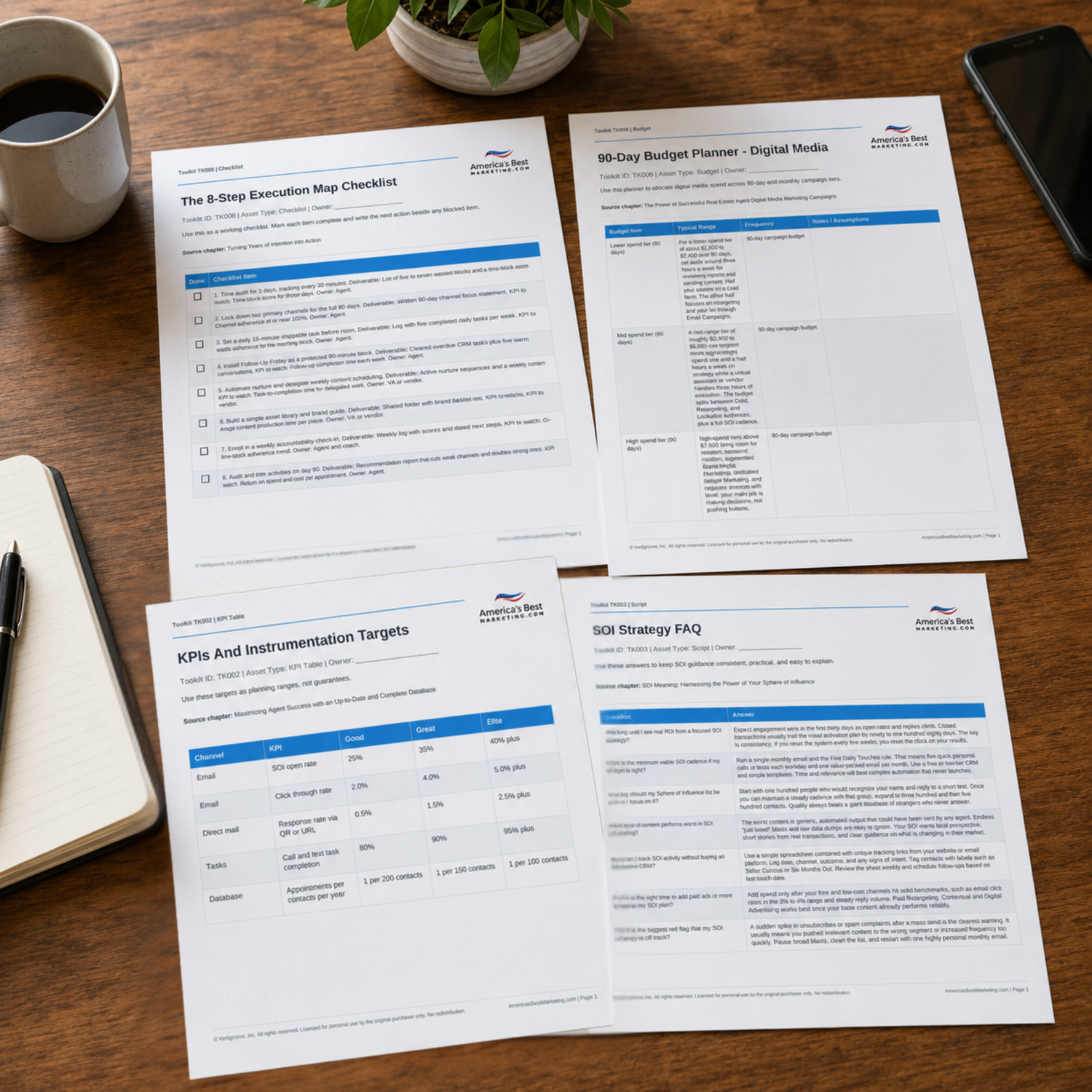
Download The Monthly Direct Mail Planning Toolkit
Use the companion Toolkit to map the twelve-month calendar, segment sphere and farm audiences, organize production, compare budget tiers, reuse campaign templates, and connect every mail piece to measurable follow-up.
Download the Toolkit ZIPRecommended reads
Recommended Reads for Real Estate Agents
These articles help agents connect follow-up discipline, database habits, client communication, and marketing execution into a repeatable system.

Real Estate Direct Mail Tips That Actually Work: A Guide for Real Estate Agents
Turn print into a consistent relationship channel instead of a one-off postcard gamble.
Read article
Postcard vs. Letter vs. Brochure: Choosing the Best Direct Mail Format for Real Estate Agents
Use postcard vs. letter vs. brochure to create a stronger bridge between client education and real conversations.
Read article
Buying and Selling Land: Real Estate Agent Playbook for Pricing, Due Diligence, and Lead Gen
Turn print into a consistent relationship channel instead of a one-off postcard gamble.
Read article
SOI Marketing: The Power of Direct Mail Campaigns
Turn print into a consistent relationship channel instead of a one-off postcard gamble.
Read articleMonthly Direct Mail Questions Real Estate Agents Ask
How many months before I see a listing from my direct mail farm?
A realistic window is six to twelve months of consistent monthly mail into the same farm. You are building familiarity first, then response. Expect early calls to lean toward questions and soft value checks rather than full listing appointments. When your brand feels familiar, the share of owners who call you first in that farm starts to climb.
What is the minimum mailing frequency if my budget is tight?
Once a month is the minimum that behaves like a true media channel instead of a reminder card. If your budget is thin, shrink the list before you cut cadence. A smaller, well chosen audience will give you better results than a larger list that only hears from you a few times a year.
How large should my farm area be for monthly mailers?
Start small enough that you can afford at least a year of consistent mail. For many agents this means between five hundred and fifteen hundred homes. Choose an area where you either already have proof of success or a strong story about why you are the right guide for that neighborhood.
What direct mail content tends to perform the worst?
Pure brag pieces without value land poorly. A long list of sold properties with no teaching point or takeaway feels like noise. Overly busy designs with tiny fonts and no clear call to action also hurt performance. Keep each piece focused on one main idea, one next step, and one way it helps the homeowner.
What simple tools can I use to track my direct mail response rate?
You can track a surprising amount with basic tools. Use a dedicated phone number, a unique landing page URL, and one QR code per campaign. Log every call, form fill, and consultation that traces back to a mailer inside your CRM so you see patterns by list, message, and month.
When is the right time to scale my direct mail spend into nearby neighborhoods?
Scale once you see steady response and at least a few closed deals from your first farm. Look for a pattern of calls and consultations across several months, not a single spike. Then clone the system into one similar nearby neighborhood while keeping your original farm fully funded.
What is the biggest red flag that signals my mail campaign is failing?
The clearest warning sign is silence over several months. No scans, no calls, no replies, and no quotes from your mail pieces in conversation. When that happens, review your list quality, your call to action, and your creative. Fix the weakest link instead of abandoning the entire channel.
Next step
Build the System Behind the Advice
Continue from one useful article into the larger ABM ecosystem: the book series for strategic depth and the full marketing program for done-for-you execution.

View the Book Series
Explore the America’s Best Real Estate Agent Marketing System books for a deeper strategic framework around visibility, referrals, listings, lead generation, and growth.
View the Book Series
See Full Marketing Program
See how AmericasBestMarketing.com runs real estate blog writing, social media, listing marketing, email, direct mail, and retargeting as one managed system.
See Full Marketing Program