How to Get Listings as a New Agent Fast
How to Get Listings as a New Agent Fast
A Focused 90-Day Seller Plan
A practical operating plan for new real estate agents who want to turn sphere outreach, geographic farming, useful seller messaging, and disciplined follow-up into listing appointments.

The fastest path to a first listing
To get listings as a new agent, choose one clear farm, activate your sphere every weekday, make a specific seller offer, and track the actions that lead to appointments. The fastest path is not chasing every lead source. It is creating enough useful homeowner conversations in one focused market to earn trust, timing information, and a clear next step.
- Choose one farm and one seller profile before spreading your budget across an entire market.
- Protect daily outreach and follow-up blocks so seller conversations become a measurable weekly habit.
- Use a simple promise around value, preparation, timing, net proceeds, or the seller’s next move.
- Track conversations, nurture contacts, appointments, and signed agreements before increasing spend.
Why Listings Create Leverage for a New Agent
Listings create leverage. One well-marketed property can attract buyer leads, create neighborhood visibility, fuel local content, and give future sellers proof that you can manage a professional launch. When your business is built around listings instead of only buyer demand, your time and marketing start to compound.
You do not need a huge brand or a huge budget to begin. You need a tight local focus, a specific seller profile, a simple promise, and a weekly cadence you can repeat long enough to become familiar. Pair that operating discipline with How to Market Yourself as a Listing Agent so your positioning and daily activity reinforce each other.
- Choose one farm before trying to market across an entire metro.
- Talk about seller problems, not just your availability.
- Move every contact toward a next step instead of leaving names in an unworked database.
- Use a weekly scoreboard so conversations, appointments, and listings stay visible.
How to Get Listings as a New Agent in 90 Days
Your first 90 days should feel like a focused sprint, not a random walk. The objective is to create a steady flow of homeowner conversations in one clear area, then give those owners practical reasons to talk with you about timing, price, preparation, and next steps.
Choose a farm and seller profile
Pick roughly eight hundred to twelve hundred homes that share a price point, property style, or life-stage pattern. Decide whether you are trying to reach move-up families, downsizing owners, investors, or another specific seller group.
Protect daily outreach time
Reserve one hour each weekday for seller outreach and thirty minutes for follow-up. Treat those blocks with the same discipline you would bring to a listing appointment.
Write a useful seller promise
Explain what you help owners do: understand value, prepare the home, choose timing, increase net proceeds, or make the next move easier.
Activate your sphere
Send ten personal texts or direct messages each weekday and make three short voice calls. Offer a quick value check, then support warm contacts with light nurture through Email Marketing for Real Estate Agents.
- Launch a farm touch system. Send one high-quality postcard or letter each month with a clear seller angle. Use Direct Mail for Real Estate Agents to keep the rhythm steady as your schedule gets busier.
- Turn open houses into listing conversations. Treat neighbors as a primary audience. Demonstrate that you understand preparation, pricing, traffic, and buyer response, then share How to Host a Successful Real Estate Open House.
- Post seller proof every week. Use local data, preparation tips, before-and-after stories, and launch examples. Social Media Management for Real Estate Agents can keep the feed moving while you stay in the field.
- Add a digital follow-up layer. Use a home value offer or seller guide on your site, then support it with Retargeting and Contextual Ads so owners who click once continue to see you.
- Host one small seller event. Partner with a lender, tax professional, stager, or downsizing expert and invite owners in your farm to a short, practical workshop.
- Review the numbers every week. Count seller conversations, new nurture contacts, appointments set, and agreements signed. Then decide which lane needs more energy next week.
In the first seven days, confirm the farm, write your seller promise, build a list of warm contacts, and prepare one value-check offer. Send the first fifty personal messages before spending more time polishing graphics. Early momentum comes from conversations, not from perfecting a campaign that nobody sees.
As homeowners reply, sort them into three groups: curious now, likely later, and long-term nurture. That simple triage keeps follow-up useful and prevents strong opportunities from disappearing into a messy contact list.
Most new agents obsess over scripts and ignore contact volume with the right people. A smaller number of strong conversations inside one tight farm will usually beat scattered activity across a whole metro. Each week, ask whether you spoke with enough likely sellers to deserve a listing from that area.
Creative and Messaging That Opens Seller Conversations
Sellers decide quickly whether you understand their situation. Your copy should make life feel easier for them, not louder for you. Use local proof, simple promises, and invitations to discuss timing rather than vague market noise.
- What your neighbors wish they knew before they listed their home
- Three pricing mistakes that quietly reduce net proceeds
- Is this a smart time to sell on your street
- A seven-day plan to prepare your home for stronger offers
- A free home value check with a short plan for your next move
- How to sell and buy again without feeling stuck between moves
Match the call to action to the relationship. A soft call to action offers an article, checklist, or guide. A middle step asks for a reply or address-specific value review. A direct call to action asks for a strategy call or home visit after the owner shows timing, money, or property-specific signals.
Three Seller Outreach Scripts You Can Use Today
Scripts are not about sounding clever. They help you relax into the conversation, stay focused on the homeowner, and move toward one clear next step.
Warm sphere call that leads to a value check
Agent dialogue
OpenI wanted to check in and share what I am seeing with home values in your area.
OfferA lot of owners nearby are asking about timing, so I am offering a short value check plus a simple plan for the next few years.
Next stepWould it help if I put together a quick value update for your place?
Open with one personal detail, share one local sales fact, listen for timing or life-change signals, and close with one clear next step.
Seller nurture email that invites a reply
Email copy
ContextMany owners in your area are wondering what their home could sell for without a rushed timeline.
ValueI track every sale in your streets and can send a short update on price, demand, and small moves that may improve your net.
Reply promptReply with your address and the word update if you want a custom report.
Send to the warm list first, repeat once or twice per month for the farm list, and log every reply with timing and motivation notes.
Direct message that opens a seller conversation
Message copy
OpenI saw your post about thinking through a move and wanted to share something useful.
PositionI work your area every week and help owners map out timing and numbers before they feel rushed.
OfferI have a short planning guide for price, preparation, and next-home options in this neighborhood. Want me to send it over?
Keep the first message short, offer value before asking for a call, and move to a voice conversation after the owner shares meaningful detail.
Budget and Production Plans You Can Repeat
You can get listings as a new agent on a lean budget when the spend supports one clear farm and one clear seller promise. The danger is not low spend. The danger is spreading money across too many ideas that never run long enough to work. Use these plans alongside consistent Listing Marketing each time you bring a property to market.
Budget about two hundred to three hundred dollars per month for one monthly mail piece, a light online ad, and basic follow-up. Send owners to a simple value page supported by IDX Real Estate Websites. Every piece should invite a short value review or planning call.
Budget about six hundred to eight hundred dollars per month for higher-frequency mail, stronger social proof, and follow-up through Retargeting and Contextual Ads. Add one small homeowner event each quarter so digital visibility turns into face-to-face trust.
| Tier | Main focus | Monthly spend | Execution notes |
|---|---|---|---|
| Lean start | Stay visible to warm contacts. | $150 to $250 | Send one mailer each month and one nurture email each week to every seller contact. |
| Balanced push | Cover sphere, farm, and social. | $400 to $700 | Layer mail, boosted posts, and nurture so each likely seller hears from you at least four times each month. |
| Focused expansion | Concentrate on one clear farm. | $800 to $1,200 | Add higher-reach ads and more frequent mail so you can support several listing wins without losing follow-up quality. |
What to Measure Every Week
You do not need a complex dashboard to know whether the plan is working. Track mail pieces sent, email opens and replies, profile visits, form fills, value-check requests, and calls from your seller page. Email Marketing for Real Estate Agents and IDX Real Estate Websites can surface the basics without heavy tools.
At the pipeline level, review three numbers: meaningful seller conversations, active nurture contacts with timing notes, and listing appointments or agreements. Your job is to move people forward one clear step at a time.
Stay Ethical While You Prospect for Listings
Strong prospecting never excuses sloppy ethics. Respect fair housing by avoiding targeting or language that hints at preference for protected groups. Aim the message at property type, timing, preparation, and market questions rather than personal traits.
Follow email rules by messaging people with a clear relationship or permission, giving them an easy way to stop receiving messages, and honoring that request quickly. Protect every contact record you collect and use it only for legitimate business follow-up.
How Consistent Action Can Turn Into Listings
Sara is a new agent who chooses a townhome community of nine hundred homes as her farm. She spends six hundred dollars each month on postcards, email, and a light online ad that feeds a simple value page. She sends one mailer monthly, one nurture email weekly, and makes daily calls to her sphere.
By the end of 90 days, she has held four listing appointments and signed two sellers who trust that she knows their streets. Those two listings create a wave of neighbor interest and give her proof that the system works.
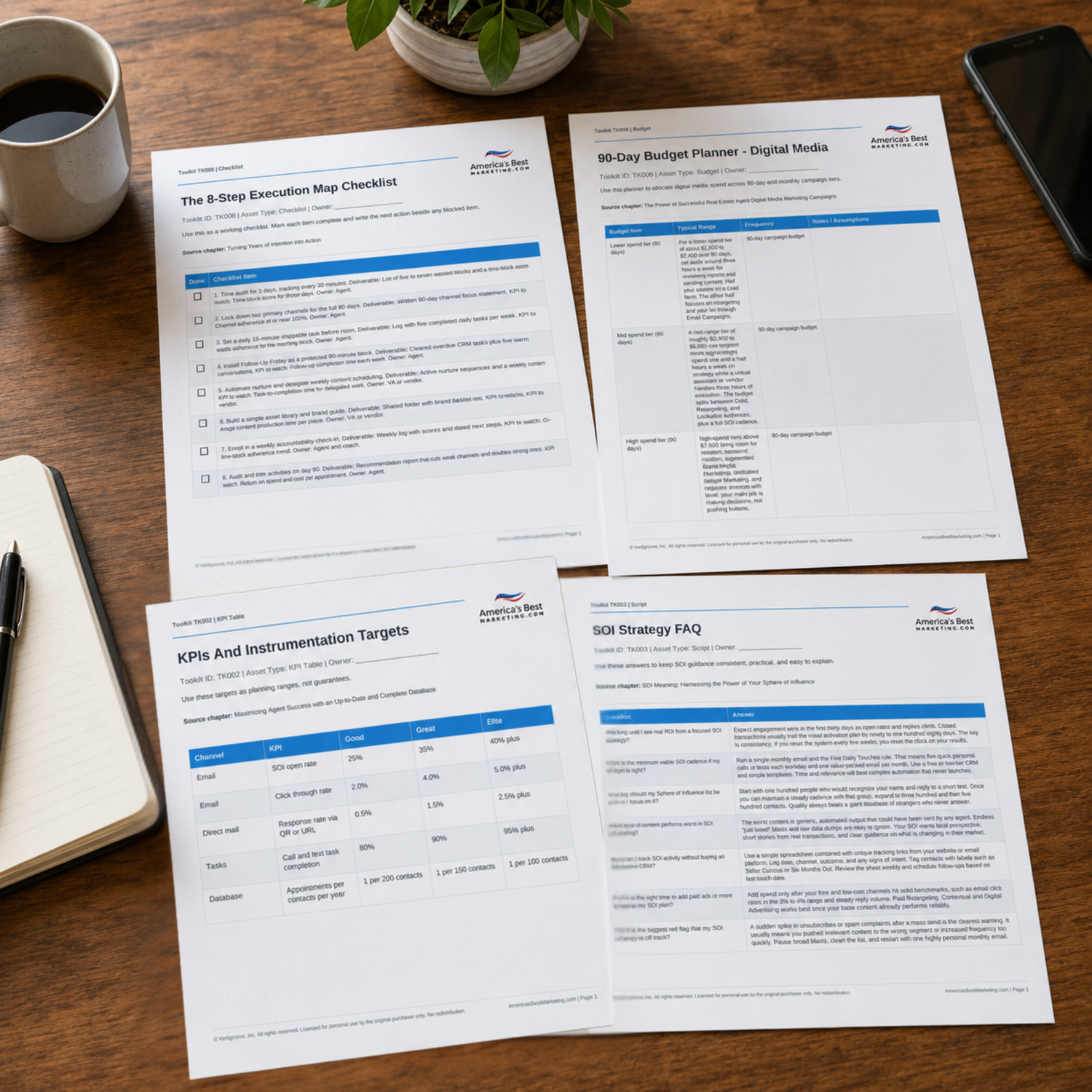
Download The 90-Day Listing Plan Toolkit
Use the companion Toolkit to plan the weekly listing-growth routine, set a working budget, track seller activity, apply repeatable outreach scripts, and keep the full 90-day execution cycle moving.
Download the Toolkit ZIPRecommended reads
Recommended Reads for Real Estate Agents
These articles help agents connect listing visibility, seller education, marketing channels, and follow-up into a clearer growth system.

Listing Launch System for Real Estate Agents: From Pre-Market to Just Sold
Use listing content to attract attention, explain value, and create better seller conversations.
Read article
Hidden Gems Content: How Real Estate Agents Create Local Guides That Generate Relocation Leads
Turn local knowledge into searchable content buyers, sellers, and relocation prospects can actually use.
Read article
Real Estate Blogging Made Simple: How Agents Can Attract Leads and Boost Their Online Presence
Make real estate blogging easier to plan, publish, and measure as part of a weekly marketing rhythm.
Read article
Real Estate Agent Lead Magnets that Actually Work (and How to Fulfill Them)
Make lead magnets that actually work easier to plan, publish, and measure as part of a weekly marketing rhythm.
Read articleQuestions New Agents Ask About Winning Listings
How long does it take to see real results from this listing plan?
Most new agents who follow a tight farm and clear weekly rhythm start to see early signals within thirty to sixty days. Replies, conversations, and first appointments usually show up before signed listings, so commit to one full ninety day cycle before judging the plan.
What is the smallest workable budget to get listings as a new agent?
A lean starting point is around one hundred fifty to two hundred dollars per month. That can support a simple postcard, basic email follow-up, and a small digital layer. Daily outreach still carries the weight.
How big should my geographic farm be when I start?
A practical starting farm is often eight hundred to twelve hundred homes. That is large enough to hold likely sellers and small enough to reach consistently. If frequency feels impossible, shrink the farm before expanding the budget.
What type of content draws sellers in?
Sellers respond to specific help around timing, pricing, preparation, net proceeds, and moving logistics. They usually ignore vague brag posts or generic market cheerleading.
How can I track my listing pipeline without complex software?
Use one simple sheet with columns for name and address, timing notes, last touch date, and next action. Update it after outreach and review it every week.
When should I increase my marketing spend for listings?
Increase spend when your weekly activity is consistent, your follow-up is under control, and seller conversations or appointments are rising. Spend should support a working system, not rescue a weak one.
What is the biggest red flag to avoid with seller lead generation?
Avoid tactics that trick owners into a conversation. Gimmicks may create clicks, but they weaken trust. Lead with clear value, honest expectations, and respectful follow-up.
Next step
Build the System Behind the Listing Plan
Continue from one useful article into the larger ABM ecosystem: the book series for strategic depth and the full marketing program for done-for-you execution.

View the Book Series
Explore the America’s Best Real Estate Agent Marketing System books for a deeper strategic framework around visibility, referrals, listings, lead generation, and growth.
View the Book Series
See Full Marketing Program
See how AmericasBestMarketing.com runs real estate blog writing, social media, listing marketing, email, direct mail, and retargeting as one managed system.
See Full Marketing Program