Google Business Page Photos, Posts & Q&A: A 30-Minute Weekly Routine
Google Business Profile Weekly Routine
Photos, Posts, and Q and A in 30 Minutes
A weekly operating cadence for real estate agents who want their Google Business Profile to look active, useful, and ready for local buyers and sellers to act on.

Direct answer: a 30-minute weekly Google Business Profile routine
A strong weekly Google Business Profile routine takes 30 minutes: reply to reviews and questions, publish one short local post with one matching link, upload one or two real local photos, seed one useful Q and A pair, and record one KPI note. The goal is not content volume. The goal is steady recency, local relevance, and trust signals that make the profile easier for buyers and sellers to act on.
- A weekly Google Business Profile habit should be short enough to repeat, not so elaborate that it waits for a quiet week.
- Real local photos, recent posts, answered questions, and review replies create visible proof that the agent is active in the market.
- Each post should send traffic to one matching page, not automatically to the homepage.
- Monthly KPI review keeps the routine tied to discovery searches, post clicks, calls, and profile actions instead of vanity activity.
Why Recency Wins in Local Search
Google does not reward a real estate profile because it was created once. It rewards profiles that look active, accurate, and useful right now. For an agent, that means fresh photos, recent posts, answered questions, review replies, and clear next steps that match the local searcher’s intent.
Recency is the easiest signal to control because it does not require a new website, a new ad campaign, or a major production lift. Every new photo, every post, and every answered question gives Google and people another reason to see that you are active in the market.
Relevance is the second lever. The words in your posts and Q and A answers help connect your profile to searches around neighborhoods, seller questions, buyer friction, market timing, and real estate services. A short answer with one local detail often beats a generic paragraph that could belong to any agent in any city.
Recency
Frequent activity proves that the profile is not dormant and that the agent is still operating in the local market.
Relevance
Neighborhood and service language helps the profile match how buyers, sellers, and homeowners actually search.
Trust
Fast replies, accurate contact information, and useful answers reduce friction before the person calls or clicks.
The 30-Minute Routine That Keeps the Profile Moving
This routine is built for operators. You do not need a full editorial calendar to keep Google Business Profile activity alive. You need a fixed weekly slot, a simple order of work, and a short note on what changed.
Monday morning works well because it sets up the profile for the week, but the exact day matters less than consistency. Put the routine on the calendar, run it in the same order each time, and stop at 30 minutes so the habit stays light enough to repeat.
Review and Q and A triage
Reply to new reviews and answer any new public questions. A practical benchmark is 24 to 48 hours, including weekends when possible.
Write one post with one link
Publish a 120 to 220 word post that names one neighborhood, client problem, or service intent. Add one button link to the page that best matches the topic, such as an IDX Real Estate Websites page when the post supports search behavior.
Upload one real photo
Add one or two real-world photos from your market. Neighborhood landmarks, listing prep, sold signage, and office moments usually feel more credible than generic graphics.
Seed one Q and A pair
Add one question a client would actually ask, then answer it in plain language with one local detail and one next step. Keep it useful, not salesy.
- Time box the work: stop at 30 minutes so the routine does not become a marketing rabbit hole.
- Repeat the order: reviews, post, photo, Q and A, KPI note.
- Track monthly: look at discovery searches, profile actions, post clicks, and call rate after enough activity has accumulated.
Most agents treat Google Business Profile posts like announcements and forget they can shape where traffic lands. If every post link points to the homepage, the next step is too vague. Each week, ask where a motivated local searcher should go next to take one useful action.
Photos That Pull Views and Prove Local Presence
Photos are one of the easiest ways to show that your profile reflects a real agent working in a real market. People scan visuals quickly, and Google can use engagement behavior as another clue about whether the profile is useful.
Your goal is not perfect photography. Your goal is proof of presence and proof of activity, delivered in small, consistent doses. Use photos that support the same local story your website, social media, and client follow-up are already telling.
Parks, trailheads, main street blocks, school-zone context, community entrances, and recognizable intersections help show local familiarity.
Showing prep, lockbox day, a stack of flyers, a listing appointment setup, or a closing table detail shows active work without overproducing the moment.
Sold sign photos, key handoffs, and listing prep milestones show results. Faces are optional, and privacy should always win.
Office photos, client-ready materials, and behind-the-scenes moments show there is a real operation behind the profile.
Before uploading, run a two-part check. First, confirm the photo is privacy-safe and fair housing safe. Second, confirm the photo supports a location or service story you can reinforce in your next post.
If your website should carry that same local signal, build neighborhood pages that match what you photograph. Use IDX SEO: Community Page Blueprint for Agents as the operating pattern, then link selected Google Business Profile posts to those pages over time.
Posts That Get Clicks Without Sounding Like Ads
A weekly post gives your profile fresh local language and gives a motivated searcher a useful place to go next. Keep the post short, specific, and tied to one clear local angle.
Use a repeatable formula so the post does not become a writing project. Anchor the location, share one useful fact, and state the next step. That is enough for most weeks.
- Location anchor: name the neighborhood, school zone, corridor, town, or micro-area.
- Useful fact: mention a market pattern, a timing issue, a buyer concern, or a seller preparation step.
- Next step: use one button link to a matching page, not a generic homepage link.
Market micro-update
Profile post example
Local hookThis week in Oak Hill, three homes sold under list and two sold over list.
Useful noteThat spread usually means street-level condition and pricing discipline matter more than the citywide median.
CTA lineIf you want a quick value range for your street, use the valuation request link below.
Buyer friction remover
Profile post example
Local hookIf you are searching in River North, the fastest mistake is ignoring HOA budgets.
Useful noteA low list price can look better than the true monthly number once dues, reserves, and parking are included.
CTA lineUse the neighborhood checklist before your next showing.
When your website structure is built correctly, Google Business Profile posts become a local traffic router. If the site foundation is weak, reference Proven SEO Strategies for Real Estate Websites to Increase Leads and make sure each key service page and neighborhood page has a clear next step.
If you already run Social Media Marketing, repurpose the weekly topic across platforms. Keep the Google Business Profile version local and direct, then remix the same idea for social with a stronger hook or one extra client example.
Q and A That Captures Long-Tail Intent
Google Business Profile Q and A looks small, but it captures the type of questions people ask when they are getting close to action. Your answers can reduce friction before the person calls, clicks, or compares you with another agent.
Use real client language. Seed questions that already come up on calls, at listing appointments, during showings, or in follow-up emails. The question should feel like something a real buyer, seller, or homeowner would ask at night while comparing options.
What happens after I request a home valuation?
Answer with the next two or three steps, then mention the local market area where you work most often.
What costs should I plan for when selling?
Keep it general, fair, and useful. Point people toward a conversation if the cost depends on property condition or local requirements.
How long does it usually take to sell nearby?
Give a balanced answer that references preparation, pricing, demand, and how quickly comparable homes are moving.
How will you market my home before it hits the market?
Explain the preparation path, then connect the person to your Listing Marketing process if they want more detail.
Keep each answer short and structured. Lead with the direct answer, add one local detail, and state one next step. When an answer mentions traffic, landing pages, or retargeting, connect the strategy to Digital Retargeting so the profile is not isolated from the rest of the marketing system.
KPIs That Show Whether the Routine Is Working
Google Business Profile gives enough data to see whether weekly work is translating into stronger visibility and more profile actions. Review metrics monthly, not daily. Daily checking creates noise and makes agents abandon a routine before it has time to compound.
| Metric | Definition | Healthy movement | Next action |
|---|---|---|---|
| Photo views | Monthly change in profile photo views. | Up 10% to 20% | If flat, post more neighborhood proof photos for four weeks and reduce generic graphics. |
| Post clicks | Clicks from the weekly Google Business Profile post. | Up 2.5% to 4% | If low, tighten the first sentence, improve the button text, and change the destination page. |
| Call rate | Calls divided by total profile views. | Up 3% to 6% | If it drops, verify phone number accuracy and simplify the post’s next step. |
| Discovery searches | Searches where people found the profile without typing the agent’s name. | Steady upward trend | If soft, add more neighborhood and service language to posts and Q and A answers. |
Two operating rules keep the system clean. Rule one: every post gets one link to a page that matches the post topic. Rule two: every seeded Q and A answer includes one micro-area reference, such as a neighborhood, school zone, community name, or corridor.
Budget Options and Creative Briefs You Can Ship
Google Business Profile work is mostly time, not money. Still, a small and disciplined budget can improve the pages your posts send traffic to and help you measure which topics create calls, valuation requests, or buyer inquiries.
Publish four Google Business Profile posts, upload four photos, seed four Q and A pairs, and reply to reviews as needed. Use the Google Business Profile dashboard and Search Console. Keep the profile fresh and push traffic to one high-intent page.
Publish four posts, upload eight photos, seed four Q and A pairs, and track landing-page behavior. Build a local content loop, test two destinations, and measure which topics create profile actions.
Send profile traffic to a neighborhood page that answers one specific buyer question. Use one recognizable landmark photo, one sentence of local context, and a button that says See the checklist.
Turn profile traffic into a valuation request. Use one sold sign photo, one line that sets expectations, and a button that says Request a quick range.
If the routine keeps slipping, use coaching and consulting to set weekly deliverables, define the content loop, and keep reporting tied to activity that can become appointments.
Common Failure Modes and the Fast Fix
Most Google Business Profile issues are not technical mysteries. They are consistency problems that quietly weaken local visibility. Use this diagnostic list once a month before chasing a new tactic.
- Inconsistent NAP: match name, address, and phone formatting across your site, profile, and key directories.
- Review stall: add a review request step to your closing process and track it like a deliverable.
- Photo gap: stop relying on launch-day images. Add one real local photo every week.
- Weak links: stop sending every post to the homepage. Match the link to the post intent.
- Ignored questions: answer within 24 to 48 hours and seed questions that remove buying or selling friction.
Keep the content service-oriented, factual, and inclusive. Do not target or exclude people based on protected classes, and avoid language that implies a neighborhood is for one type of person. Focus on property features, process, market facts, amenities, commute context, and helpful next steps.
Eight-Week Profile Activity Sprint
Pick one weekly time slot and run the routine for eight straight weeks without missing. That is long enough to see whether discovery searches, post clicks, photo views, and profile actions are trending in the right direction.
After that, tighten the loop. Keep the photo mix local, keep the post links specific, keep Q and A focused on real client objections, and keep your KPI review monthly. Google Business Profile is not a set-and-forget listing. It is a small weekly habit that can compound into stronger local visibility and cleaner client action.
- Reply to reviews and public questions, with a 24 to 48 hour target.
- Publish one 120 to 220 word post with one neighborhood mention.
- Add one button link to a matching site page.
- Upload one or two real local photos.
- Seed one new question and answer it in plain language.
- Log one KPI note for photo views, post clicks, discovery searches, or call rate.
How This Becomes A Managed Marketing System
A weekly Google Business Profile routine becomes stronger when it is connected to the rest of the marketing stack. The post should route to a useful page. The photo should support the same local story used in social. The Q and A should reveal questions that become future blog topics, email notes, and listing presentation language.
Use Real Estate Blog Writing Services to build the destination pages, Email Campaigns to reinforce the same local topics with your database, Direct Mail Marketing to carry strong local proof into the farm, and Social Media Marketing to remix the weekly profile topic into visible public momentum.
If you want this routine to run without stealing time from showings, let AmericasBestMarketing.com build the weekly content loop, connect it to your site pages, and track the right profile actions so you can see what is working.
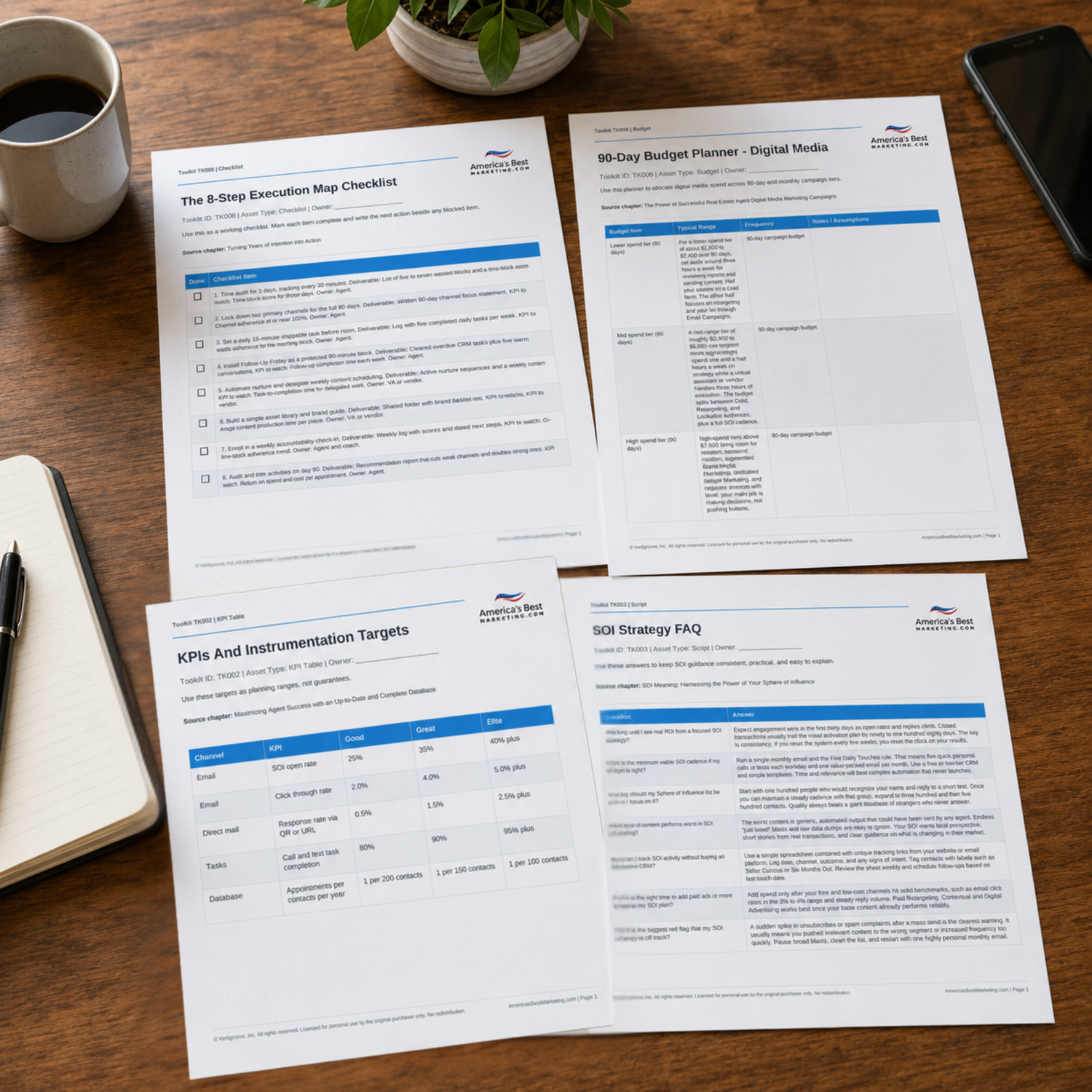
Download The Google Business Profile Weekly Toolkit
Use the companion Toolkit to plan a weekly photo, post, Q and A, and review-reply cadence, then track photo views, post clicks, discovery searches, calls, and the page destinations that turn profile activity into client action.
Download the Toolkit ZIPRecommended reads
Recommended Reads for Real Estate Agents
These articles help agents connect local visibility, useful content, channel strategy, and follow-up into a stronger search-friendly marketing system.

Google Business Profile for Real Estate Agents: Ranking & Review Scripts
Make Google Business Profile more useful by tying the message, audience, and next step together.
Read article
IDX SEO: Community Page Blueprint for Agents
Turn search visibility into a clearer publishing system for neighborhoods, services, and client decisions.
Read article
Evergreen Content for Real Estate Agents: Build Posts That Rank for Years (and Compound Leads)
Build organic reach with pages and posts that are easier to find, trust, and act on.
Read article
Google Business Profile for Real Estate Agents: Advanced Optimization for Local Rankings
Use google business profile to strengthen visibility, follow-up, and client conversations without adding more random tasks.
Read articleGoogle Business Profile Routine Questions Agents Should Be Ready To Answer
What is the best weekly Google Business Profile routine for real estate agents?
The best weekly routine is simple enough to repeat: reply to reviews and questions, publish one short local post, upload one or two real local photos, seed one helpful Q and A pair, and log one KPI note. A 30-minute weekly slot is enough when the process stays focused.
How soon can Google Business Profile activity show up in metrics?
Measure the routine over 60 to 90 days, not one week. Photo views and discovery searches often move first because they reflect visibility. Profile actions like calls, website clicks, and direction requests usually need more consistent activity before the trend is clear.
What should I do if I only have 15 minutes?
Upload one real local photo and publish one short post with one matching link. That keeps the recency signal alive and gives Google new local language to index. Skip the seeded Q and A only when you have to, but still answer any new public question quickly.
Should real estate agents geo-tag every photo?
Geo-tagging can help when it happens naturally, but it should not become the main work. A real local photo uploaded consistently is more valuable than a perfect metadata process that never gets done. Focus first on useful photos that clearly connect to the market you serve.
How long should a Google Business Profile post be?
For most real estate posts, 120 to 220 words is enough. Use one location anchor, one useful fact, and one next step. The post should feel like a clear client note, not a long essay or a generic ad.
How do I seed Q and A without making it look fake?
Use questions you already hear from buyers, sellers, and homeowners. Then answer with one direct response, one local detail, and one practical next step. Avoid stacked sales language. A good answer should sound like help, not a pitch.
What is the biggest mistake agents make with post links?
The biggest mistake is linking every post to the homepage. Match the link to the searcher’s intent instead. A neighborhood post should link to a neighborhood page, a seller post should link to a valuation or listing plan page, and a buyer post should link to a page that helps the buyer act.
How do I keep Google Business Profile content fair housing safe?
Keep the content service-oriented, factual, and inclusive. Do not target or exclude people based on protected classes, and avoid language that implies a neighborhood is for one type of person. Focus on property features, process, market facts, amenities, commute context, and helpful next steps.
Next step
Build the System Behind the Advice
Continue from one useful article into the larger ABM ecosystem: the book series for strategic depth and the full marketing program for done-for-you execution.

View the Book Series
Explore the America’s Best Real Estate Agent Marketing System books for a deeper strategic framework around visibility, referrals, listings, lead generation, and growth.
View the Book Series
See Full Marketing Program
See how AmericasBestMarketing.com runs real estate blog writing, social media, listing marketing, email, direct mail, and retargeting as one managed system.
See Full Marketing Program