Evergreen Content for Real Estate Agents
Build Posts That Rank for Years and Compound Leads
A durable content briefing for agents who want local search visibility, better buyer and seller education, and owned pages that keep producing after the first publication push.

Evergreen content for real estate agents, defined
Evergreen content for real estate agents is the set of durable local pages that answer buyer, seller, relocation, neighborhood, inspection, tax, HOA, and transaction questions that keep coming back year after year. Instead of feeding a daily posting treadmill, the agent builds owned content assets that can rank, educate, retarget, support email follow-up, and convert research into inquiry long after the first publication date.
- Evergreen content works best when it answers year-round local questions that buyers and sellers already ask in appointments, emails, and transaction conversations.
- Cornerstone guides create the search authority base; supporting posts give each major topic more depth, internal links, and long-tail visibility.
- Maintenance is part of the asset model. A quarterly refresh protects accuracy, improves internal links, and prevents content decay.
- The best lead magnets match the page topic exactly, so the reader feels helped rather than interrupted.
- Traffic is only useful when measured against time on page, scroll depth, lead rate, return visits, and booked conversations.
Why Evergreen Content Compounds
Evergreen wins because it behaves like infrastructure. You build it once, maintain it on schedule, and let the page support future searchers while you are in showings, listing meetings, and follow-up conversations. A strong page can keep earning impressions, internal links, email clicks, social traffic, retargeting audiences, and inbound questions after the first week is over.
Most agents over-invest in content that disappears. A market snapshot, a quick opinion post, or a short social update may create familiarity, but it rarely gives Google or a future buyer enough depth to return to. Evergreen pages do the opposite. They answer the durable questions that repeat every month: how property taxes work, what an inspection finds, how HOA documents should be reviewed, what relocation buyers need to know, and how sellers should prepare before listing.
That is why the first strategic move is topic discipline. Start with the real questions in your inbox, your buyer consult notes, your listing presentations, and your transaction files. Then match those questions to pages that deserve to exist for years. Use Real Estate Blogging Made Simple: How Agents Can Attract Leads and Boost Their Online Presence as the writing baseline, then pressure-test your search structure against Proven SEO Strategies for Real Estate Websites to Increase Leads.
- Durable pages give future prospects a useful reason to discover you before they are ready to interview agents.
- Topic clusters give search engines a clearer map of your local expertise and the problems you solve.
- Owned pages create retargeting audiences and email content without depending on social reach alone.
- Updated pages protect trust because readers can see that your advice is maintained, not abandoned.
The Twelve-Month Evergreen Content Engine
The operating model is simple: audit the questions, build the cornerstone assets, publish supporting posts, connect the cluster with internal links, attach a relevant lead magnet, and maintain the system before rankings decay. Think of yourself as a digital developer. Every useful page is a property you own. Every internal link is a road that moves visitors deeper into intent.
The first month is the keyword and question audit. Build a list of problem-solving queries that do not expire: property taxes, inspections, HOA documents, flood zones, school boundaries, relocation logistics, seller preparation, appraisal basics, financing friction, and moving checklists. Group each topic by buyer intent, seller intent, homeowner intent, and transaction intent. Every page should know its audience before the first paragraph is written.
Build the authority base
Choose three cornerstone guides that deserve permanent placement on your site. A relocation guide, a seller preparation guide, and a neighborhood guide can become the starting map for future posts.
Host the assets on your IDX real estate website so education, live search, and lead capture sit in the same environment.
Add supporting posts
Publish three to five narrow posts for each cornerstone guide. Each post should answer one specific question, link back to the main guide, and point the reader toward the next practical step.
This is where internal link architecture matters. Do not leave strong posts isolated. Build a clear path from broad research to narrow answers to conversion.
Maintain and distribute
Use social media management for real estate agents, email distribution, and retargeting to bring readers back to the strongest pages.
Review cornerstone guides quarterly and supporting posts twice per year. Update the summary, repair old links, add one new internal link, and improve the lead magnet if conversion slips.
Most agents treat evergreen content like a writing project. Treat it like an asset portfolio. Each page needs a purpose, a maintenance schedule, a conversion path, and a measurement standard. If a stranger would not stay for three minutes, save the page, or ask a follow-up question, the asset is not finished.
Build Topics Around Search Intent, Not Random Ideas
Evergreen headlines work when they mirror the problem a person is trying to solve. Skip clever phrasing and write for clear intent. The page should tell the reader exactly what they will understand after they click.
- The complete guide to property taxes in your city
- How to sell a home in your city without missing the prep work
- Home inspection red flags buyers should know before they waive leverage
- Relocation checklist for moving to your city
- Neighborhood guide for buyers comparing commute, schools, parks, and price bands
Each page also needs a next-step ladder. A soft CTA keeps the reader engaged, a mid-funnel offer trades a useful checklist for an email address, and a hard CTA invites a conversation. All three can live on the same page when the offer stays on topic and the layout stays clean.
Save this guide before your next showing or share it with someone who is preparing to move. This keeps the interaction useful without asking for commitment too early.
Download the relocation checklist, inspection red-flag sheet, or seller prep planner that extends the page and helps the reader complete the task.
When the topic is strong, promotion becomes easier. Add the new guide to your next email, pin it to your social profiles, reference it during consults, and use digital retargeting to bring prior visitors back when they do not convert on the first visit.
Three Launch Scripts For Evergreen Assets
Evergreen pages perform better when agents know how to introduce them. Use the page as a useful asset in normal client conversations, not just as a passive SEO page sitting on the site.
The relocation guide follow-up
Agent dialogue
Hook lineI pulled together the main relocation questions buyers ask before they commit to this area.
Middle lineThe guide covers neighborhoods, commute logic, timing, and the details people usually discover too late.
CTA lineRead it before our call, then send me the three questions you still want answered.
Use this after an online inquiry, portal registration, referral introduction, or first relocation email.
The seller prep guide introduction
Agent dialogue
Opening lineBefore we talk price, I want you to see the prep work that usually protects leverage.
Build lineThis guide shows what to fix, what to ignore, what to photograph, and how to avoid wasting money before listing.
CTA lineMark anything you have already handled, and I will use the rest to build your launch plan.
Pair this with listing marketing so seller education connects directly to launch execution.
The lead magnet handoff
Agent dialogue
Opening lineI made the checklist because the article is useful, but the worksheet is what helps you act on it.
Explain lineIt gives you the sequence, the decision points, and a place to track what still needs to be done.
CTA lineDownload it, fill in what you know, and send it back when you want me to review your next step.
Use this mid-page and near the end of the guide. Keep the form short so the offer feels like help, not friction.
Budget And KPI Model For Evergreen Content
You can start with a lean content rhythm or a more aggressive cluster build. The important part is keeping production, promotion, maintenance, and measurement in the same system. Content that is never promoted or updated is not an asset. It is an archive.
Publish two evergreen posts each month and refresh one older guide. Use one hundred fifty dollars for retargeting and two hundred dollars to promote the newest guide for ten days. Keep frequency near six impressions per week per person.
Audience split: seventy percent guide visitors and thirty percent listing page visitors. Priority: return visits and email opt-ins.
Publish four supporting posts each month and update two cornerstone guides per quarter. Use four hundred fifty dollars for retargeting, three hundred dollars for contextual traffic, and one hundred fifty dollars for email list growth.
Audience split: sixty percent guide visitors, twenty-five percent valuation page visitors, and fifteen percent relocation page visitors. Priority: consult requests and call bookings.
Measure the numbers that connect attention to pipeline. Rankings matter, but they lag. Time on page, scroll depth, return visits, form starts, and booked calls tell you whether the page is earning trust before the ranking report catches up.
| Signal | Measured by | Target benchmark | Why it matters |
|---|---|---|---|
| Time on page | Analytics average | 2:30 to 4:30 | Longer reads suggest the page matches intent and builds enough confidence to keep the visitor engaged. |
| Scroll depth | Engagement event | 60% to 80% | Deep scrolls show that the structure, headings, and examples are carrying the reader through the page. |
| Lead rate | Forms or booked calls divided by visits | 0.8% to 2.0% | Lead rate keeps the asset tied to appointments instead of vanity traffic. |
Mini Case Pattern: Sarah Builds A Digital Estate
Sarah was spending hours each week publishing short updates and getting polite likes with no consistent inbound calls. She shifted her effort into a cornerstone guide about buying a historic home in her city. The guide explained document requests, inspection issues, insurance friction, and neighborhood due diligence in one clean sequence.
She then published five supporting posts that answered narrow questions and linked back to the main page. In this illustrative scenario, the guide began earning long-tail local traffic within six months because it matched durable buyer intent. Three years later, the asset still produces a small number of high-intent buyer inquiries each month while Sarah focuses on active listings and client work.
The pattern is not magic. It is asset management. Sarah reviews her top pages once per quarter, refreshes the first-screen summary, repairs outdated links, adds one new internal link, and improves the lead magnet when conversion dips. That is the digital developer mindset in action.
The Ten-Point Evergreen SEO Audit
Run this audit before publication, then repeat it every quarter on the pages that matter most. The goal is clean structure, clean signals, and a better reading experience that moves people from research to action.
- Use the primary keyword naturally in the first one hundred twenty words.
- Keep one H1 in the CMS environment and use a clean H2 and H3 hierarchy inside the article.
- Write a clear meta title and a meta description that states the reader payoff.
- Use a short slug that matches the search intent and is easy to say out loud.
- Write image alt text that describes the scene without repetitive keyword stuffing.
- Add visible update language when a page has been materially refreshed.
- Add internal links from the page to two related guides and one service page.
- Place one topic-matched lead magnet with a short form and a clear follow-up step.
- Keep above-the-fold scannability tight with short paragraphs, a useful list, and a clear promise.
- Test the conversion path end to end: form, thank-you step, email delivery, and follow-up timing.
How Evergreen Content Becomes Marketing Infrastructure
Evergreen content becomes stronger when it is connected to the rest of the marketing stack. The guide gives buyers and sellers a reason to stay. Email Marketing for Real Estate Agents gives you a reason to redistribute the asset. Direct Mail can turn the same topic into neighborhood authority. Retargeting keeps the conversation alive after the first visit.
This is where evergreen content stops being a blog tactic and becomes a business development system. A relocation guide can power buyer consults. A seller prep guide can support listing presentations. A neighborhood guide can strengthen local search. A testimonial page can add proof to follow-up. Each asset should do a job in the pipeline, not merely fill the website.
If you want the system managed end to end, build on IDX Real Estate Websites, distribute consistently through Social Media Management, keep prior visitors moving with Digital Retargeting, and connect the whole stack to the Full Marketing Program.
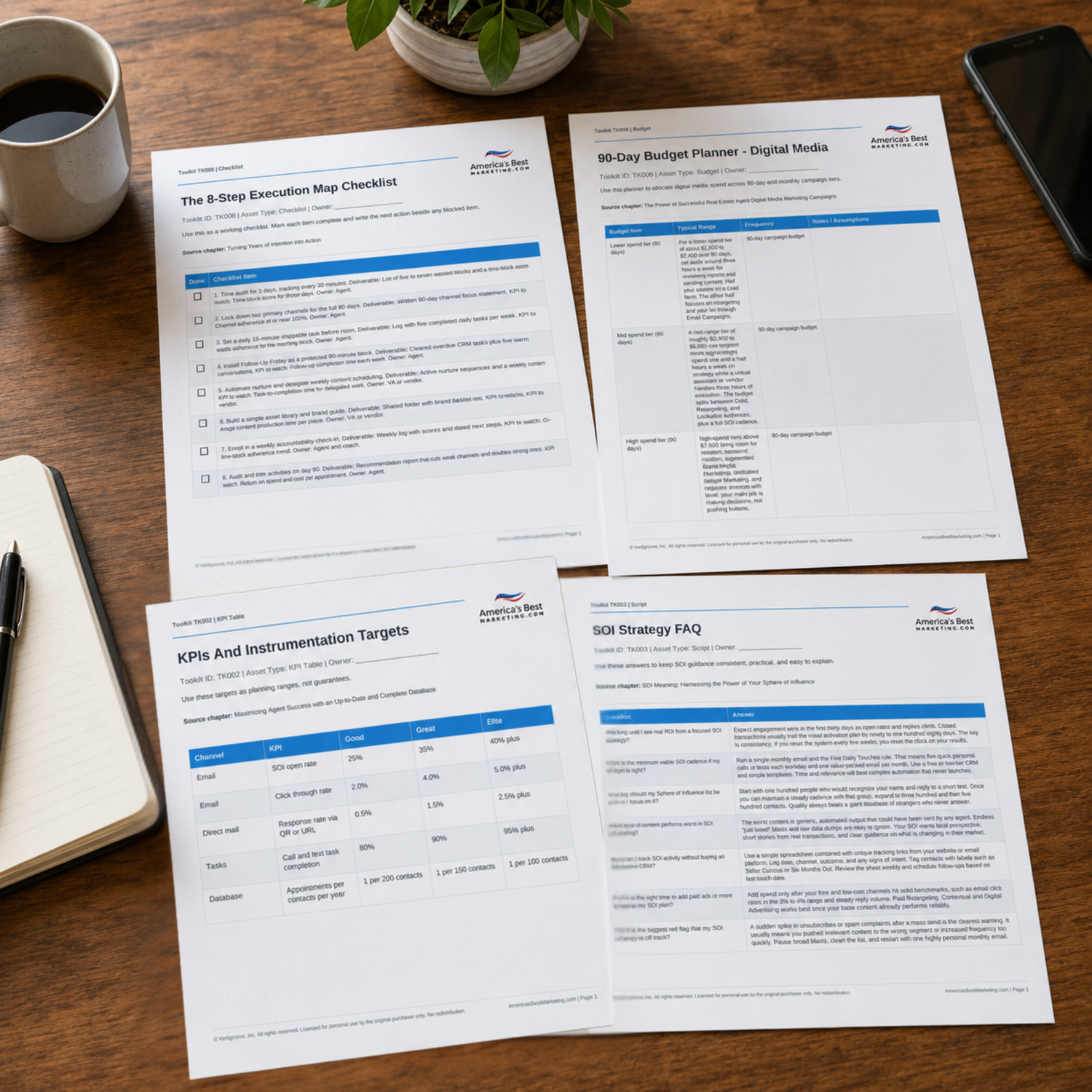
Download The Evergreen Content Toolkit
Use the companion Toolkit to plan a twelve-month evergreen engine, audit SEO structure, benchmark KPIs, shape budget choices, and turn durable real estate questions into lead-focused content assets.
Download the Toolkit ZIPRecommended reads
Recommended Reads for Real Estate Agents
These articles help agents connect local visibility, useful content, channel strategy, and follow-up into a stronger search-friendly marketing system.

SEO-Friendly Blog Titles for Real Estate Agents: Templates + A/B Testing Checklist
Build organic reach with pages and posts that are easier to find, trust, and act on.
Read article
Neighborhood Guides for Young Professionals: Real Estate Agent Content Framework + Lead Capture
Build organic reach with pages and posts that are easier to find, trust, and act on.
Read article
The Role of User Experience (UX) in Real Estate SEO
Build organic reach with pages and posts that are easier to find, trust, and act on.
Read article
Testimonial Content That Books Appointments (Real Estate Agent Templates)
Publish content that answers local questions, supports lead capture, and gives future conversations a reason to start.
Read articleEvergreen Content Questions Agents Ask
How often should I update evergreen posts?
Update cornerstone guides quarterly and supporting posts twice per year. Each update should change something real: a step, a link, a screenshot, or a local requirement. Add a visible Last Updated line near the top so readers trust the page. Treat updates like maintenance on a rental property. Small, scheduled work prevents decay and protects rankings.
Is evergreen content better than social media for new agents?
They do different jobs. Social posts create familiarity fast, but they fade quickly and rarely rank in search. Evergreen pages are slower to build but keep producing compounding traffic and leads. New agents should publish short content for reach while producing one evergreen page per month that targets a common local question. The mix creates momentum and durability.
How long does it take to see measurable ROI from SEO?
Early movement often shows up in 60 to 120 days if the page matches intent and the site is technically healthy. Measurable lead flow usually follows after several months once you have a small cluster of linked pages, not just one post. Track time on page, scroll depth, and lead rate first. Rankings are a lagging signal of those behaviors.
What content performs worst for long-term ranking?
News-style market commentary and thin opinion posts decay fast because the facts change and the intent shifts. Content tied to weekly snapshots rarely holds search demand. If you want a durable page, build around stable processes: inspections, taxes, HOA documents, appraisal basics, and moving logistics. Those questions keep coming, even when the market mood swings.
How do I pick evergreen topics for my city without guessing?
Start with your inbox and your transaction notes. List the top questions buyers and sellers ask year-round, then match each question to a single page with a clear promise. Use Search Console queries to confirm wording, then build a cluster: one cornerstone guide and three to five narrow supporting posts. The win is not creativity. The win is precision and repetition.
How long should an evergreen blog post be?
Long enough to fully answer the question and short enough to stay readable. For broad topics, 1,800 to 2,600 words often works because it gives room for structure, examples, and internal links. For narrow questions, 900 to 1,400 words is usually plenty. Use short paragraphs, a few lists, and clear headings so the page scans fast before it reads deep.
How do I add a lead magnet without sounding salesy?
Make the lead magnet a natural extension of the page. If the guide is about relocation, the lead magnet is a printable relocation checklist. If the guide is about inspections, the lead magnet is a red-flag checklist. Offer it once mid-page and once near the end, then keep the form short. The reader should feel you reduced their workload, not interrupted their research.
Next step
Build the System Behind the Content
Continue from one useful article into the larger ABM ecosystem: the book series for strategic depth and the full marketing program for done-for-you execution.

View the Book Series
Explore the America’s Best Real Estate Agent Marketing System and use the books to sharpen strategy, messaging, listing visibility, follow-up, and growth discipline.
View the Book Series
See Full Marketing Program
See how AmericasBestMarketing.com runs real estate blog writing, social media, listing marketing, email, direct mail, and retargeting as one managed system.
See Full Marketing Program