Delegation for Real Estate Agents: What to Offload First and How to Systematize It
Delegation for Real Estate Agents
What To Offload First And How To Systematize It
A practical operating brief for agents who want to protect selling time, document repeatable work, and hand off execution without losing control of quality or brand voice.

Delegation protects selling time first
The first delegation lane for most real estate agents should be repeatable marketing fulfillment: social publishing, email setup, listing launch materials, and routine content production. These tasks matter, but they do not require live agent judgment. Document the checklist, set a turnaround standard, keep one approval lane, and reserve the agent’s best hours for appointments, pricing, negotiation, and follow-up conversations.
- Delegate repeatable marketing production before you delegate client judgment.
- Every handoff needs a checklist, deadline, file location, approved example, and definition of done.
- Agent-owned time should stay focused on appointments, pricing guidance, negotiation, and serious lead conversations.
- Weekly quality review and monthly strategy review prevent delegation from becoming reverse management.
Why Delegation Breaks The Growth Ceiling
Most agents start delegation too late and too emotionally. They hit a wall, hire reactively, and then wonder why the handoff feels sloppy. The better move is to run an hourly-worth calculation first. Divide your realistic annual gross by the number of hours you actually work, then compare that number to the cost of outside execution. If your effective rate is two hundred dollars an hour and you are still doing thirty-five dollar work, you are paying a premium to stay overloaded.
The opportunity cost hides inside productive-looking work. Building a flyer, posting social content, cleaning up a CRM, and formatting an email all feel useful. But if those tasks consume fifteen hours a week, they steal the exact window where appointments, follow-up calls, and negotiation work happen.
The cleanest path starts with specialized support for Social Media Management for Real Estate Agents, Email Marketing for Real Estate Agents, and Listing Marketing. The point is not to look busier. The point is to move low-dollar production work out of the agent calendar.
Delegation is risk control. If your workflow still requires you to touch every post, flyer, email, and lead-routing step, you have made yourself the single point of failure. Ask one blunt question every time a task lands on your desk: does this require my judgment, or just my attention?
What To Offload First
The first tasks to leave your plate should be repetitive marketing tasks that still need consistent output. Offload social publishing, campaign assembly, listing promotion, and nurture emails before handing off deeper operational authority. You want immediate time recovery without creating client risk.
For most teams, that means one calendar, one approval path, one turnaround window, and one reporting cadence. If you also want a stronger automation layer behind the scenes, review Leveraging AI and Automation in Real Estate Lead Generation to tighten lead routing and response timing.
Move production first
Social captions, graphics, email assembly, listing flyers, and routine content formatting are visible, repeatable, and easier to quality-check than live client conversations.
Standardize the launch
Property copy, photo notes, collateral requests, vendor updates, timeline nudges, and launch checklists should follow the same path every time.
Delegate the routing
Forms, tags, reminders, calendar links, and response triggers should run without manual entry while serious conversations stay with the agent.
The Three-Tier Roadmap
Tier one, weeks one through four: marketing fulfillment. Hand off the posting calendar, caption production, graphic formatting, and email send schedule. Use agent-provided assets, one approval lane, and a weekly content queue.
Tier two, weeks five through eight: listing and transaction operations. Standardize flyer edits, property copy, collateral revisions, timeline nudges, and file chasing with documented listing support so the same service level shows up every time.
Tier three, weeks nine through twelve: lead management and follow-up. The system should capture, route, and stage leads correctly so the agent steps in at the highest-value point. Lead routing, form capture, auto-response, and reminders should happen without manual data entry.
Contained support
Cover three social posts each week, one email send each month, and one listing support queue. The operating goal is consistency without payroll pressure.
Managed cadence
Cover social publishing, two monthly email sends, ongoing listing collateral, and a monthly workflow review that keeps the delegated lane accountable.
The Value-Per-Hour Task Audit
Run the audit against your last thirty days, not your intentions. If a task happens often, follows a repeatable sequence, and does not need your live judgment, it belongs in a handoff queue.
| Task | Agent-Value Level | Monthly Drag | Delegate To | Target Benchmark |
|---|---|---|---|---|
| Content production | Low | 12 to 15 hours | Social team owns weekly publishing. | Three posts per week stay on schedule. |
| Listing collateral | Low | 5 to 8 hours | Listing partner builds the package. | Listing assets turn within one business day. |
| Email nurture | Mid | 10 or more hours | Email system sends and tags the list. | Campaign cadence stays visible to the database. |
| Conversion calls | High | 20 or more hours | Agent handles serious live conversations. | Qualified appointments advance to signed agreements or active-client status. |
The Ten-Point Offload-Ready Checklist
Most delegation failures are setup failures. Run this checklist before you hand off the next major function.
- Document your listing support process from intake to approval in one shared checklist.
- Create one folder structure for logos, headshots, brand files, listing assets, and approved copy.
- Write acceptance criteria for every recurring task, including deadline, file type, and approval owner.
- Sync CRM tags and list segments with your email system.
- Set up auto-responders and lead-routing rules inside your website forms and CRM.
- Define target benchmarks for vendors, including turnaround time, send cadence, and posting consistency.
- Record one short walkthrough for any task that needs your tone or judgment call.
- Schedule one weekly review block instead of reacting to tasks all day.
- Keep lead conversion, pricing guidance, and negotiation in the agent-owned lane.
- Use a monthly strategy review to decide whether each delegated lane should stay, expand, or be rebuilt.
What The 90-Day Shift Looks Like
An agent closing roughly twenty-five million dollars in volume was working close to eighty hours a week and still felt behind. Every week included social posting, listing collateral fixes, CRM cleanup, email formatting, and rushed follow-up between appointments.
The first move was to offload brand consistency and automate nurture. The second move was operational: property packages, timeline nudges, and collateral requests moved into a documented intake process. Within ninety days, roughly twenty weekly hours moved out of the admin lane and back into appointments, pricing, and negotiation.
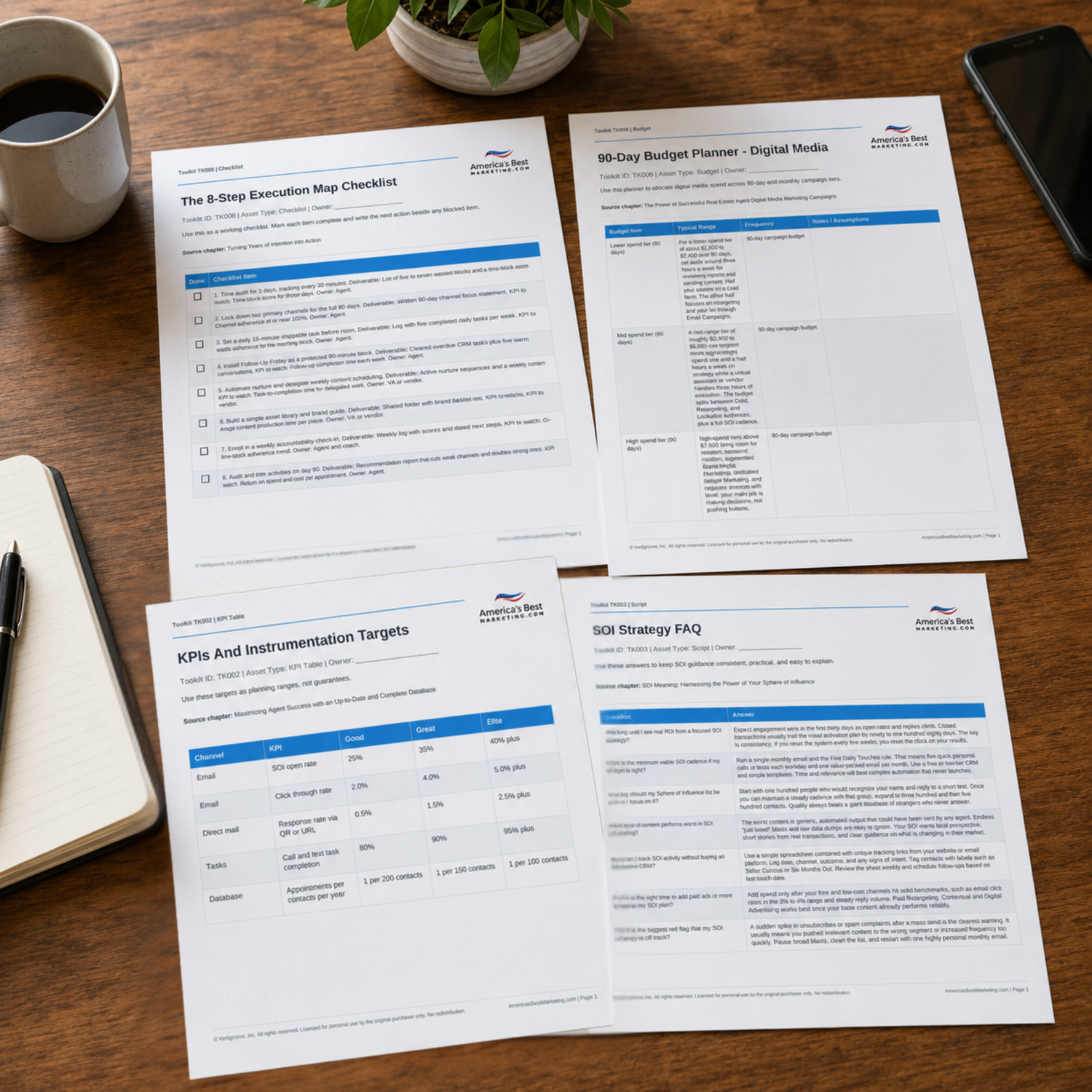
Download The Delegation Operating Pack
Use the companion Toolkit to audit low-value tasks, set budget guardrails, confirm whether a handoff is ready, and answer delegation objections with a cleaner operating plan.
Download the Toolkit ZIPRecommended reads
Recommended Reads for Real Estate Agents
These articles help agents connect follow-up discipline, database habits, client communication, and marketing execution into a repeatable system.

Real Estate Agent Workflow Automation: Tools, Triggers, and Process Maps
Use workflow automation to create a stronger bridge between client education and real conversations.
Read article
AI for Real Estate SEO: What to Automate, What to Avoid, and How to Measure Impact
Turn search visibility into a clearer publishing system for neighborhoods, services, and client decisions.
Read article
Google Business Profile for Real Estate Agents: Ranking & Review Scripts
Make Google Business Profile more useful by tying the message, audience, and next step together.
Read article
Client Onboarding System: A Personalized First 30 Days That Improves Retention
Make execution easier to maintain when marketing, follow-up, and client service compete for time.
Read articleDelegation Questions Agents Should Be Ready To Answer
What is the very first thing a real estate agent should delegate?
Start with recurring marketing fulfillment. Social posting, email setup, and listing support are visible, repeatable, and easier to quality-check than live client conversations. Move production work first and keep pricing, negotiation, and trust-transfer conversations in the agent-owned lane.
How do I protect quality when I stop doing the work myself?
Quality comes from standards, not hovering. Give every recurring task a checklist, one approved example, a deadline, a file location, and a definition of done. Then review the system once a week instead of reacting to production tasks all day.
Should I hire a virtual assistant or a local assistant first?
Start with task type, not geography. Digital, repeatable, process-driven work can be handled remotely. In-person logistics, lockbox handling, sign movement, or local vendor coordination may require local support.
How do I know whether a task is safe to offload?
Ask whether the task needs your judgment or only your attention. If it needs pricing advice, negotiation skill, market read, or client trust, keep it. If it follows the same steps every time, document it and hand it off.
Should I delegate lead follow-up too?
Delegate the system before you delegate the conversation. Auto-responses, CRM routing, tagging, reminders, and calendar links should run without manual data entry. Serious live lead calls usually stay with the agent.
What if my brand voice gets diluted after delegation?
That usually means the brand rules were never documented. Create a short voice guide with phrases you use, phrases you avoid, approved captions, approved emails, headshots, logos, and examples of finished work.
How often should I review delegated work?
Use one weekly review block and one monthly strategy review. Weekly is for deadlines, quality, and small corrections. Monthly is for budget, workflow changes, and whether a delegated lane should stay, expand, or be rebuilt.
Turn Delegation Into A Managed Marketing System
The next move is simple. Audit your last forty hours of work and highlight everything that was not a money-making activity. Then move one recurring lane into a documented system before another month disappears into low-dollar work. For many agents, that first lane is a coordinated mix of social, email, listing promotion, direct mail, and retargeting that can be managed without pulling the agent out of sales conversations.
That is the strategic difference between help and leverage. Help takes tasks off your desk. Leverage protects the calendar where listings, referrals, and client trust are actually created.
Next step
Build the System Behind the Advice
Continue from one useful article into the larger ABM ecosystem: the book series for strategic depth and the full marketing program for done-for-you execution.

View the Book Series
Explore the America’s Best Real Estate Agent Marketing System books for a deeper strategic framework around visibility, referrals, listings, lead generation, and growth.
View the Book Series
See Full Marketing Program
See how AmericasBestMarketing.com runs real estate blog writing, social media, listing marketing, email, direct mail, and retargeting as one managed system.
See Full Marketing Program