Client Onboarding System: A Personalized First 30 Days That Improves Retention
Client Onboarding System
A Personalized First 30 Days That Improves Retention
A client-retention briefing for real estate agents who want calmer clients, clearer next steps, fewer anxiety calls, and stronger referral conversations during the first month.

How a client onboarding system improves retention
A strong client onboarding system turns a signed agreement into a guided first 30 days. It gives clients clear next steps, proactive updates, simple education, and a reason to trust the process before stress peaks. The result is fewer anxiety calls, stronger client confidence, cleaner referral conversations, and a more professional experience from the first day of the relationship.
- The first 30 days after a client signs are a retention window, not an administrative afterthought.
- Clients need to know the next step, the next date that matters, and how communication will work.
- Physical touchpoints, short education sequences, and CRM segmentation make onboarding feel personal without creating chaos.
- The best referral ask happens after the client feels guided, not after months of inconsistent communication.
Why The First 30 Days Decide Client Confidence
A client onboarding system is a retention lever disguised as admin work. Right after the signature, the client has committed emotionally, financially, and logistically. That is when the brain starts looking for proof that the decision was smart. If the next few days feel quiet, vague, or improvised, the relationship starts absorbing doubt before the transaction even becomes difficult.
Most retention problems do not begin with the inspection, the appraisal, the price reduction, or the closing delay. They begin when the client does not understand what happens next. That gap creates what this article calls Post-Signature Remorse. The client wonders if they chose the right agent, whether anyone is managing the process, and what they are supposed to do now.
The fix is not more noise. The fix is a Concierge Onboarding framework that shortens the Trust Horizon. Clients should always know the next step, the next date that matters, and the correct communication channel. If they cannot answer those three questions, the onboarding process has a gap that will eventually cost time, confidence, or referrals.
- You reduce preventable status calls because the client already knows what happens next.
- You create a repeatable first impression that does not depend on memory, mood, or a heroic assistant.
- You make the client more likely to explain your value to someone else because your process is easy to describe.
The 30-Day Client Concierge Framework
The objective is simple: build a repeatable system with a few personalization slots. Every client receives the same standard of care, while the language, sequence, and examples adjust to their timeline, client type, and top concern. This keeps the experience personal without forcing the agent to write every touchpoint from scratch.
Start with CRM segmentation. Create tags for timeline, client type, and concern. A signed client who is relocating in 30 days needs a different cadence than a long-horizon seller who is quietly preparing a listing. Capture one note in the client record titled, “What they fear most.” Use their words. That sentence becomes the personalization engine for the first month.
Send the digital welcome kit
Use one clean welcome message with three parts: the next steps, the timeline, and your communication norms. Keep it focused. The client should know what to do today, what you will handle, and when they will hear from you next.
Host the welcome kit on your site so clients can return to it without hunting through old texts. Keep the page short and update it quarterly.
Use physical proof of process
Send one handwritten note and one printed roadmap. This is not about expensive gifting. It is about tactile proof that there is a system behind the relationship.
Pair the note with Direct Mail for Real Estate Agents so the client receives a real-world signal of professionalism early.
Educate before the client worries
Build four to six short education messages that explain timeline, documents, pricing norms, inspection, appraisal, and closing week. Each message should cover one decision area and one action.
Run the sequence through Email Marketing for Real Estate Agents so every client receives the same baseline clarity.
Close the loop and ask cleanly
Run one short survey and one personal checkpoint call. Ask what feels clear, what feels unclear, and what would make the client more confident this week.
Then make the referral ask specific. Ask for one person who is actively thinking about moving, not a vague list of names.
Most agents miss that referral intent can be high during the first month because excitement and conversation frequency are both elevated. Front-load about 70 percent of your client education early so the client can explain your process before someone in their network asks, “How is it going with your agent?”
Three Onboarding Scripts You Can Use Immediately
Scripts keep the first month consistent. They also protect your positioning because every client hears the same calm operating language. Use the scripts as a base, then add one personalization sentence from the client’s intake notes.
The same-day welcome message
Agent dialogue
Hook lineI am glad we are working together, and I want the first few days to feel very clear.
Middle lineHere are the next three steps, what I will handle, and when you will hear from me next.
CTA lineReply with the one thing you most want handled carefully this week so I can keep it front and center.
Use this within 24 hours of signing. The goal is to remove uncertainty before the client has time to invent it.
The roadmap handoff
Agent dialogue
Hook lineThis roadmap shows the milestones we will move through together.
Build lineSome dates can shift, but the sequence gives you a clear view of what happens next and where decisions usually come up.
CTA lineKeep this handy, and text me the best time for a 10-minute checkpoint call.
Use this with a Day 7 printed roadmap or PDF. It gives spouses, partners, and decision-makers one shared reference point.
The first referral ask
Agent dialogue
Opening lineI want to pause and ask how clear the process feels so far.
Explain lineIf this has helped you feel more organized, I would be grateful for one introduction to someone who is actively thinking about moving.
CTA lineI can send you a simple text you can forward so the introduction is easy and comfortable.
Use this after you have delivered visible clarity. The ask should feel like a continuation of service, not a sales interruption.
Execution Plans For Different Agent Capacity Levels
A strong onboarding system does not have to be elaborate. It has to be dependable. Build the lightest version that you can run every time, then add design, automation, and channel depth as the workflow proves itself.
Spend $40 to $90 per client across two touchpoints: one handwritten note and one printed roadmap. Use a simple CRM tag structure and a five-touch cadence: Day 1 welcome kit, Day 3 note, Day 7 roadmap, Day 15 milestone update, and Day 30 survey plus call.
Spend $120 to $220 per client with a branded folder, printed roadmap, scenario-specific FAQ sheet, and segmented email automation. Add quarterly script review through 1:1 Marketing Coaching so the experience stays polished as volume grows.
The channel mix should mirror the client’s communication style. Use email for structured education, text for short weekly recaps, direct mail for tactile proof, and social proof for reinforcement. A client who sees your public professionalism through Social Media Management for Real Estate Agents should feel that same structure privately after signing.
Make sure your site and forms support the experience. If your client resource links, phone number, or contact forms are outdated, tighten them through IDX Real Estate Websites before you scale the onboarding sequence. A polished welcome system breaks down quickly when the links behind it are stale.
Onboarding Touchpoint Cadence Table
This cadence gives clients predictable reassurance without smothering them. Adjust the timing by a few days for your market and transaction type, but do not remove the early physical touchpoints or the day 30 feedback loop.
| Day | Action Item | Delivery Channel | KPI |
|---|---|---|---|
| Day 1 | Send welcome kit with next steps and communication norms. | Email sequence via Email Marketing for Real Estate Agents. | Open rate and reply rate. |
| Day 3 | Mail handwritten note that restates goals and response standards. | Direct Mail for Real Estate Agents note card. | Client reply within 48 hours. |
| Day 7 | Deliver one-page roadmap with milestones and decision points. | Direct mail kit plus short text heads-up. | Roadmap view confirmation. |
| Day 15 | Send milestone update and what the client should do this week. | Short email plus text recap. | Reply rate on update email. |
| Day 30 | Run onboarding survey and schedule a 10-minute checkpoint call. | Personal call plus simple form link. | Net promoter score trend. |
The 10-Point Onboarding Readiness Audit
Use this checklist before you sign the next client. The goal is repeatability: same cadence, same quality, with personalization slots that do not break the workflow.
- CRM tags exist for timeline and client type, and you actually use them.
- The Day 1 welcome kit is a single link and has been reviewed within the last quarter.
- Email automation sends four to six education messages with plain subject lines.
- All templates use your normal voice and short, direct sentences.
- Direct mail inventory is stocked with note cards, envelopes, stamps, and one printed roadmap.
- Direct mail timing is documented so an assistant can run it without guesswork.
- Landing pages and contact forms match your current phone number and email address.
- Social proof assets are ready: three testimonials, one process graphic, and one short client story.
- The feedback loop is scheduled on day 30 with a survey and call script.
- The referral request script is written, practiced, and tied to a clear next step.
A Realistic Before And After
A solo agent signed steady business but lost momentum right after each agreement because follow-up depended on memory. Clients felt ignored during the quiet days between signing and the first major milestone, and small questions turned into late-night texts. The agent installed a standardized 30-day onboarding cadence with a Day 1 welcome kit, two direct mail touchpoints, and a short education sequence.
Within six months, the agent saw a 50 percent increase in referrals from active clients as a working benchmark, and reclaimed about five hours a week by moving repeated explanations into automation. More important, client calls shifted from anxious to informed because the next step was always clear.
Client onboarding is not a courtesy layer. It is the first proof of how the relationship will feel under pressure. Build the first 30 days as a system and clients become easier to serve, easier to retain, and easier to refer from.
How This Becomes Marketing
A client onboarding system becomes marketing when the client can describe the experience in plain language. The best process is not just felt privately. It becomes visible through testimonials, email stories, client education, direct mail, and referral prompts that all reinforce the same promise: clients know what happens next.
Turn your onboarding assets into reusable content through Real Estate Blog Writing Services, Social Media Marketing, Email Campaigns, Direct Mail, and Digital Retargeting. Each channel should tell the same story. You guide clients before confusion gets expensive.
If you want help turning a loose client experience into a managed growth system, AmericasBestMarketing.com can help convert your onboarding process into campaigns, scripts, email sequences, direct mail, and follow-up assets that support retention and referrals.
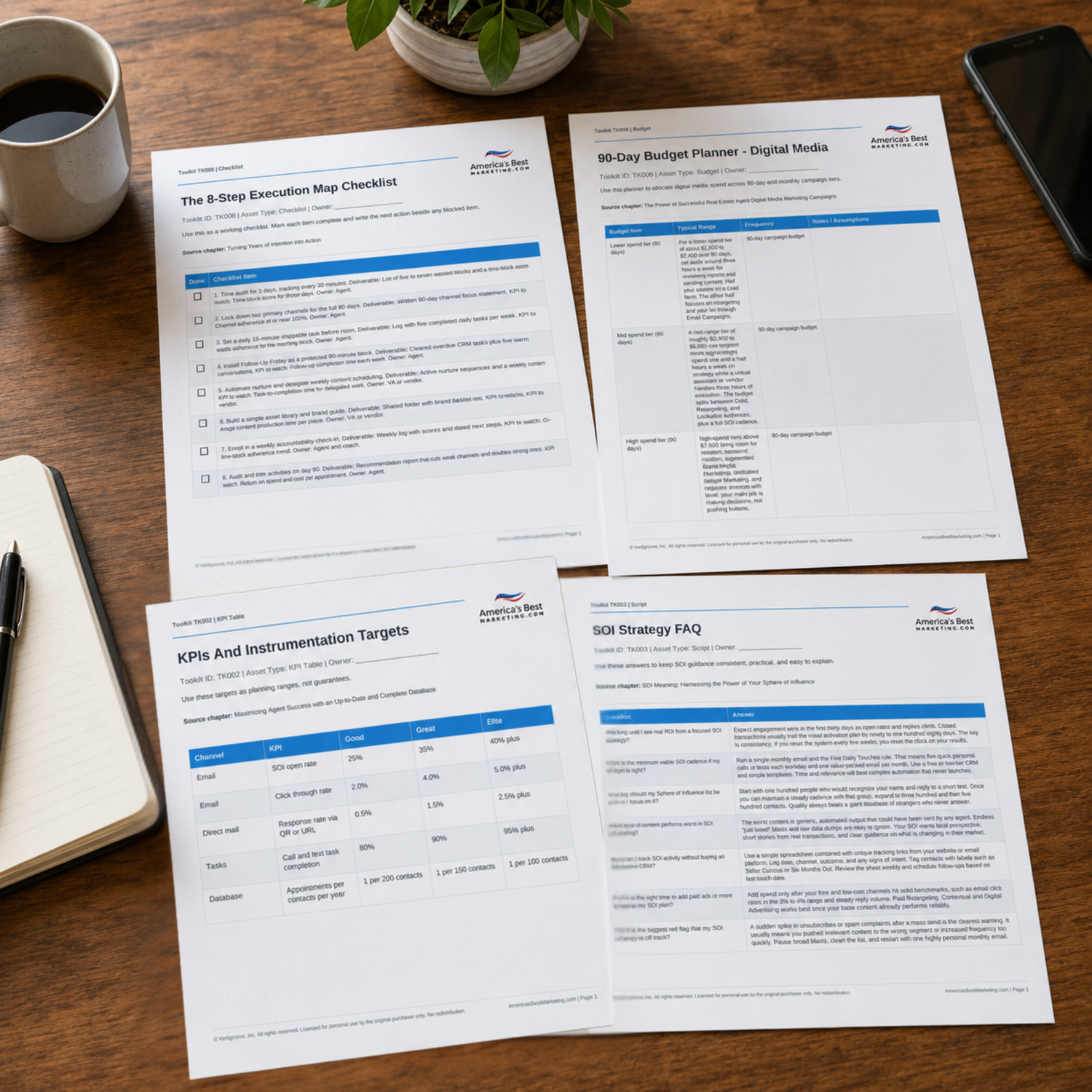
Download The Client Onboarding Toolkit
Use the companion Toolkit to map onboarding spend, audit your first-month process, plan the touchpoint cadence, and sharpen the client FAQ conversation before anxiety turns into extra work.
Download the Toolkit ZIPRecommended reads
Recommended Reads for Real Estate Agents
These articles help agents connect follow-up discipline, database habits, client communication, and marketing execution into a repeatable system.

Real Estate Agent Workflow Automation: Tools, Triggers, and Process Maps
Use workflow automation to create a stronger bridge between client education and real conversations.
Read article
AI for Real Estate SEO: What to Automate, What to Avoid, and How to Measure Impact
Turn search visibility into a clearer publishing system for neighborhoods, services, and client decisions.
Read article
Real Estate Agent Branding: Crafting Your Unique Identity to Stand Out and Attract Clients
Clarify the message, visuals, and client experience that make an agent feel distinctive.
Read article
Delegation for Real Estate Agents: What to Offload First and How to Systematize It
Use systems, delegation, and scorecards to protect the work that creates future business.
Read articleClient Onboarding System Questions Agents Should Be Ready To Answer
How fast will I see ROI from a client onboarding system?
You should feel impact quickly in fewer repeat questions, fewer check-in calls, and smoother decision points. Referral impact takes longer because it depends on conversation timing and the client’s network. Track short-term proof through response time, email engagement, and the number of unplanned status calls you receive per week.
What is the minimal viable onboarding cadence for a solo agent?
Run five touches in the first 30 days: Day 1 welcome kit, Day 3 note, Day 7 roadmap, Day 15 milestone update, Day 30 survey plus call. Keep the touchpoints short and specific. Consistency matters more than fancy design because predictability is what reduces anxiety.
Should I send a gift before the deal closes?
A small, practical item can work if it supports the process, like a folder, a checklist printout, or a local resource card. Avoid expensive gifts that feel transactional or raise expectations you cannot repeat. If you do send something, tie it to clarity and next steps, not celebration.
How do I personalize onboarding without creating extra work?
Use personalization slots, not custom messages from scratch. Capture three fields at intake: timeline, top fear, and decision driver. Then select the right template branch in your CRM and add one sentence that mirrors their own words. That keeps the system repeatable and still feels personal.
What KPIs should I track in the first 30 days?
Track operational KPIs, not outcome promises. Measure email open rate and reply rate, time-to-first-response, and the count of unplanned status calls per active client. Add a day 30 net promoter score and one open-ended question so you catch confusion early and fix it fast.
How do I prevent onboarding emails from feeling generic?
Write each message around one decision point: pricing, inspection, appraisal, timing, or next steps. Use subject lines that sound like a person, and keep each email to one action. Pair the drip with a short weekly text recap for clients who prefer phone-first communication.
When is the right time to ask for a referral during onboarding?
Ask after you have delivered clear value and reduced uncertainty, usually around day 21 to day 30. Make the ask specific: one person who is actively thinking about moving. Offer a simple next step, like an intro text they can forward, so you remove friction and keep the request comfortable.
Next step
Build the System Behind the First 30 Days
Continue from one useful article into the larger ABM ecosystem: the book series for strategic depth and the full marketing program for done-for-you execution.

View the Book Series
Explore the America’s Best Real Estate Agent Marketing System books for a deeper strategic framework around visibility, referrals, listings, lead generation, and growth.
View the Book Series
See Full Marketing Program
See how AmericasBestMarketing.com runs real estate blog writing, social media, listing marketing, email, direct mail, and retargeting as one managed system.
See Full Marketing Program