AI for Real Estate SEO: What to Automate, What to Avoid, and How to Measure Impact
AI for Real Estate SEO
What to automate, what to avoid, and how to measure impact.
A practical operating brief for real estate agents who want AI-assisted SEO without generic pages, compliance drift, or vanity publishing.

AI real estate SEO works when it supports a disciplined publishing system
Use AI to organize keywords, structure pages, draft schema, audit internal links, and prioritize refreshes. Do not use it as a one-click content machine. The pages that win are still built on local proof, clear intent, first-hand judgment, and conversion paths that connect search visitors to IDX searches, email follow-up, retargeting, and real conversations.
- AI is strongest at repetitive SEO workflow tasks: clustering, outlining, schema drafting, internal link mapping, and refresh triage.
- AI is weakest where experience matters: local interpretation, fair housing judgment, client-facing advice, and market nuance.
- The best AI-assisted pages combine one tight intent cluster, verified local proof, and a clear next step such as a saved search or consultation request.
- Measure AI SEO by query growth, click-through rate, engagement, and lead actions, not by the number of pages published.
Why AI SEO Only Works With Local Proof
AI can scale your SEO output, but only if the foundation is clean. A real estate website still needs indexable pages, useful search paths, strong internal links, fast mobile performance, and a local structure that gives buyers and sellers a reason to stay. That is why AI SEO should sit on top of a serious site foundation like Why Every Real Estate Agent Needs an IDX-Integrated Website, not replace it.
The mistake is treating AI like a writing robot. The better move is treating it like an operations analyst. It can help you see query patterns, organize content clusters, identify missing internal links, draft structured data, and spot thin pages. You still decide what deserves to be published and what local proof must be added before a page is credible.
Think of the winning formula as workflow plus experience. AI supplies structure and acceleration. The agent supplies judgment, real market observations, original photos, neighborhood context, client questions, and compliance awareness. Search engines and readers can both feel the difference.
- Use AI to organize the work so your publishing cadence becomes manageable.
- Use local fact sheets to keep every community page anchored in verifiable details.
- Use your own field notes to turn a generic page into a useful buyer or seller resource.
What AI Should Own In Your SEO Stack
AI is a force multiplier when you assign it the right jobs. The right jobs are repetitive, data-heavy, and easy to validate with a fast human review. The wrong jobs are opinion, prediction, and anything that depends on first-hand local experience.
Break AI into two lanes. Use generative AI for drafts, outlines, titles, meta descriptions, FAQ options, and formatting. Use analytical AI for pattern detection, technical issues, and content gap discovery. Your goal is E-E-A-T: experience, expertise, authoritativeness, and trustworthiness. AI can support the last three, but only you can supply the experience layer.
Cluster demand before you write
Feed Search Console queries plus your city, neighborhood, and property-type list into AI, then group the terms into clean topic clusters with one primary page per cluster.
Label each cluster as buyer, seller, investor, or local information so the page purpose stays tight and the conversion path is obvious.
Connect authority to action
Ask AI to suggest internal links from authority pages to high-intent service pages, IDX pages, neighborhood guides, and conversion pages.
Then review the map manually so you build useful pathways instead of random link sprawl.
Standardize technical signals
Draft JSON-LD fields for WebPage, BlogPosting, FAQPage, and local business references so your metadata stays consistent site-wide.
Use AI to compare older pages against current priority topics and decide which page deserves the next proof-heavy refresh.
Here is the operator move that keeps AI from hallucinating: build a local fact sheet and make it a required input for every community page. Keep it short, real, and verifiable.
- Neighborhood name variants locals actually use.
- Two to four real parks, public spaces, or civic resources you can verify.
- Commute corridors described as routes, not promises.
- Housing patterns you see on tours, such as lot size, typical architecture, and common listing presentation questions.
- Two buyer questions you hear every week, written in plain language.
- A proof list, such as original photos, open house notes, verified public resources, or client-safe observations.
Once that fact sheet workflow exists, connecting content to IDX-Integrated Websites becomes straightforward. Your content answers questions. Your IDX search captures intent. Together they keep visitors on your site longer and create more trackable actions.
Where AI Breaks Rankings And Reputation
AI failure modes are consistent, which is good news. If you build guardrails once, you prevent most problems permanently. If you do not build guardrails, you eventually publish something generic, inaccurate, or locally embarrassing.
Google does not need to identify AI to suppress AI-shaped pages. It only needs to see weak usefulness signals: short visits, poor engagement, low click-through rate, thin internal links, and pages that do not satisfy the searcher’s intent. The algorithm rewards pages that solve the query and punishes pages that waste time.
- The copy-and-paste trap: raw AI output can invent school references, blur boundaries, and describe landmarks that do not exist.
- Generic voice: AI defaults to brochure copy that does not sound like a working professional in your market.
- Repetition: AI repeats phrases until the page feels robotic, which reads like low-quality content.
- Technical neglect: agents publish faster but ignore speed, mobile usability, indexability, and internal links.
- Fair housing drift: AI can slide into steering language or subjective descriptions about who belongs where.
Use a simple content review checklist before anything AI-assisted goes live. Delete any claim you cannot verify in two minutes. Add at least three local proof elements. Remove subjective descriptors about people. Rewrite the first 150 words in your voice. Confirm one clear next step, such as a saved search, a market report request, or a call request.
Do not ignore your local presence signals. Your on-site SEO and your Google Business Profile should reinforce each other with consistent details and steady review velocity. If you need a clean operational baseline, use Google Business Profile for Real Estate Agents: Ranking & Review Scripts.
Most agents use AI to write faster, but the bigger win is using AI to find the exact questions top-ranking pages refuse to answer. Fill that intent gap with real local proof and you win clicks from searchers who are already trying to make a decision.
The 8-Week AI SEO Rollout That Actually Holds Up
Publishing faster is not a strategy. Sequencing is the strategy. This rollout builds a technical foundation, ships authority pages with proof, then adds distribution so the work compounds instead of sitting quietly on your site.
Run two sessions each week. Session one is research and build. Session two is review and publish. That cadence is sustainable and keeps quality high without turning the agent into a content factory.
Audit the site, fix broken pages, remove thin pages, verify indexability, and build a hyper-local keyword map with 50 intent terms tied to neighborhoods and property types.
Publish five neighborhood guides built from fact sheets. Add original photos, two short pro tips, housing-pattern observations, and a clear IDX path on every guide.
Add internal links that connect new guides to core pages like your listing process, buyer resources, and high-intent IDX experiences.
Draft schema, validate consistency, push guides through email and social, then run a light outreach plan to earn local mentions and links.
The mistake to avoid in weeks three and four is trying to cover everything. One guide should cover one neighborhood intent cluster. If you add five neighborhoods to one page, you dilute relevance and confuse the reader.
Use IDX SEO: Community Page Blueprint for Agents as the structure for pages that combine local content and a clear IDX path. A guide that ends with nothing is a leak. A guide that ends with a saved search is a machine.
SEO also performs better when your database revisits pages and your market sees the same guide across multiple touchpoints. That is why the rollout should include Email Campaigns, social distribution, and light paid follow-up.
Prompting Standards That Produce Useful Local Pages
Prompts are specs. Treat them like an operator spec and the output becomes predictable. Treat them like a wish and the output becomes generic filler.
Use the same structure every time: audience, page goal, fact sheet inputs, exclusions, and proof requirements. Then force the output into a format you can review quickly.
Neighborhood guide prompt
Use only verified inputs
AudienceWrite for buyers comparing one neighborhood inside this market.
InputsUse my fact sheet only and do not invent schools, boundaries, parks, commute times, or demographic claims.
OutputInclude housing types, commute corridors, parks, buyer questions, and a saved-search call to action.
The point is to make AI draft structure from verified material, not let it pretend to know the neighborhood.
Title, meta, and FAQ prompt
Match intent before style
TitleWrite five direct title options that match buyer or seller intent without hype language.
MetaWrite one short meta description that promises a practical answer and a next step.
FAQGenerate five objective questions based on the outline and keep answers short, clear, and fair housing safe.
Two prompt rules prevent most problems: ban market prediction and ban subjective audience descriptions.
Internal link prompt
Build a path to conversion
Source pageSummarize the page intent in one sentence.
Link targetsSuggest five internal links to related guides, service pages, IDX pages, or follow-up resources.
ReasonExplain the intent match for each link in one line so the map can be reviewed fast.
When the visitor leaves, use Retargeting, Contextual & Digital Advertising to create a second and third touch.
Budgets And Briefs That Keep AI SEO Practical
AI reduces production time, but it does not remove the need for standards, review, and distribution. Treat spend as tooling plus traffic capture plus follow-up, not as a writing subscription.
These ranges are planning benchmarks. Adjust based on market size, competition, and how many neighborhoods you want to build around first.
Spend $150 to $350 per month on AI and crawl tools, plus $0 to $150 on tracking add-ons. Publish one neighborhood guide each week and refresh one older page every two weeks.
The focus is tight cluster coverage, proof elements, internal links, and calls to action that point to saved searches and lead actions.
Spend $650 to $1,400 per month across AI, crawl, reporting tools, and light content support. Publish two neighborhood guides each week and run one technical cleanup session weekly.
The focus is local authority pages plus seller-intent pages that explain process, proof, timing, and follow-up clearly.
Two briefs are worth building first. For buyers, create a neighborhood guide with real photos, three pro tips, an embedded saved search, and the call to action: save this search and get new listings as soon as they hit the market. For sellers, create a proof page that explains your listing process in five steps, includes a short FAQ, and invites homeowners to request a pricing range and timeline plan for their address.
KPIs That Prove Impact Without Guessing
Do not grade AI SEO by how many pages you publish. Grade it by whether the right pages move up and whether those pages create measurable actions.
Use Google Search Console for query movement and page visibility. Use analytics on your IDX site for engagement and lead actions. Review every 14 days so you catch problems early and adjust one variable at a time.
| Metric | Signal | Target | How to act |
|---|---|---|---|
| Rank shift | Core page moves up. | Top 10 | Refresh sections users skip and add one new proof element, such as photos, field notes, or a verified resource link. |
| Intent clicks | Searchers choose you. | 2% to 5% | Rewrite the title and meta, then tighten the first 150 words to match the query more clearly. |
| Lead rate | Visitors take action. | 1.5% to 3% | Add one clear next step above the fold and remove distracting links that pull users away from the intended action. |
Set a simple hygiene cadence. Every 14 days, run a crawl report, check for new 404s, confirm priority pages are indexed, and verify internal links still point where you think they point. This is where most agents lose momentum: they publish, then never maintain.
Finally, connect the system. When you publish a guide, push it to your database, post it socially, and keep it in view with light follow-up. That is how SEO becomes predictable pipeline growth instead of a slow hobby.
How This Becomes A Managed Marketing System
AI SEO is not a standalone tactic. It becomes powerful when it feeds a managed marketing rhythm. One proof-heavy guide can become a blog post, a short email, a social sequence, a direct mail angle, and a retargeting audience.
Use your SEO pages inside Real Estate Blog Writing Services, Social Media Marketing, Listing Marketing, Email Marketing, Direct Mail Marketing, and Digital Retargeting. Each channel should reinforce the same useful answer and point people toward a real next step.
Pick one neighborhood where you already have traction, publish a proof-heavy guide with real photos, then connect it to a saved search and a follow-up plan. If you want a done-for-you execution path, see the real estate marketing company overview and build the first eight-week rollout with clear standards and tracking.
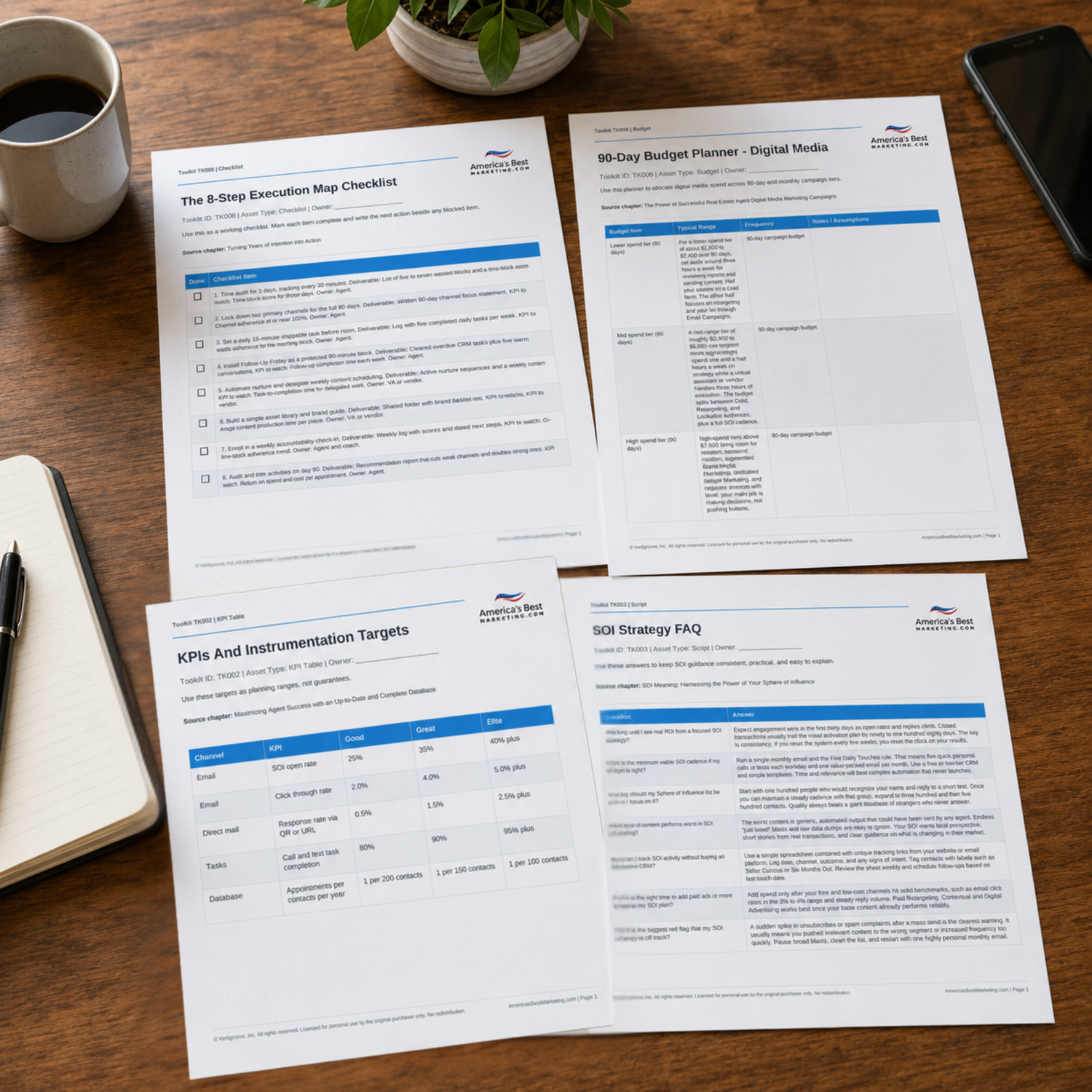
Download The AI SEO Rollout Toolkit
Use the companion Toolkit to plan the eight-week rollout, review AI-assisted pages, track KPI movement, and keep SEO work tied to real lead actions.
Download the Toolkit ZIPRecommended reads
Recommended Reads for Real Estate Agents
These articles help agents turn client questions, local guidance, marketing channels, and follow-up into a more useful content system.

IDX SEO: Community Page Blueprint for Agents
Turn search visibility into a clearer publishing system for neighborhoods, services, and client decisions.
Read article
Proven SEO Strategies for Real Estate Websites to Increase Leads
Turn search visibility into a clearer publishing system for neighborhoods, services, and client decisions.
Read article
SEO for Real Estate: How Agents Can Dominate Local Search and Generate More Leads
Build a cleaner system for SEO for real estate, with better timing, clearer messaging, and a next step people can act on.
Read article
Real Estate Agent Workflow Automation: Tools, Triggers, and Process Maps
Use workflow automation to create a stronger bridge between client education and real conversations.
Read articleAI SEO Questions Real Estate Agents Should Be Ready To Answer
How long does it take to see measurable SEO lift from AI-assisted content?
AI speeds up production, not indexing. Many sites see impression growth in the first month, then more stable query movement after several weeks of consistent publishing and internal linking. Track impressions and average position on your top neighborhood pages, then use click-through rate as the tie breaker. If impressions rise but clicks do not, your snippet and first paragraph are not aligned with intent.
What is the minimum viable weekly cadence for a solo agent?
Publish one neighborhood guide each week and refresh one older page every other week. Spend 30 minutes on the AI outline and draft, then 30 minutes adding your own photos, facts, and pro tips. That one hour habit builds compounding coverage without burnout. Consistency beats a big burst of content that never repeats.
What content performs worst when generated by AI?
Opinion pieces and market prediction. AI has no first-hand market experience and it will output generic commentary that sounds confident but carries no proof. Use AI for structured drafts and research summaries. Use your voice for local interpretation, negotiation lessons, and client-facing guidance where trust matters most.
Do AI-written pages get penalized by Google?
Google rewards helpful pages and suppresses low-value pages. If a page is generic, repetitive, or lacks proof, it will underperform whether it was written by AI or a human. Add an experience layer: real photos, first-hand notes, and clear answers to buyer questions you hear in the field. That is what separates useful from filler.
How do I keep AI content fair housing safe?
Use prompts that force objective language and ban subjective descriptors about who belongs in an area. Focus on amenities, services, transportation, and housing types rather than describing people. Run a quick compliance scan before publishing and remove anything that reads like steering. If you publish school resources, link to official sources and avoid rating language.
How do I track SEO without advanced tools?
Connect your site to Google Search Console and watch three signals: impressions, click-through rate, and average position on priority pages. Pair that with basic site analytics for time on page and lead actions. Review every 14 days and adjust one thing at a time so you can see cause and effect.
What is the major red flag to avoid with AI SEO tools?
A tool that promises instant rankings or one-click success. SEO is earned through relevance, proof, and technical clarity. If a tool claims it can trick Google, it will eventually fail and may create a cleanup problem. Choose tools that improve workflow and validation, not tools that sell magic.
Next step
Build the System Behind the Advice
Continue from one useful article into the larger ABM ecosystem: the book series for strategic depth and the full marketing program for done-for-you execution.

View the Book Series
Explore the America’s Best Real Estate Agent Marketing System books for a deeper strategic framework around visibility, referrals, listings, lead generation, and growth.
View the Book Series
See Full Marketing Program
See how AmericasBestMarketing.com runs real estate blog writing, social media, listing marketing, email, direct mail, and retargeting as one managed system.
See Full Marketing Program