Why Every Real Estate Agent Needs An IDX Integrated Website
Why Real Estate Agents Need IDX Websites
Own search, capture intent, and reduce portal dependence
An IDX website briefing for agents who want live listing search, cleaner lead routing, stronger local SEO, and a follow-up system that keeps the client journey inside their brand.
IDX website strategy for real estate agents
An IDX-integrated website gives a real estate agent one controlled place to attract search traffic, display live listing inventory, capture buyer and seller intent, and route those leads into follow-up. Without it, too much of the client journey starts on portals, broker platforms, and third-party systems where the agent may appear, but does not control the relationship.
- An IDX website turns a static agent site into a searchable, branded home base for buyer and seller intent.
- The site must connect live search, registration, CRM routing, email nurture, retargeting, analytics, and local SEO.
- The first ninety days should prioritize search setup, capture paths, traffic, follow-up, and optimization before cosmetic refinements.
- The core business advantage is reduced portal dependence and a stronger owned database.
Why IDX Control Matters
Most agents know they need a website, but many still treat it like a digital business card. A bio, a few testimonials, a contact form, and a handful of featured listings may help someone verify who you are. It does not give buyers and sellers a strong reason to return, search, save, inquire, and stay connected to your brand.
IDX changes the job of the website. Instead of sending people away to search somewhere else, your site can display searchable listing inventory under your name, your domain, and your follow-up system. Buyers can browse homes, save searches, request showings, and ask questions without beginning the relationship inside a portal experience.
The seller-side value is just as important. A strong IDX site shows that your marketing infrastructure is tied to real market activity, not just personal branding. When sellers see property search, community pages, valuation offers, retargeting paths, and reporting in one system, your digital presence becomes easier to believe.
- Portals own the relationship when they control the search experience and registration moment.
- An IDX website gives your brand the search hub buyers can return to again and again.
- Your database improves when saved searches, inquiries, and valuation requests flow into your own follow-up process.
What A High-Performing IDX Website Must Do
A useful IDX website does more than display listings. It connects property search to lead capture, lead capture to CRM routing, CRM routing to follow-up, and follow-up to appointment opportunities. If one of those steps is missing, the site may look polished but still fail as a business asset.
At a technical level, a strong IDX build has three responsibilities. The feed keeps listing data fresh enough for consumers to trust the experience. Lead capture tools turn search behavior into registrations, inquiries, saved searches, and valuation requests. The SEO structure gives search engines a clean path to understand local pages, neighborhood content, listing-related guidance, and service pages.
Design still matters. Agents who invest in layout, hierarchy, and clarity keep visitors on the page long enough to convert. The design should support the funnel, not compete with it. A beautiful page that hides the search tool, buries the contact path, or fails on mobile is not a premium asset. It is expensive friction.
Make live inventory easy to use
Keep the main search path simple, mobile-friendly, and locally organized. Buyers should be able to filter, browse, save, and return without feeling as if they have entered a generic portal clone.
Capture intent at the right moment
Use registrations, valuation requests, showing requests, and saved search prompts at natural decision points. The goal is to convert genuine intent without blocking every visitor too early.
Move every action into a next step
Connect each form, saved search, inquiry, and valuation request to a CRM or structured follow-up process. Leads should never sit unnoticed in a website dashboard.
Build pages search engines can understand
Create focused city, neighborhood, community, and property-type pages that answer real search questions. The deeper pages often create more long-term value than the homepage.
Build The First Ninety Days Like A Funnel
The first ninety days should not disappear into color debates, photo swaps, and minor layout preferences. The priority is to get the core infrastructure working: search, capture, tracking, follow-up, traffic, and optimization. Once that foundation is active, the site becomes something you can improve every month.
Foundation and SEO setup
Connect the IDX feed, test real searches, verify required MLS display details, use a clean branded domain, and publish the highest-value city, neighborhood, or community pages with direct calls to action.
Traffic and nurture
Send buyers to saved-search and live inventory pages. Send sellers to valuation and local proof pages. Route every registration, inquiry, and valuation request into a CRM, then support the lead with email and retargeting.
Optimization and authority
Identify which pages attract traffic, which pages convert, and which pages lose mobile visitors. Improve high-traffic pages with weak conversion before creating more pages.
Keep improving the system
Review analytics, saved searches, inquiries, return visits, and follow-up results monthly. Treat the website as a managed asset, not a project that ends at launch.
The homepage is not the entire strategy. The deeper IDX, neighborhood, community, and market pages often create the long-term SEO and conversion value. Treat each high-intent area page like a mini landing page with one clear offer and one obvious path into follow-up.
What To Budget And Measure
Your IDX site becomes an asset when it receives steady traffic and disciplined follow-up. Traffic can come from email, social media, direct mail, client events, SEO, retargeting, contextual ads, or listing campaigns. The key is to send people back to a site you control instead of rebuilding attention on platforms you rent.
Invest two hundred fifty to four hundred dollars per month into Retargeting that brings warm visitors back to IDX search pages, featured communities, and valuation offers. Keep the creative simple: one local promise and one direct next step.
Invest six hundred to nine hundred dollars per month with part of the budget driving fresh traffic to saved-search and valuation pages and part retargeting warm visitors. Pair the traffic with Email Campaigns so new leads see your brand in more than one place before they are ready to talk.
Traffic alone does not prove that the website is working. What matters is how many visitors raise a hand, how often they return, and how many of those relationships move toward live conversations. Use a short list of site-level KPIs so you can improve the funnel one step at a time.
| KPI Name | What It Tracks | Target Range | Change To Test First |
|---|---|---|---|
| Site signups | Visitors who register or save a search | Three to five percent | Strengthen CTAs on high-traffic pages and simplify the registration path. |
| Return visits | Visitors who return within thirty days | Thirty five to fifty percent | Use listing alerts, email reminders, and retargeting that point people back to live search. |
| Lead to client | Leads that progress into closed clients | One and a half to three percent | Improve speed to first contact and add structured follow-up touches. |
How IDX Reduces Portal Dependence
An IDX website is more than a marketing add-on. It is part of the operating infrastructure. It helps buyers search, gives sellers a stronger reason to believe the agent’s marketing is real, and gives the business a central digital asset that keeps working after a post, ad, or email has come and gone.
Compliance still matters. The website vendor should help manage feed rules, required disclaimers, data-refresh timing, and MLS display requirements so visitors are not confused by stale or mislabeled listings. Forms should also explain how contact information will be used and how often people can expect updates.
Accessibility is part of trust as well. A site that works on mobile, loads quickly, supports screen readers, uses readable contrast, and gives keyboard users a workable path through the page helps more people reach reliable property information. That quality also supports SEO because search engines are trying to reward useful, accessible, well-structured experiences.
- Audit the website on mobile and desktop before sending paid traffic.
- Confirm analytics can separate searches, registrations, forms, valuation requests, and showing inquiries.
- Build thank-you pages that tell leads what happens next instead of leaving them at a dead end.
- Document what worked so future campaigns build from tested behavior instead of opinion.
How This Becomes Marketing
Over the next two days, audit the current website and choose three core neighborhoods or communities that deserve dedicated pages. Map one search path, one seller path, and one follow-up path for each. That small planning sprint will reveal whether the site is functioning as a real funnel or only as a brochure.
When the foundation is ready, connect the website to Social Media Marketing, Listing Marketing, Email Campaigns, Direct Mail, Digital Retargeting, and IDX Real Estate Websites. The website becomes the hub, the campaigns become the spokes, and each client touch brings people back to a digital home that you control.
For agents who want the heavy lifting handled, AmericasBestMarketing.com’s full marketing program connects blog writing, social media, listing marketing, email, direct mail, retargeting, and website strategy into one managed system.
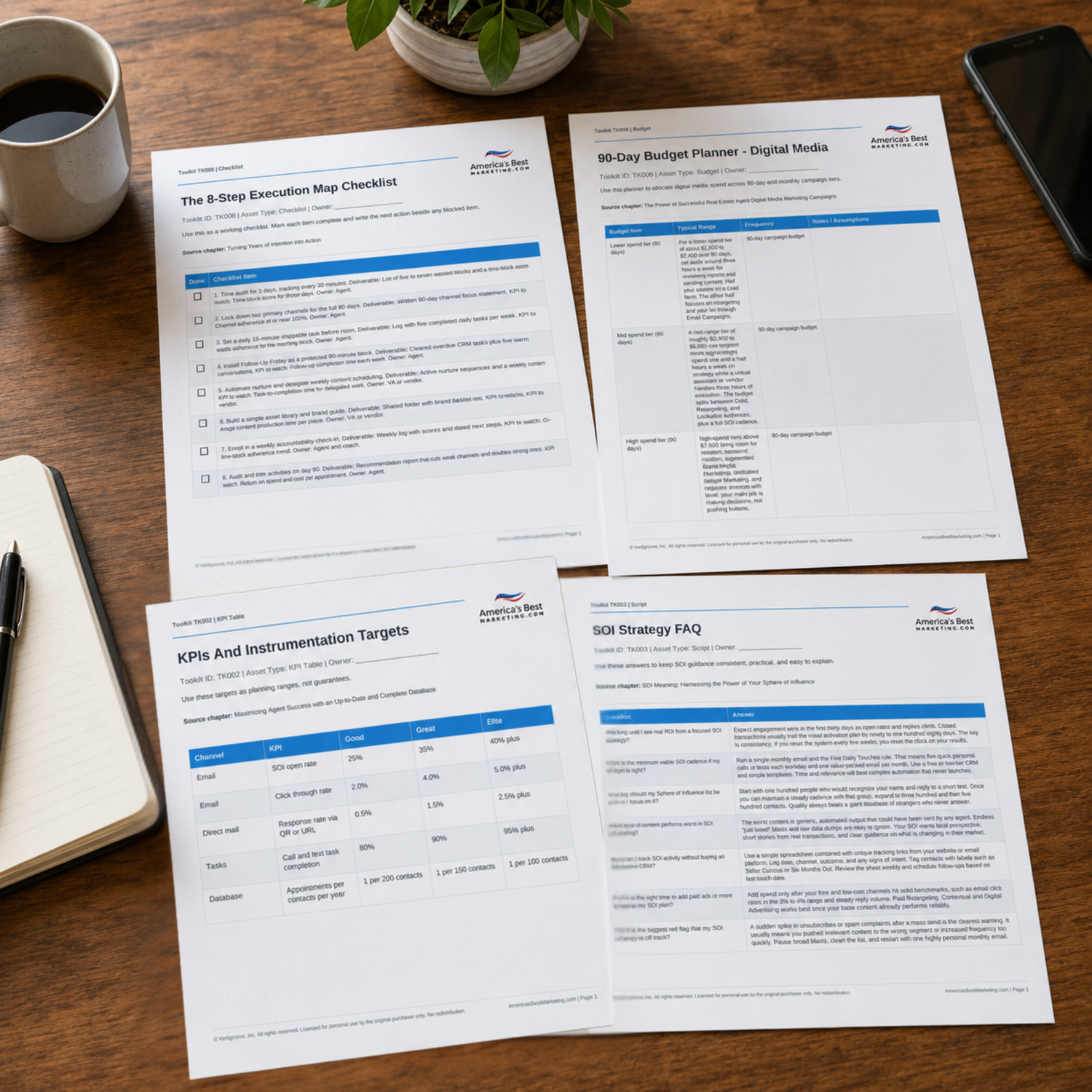
Download The IDX Website Implementation Toolkit
Use the companion Toolkit to plan your IDX website budget, ninety day implementation sequence, website-health KPI review, lead-routing checklist, and buyer or seller explanation script.
Download the Toolkit ZIPRecommended reads
Recommended Reads for Real Estate Agents
These articles help agents connect local visibility, useful content, channel strategy, and follow-up into a stronger search-friendly marketing system.

IDX Lead Routing & Alerts: From Browse to Booking in Under 5 Minutes
Bring more structure to IDX lead routing and alerts so every touchpoint supports visibility and trust.
Read article
High-End Buyer/Seller Tech Stack: Tools and Systems Luxury Agents Use
Create more leverage from high-end buyer/seller tech stack with a clear path from attention to follow-up.
Read article
Best Website Builders for Real Estate Agents: Costs, SEO Tradeoffs, and Setup Tips
Bring more structure to website builder decisions so every touchpoint supports visibility and trust.
Read article
Could Poor Website Design Be Costing You Clients? How Agents Can Build High-Converting Real Estate Websites
Use website design and conversion to strengthen visibility, follow-up, and client conversations without adding more random tasks.
Read articleIDX Website Questions Agents Should Be Ready To Answer
Is an IDX website only worthwhile for high-volume agents?
No. The primary advantage of an IDX website is control over search, branding, and lead data. That matters for agents at many production levels because each registration, saved search, inquiry, and valuation request can begin inside an owned follow-up system instead of a portal-controlled experience.
Can I keep my current site and just add IDX?
Sometimes, but the stronger move is to evaluate the full funnel first. If the current site is slow, cluttered, weak on mobile, or unclear about next steps, adding IDX may create more pages without better conversion. IDX works best when the site is designed around search, capture, saved alerts, valuation requests, and fast routing.
How long before an IDX site starts generating leads?
Early registrations can happen quickly when the site receives traffic from email, social media, ads, direct mail, and sphere outreach. Organic search usually takes longer because search engines need time to crawl, evaluate, and trust local pages. The practical plan is to send visitors from multiple channels while the SEO foundation matures.
Will this help me compete with national portals in search results?
An individual agent is unlikely to outrank national portals for broad home-search terms in large markets. The better opportunity is long-tail local search built around neighborhoods, property types, lifestyle questions, seller education, and community-specific guidance. IDX supports that plan when paired with useful local pages and consistent internal linking.
What tools should my IDX site integrate with first?
Start with a CRM, an email platform, analytics, and lead notifications. The CRM should record registrations, saved searches, showing inquiries, and valuation requests. Email should support nurture and listing alerts. Analytics should separate real conversion actions from ordinary page views.
What happens to my website leads if I change brokerages?
When the agent owns the domain, website, and database, the asset is more portable than a platform controlled entirely by a broker or portal. Branding, MLS details, and required disclaimers may need updates, but the core relationship history and follow-up structure can remain under the agent’s control.
How do I explain the value of my IDX site to potential sellers?
Show sellers how the listing will live inside a larger marketing system. Walk them through the property page, search experience, local content, retargeting, email follow-up, and reporting. The point is not simply that you have a website. The point is that your website gives the listing a branded digital home tied to measurable outreach.
Next step
Build the System Behind the Website
Continue from one useful article into the larger ABM ecosystem: the book series for strategic depth and the full marketing program for done-for-you execution.

View the Book Series
Explore the America’s Best Real Estate Agent Marketing System books for a deeper strategic framework around visibility, referrals, listings, lead generation, and growth.
View the Book Series
See Full Marketing Program
See how AmericasBestMarketing.com runs real estate blog writing, social media, listing marketing, email, direct mail, and retargeting as one managed system.
See Full Marketing Program