Maximize Your Business Growth with High-Impact Marketing Solutions
High-Impact Marketing Solutions for Business Growth
A 90-day real estate marketing system for connected channels
How agents can connect website, ads, email, direct mail, social content, events, and follow-up into one accountable growth engine.

High-impact marketing solutions for real estate agents
High-impact marketing is not one expensive campaign. It is a connected operating system where your website, ads, email, direct mail, events, social content, and follow-up move prospects toward the same next step. The practical objective is simple: make every channel reinforce the same offer, route every response into one owned hub, and track the numbers long enough to know what deserves more budget.
- Use your IDX website or primary landing page as the hub for every campaign, not as a passive brochure.
- Make every channel repeat the same offer, promise, audience, and call to action.
- Run the plan for at least ninety days before judging the full conversion path.
- Track traffic, cost per lead, and lead-to-appointment movement before increasing spend.
- Keep the system ethical, permission-based, mobile-ready, and easy to follow up on.
Why High-Impact Marketing Solutions Work
Most agents do not lose deals because they lack activity. They lose deals because activity drifts between disconnected channels with no consistent path back to a real conversation. High-impact marketing solves that by putting the website, ads, social content, email, direct mail, and follow-up on one shared plan.
The system matters because it creates proprietary lead flow instead of hoping portals, boosts, or one-off campaigns save the month. When IDX Real Estate Websites, Email Marketing for Real Estate Agents, Direct Mail Marketing, Social Media Marketing, and Listing Marketing share the same offer, prospects feel like they already know the agent before the first appointment.
If you already run Client Appreciation and Gifting Programs for Real Estate Agents, this is the next layer. Instead of letting appreciation touches sit on an island, the system connects those relationship assets to email, retargeting, content, listing promotion, and a measurable follow-up path.
- Marketing becomes easier to judge because each channel has a clear job.
- Past clients and SOI contacts see the same positioning across email, mail, social, and events.
- Warm leads stop falling between platforms because every response routes back to the same hub.
Build The Hub-And-Spoke Engine
The hub is the owned destination. For most agents, that means an IDX website, a focused landing page, or a market-specific content page that can capture the click, explain the offer, and hand the lead to a follow-up process. The spokes are the channels that create repeat exposure and drive people back to that hub.
Every spoke needs the same message architecture. The headline, promise, proof, and call to action should feel consistent whether the prospect sees a postcard, a video, a retargeting ad, a listing email, or a neighborhood event invitation. That consistency lowers friction because the prospect is not forced to decode a new campaign every time they see the agent.
Own the response path
Your IDX website or landing page should collect every click, search, form fill, and inquiry so the audience becomes a business asset instead of rented attention.
Use clear calls to action, mobile-first forms, fast load times, and one conversion goal per page.
Drive controlled visibility
Digital Retargeting, direct mail, social media, listing marketing, and local content should all point to the same campaign promise.
The job is not to be everywhere at random. The job is to show up repeatedly in the right places with the same next step.
Keep timing on your side
Email, branded print, client events, and personal follow-up keep past clients, SOI contacts, and new leads seeing the agent’s value until the timing is right.
The loop works when every channel feeds the database and every database segment receives a relevant next touch.
Most agents think high-impact marketing means spending more money. The better interpretation is spending smarter by integrating the channels. The overlooked attribution gap is usually between direct mail and digital conversion. Every printed piece should drive to a unique, trackable landing page so the agent can see the true digital impact of print spend.
Build The Engine Before You Scale Spend
The first thirty days are about foundation and integration, not volume. Audit the website for speed, mobile readiness, local relevance, and clear calls to action. Connect every form to the CRM and email platform so leads never sit in an inbox. Lock one brand style so ads, mailers, videos, and email templates look like a single operating system.
The next sixty days focus on traffic, proof, and measurement. Launch a focused direct mail farm, one always-on retargeting campaign, a weekly email, and a content rhythm that points back to fresh pages. During this phase, compare your plan against How Much Should a Real Estate Agent Budget for Marketing? and idea sets like 25 Proven Real Estate Marketing Ideas for Spring so every dollar has a job.
Foundation and integration
Confirm the campaign hub, CRM routing, list segmentation, tracking links, email templates, ad audiences, direct mail farm, and listing promotion standards.
End the month with the system connected, not merely planned.
Traffic and proof
Run the campaign with enough consistency to see directional numbers. Measure traffic, lead capture, reply rate, booked conversations, and follow-up completion.
End the quarter by shifting budget toward the channels creating real appointments.
Three Ready-To-Use Multi-Channel Plays
A useful marketing system becomes stronger when it can be repeated. The following plays give agents a practical way to connect direct mail, social content, retargeting, email, and the website around one market-facing idea.
The Neighborhood Everywhere Burst
Agent dialogue
Hook You are seeing my name for a reason. I focus on your street and the streets that touch it.
CTA Scan the card or tap the link to see what buyers are paying near you this month.
Channel plan
Mail Send a direct mail market report postcard with a QR code to one farm landing page.
Social Publish a short video that echoes the postcard headline and points to the same page.
Ads Retarget visitors who land on the page but do not fill the form.
Email Send the same offer to the SOI list within three days.
The goal is saturation in one small area so prospects feel repeated market presence without bloated spend.
The Problem And Solution Follow-Up Sequence
Agent dialogue
Hook Most owners guess on price and either leave money on the table or scare away the right buyers.
Build My clients use a three-step review covering timing, competition, and net sheet before they decide.
CTA Reply with the word plan or tap the button to see how the review works in your neighborhood.
Channel plan
Ad Run a lead ad with the three-step review as the offer.
Page Use a landing page that explains the review and collects contact details.
Email Send a three-touch sequence that walks through timing, competition, and net sheet.
This turns vague seller interest into a structured path instead of a disconnected lead capture form.
The Hidden Value And Local Proof Sequence
Agent dialogue
Hook Your home has value buyers can miss until someone shows them where it lives.
Build From storage to walkability, I package the details that do not show up in a search filter.
CTA Tap to see how I market hidden value in your neighborhood and what buyers are clicking on now.
Channel plan
Listing Package the property page with lifestyle features, local spots, and specific value details.
Video Move from the property to one or two nearby proof points in a short social clip.
Email Link the listing to the database and invite owners to ask how their home would be packaged.
This play positions listing marketing as a consultative asset, not only a seller deliverable.
Starter And Mid-Range Multi-Channel Budgets
Budget is not just a dollar figure. Budget is also time, focus, and management attention. A smaller integrated plan will usually outperform a larger scattered one because every touch repeats the same promise and every channel has a measurable job.
$1,200-$2,000
Put roughly half the spend into digital retargeting that drives to one or two landing pages. Use the remaining budget for a small direct mail farm and basic social boosts. Cap exposure and avoid spreading the spend across too many offers.
$3,000-$5,000
Keep the starter plan in place, then add a second direct mail farm, stronger listing marketing for every property, one new local authority article per month, and one branded email per week.
| Tier | Primary focus | Monthly spend | What changes after ninety days |
|---|---|---|---|
| Minimum viable | Nurture and retarget | $1,200-$2,000 | You confirm that email and simple ads can pay for themselves with warm lead follow-up. |
| Growth | Farm and listings | $3,000-$5,000 | Your brand shows up in one local farm, and every listing launches with a connected campaign plan. |
| Market authority | SEO and authority | $5,000+ | You build share of voice so more listing appointments come from repeated exposure across channels. |
Use a simple hygiene cadence to keep the engine healthy. Review core numbers weekly and monthly so you can move money toward what is working instead of hoping the trend changes on its own.
- Review digital retargeting performance and cost per lead every week.
- Add new or refreshed content to the website twice per month.
- Check email open and click rates twice per month and adjust subject lines and offers.
- Look at social comments, shares, and saves weekly so you know which topics land.
- Pull recent reviews and add the best proof points to the website and social profiles every month.
- Plan the next direct mail drop each month so print deadlines never become emergencies.
Keep Compliance, Permission, And Data Security Under The System
Compliance and ethics sit underneath every piece of the engine. Keep Fair Housing rules at the center of creative so marketing speaks to homes, services, and market decisions, not protected classes. Make sure bulk email includes a visible unsubscribe path and that the list is built from people who have given clear permission to hear from the agent.
Data security matters for the same reason. Leads who fill out forms on an agent’s website expect their information to be protected. Use secure storage, strong passwords, limited account access, and vendor partners who take privacy seriously. Trust is a growth asset, not a technical footnote.
In practice, the synergy can be simple. An agent starts with a direct mail market report postcard that points to a trackable URL, retargets every visitor with a seller strategy session, then follows up by email with a clear local next step. The goal is not to claim guaranteed results. The goal is to create a measurable path from mailbox, to landing page, to follow-up, to booked conversation.
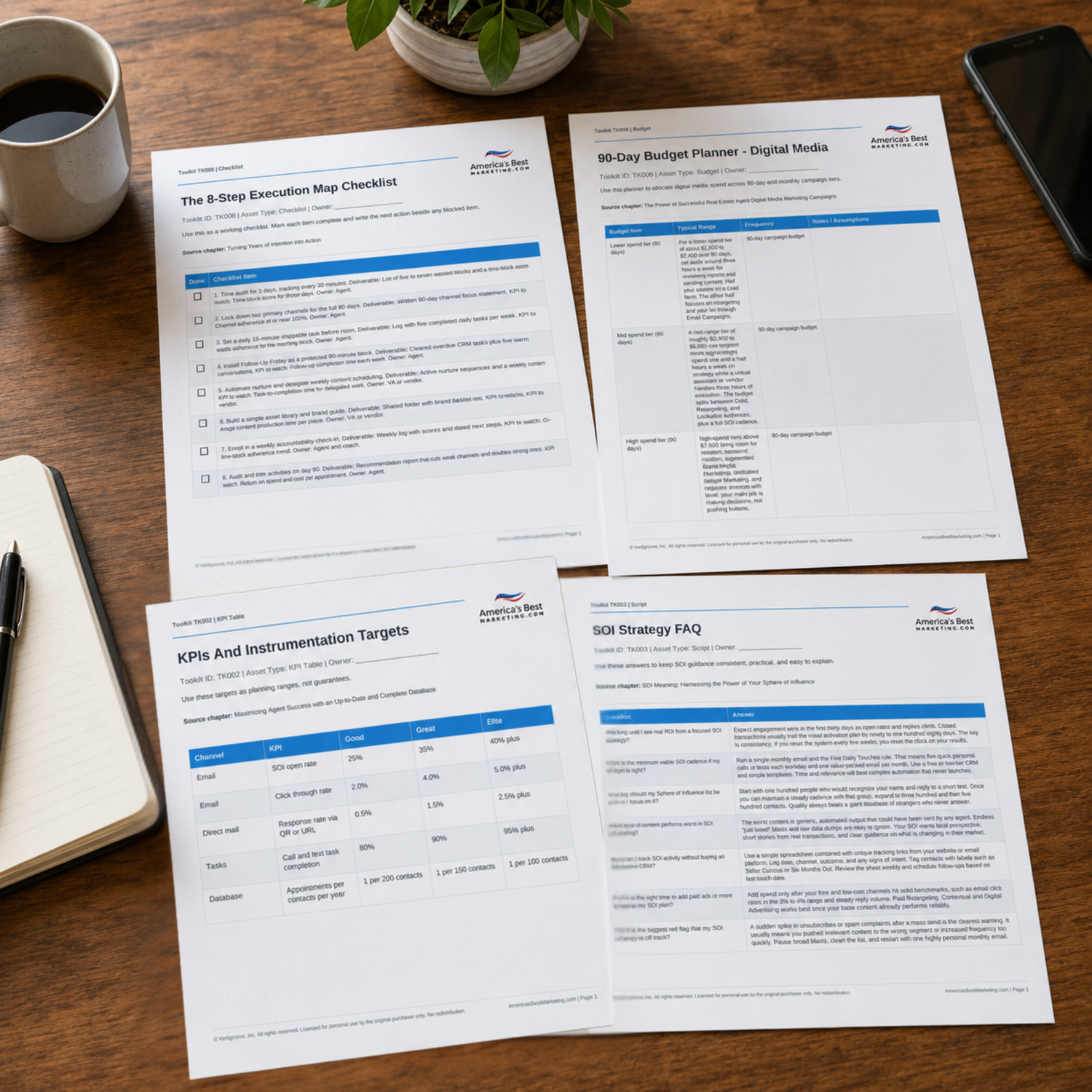
Download The High-Impact Marketing Toolkit
Use the TK031 Toolkit to turn the article into a working plan with starter and mid-range budget resources, a hygiene cadence checklist, a budget-tier KPI table, multi-channel scripts, and FAQ support.
Download the Toolkit ZIPRecommended reads
Recommended Reads for Real Estate Agents
These articles help agents connect follow-up discipline, database habits, client communication, and marketing execution into a repeatable system.

What the Best Real Estate Marketing Companies Do Differently
Build a cleaner system for what the best real estate marketing companies do differently, with better timing, clearer messaging, and a next step people can act on.
Read article![Build a Relocation Lead Engine in [Your City] (Guide for Real Estate Agents) article preview for real estate agents](https://images.squarespace-cdn.com/content/v1/674ca5283c99f218d8bbb451/af9d20d1-51ed-4e2c-9c4d-f00444ec2a10/Blog+142+Build+a+Relocation+Lead+Engine+in+%5BYour+City%5D+%28Guide+for+Real+Estate+Agents%29.png?format=1500w)
Build a Relocation Lead Engine in [Your City] (Guide for Real Estate Agents)
Use relocation lead engine to strengthen visibility, follow-up, and client conversations without adding more random tasks.
Read article
Real Estate Agent Video Marketing: Boost Conversions and Engage Clients with Effective Videos
Create video content with clearer scripts, simpler formats, and a cadence agents can actually maintain.
Read article
Business Growth Strategy for Real Estate Agents
Use business growth planning to strengthen visibility, follow-up, and client conversations without adding more random tasks.
Read articleHigh-Impact Marketing Questions Agents Ask First
How long should I run a multi-channel plan before I judge it fairly?
Give a focused multi-channel plan at least ninety days before you judge it. That window lets your ads exit the learning phase, your direct mail hit homes more than once, and your email marketing build recognition. You may see early indicators inside thirty days, yet the real clarity on cost per lead and lead-to-client conversion usually lands closer to the ninety day mark.
What is the smallest budget that still makes high-impact marketing solutions worth it?
If you sell homes consistently and already have a list, a starter budget can work when it is focused. Pick one farm, one primary offer, one landing page, and one steady email schedule. Scatter will waste even a large budget, while focus lets a modest spend create repeatable visibility.
Do I need an IDX website before I run ads and mailers?
You can start with a basic landing page, but an IDX website hub gives the plan a stronger center. It lets you capture search behavior, support saved searches, and keep visitors inside your brand instead of sending them back to portals. If budget is tight, build a clean hub before scaling digital retargeting and direct mail.
How often should I send email to my list without annoying people?
Most agents send too little. A weekly email with real value such as local stats, new listings, seller guidance, and clear offers is a strong baseline. Consistency is more important than volume. Watch unsubscribes, replies, and clicks so the cadence is guided by behavior instead of guesswork.
What should I measure first if I feel overwhelmed by data?
Start with three numbers. Website conversion rate shows whether the hub turns visitors into leads. Cost per lead shows whether traffic is efficient. Lead-to-client conversion rate shows whether your follow-up converts conversations into closings. Once those numbers are stable, you can dig into channel-level diagnostics.
How do I balance branding with direct response marketing?
Branding and direct response should reinforce each other. The simplest way to balance them is to use direct response offers that match your brand promise. Think clear guides, local reviews, market alerts, and strategy calls instead of loud discounts. The same look and voice should appear across every channel while each asset asks for a specific next step.
Where does a done-for-you partner fit in a high-impact marketing plan?
A strong partner handles build, execution, reporting, and optimization so you can stay focused on appointments and negotiations. They connect IDX websites, social media, direct mail, email, listing marketing, and retargeting into one operating rhythm. That is especially useful once your budget reaches the mid-range level and your time becomes the bottleneck.
Next step
Build the System Behind the Growth
Continue from one useful article into the larger ABM ecosystem: the book series for strategic depth and the full marketing program for done-for-you execution.

View the Book Series
Explore the America’s Best Real Estate Agent Marketing System books for a deeper strategic framework around visibility, referrals, listings, lead generation, and growth.
View the Book Series
See Full Marketing Program
See how AmericasBestMarketing.com runs real estate blog writing, social media, listing marketing, email, direct mail, and retargeting as one managed system.
See Full Marketing Program