Best Marketing for Real Estate Agents: Strategies That Actually Work
Best Marketing for Real Estate Agents
Strategies That Actually Work
A ninety day operating plan that connects social media, email, direct mail, search visibility, and follow-up so agents can turn repeated attention into measurable listing conversations.

What actually works in real estate marketing
The best marketing for real estate agents is a repeatable multi-channel system built around a clean sphere database, one focused geographic farm, useful local content, and disciplined follow-up. Social media earns attention, email explains value, direct mail reinforces local presence, search confirms credibility, and retargeting keeps the agent visible until timing creates a conversation.
- Protect cadence before polish because repeated useful contact usually outperforms occasional campaign bursts.
- Build around three owned assets: your sphere list, your geographic farm, and your website with current proof.
- Use one campaign theme across social, email, direct mail, search, and retargeting instead of running disconnected tactics.
- Review a small KPI set every week so budget and effort move toward the messages that create replies and appointments.
Core Moves Under Every Strong Marketing Plan
Scattered marketing creates scattered results. A stronger real estate marketing plan gives your sphere, farm, and online prospects the same clear message across social, email, direct mail, search, and follow-up so attention turns into real listing conversations.
Every serious agent builds around three core assets. Your sphere list is the audience that already trusts you. Your geographic farm is the slice of the map where you intend to be the obvious choice. Your digital footprint is the trail of content, reviews, and search results that strangers use to decide whether you are worth a call.
Start by tightening each foundation. Clean your database so you have one list with clear tags for past clients, hot prospects, cold leads, and local partners. Choose a farm that you can touch on a regular cadence rather than a huge zone you rarely reach. Then study your online presence so your website, profile, and reviews align with one clear positioning, supported by ideas from Best Real Estate Content Marketing Ideas and market niches that match your strengths.
- Sphere nurturing means regular, useful contact with a known list so people remember your value when life events create a real estate need.
- Geographic farming means one tight area where signs, mail, events, and search visibility make your name feel familiar.
- Digital proof means a current website, recent reviews, and helpful content that builds trust before a prospect ever meets you.
The positioning work matters because most agents are competing with forgettable sameness. A stronger plan clarifies who you serve, what you help them decide, and why your local knowledge is worth a conversation. An agent focused on move-up sellers, downsizers, waterfront homes, first investment purchases, or one neighborhood can make a clearer promise than an agent trying to sound relevant to everyone. Use Top Real Estate Niches to Target as a positioning reference, then make the message specific to your market.
Why The Best Marketing Is Multi-Channel
Single-channel marketing puts all of your risk in one basket. A social algorithm change can flatten reach. A dip in email engagement can hide a good message. A direct mail piece can underperform when it is disconnected from the rest of the campaign. A multi-channel plan spreads those bets across social, email, direct mail, and search so prospects see you in different contexts and comfort grows each time.
Think of each channel as a role on a small team. Social introduces you and shows personality. Email explains and educates. Direct mail signals local commitment and staying power. Your site and search results confirm that you are legitimate. Together they create repeated exposure without requiring you to live on your phone.
- Inconsistent execution confuses people because you appear in bursts and then disappear for weeks at a time.
- Lack of branding makes every postcard, post, and email look like a different person, so nobody remembers you by name.
- Neglected databases leave years of repeat and referral business untouched while you chase colder lead sources.
- Posting without a calendar turns your feed into a random diary instead of a guided path toward a call.
- Ignoring owned assets keeps you at the mercy of platforms you do not control while your site and list gather dust.
Most pipeline problems are cadence problems before they are creative problems. An average message shown consistently to the right people usually beats a polished campaign that only appears when business gets slow.
Build The System In Three Phases
Use ninety days to build one simple plan around three phases. Foundation covers weeks one through four. Activation covers weeks five through eight. Optimization covers weeks nine through twelve. Each phase uses the same channels on a tight cadence so the work feels clear and repeatable.
Foundation
Audit your brand, database, website, reviews, and current outreach. Segment contacts into a core sphere list, nurture list, and cold list. Check that your website has clear local pages, working forms, and one primary next step.
Activation
Launch three to five social posts per week, one educational email, one nurture email, one coordinated direct mail piece, and focused retargeting for people who already visited your website.
Optimization
Compare open rates, click rates, site visits, replies, form fills, calls, and appointment requests. Reduce content that earns no response and create more of the messages that produce engagement.
For the first thirty days, use these steps to turn the plan into a weekly operating rhythm.
- Pick one clear positioning lane such as downsizers, move-up buyers, or a specific neighborhood.
- Clean your database into one master list with tags for past clients, hot prospects, nurture leads, and local partners.
- Choose one core farm where you already have some presence and define exact boundaries street by street.
- Refresh your home page and about page copy so they match your positioning and point to one primary lead form.
- Claim or update your map listing and request recent reviews that mention your style, speed, or local knowledge.
- Draft a four week social calendar with listing content, market proof, homeowner education, and local context.
- Write one sphere email that recaps the market in plain language and one value email with a clear homeowner tip.
- Plan one direct mail piece that echoes the same theme as your posts and emails and includes one clear call to action.
- Set up basic tracking so you can see email activity, site visits, leads, calls, and appointments in one view.
- Block a weekly sixty minute meeting with yourself to review numbers and assign tasks for the next week.
As you work this plan, plug in support where it saves the most time. Many agents choose Social Media Management for Real Estate Agents so posting and formatting leave their plate. Others lean on Email Marketing for Real Estate Agents to keep consistent follow-up running while they stay in appointments. The objective is reliable motion in every channel.
Direct mail and your website form the backbone of local presence. Use Direct Mail for Real Estate Agents to reach the doors in your farm with the same offer that appears in your feed and emails. Pair that with local pages powered by IDX Real Estate Websites. For digital follow-up, Retargeting & Contextual Ads can keep your face and message in front of people who already showed interest.
Match The Message To The Channel
Messaging does the heavy lifting in this system. You do not need clever jokes. You need clear hooks, proof, and calls to action that match where the prospect sits in the journey. Every channel should point toward the same strategic idea, while the format should match the medium.
- For a listing story, lead with one buyer benefit such as storage, layout, school zone, commute, yard space, or move-in timing.
- For a market story, explain one useful local signal such as inventory, days on market, buyer demand, or price band movement.
- For a sphere story, give homeowners a practical reason to reply, save, or ask a question before they are ready to sell.
- For a farm story, show street-level proof that makes the message feel local instead of generic.
Use a soft call to action for saving a post, downloading a checklist, or replying with a simple question. Use a mid-level call to action for requesting a home value report, sending a street name, or asking for a local snapshot. Use a hard call to action when the next step is scheduling a strategy call, requesting a walk-through, or starting a listing plan.
Quick listing tour message
Agent dialogue
Hook lineOpen with the storage problem owners in this neighborhood mention most.
Build lineConnect the entry, kitchen, pantry, garage, and yard in one fast sequence.
CTA lineInvite viewers to send the word storage for the complete tour link.
Turn one listing benefit into a short video, email snippet, postcard headline, and website listing note. The channel changes, while the core message stays consistent.
Local market update message
Agent dialogue
Hook lineOpen with the seller question about whether buyers disappeared in this area.
Build lineUse one local number to explain what is actually happening.
CTA lineInvite the homeowner to send a street name for a simple local snapshot.
Pair this message with a value email, a social post, and a retargeting ad so people who already showed interest see the same answer more than once.
Production Plans You Can Repeat
Do not try to run a television studio. Treat production as a small weekly habit that feeds every channel. Choose a starter level or a mid-range plan, then repeat that pattern every quarter. The goal is enough useful raw material to fill social, email, mail, and your website without burning you out.
Spend three to four hours per week and a modest monthly budget. Record one listing clip, one market explanation, and one quick local note per week on your phone. Use those assets to power three social posts, one short email, and a simple section on a direct mail piece.
Spend five to seven hours per week and a higher but still controlled monthly budget. Batch record two listing angles and one deeper market story every other week. Add a second email touch for warm leads and remarketing for visitors who already reached your website.
Track The KPIs That Show Real Movement
You cannot improve what you never measure. One shared sheet or simple dashboard can track a short list of numbers every week and show whether your marketing is producing attention, response, and appointments.
| Phase | Focus | Monthly spend | Target signal |
|---|---|---|---|
| Foundation | Audit, segment, and clean data | $300 to $600 | Higher email activity, clearer website paths, and fewer broken follow-up steps. |
| Activation | Launch connected campaigns | $600 to $900 | Rising replies, form fills, website visits, and first listing conversations. |
| Optimization | Shift budget toward winners | $400 to $800 | Lower wasted spend while inquiry volume stays steady or increases. |
Watch email open rate, click rate, and reply volume. Track social reach, saves, comments, and link clicks, plus the number of people who visit your website from those posts. Follow website visits, time on page, form fills, call clicks, and consultation requests. For direct mail, count calls, reply codes, QR scans, or visits from the URLs on each piece.
Set a weekly hygiene routine. Check that links still work, forms still flow into your list, and automations still send on schedule. Archive tags you no longer use and merge duplicate contacts. A monthly review can go deeper into channel performance so you can move budget into the lines that show reliable impact.
Compliance And Trust Without Slowing Down
Long-term marketing only works when it respects the rules and the people you want to serve. Stay inside Fair Housing guidance, use inclusive copy, and avoid claims that rely on protected classes. Market every listing in a way that respects both your client and the neighbors who will see your message.
Email campaigns need honest sender names, clear subject lines, working unsubscribe links, and respectful list hygiene. Direct mail should avoid misleading claims. Online forms should collect only the information needed for follow-up. When a campaign touches legal, brokerage, or advertising compliance questions, get the right local guidance before scaling spend.
How A Simple Plan Turns Into Listing Conversations
Picture an agent named Jordan who closes around eight homes per year from repeat clients and scattered online leads. Jordan chooses a farm of six hundred homes, cleans a sphere list, and commits to three social posts per week, one email per month to the full list, and one direct mail piece to the farm each month.
After one quarter, Jordan sees more replies from past clients, more saved market posts, and several inbound requests for neighborhood value snapshots. A few of those conversations become listing consultations. One postcard or one post did not do all the work. The system made Jordan easier to remember when timing changed.
The Bottom Line For Your Marketing Plan
The best marketing for real estate agents is a visible, repeatable pattern that keeps you in front of the same people with clear value and clear next steps. Social shows your face and story, email explains, direct mail proves you are rooted in the area, and your website turns attention into leads you own.
Your first move is simple. Choose one positioning statement and one farm, then complete the first thirty day checklist. Your second move is to pick a starter or mid-range production plan and block weekly time to support it. From there, keep the cadence going and let the numbers tell you where to adjust.
Turn The Operating System Into Market Visibility
A repeatable marketing plan becomes more valuable when each channel tells the same story. Use Real Estate Blog Writing Services, Social Media Marketing, Listing Marketing, Email Campaigns, Direct Mail, and Digital Retargeting to reinforce one positioning message instead of creating six unrelated campaigns.
When those channels operate as one managed system, the agent stays visible before the first conversation, useful during the decision process, and organized after the lead raises a hand.
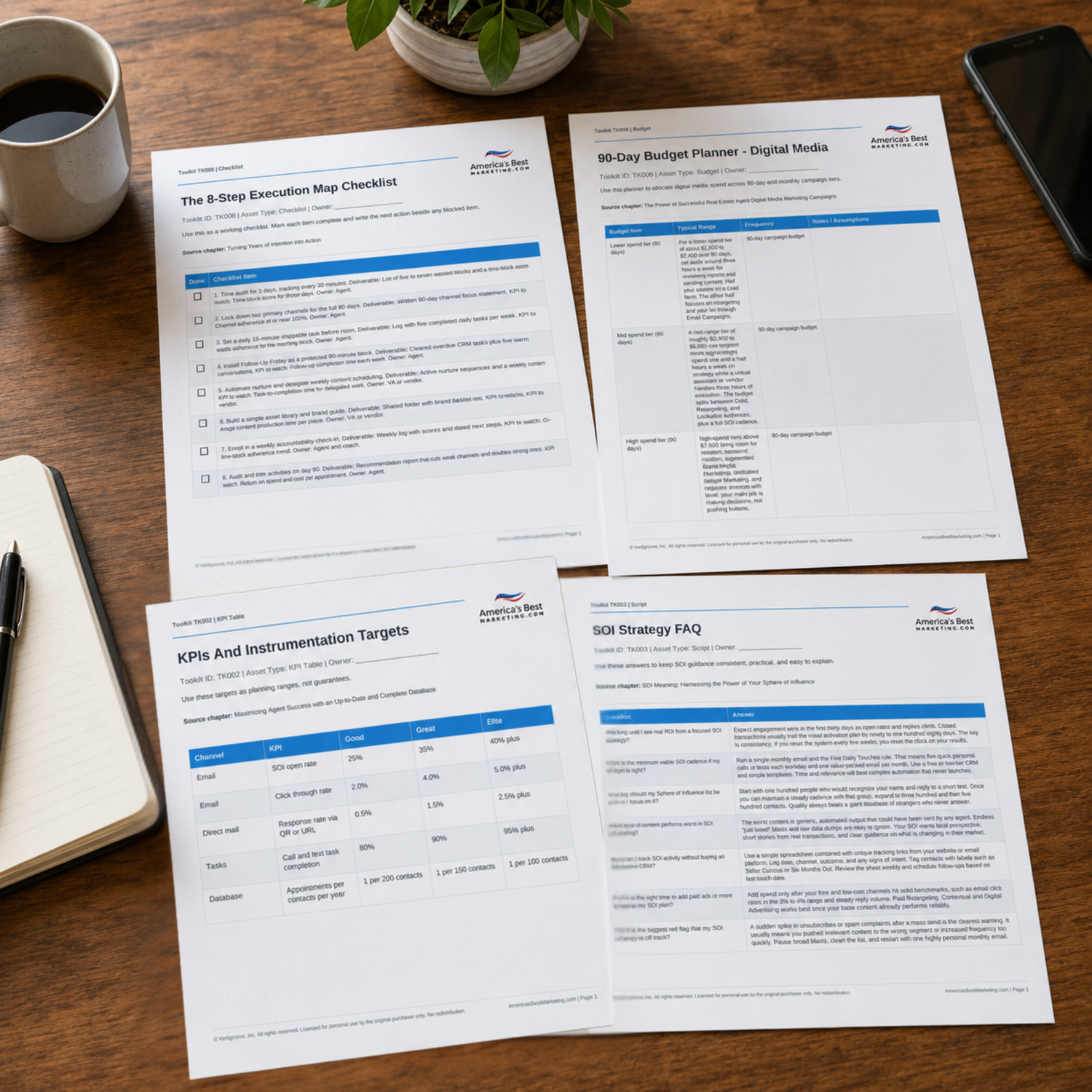
Download The Real Estate Marketing Plan Toolkit
Use the companion Toolkit to organize the first thirty days, the ninety day launchpad, channel messaging, production plans, KPI tracking, and the weekly review rhythm.
Download the Toolkit ZIPRecommended reads
Recommended Reads for Real Estate Agents
These articles help agents connect follow-up discipline, database habits, client communication, and marketing execution into a repeatable system.

Best Real Estate Marketing Ideas: 15 Innovative Strategies to Attract More Clients
Use real estate marketing ideas to strengthen visibility, follow-up, and client conversations without adding more random tasks.
Read article
HOA Navigation for Real Estate Agents: Red Flags, Document Requests, and Buyer Scripts
Give hoa navigation a clearer role in the marketing system instead of treating the work as a one-off idea.
Read article
Real Estate Agent Video Marketing: Boost Conversions and Engage Clients with Effective Videos
Create video content with clearer scripts, simpler formats, and a cadence agents can actually maintain.
Read article
Proven Real Estate Marketing Strategies: A 30 Day Plan for More Leads and Sales
Bring more structure to real estate marketing strategies so every touchpoint supports visibility and trust.
Read articleReal Estate Marketing Questions Agents Ask Most
How long does it usually take to see measurable return from this type of plan?
Most agents start to see clearer signals within sixty to ninety days. Early wins show up as higher open rates, more replies, more site visits, and more casual conversations from their sphere. New listings often follow in later cycles as trust compounds. The key is to keep the cadence steady instead of judging the plan by one quiet week.
What is the minimum viable cadence if my budget is tight?
Protect cadence before polish. Aim for one useful email per month to your sphere, three social posts per week, and one direct mail piece per quarter to a small farm. Focus any paid spend on remarketing to people who already visited your site. That pattern beats bigger spend that starts and stops.
How big should my target audience or farm be for this to work?
Most solo agents do best with a farm of five hundred to one thousand homes plus a sphere list of a few hundred contacts. That size is large enough to produce real deals and small enough to reach on a regular schedule. Choose an area where you already have traction or relationships so your message feels rooted.
What type of content usually performs worst for real estate agents?
Pure self-promotion without context tends to fall flat. Long market rants, generic slogans, and dense text graphics usually earn low engagement. Content that ignores local life or real homeowner questions also struggles. The strongest posts speak to specific moments like upsizing, downsizing, first investment purchases, or listing preparation in your actual market.
How can I track results if I do not use advanced tools or dashboards?
Start with a simple sheet. Each week, log email open rate, link clicks, social reach, comments, saves, site visits, new form fills, calls, and listing appointments. Add a short note about which message produced each response. Over a few months, patterns emerge that show which channels move people toward conversations.
When should I increase my marketing spend or move to a higher tier plan?
Scale spend after your system shows steady response at a small level. If open rates, replies, site visits, and inquiry volume stay strong for several cycles and you can handle more conversations, raise spend in small steps. Add budget to the channel that already converts well instead of chasing a new tactic every month.
What is the major red flag that tells me my marketing plan is off track?
The biggest red flag is silence. If your list never replies, your farm never calls, and nobody mentions seeing your content, something is broken. Check cadence first, then check message clarity and audience fit. Strong-looking metrics with no human response usually mean the system is showing up in the wrong places.
What is the best marketing for real estate agents on a small budget?
On a lean budget, the best marketing for real estate agents leans hard on owned channels. Focus on an up-to-date site, a clean email list, and a simple social plan that reuses the same assets. Add small direct mail drops to a very tight farm. Consistency and relevance beat volume at low spend levels.
Next step
Build The Strategy Or Hand Off The Execution
Continue from one useful article into the larger ABM ecosystem: the book series for strategic depth and the full marketing program for done-for-you execution.

View the Book Series
Explore the America’s Best Real Estate Agent Marketing System books for a deeper strategic framework around visibility, referrals, listings, lead generation, and growth.
View the Book Series
See Full Marketing Program
See how AmericasBestMarketing.com runs real estate blog writing, social media, listing marketing, email, direct mail, and retargeting as one managed system.
See Full Marketing Program