The Tactical Real Estate Agent First 90 Days Plan: Launching with Consistency and Systems
Real Estate Agent First 90 Days Plan
Launching with Consistency and Systems
A tactical first-quarter operating plan for agents who want to activate their sphere, install repeatable marketing, create measurable conversations, and avoid busywork.

What a strong first 90 days plan includes
A strong real estate agent first 90 days plan has three phases. Days one through thirty build the database, budget, brand basics, and outreach rhythm. Days thirty-one through sixty create visible market activity through useful content, open houses, email, social media, and direct mail. Days sixty-one through ninety concentrate time on warm follow-up, consultations, listing preparation, and weekly KPI review so activity becomes pipeline.
- Treat the first quarter as a business launch with daily outreach, weekly marketing, and a measurable operating rhythm.
- Build and tag a sphere database before spending heavily on cold lead generation.
- Use helpful local information and client education instead of announcing that you are new or asking broadly for business.
- Measure contacts, conversations, follow-ups, consultations, and signed clients before judging the plan by closed commission.
Why The First 90 Days Determine Your Operating Standard
A strong first-quarter plan separates agents who are building a real business from agents who are waiting for the phone to ring. The first group installs a CRM, activates its sphere, publishes useful market content, runs open houses, and follows a weekly scorecard. The second group stays busy with training, branding decisions, and scattered posts while the pipeline remains thin.
The central mistake is treating education as the business. Contracts, scripts, and brokerage training matter, yet they do not replace conversations. For the first ninety days, roughly eighty percent of your work hours should support marketing, lead generation, follow-up, and appointments. The remaining twenty percent can support education and transaction preparation. Once the pipeline matures, client interaction should claim more of the calendar.
Agents who already follow the habits inside Five Client-Winning Habits can use this plan to turn those habits into a launch system. The objective is not to look busy. The objective is to create a repeatable chain from contact to conversation, from conversation to consultation, and from consultation to client.
- You reduce the income gap by creating more real conversations before confidence fades.
- You build a database and follow-up discipline that compounds after the first quarter.
- You create visible proof that friends, neighbors, and future clients can remember and refer.
The Three-Phase Real Estate Agent First 90 Days Plan
Build the quarter in three phases instead of treating ninety days as one long task list. Each phase has a distinct operating priority, a measurable finish line, and a clear handoff to the next phase.
Build the base
Finalize a simple business plan with an income target, brokerage split, operating expenses, primary lead sources, and a realistic marketing budget.
Set up the CRM, import at least two hundred sphere contacts whenever possible, clean phone and email fields, and tag each contact by relationship and readiness.
Launch a thirty-day announcement sequence using calls, weekly email, social posts, and a simple invitation for coffee or a short market review.
Create visibility
Run open houses whenever inventory and brokerage access allow, then follow up the same day with every visitor.
Publish useful market updates and client education through Social Media Marketing and Email Marketing.
Add a focused geographic farm using Direct Mail Marketing and one simple lead magnet such as a home value review or buyer path checklist.
Convert momentum
Shift more time toward consultations, warm leads, listing preparation, open house follow-up, and offers connected to a specific need.
Use Digital Retargeting to stay visible to warm website visitors and engaged audiences instead of relying only on cold traffic.
Review the KPI scorecard every week, refine the talk tracks that create appointments, and prepare a complete listing marketing campaign before the first sign reaches the yard.
New agents often polish logos while the CRM remains empty. The leverage comes from how many real people you log, tag, contact, and help each week. When branding work starts to expand, ask one harder question: how many live contacts did I add or follow up with today?
Three Failure Modes That Empty The Pipeline
Most first-quarter failures are not caused by a lack of ambition. They come from a system that makes activity feel productive without creating enough conversations or follow-up.
DIY marketing overload
You try to plan, design, write, post, and measure every asset by hand. The result is inconsistent publishing, decision fatigue, and less time for conversations.
Delegate repeatable execution through managed social media and email so your feeds and inbox stay active while you work the database.
A silent sphere
Friends and family know you changed careers but never receive a clear explanation of how you can help or what kind of introduction would be useful.
Use a structured announcement sequence with calls, one useful email each week, a branded mailer, and a low-pressure invitation for a market conversation.
Activity without strategy
You spend hours in training or on social platforms but cannot connect the time to contacts, consultations, or appointments.
Set daily activity targets, tag every lead source, and review the numbers during a weekly Coaching and Consulting session.
Messaging That Makes A New Agent Sound Useful
Your first-quarter message should sound like a trusted local guide, not a hungry salesperson. Do not lead with being new. Lead with market insight, useful checklists, or a short story about how clients can avoid regret, delay, or unnecessary cost. Specificity creates authority faster than broad claims.
Treat calls to action as a ladder. Soft calls invite someone to save a checklist or request a guide. Mid-level calls invite a short market review or fifteen-minute planning conversation. Strong calls invite a listing consultation or private tour based on a specific property or need.
Teach one decision
Subject line: The one thing missing from most home inspection checklists.
Explain the issue in plain language, give one action, and invite the reader to reply with a question or address.
Make local movement visible
Headline: What changed in your neighborhood market this month.
Show one meaningful price, inventory, or timing shift and explain what it means for owners who may sell within the next year.
Translate a costly tradeoff
Caption: The true cost of waiting to move.
Use a simple comparison to explain how timing can affect payment, equity, or available choices without making a prediction you cannot support.
Reduce uncertainty
Offer: A neighborhood zoning and future projects guide.
Help buyers understand what may change near a home and invite them to request a short list of questions to ask before making an offer.
Warm prospects can move from educational content to listings and neighborhood research on IDX Real Estate Websites. The website should support the conversation, capture intent, and give retargeting audiences a useful next step.
Three Outreach Scripts For The First 90 Days
Use these as structures, not performances. Keep the language natural, connect each message to a real next action, and log the outcome in the CRM before moving to the next contact.
The sphere launch call that feels natural
Agent dialogue
Hook lineI wanted to share some news and make sure you hear it from me, not from a social post.
Value lineI launched my real estate business with a focus on helping people plan moves with less stress and clearer numbers.
Offer lineIf you have questions about the market or know someone who does, I will gladly be a resource with no pressure.
Soft closeIs there anyone in your world who may be thinking about a move in the next year that I should keep an eye on for you?
Open the CRM record before dialing, note one personal detail, decide the next action, and reserve thirty minutes after the call block for follow-up texts.
The market update email that builds authority
Email body structure
Hook lineMost owners in our area are asking the same question about prices and timing.
Problem lineNational headlines rarely explain what is happening in one specific neighborhood.
Solution lineI pulled a short summary of local sales and what the numbers may mean if you plan to buy or sell.
CTA lineReply with your address and the word review, and I will send a custom snapshot for your home.
Send through Email Marketing, tag every reply, and record the lead source so list performance becomes measurable.
The open house follow-up that converts
Text or call structure
Hook lineThanks again for stopping by the open house earlier.
Context lineI like to make sure visitors receive more value than a quick walk-through and a flyer.
Question lineAre you still in research mode, or do you have a timeline in mind for a possible move?
CTA lineI can send a short list of similar homes plus one or two options that are often missed by broad portals.
Use digital sign-in, send the thank-you the same day, tag the move timeline, and place warm visitors into a nurture sequence such as Real Estate Drip Campaigns That Actually Convert.
Production Plans And KPIs You Can Repeat
Your first ninety days should track activity and response before commission. The lagging signal is a closed transaction. The leading signals are contacts added, conversations completed, follow-ups made, consultations set, and clients signed.
Budget is only useful when it protects consistency. One agent may begin lean and contribute more personal time. Another may spend more to delegate content, email, mail, and reporting so live conversations receive most of the calendar.
Use a lean budget for a CRM, weekly email, consistent social publishing, and basic coaching. Block one focused hour each week to review numbers, confirm the next campaign, and protect the follow-up rhythm.
Delegate social media, email, direct mail, listing support, and retargeting as one coordinated system. Use two ninety-minute blocks each week for lead review, CRM cleanup, consultations, and task assignment.
| Tier | Main Focus | Monthly Spend | How It Supports The Launch |
|---|---|---|---|
| Foundation tier | Cover core basics | $500 to $1,000 | Funds a simple mix of email, social scheduling, CRM discipline, and coaching so visibility continues while the agent learns the craft. |
| Consistency tier | Increase visibility | $1,500 to $2,500 | Adds recurring direct mail, stronger listing preparation, and more frequent content so the sphere and farm see the agent every month. |
| Growth tier | Scale lead flow | $3,000 to $5,000 | Supports broader delegation, warm retargeting, and search-driven traffic so more agent time can move toward consultations and client work. |
Treat these ranges as planning tools, not promises. Every dollar should support one of three business outcomes: visibility, follow-up, or appointment creation. Track response by source before shifting spend.
The Business Hygiene Checklist
This checklist keeps the first 90 days measured and predictable. Complete the same operating actions each week so the database and pipeline do not depend on mood.
- Block two hours each workday for calls, texts, follow-up messages, and consultation preparation.
- Log every live conversation in the CRM and attach at least one lead-source tag.
- Review social media engagement once a week and note which topics created replies or direct messages.
- Check email replies and unsubscribes, then remove opted-out contacts from future outreach.
- Prepare the next direct mail list and creative direction by the middle of the current month.
- Role-play one objection or script each week with a peer, mentor, or coach.
- Review consultations set and held, then reset the coming week’s activity targets.
- Refresh major directory profiles, photos, and contact details at least once during the quarter.
- Identify the ten most engaged database contacts and schedule a personal check-in.
- Scan local market statistics and write down one useful insight you can share that day.
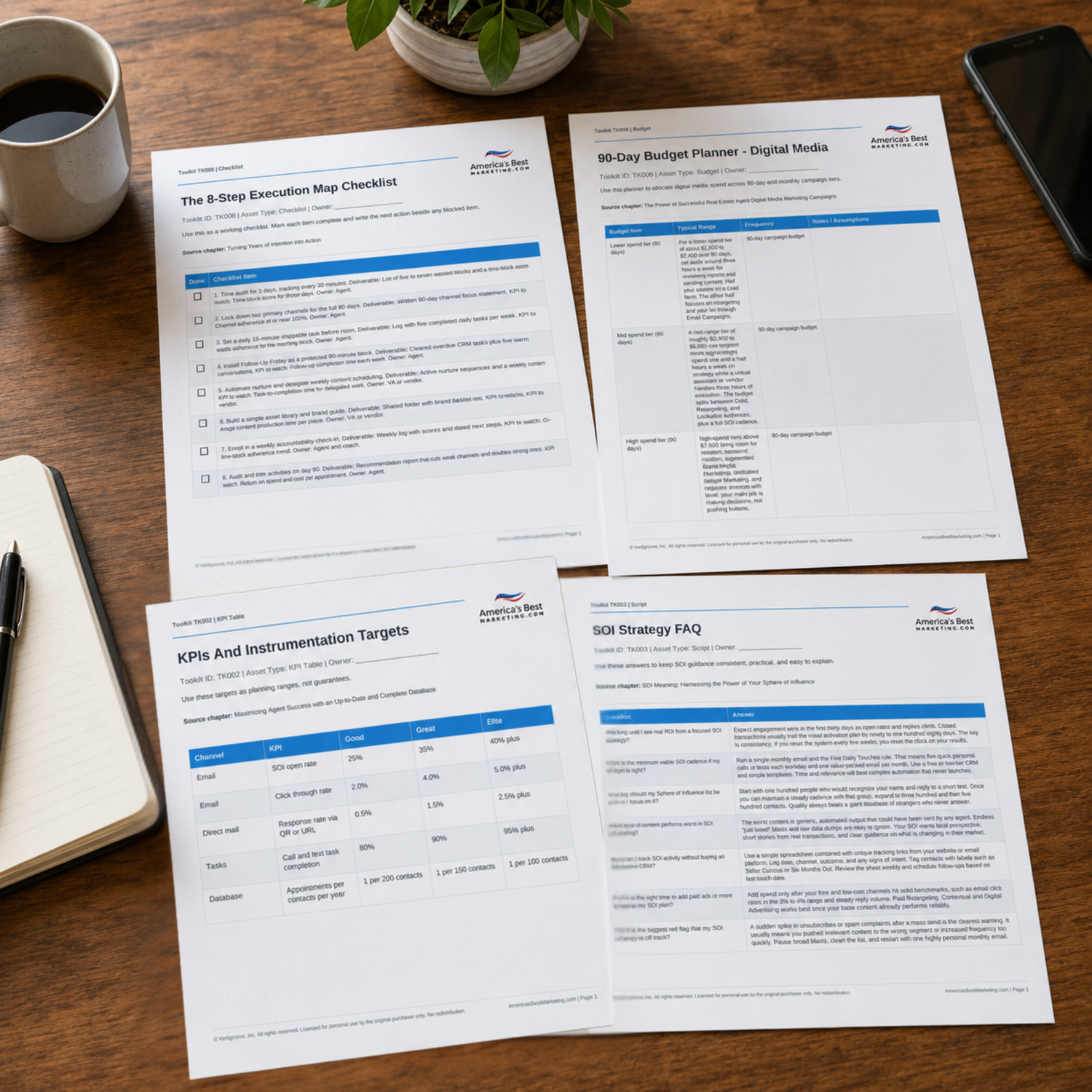
Download The First 90 Days Planning Toolkit
Use the companion Toolkit to organize the three launch phases, weekly outreach, scripts, KPI tracking, budget tiers, open house follow-up, and first-quarter business hygiene.
Download the Toolkit ZIPRecommended reads
Recommended Reads for Real Estate Agents
These articles help agents connect follow-up discipline, database habits, client communication, and marketing execution into a repeatable system.

The 90-Day Multi-Channel Plan for New Agents
Make the 90-day multi-channel plan for new agents easier to plan, publish, and measure as part of a weekly marketing rhythm.
Read article
How to Choose the Right Real Estate Agent
Make “How to choose the right real estate agent” more useful by turning the topic into a clear buyer-and-seller education resource with a defined audience, message, and next step.
Read article
Live Streaming Q&As for Real Estate Agents: Topics, Scripts, and Promotion Plan
Create video content with clearer scripts, simpler formats, and a cadence agents can actually maintain.
Read article
Business Growth Strategy for Real Estate Agents
Use business growth planning to strengthen visibility, follow-up, and client conversations without adding more random tasks.
Read articleFirst 90 Days Questions New Agents Should Be Ready To Answer
How long should I wait to see measurable return from this launch plan?
Expect the first ninety days to deliver momentum, not instant commission checks. Measure progress through leading signals such as new contacts added, consultations set, and follow-up completed. When your systems and cadence are running at full strength by day ninety, the business has a credible foundation for appointments, contracts, and later closings.
What is the minimum viable cadence if my budget is tight?
Send one useful email each week, make at least five personal calls or texts each workday, and publish three focused social posts each week. Use a basic CRM to record every conversation and next action. The cadence must be simple enough to maintain for the entire quarter, not just during the first enthusiastic week.
How large should my target sphere or farm be in the first ninety days?
Start with a sphere of at least two hundred real contacts whenever possible. For a geographic farm, choose a focused area of roughly five hundred to one thousand households where you can commit to consistent monthly touches for a full year. Depth and repetition matter more than choosing the largest possible audience.
What content tends to perform worst for new real estate agents?
Pure self-promotion usually falls flat. Generic announcements, vague market tips, poor listing photos, and posts that only say you are available give people little reason to respond. Specific local data, clear checklists, useful explanations, and short client-centered stories create stronger authority.
How can I track results without advanced tools?
Ask every new contact what prompted the conversation and record the answer in a spreadsheet or CRM lead-source field. Track contacts added, conversations, follow-ups, consultations set, consultations held, and signed clients. Review the same numbers every week so trends become visible before commission arrives.
When should I scale marketing spend beyond the starter tier?
Hold a consistent channel mix long enough to evaluate it, usually at least ninety days. Increase spend after a specific combination such as sphere email, open houses, direct mail, and retargeting repeatedly creates qualified conversations. Scaling a measured system is growth. Scaling untracked activity is guesswork.
What is the biggest red flag in a real estate agent first 90 days plan?
The biggest red flag is waiting for confidence, a listing, or a perfect brand before launching. Delay creates a longer income gap and more pressure. Start with clear messages, a clean database, daily outreach, and a weekly review rhythm, then improve the assets as real conversations reveal what clients need.
Next step
Build The System Behind The First Quarter
Continue from one tactical plan into the larger America’s Best Marketing ecosystem: the book series for strategic depth and the full marketing program for done-for-you execution.

View the Book Series
Explore the America’s Best Real Estate Agent Marketing System books for a deeper strategic framework around visibility, referrals, listings, lead generation, and growth.
View the Book Series
See Full Marketing Program
See how AmericasBestMarketing.com runs real estate blog writing, social media, listing marketing, email, direct mail, and retargeting as one managed system.
See Full Marketing Program