Tips for Taking Professional Real Estate Photos: The Agent’s Production Playbook
Tips for Taking Professional Real Estate Photos
The Agent’s Production Playbook
A production-style workflow for agents who want listing visuals to prep cleanly, shoot consistently, edit honestly, and repurpose across every marketing channel.

How should agents take professional real estate photos?
Agents should treat listing photography like a production system, not a last-minute errand. Prep the set, control light, follow a fixed shot list, edit for honest color and straight verticals, then repurpose the best frames across listing pages, social media, email, direct mail, and retargeting. The goal is not more photos. The goal is a repeatable visual standard that makes every listing feel intentional.
- Professional real estate photos come from controlled prep, lighting, composition, and sequencing more than expensive gear.
- A shot list turns a property into a usable asset library instead of a random pile of room photos.
- Editing should correct exposure, color, and vertical lines without changing the truth of the property.
- The strongest agents repurpose listing photos into a full week of marketing across the channels buyers and sellers already watch.
Foundations That Make Listing Photos Feel Expensive
If your listing photos feel random, your marketing will feel random too. A clean photo workflow gives every property a deliberate visual story, which is the same standard behind The Power of High-Quality Marketing Design vs. Static and Dated.
Run the listing like a movie set. You are the director, the home is the set, and the buyer is the viewer deciding whether the next image is worth their attention. The first frame should sell the feeling of the home. The supporting frames should prove the facts.
That distinction matters. Visual storytelling answers what it would feel like to live there. Documentary photography answers what exists there. You need both, but the opening image should create the click before the rest of the gallery earns trust.
- Lighting: Golden hour is the easiest free upgrade. Shoot exteriors close to sunrise or sunset so the home looks warm and dimensional.
- Composition: Use the rule of thirds so the viewer’s eye lands on the feature you want, not on a ceiling fan or random chair.
- Perspective control: Keep vertical lines vertical. A leaning doorway reads like a rushed process, even if the house is strong.
- Page speed: Export images at web-friendly sizes so pages built for IDX Real Estate Websites do not feel slow.
Most bad photos are not camera problems. They are production problems. Clutter, mixed bulbs, tilted frames, blown windows, and repeated angles create distrust long before a buyer reads the property description.
Prep Like a Director and the Shoot Gets Easy
Great shoots start before you open your camera app. The missing production tool is a call sheet, which is a one-page plan that tells you what to shoot, when to shoot it, and what must be ready before the first frame.
Start with a ten-minute set walk and build your shot list in the order you will shoot. That keeps you from bouncing around, losing light, and missing the money angles. You are collecting dailies, meaning clean, consistent, labeled assets you can publish without guesswork.
Clear the frame before you shoot
Clear counters, cords, shampoo bottles, pet bowls, fridge magnets, loose clothing, and personal names. If it pulls the eye, it steals the scene.
Nudge chairs, straighten rugs, square bedding, align pillows, and match window blinds. Small alignment reads like quality.
Control the room before the edit
Turn on flattering practical lights and turn off harsh overheads that flatten the room. Match bulb color where possible so walls do not shift from blue to orange.
Shoot interiors when window light is even. If the room still feels dark, add light on set instead of trying to rescue everything later.
Know what you can publish
Use photography you created or have licensed. If a third party shot the images, confirm usage rights before you publish them to your site, social feeds, postcards, or ads.
Never treat a beautiful image as usable just because it was shared with you. Rights problems are production problems too.
The hero shot is a psychological hook, not a property diagram. A twilight fire pit, a clean kitchen detail, or a warm entry can create a stronger first click than another standard front exterior. Ask one question on every shoot: what single image makes someone want the next image?
The Visual Workflow That Turns One Shoot Into Marketing
Think in four stages. Stage one creates clean raw material. Stage two makes it publishable. Stage three ships it into the listing stack. Stage four turns one shoot into content that keeps working after the gallery is live.
The shoot
Use a phone or camera, wide lens attachment if needed, microfiber cloth, small tripod, spare battery, and a clip-on light for dark corners.
Capture the essential sequence: front hero, entry, main living, kitchen wide, kitchen detail, dining, primary suite, baths, secondary rooms, laundry or mudroom, backyard wide, backyard lifestyle, and one neighborhood feel frame.
The edit
Correct white balance, vertical alignment, exposure, and crop. Do not remove permanent flaws, fake views, warp room size, or edit anything a buyer would feel misled by at the showing.
Use sky replacement sparingly and keep it believable for the location, season, and light direction. Trust is worth more than drama.
The post
Package the visuals so they load fast, read clean, and convert interest into inquiries. This is where Listing Marketing becomes a system instead of a one-off upload.
Lead with lifestyle, prove with wide shots, then close with hidden value such as storage, garage, outdoor living, and neighborhood context.
The repurpose
Use five hero frames as quick cuts in a short video, a carousel sequence, a neighborhood postcard, and an email feature. Pair the rhythm with Social Media Marketing and Direct Mail Marketing.
The work stays the same, but the distribution multiplies. That is the leverage point.
On your own site, speed matters. If your gallery is heavy, your page feels slow. If your sequence repeats the same room three times, the buyer feels fatigue. A better order creates a better browsing experience and gives your follow-up channels better assets to reuse.
Captions, Calls To Action, and Compliance
Your photos are the film. Your captions are the trailer. The caption should match the image, make one clear point, and end with a simple next step. Avoid inflated language. Say what is real, show what is real, and let the visuals carry the emotion.
Headline patterns work best when they make the viewer choose a side. They either agree and keep reading, or they disagree and keep reading. Either way, you earn attention.
- The five photos every premium listing should include.
- Why phone photos quietly cost agents listing credibility.
- The one angle sellers notice before they read the description.
- How to make small rooms look honest and stronger on screen.
- When twilight photography is worth the extra production step.
Match the ask to the audience. A cold viewer may need a soft next step. A warm seller may be ready for a stronger one. The same image set can support a downloadable prep checklist, a visual content training, an Email Marketing for Real Estate Agents feature, or a consultation CTA.
| Asset | Best use | Typical cost range | Lifespan |
|---|---|---|---|
| Pro photos | Core listing gallery | $250 to $800 per listing shoot | Use for the full listing run and future seller proof. |
| Drone video | Lot and location context | $300 to $900 per drone video or listing package | Best for acreage, views, and properties where setting drives value. |
| 3D tour | Remote screening | $200 to $600 per property tour | Useful until the home sells, then reusable as seller case-study proof. |
Photos must accurately represent the property. Clean up clutter and correct color, but do not remove permanent structural flaws. Your goal is trust, and trust is the asset that gets you referrals.
The 12-Item Shoot Day Audit
Run this like a pre-flight checklist. If the set is not ready, do not shoot. Fix the set, then roll camera.
- Toilets closed and counters cleared in every bath.
- All personal photos and names removed from view.
- Trash cans, pet bowls, and cords hidden.
- Window blinds matched and pulled to the same height.
- Lights set to a consistent color and turned on where flattering.
- Ceiling fans off unless the room needs airflow for comfort.
- Bed made tight with aligned pillows and no loose clothing.
- Kitchen sink empty, dish soap removed, towels folded clean.
- Chairs squared and rugs straightened to the room.
- Exterior entry cleared and doormat placed straight.
- One lifestyle prop set where true, such as a table setting or fire feature.
- Lens cleaned and verticals checked before the first frame.
How This Becomes Managed Marketing
A visual production system is more than a listing aid. It is a positioning asset. It gives you a credible reason to talk about seller preparation, visual standards, neighborhood reach, and buyer attention before a prospect asks how you market homes.
Use the photo workflow as a recurring theme inside Real Estate Blog Writing Services, social content, listing campaigns, database emails, direct mail, and digital retargeting. The more consistent the visual language becomes, the more your brand feels like a studio rather than a solo task list.
Want your listings to look like a studio runs them and publish like clockwork? Build your visual production into a full multi-channel system with the done-for-you marketing program for real estate agents at AmericasBestMarketing.com.
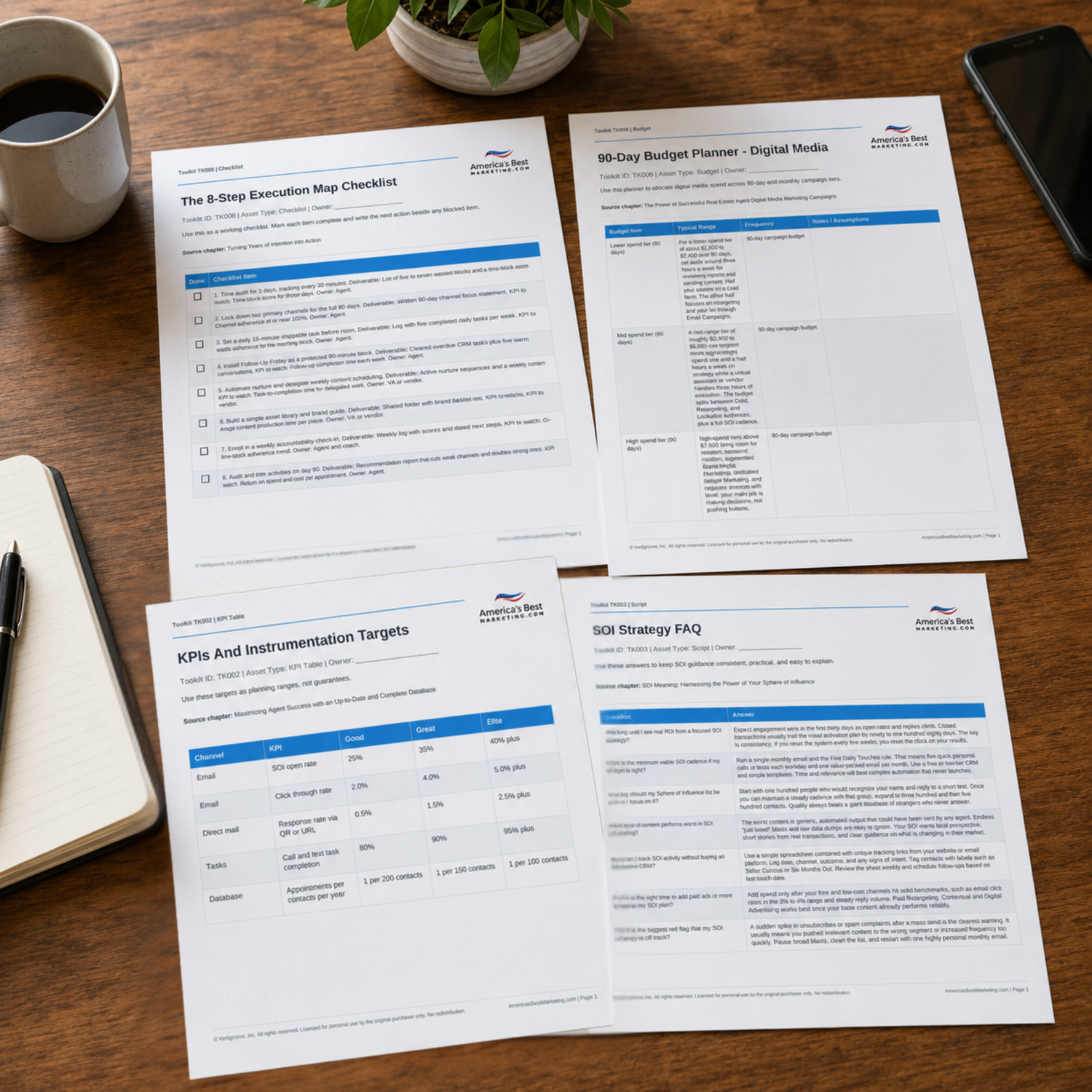
Download The Real Estate Photo Workflow Toolkit
Use the companion Toolkit to tighten your shoot-day audit, visual asset cost and lifespan guide, real estate photography FAQ script, and repurposing workflow before your next listing shoot.
Download the Toolkit ZIPRecommended reads
Recommended Reads for Real Estate Agents
These articles help agents connect listing visibility, seller education, marketing channels, and follow-up into a clearer growth system.

"Before & After" Content for Real Estate Agents: Photo + Copy Frameworks That Convert
Make listing promotion feel planned instead of improvised, from pre-market to post-sale follow-up.
Read article
Hyper-Local Content Kit for Real Estate Agents: Parks, Events, Map Posts
Turn local knowledge into searchable content buyers, sellers, and relocation prospects can actually use.
Read article
Google Business Page Photos, Posts & Q&A: A 30-Minute Weekly Routine
Turn google business page photos, posts and qanda into a steady operating habit, not another item that waits for a quiet week.
Read article
How to Choose the Right Marketing Company for Real Estate Agents
Use choose the right marketing company to strengthen visibility, follow-up, and client conversations without adding more random tasks.
Read articleReal Estate Photo Questions Agents Should Be Ready To Answer
Is it better to use a phone or a professional camera for real estate?
A phone is fine if you control light and keep lines straight. The bigger gap is process, not gear. Use window light, keep the camera level, and shoot a consistent sequence. A dedicated camera can help in low light, but it will not fix clutter, mixed bulb colors, or sloppy composition. If you can only improve one thing, improve your shot list and your prep.
What time of day is best for real estate photography?
For exteriors, golden hour near sunrise or sunset is the easiest quality boost. For interiors, shoot when window light is even and not blasting through one side of the room. Midday sun can create harsh contrast and blown windows. If the schedule forces midday, close blinds slightly, turn on balanced lights, and prioritize rooms with softer light first.
How many photos should a real estate listing have?
Ship enough to cover the full story without repeating angles. A common range is 25 to 45 images for an average home, with fewer for small condos and more for large properties. Lead with lifestyle and primary spaces, then prove with bedrooms, baths, storage, and outdoor living. Avoid five versions of the same wide shot. Variety builds trust faster than volume.
What is the major red flag to avoid in photo editing?
The major red flag is editing that changes reality in a way a buyer would feel misled by in person. Do not remove permanent flaws, do not warp room sizes, and do not fake views. Correct color, straighten verticals, and balance exposure. Keep skies believable if you replace them. Your photos are a trust contract. Breaking that contract costs you reputation and referrals.
How do I avoid dark rooms and blown-out windows without gimmicks?
Start with better light on set. Open doors, turn on flattering lamps, and shoot from positions that reduce direct glare into the lens. Keep the camera level and expose for the room, then lift shadows gently in editing. If windows are still blown, the fix is usually adding light next time, not pushing extreme edits. The goal is a natural look buyers recognize.
What is the fastest way to turn one photo shoot into a full week of content?
Pick five hero frames and assign them jobs. One becomes your listing lead image, one becomes a carousel cover, one becomes a postcard hero, one becomes a detail close-up post, and one becomes a neighborhood feel story. Write one caption template and swap the feature lines. This turns dailies into distribution. The work stays the same, but the output multiplies.
Next step
Build the System Behind the Advice
Continue from one useful article into the larger ABM ecosystem: the book series for strategic depth and the full marketing program for done-for-you execution.

View the Book Series
Explore the America’s Best Real Estate Agent Marketing System books for a deeper strategic framework around visibility, referrals, listings, lead generation, and growth.
View the Book Series
See Full Marketing Program
See how AmericasBestMarketing.com runs real estate blog writing, social media, listing marketing, email, direct mail, and retargeting as one managed system.
See Full Marketing Program