Agent Branding: Crafting Your Unique Identity to Stand Out and Attract Clients
Real Estate Agent Branding That Clients Remember
Craft Your Unique Identity To Stand Out And Attract Clients
A practical branding brief for agents who want a clearer niche, a recognizable client promise, and an eight week rollout that turns identity into trust.

What makes a real estate agent brand work
A real estate agent brand works when clients can quickly recognize who the agent serves, what the agent stands for, how the experience feels, and why the process is worth trusting. The logo is only one signal. The operating brand is the repeated promise, tone, visual system, proof, and follow-up experience that make the agent easier to remember and easier to refer.
- A brokerage logo is a trust layer, not a complete personal brand.
- A useful niche gives clients and referral partners simple language they can repeat.
- Website, social, email, print, reviews, and live conversations should reinforce the same promise.
- The first ninety days should be measured through replies, referral language, review language, and better-fit conversations.
Why Real Estate Agent Branding Is A Lead Filter
Most agents do not have a lead problem first. They have a clarity problem. A buyer, seller, past client, or referral partner may know that the agent sells homes, but that fact alone is not memorable. Branding gives people a simple way to understand who the agent helps, where the agent focuses, how the work is handled, and why the process feels different.
The practical objective is to stop competing as one more name in a search result and become the obvious match for a specific client group. When the same message repeats across the website, email, social media, print, and conversations, it creates the mental shortcut described in Repetitive Exposure in Real Estate Marketing: How Consistency Builds Trust, Brand Recognition, and Referrals.
- Your brokerage logo is not your personal brand. It is only one layer of trust.
- Your brand should make your ideal client feel understood before a form is completed.
- Your photos, bio, reviews, emails, and listing materials should support one client promise.
- Your niche should make referral language easier, not make the business feel smaller.
- Your proof should come from client language, repeatable systems, and visible consistency.
Branding works best when it shortens the path from first impression to clear next step. Ask every new lead which touch made them reach out. The pattern will show which messages, reviews, channels, and images are carrying the most trust.
The Eight Week Brand Foundation Build
A strong brand is built in sequence. The order matters because agents often jump to colors, fonts, and headshots before deciding what the market should remember. The plan below works for solo agents and small teams and supports the execution ideas in Building a Personal Brand as a Real Estate Agent: From Your Bio to Your YouTube Channel.
Choose The Market Position
Week one: List three client segments you already serve well, such as move-up sellers, downsizing owners, relocation buyers, first-time buyers, or luxury condo clients. Select one primary segment and write one sentence that states who you serve, where you focus, and what result your process protects.
Week two: Choose three brand traits that match the way clients already describe you. Then create short bio versions for the website, social profiles, email signature, listing presentation, and video introductions.
Align The Visual And Digital Assets
Week three: Gather a current headshot, one market photo, one client-facing working image, and two lifestyle scenes that feel credible for the niche. Replace outdated headshots, random stock images, and mismatched banners.
Week four: Update the About page, service copy, contact paths, and lead capture language so they match the brand promise. Review whether IDX Real Estate Websites can support a stronger branded funnel.
Synchronize Profiles And Content
Week five: Update profile images, banners, bios, featured links, and pinned posts across every public profile. When the ongoing content load becomes a bottleneck, Social Media Marketing support can keep the brand visible.
Week six: Map five blog or email topics that prove expertise for the chosen niche. Each topic should answer a real client question and support local search visibility without drifting from the core promise.
Launch, Audit, And Build Proof
Week seven: Publish the updated bios, refresh signatures, update listing templates, and audit the website, social channels, email, and print against one checklist.
Week eight: Ask recent clients for reviews that describe the strengths future clients should notice. Reuse exact phrases from those reviews in bios, listing packets, email nurture, and social proof sections.
Three Brand Scripts You Can Use Today
Your brand becomes useful when other people can explain it for you. These scripts turn the niche, process, and proof into language that can be repeated on an About page, in a short video, inside lead nurture, or during a referral conversation.
The focused seller origin story
Agent dialogue
Hook lineMost sellers in this city feel lost once they decide to move, so my job is to give them a clear prep, pricing, and launch plan.
Middle lineI focus on move-up families in these school zones and handle each stage from preparation through closing so life can keep moving.
CTA lineIf that sounds like your world, I can walk you through the plan I use with sellers before we ever talk price.
Use this on the About page, in a short homepage video, at the opening of a seller guide, and in referral partner conversations.
The buyer problem-and-solution message
Agent dialogue
Hook lineToo many buyers spend months scrolling listings without a clear way to compare homes.
Build lineMy clients get a simple scorecard so they can weigh commute, payment, repairs, and long-term suitability.
CTA lineThat way they can say yes with confidence instead of guessing from photos and a quick walk-through.
Use this on buyer landing pages, in lead nurture emails, in short educational posts, and during the first consultation.
The review request that strengthens the brand
Agent dialogue
Opening lineThank you for trusting me with the move. Your perspective can help future clients understand what the experience is really like.
Prompt lineWhat did you value most about the way we worked together, especially during the moments that felt complicated?
CTA lineA few honest sentences in your own words would mean a great deal and help another client know what to expect.
Save the exact language clients use. Repeated phrases reveal the traits your market already associates with the brand.
Budget Plans And Brand Metrics You Can Follow
Brand work does not require a massive agency budget, but it does require a clear decision about time, delegation, and consistency. Decide whether you will write and assemble the first version yourself, share the work with a design or copy partner, or stay in strategy while a team executes.
Set aside one hour each week and a small monthly budget for tools, image updates, and templates. Tighten the niche line, update bios, refresh photos you already own, and clean up free profiles. Keep the operating priority on clarity and consistency.
Invest five to eight hours per month and use outside help for design, editing, and light social support. Your job is to approve direction, protect the niche, and confirm that every asset sounds like you and reinforces the same client promise.
Soft calls to action belong on About pages, bios, and educational posts. They invite a low-pressure next step, such as reviewing a guide or asking for a plan. Stronger calls to action belong on valuation, listing, and consultation pages. They should point to one specific action, such as scheduling a pricing conversation or requesting a move strategy.
Ninety Day Brand Investment And Output Table
Treat the ranges below as planning guidance, not promises. The right investment depends on the market, production level, current assets, and the amount of support already available.
| Investment Tier | Monthly Time Focus | Ninety Day Cost | Primary Deliverable |
|---|---|---|---|
| Low tier | You write and assemble every asset. | $0 to $400 | A clear niche line, updated bio set, and one consistent headshot across major channels. |
| Mid tier | You share work with a design and copy partner. | $800 to $2,500 | A visual style guide and three brand-aligned marketing pieces for website, social, and print. |
| High tier | You stay in strategy mode while a team executes. | $3,000 to $7,000 | A full brand system, refreshed website direction, and a ninety day content calendar for the niche. |
Track simple signals before judging the work. Review how many conversations come from referrals, how often leads repeat language from the website or profiles, and whether reviews mention the traits you want to own. Cost per acquisition may improve over time when the brand filters out poor-fit leads and gives better-fit prospects more confidence before contact.
Branding That Respects Rules And Builds Authority
Brand choices still need to respect fair housing standards, local advertising rules, brokerage requirements, and copyright discipline. Avoid language or imagery that suggests a preference for any protected class. Keep promises focused on service quality, preparation, communication, expertise, and process instead of outcomes you cannot control.
Use images, icons, fonts, and templates that you own, license, or access through approved tools. Avoid lifting taglines or visual concepts from other agents. A clean brand should be easy to recognize, easy to trust, and easy to defend.
- Do not use neighborhood descriptions or imagery that imply who should or should not live there.
- Do not promise a sale price, timeline, or transaction outcome that depends on the market or third parties.
- Do not copy another agent’s tagline, design system, or original creative work.
- Do keep brokerage-required disclosures and branding elements accurate and visible.
From Generalist To Referable
A generalist agent who tries to speak to every buyer and seller may look active but remain difficult to describe. A tighter brand changes that. When the agent leads with one clear client segment, updates the bio, refreshes the visual identity, and asks past clients for reviews that mention the same strengths, referral partners gain a simple story they can repeat.
The shift does not prevent the agent from serving other strong referrals. It gives the market a memorable lead story. The agent becomes easier to place in a conversation because the niche, client promise, and proof now work together.
Ninety Day Brand Activation Sprint
Use this sprint to turn the eight week foundation into a visible operating rhythm. The objective is not a one-time reveal. It is consistent recognition across the channels clients actually encounter.
- Month one: finalize the niche statement, three brand traits, core bio, and current image set.
- Month one: align the website, email signature, listing presentation, and public profiles with the same promise.
- Month two: publish five niche-specific educational topics across blog, email, and social.
- Month two: add one low-pressure call to action and one consultation-focused call to action to the appropriate pages.
- Month three: request reviews that describe the process, communication style, and strengths you want future clients to notice.
- Month three: review lead sources, repeated client language, referral quality, and the assets that generated the strongest response.
Strong branding is not vanity. It is a practical system for attracting better-fit people, earning trust faster, and defending value because clients can see the process behind the promise.
How The Brand Becomes A Marketing System
A clear identity becomes valuable when it travels through every client touchpoint. The niche statement shapes website copy. The brand traits shape tone. The image system shapes recognition. Client reviews supply proof. The content calendar keeps the promise visible long enough to become familiar.
Use the same positioning inside Social Media Marketing, Email Marketing for Real Estate Agents, Listing Marketing, and Direct Mail Marketing. Each channel should reinforce the same client promise instead of presenting a different version of the agent.
Brand clarity gets easier when identity, content, and campaigns are managed as one system. AmericasBestMarketing.com builds multi-channel marketing for real estate agents who want steady branding and practical execution instead of disconnected posts and one-off materials.
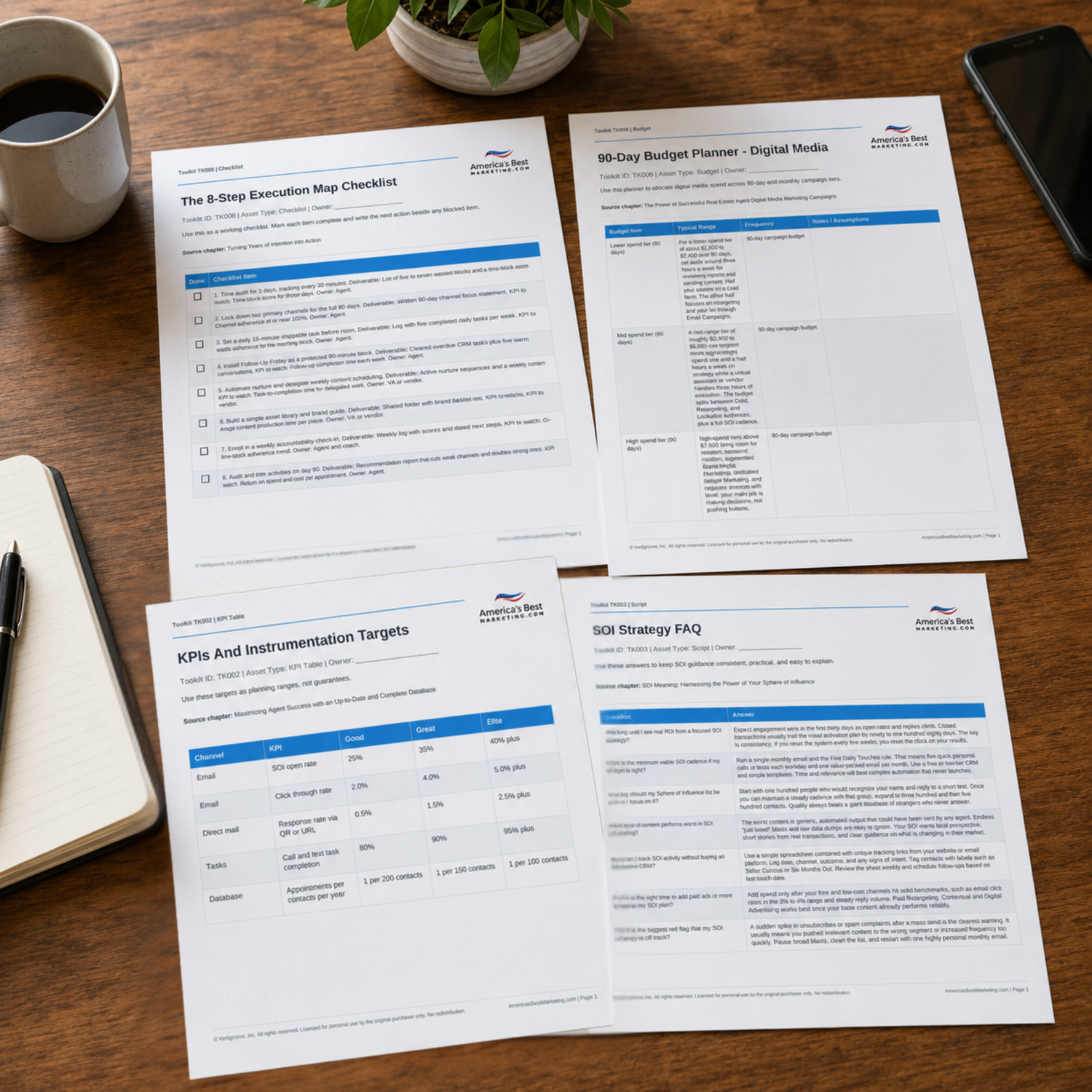
Download The Real Estate Agent Branding Toolkit
Use the companion Toolkit to plan the brand budget, complete the eight week rollout, track ninety day KPIs, collect stronger review language, and adapt reusable brand story scripts.
Download the Toolkit ZIPRecommended reads
Recommended Reads for Real Estate Agents
These articles help agents connect marketing strategy, content, visibility, and follow-up into a more consistent growth system.

What Makes a Real Estate Agent Memorable? Branding Psychology Explained
Turn personal brand work into a system clients can notice, remember, and trust.
Read article
Impactful Real Estate Agent Branding and Logo Development
Make the agent’s brand easier to recognize through clearer positioning, touchpoints, and proof.
Read article
Blog Topic: Real Estate Agent Brand Kit: Fonts, Colors, and Post Styles That Signal “Pro”
Clarify the message, visuals, and client experience that make an agent feel distinctive.
Read article
How to Handle Difficult Clients and De-escalate Situations
Use handle difficult clients and de-escalate situations to create a stronger bridge between client education and real conversations.
Read articleReal Estate Agent Branding Questions
How long should I wait to see results from new branding work
Plan on a ninety day window for the first clear signals. Early signs show up in warmer replies, better profile engagement, more specific review language, and easier referral conversations. Closed volume and fee strength usually take longer because they depend on pipeline timing.
What is the biggest red flag that my branding is not working
The strongest warning sign is that new leads cannot repeat what you do differently after the first call. If people describe you only as friendly or helpful, your brand is too generic. A healthy brand produces specific language about your niche, process, market, or client experience.
What is the minimum branding cadence if my budget is tight
Keep one monthly public rhythm and one weekly behind the scenes rhythm. Public touches can include a fresh post, a short email, or a neighborhood note. Behind the scenes work can include review requests, bio updates, and content outlines.
How can I choose a niche without killing my other business
Think of your niche as the story you lead with, not a wall that blocks every other client. Choose a segment where you already have proof and where you want more momentum. You can still serve strong referrals outside that lane while your public message becomes easier to understand.
Should I build my brand around my name or a team name
Use your personal name if you are the clear face of the business and plan to stay that way for years. Use a team name if you are building a group that should outlive one producer. Either way, the promise and visual language must stay consistent.
How do I track client perception without complex surveys
Ask one question at the end of every successful transaction: what did you value most about the way we worked together? Save the exact words in a simple document. Repeated phrases become the raw material for bios, taglines, scripts, and testimonial summaries.
Next step
Build The System Behind The Brand
Continue from one useful article into the larger ABM ecosystem: the book series for strategic depth and the full marketing program for done-for-you execution.

View the Book Series
Explore the America’s Best Real Estate Agent Marketing System books for a deeper strategic framework around visibility, referrals, listings, lead generation, and growth.
View the Book Series
See Full Marketing Program
See how AmericasBestMarketing.com runs real estate blog writing, social media, listing marketing, email, direct mail, and retargeting as one managed system.
See Full Marketing Program