The Power of Successful Real Estate Agent Social Media Campaigns
Successful Real Estate Social Media Campaigns
A 12-week campaign system for agents who want better leads, cleaner follow-up, and stronger local recall
Use local storytelling, one clear offer, KPI tracking, and repeatable scripts to turn posting into a campaign that creates qualified conversations instead of vanity metrics.

How real estate social media campaigns create better leads
Real Estate Social Media Campaigns work when every post has a defined audience, a local point of view, a clear offer, and a follow-up path. The strongest agents stop treating social media as a notice board and start running 12-week sprints that combine local storytelling, listing visibility, retargeting, email follow-up, and KPI review.
- Random posting creates activity. A campaign creates a sequence of planned touches around one audience and one business objective.
- A 12-week sprint gives agents enough runway to test hooks, rotate content pillars, identify winning posts, and retarget interested viewers.
- The best campaigns connect social posts to one destination, such as a guide, valuation request, private tour page, or local market resource.
- Social metrics matter only when they are connected to qualified conversations, appointments, database growth, and follow-up visibility.
Why Campaigns Beat Random Posting
Most agents treat social media like a digital corkboard. One new listing appears, then an open house flyer, then a closing photo, then silence. The feed may look active in bursts, but it does not teach the market what the agent is known for or why a buyer, seller, or past client should respond now.
A campaign changes the economics of attention. Instead of asking one post to do everything, the agent builds a connected series of touches. Market updates create authority. Local spotlights create familiarity. Listing content shows execution. Client proof reduces perceived risk. Clear calls to action move the right people from passive viewing to direct conversation.
That structure matters because real estate decisions usually form over months. Buyers compare neighborhoods before they ask for showings. Sellers watch price changes before they request valuations. Past clients notice consistency before they send referrals. A planned campaign keeps the agent visible through that full decision window.
Strong Real Estate Social Media Campaigns also pair naturally with other channels. A social post can send visitors to IDX Real Estate Websites, support a seller sequence from Listing Marketing, reinforce a monthly Email Marketing for Real Estate Agents campaign, and build warm audiences for Retargeting.
- Use social media to create recognition before the buyer or seller raises their hand.
- Build campaigns around a market segment, not a vague hope for more engagement.
- Route attention to one next step so every qualified viewer has a path to conversation.
The 12-Week Real Estate Social Media Campaign Framework
A strong campaign works best as a focused sprint. Twelve weeks is long enough to repeat themes, measure response, and amplify what the market actually notices. It is also short enough to prevent the plan from becoming a bloated content calendar that nobody follows.
Start with one niche audience. That audience can be downsizing owners, move-up buyers, condo owners, relocation prospects, luxury sellers, first-time buyers, or past clients in one geographic farm. Then choose three content pillars that match the audience. For this article, the cleanest structure is Market Context, Local Lifestyle, and Client Success.
Audit and setup
Define the campaign audience, review current profiles, tighten bio links, and make sure every platform points to the same offer or destination.
Capture the baseline: reach, profile visits, engagement, website clicks, direct messages, and qualified conversations. Without that baseline, you cannot tell whether the campaign improved anything.
Prepare branded post templates for market updates, local spotlights, listing proof, client proof, and short-form advice so production can move faster once the sprint begins.
Content acceleration
Publish authority content consistently. Use pricing breakdowns, neighborhood tradeoffs, preparation advice, local events, and client stories to teach the market how you think.
Use short video as the anchor format when possible. Video gives agents a practical way to show voice, judgment, local knowledge, and property context without writing a long article every time.
Move design and scheduling into a repeatable workflow. Many agents use Social Media Marketing support so their own time is reserved for approvals, comments, direct messages, and follow-up.
Paid amplification
Identify the strongest organic posts using saves, shares, comments, profile visits, clicks, and direct-message activity. Do not boost weak posts just because they are new.
Put controlled budget behind the winners through Digital Retargeting and focused social amplification. Aim that traffic at one lead destination.
Compare lead quality by location, price band, timeline, and intent. The goal is not cheaper clicks. The goal is more qualified conversations that your follow-up system can actually handle.
Most agents overvalue new followers and undervalue re-engagement from people who already know them. If your Sphere of Influence does not respond to your best local content, the campaign is probably too generic. Move toward neighborhood-specific insight, timely market context, and offers that give people a reason to reply.
Three Campaign Scripts You Can Use This Week
Campaign scripts keep creative production from becoming a weekly scramble. Use these formats for videos, carousels, stories, captions, and email follow-up. Each one has a hook, a local proof point, and a next step.
The fast listing tour
Agent dialogue
Hook lineYou can tour this home in fifteen seconds and decide if it belongs on your short list.
Middle lineWatch the kitchen flow, the storage, the natural light, and the outdoor space because those details are what buyers compare after the first showing.
CTA lineMessage me with the word tour and I will send the full link plus the pricing breakdown.
Use this format for every important listing. Build it into your Listing Marketing process so each property gets social visibility beyond a static flyer.
The seller question post
Agent dialogue
Hook lineSellers in this neighborhood keep asking one question about prices right now.
Build lineHere is how we priced and prepared a home like yours so it attracted serious buyers without a wild list number.
CTA lineSend me your street name and I will build a quick price and timing snapshot for your home.
Pair this post with a valuation landing page, a seller guide, or an email follow-up sequence so the campaign captures demand instead of only collecting comments.
The hidden feature and local gem reel
Agent dialogue
Hook lineMost buyers miss this detail on the first tour even though it can matter over time.
Explain lineWalk with me and you will see why this feature affects comfort, storage, monthly costs, or resale appeal.
Local lineNow add the nearby park, café, trail, school route, or event calendar and the home starts to make more sense.
CTA lineFollow for more hidden details in this neighborhood and message me for a private tour link.
Use this script when you want the content to feel local, advisory, and specific rather than generic property promotion.
Production Plans You Can Repeat
You do not need a studio operation to run a serious Real Estate Social Media Campaign. You need a production rhythm, a campaign owner, and a clean split between agent voice and execution support.
Block two hours each week for approvals, recording, and replies. Publish three high-quality posts weekly across the platforms where your audience is already active. Reserve a small monthly budget to boost one proven post at a time inside your core zip codes.
Block three to four hours each month for strategy and approvals while creation, formatting, and scheduling are delegated. Add retargeting audiences, website traffic, and database traffic once the content themes prove they can earn attention.
The practical win is leverage. The agent should not spend prime appointment hours resizing graphics, rebuilding captions, and guessing what to post. The agent should supply voice, local judgment, listing context, and timely responses. The system should handle packaging, scheduling, measurement, and repetition.
For broader execution, social media should not sit alone. The strongest model connects social posts to Email Campaigns, Direct Mail Marketing, Retargeting, and a managed content plan. That is how a campaign moves from simple visibility into a real follow-up asset.
KPI Table For Social Campaign Decisions
Track the signals that prove whether the campaign is creating a pipeline or just generating impressions. Vanity metrics are not useless, but they need to be interpreted through lead quality and follow-up behavior.
| Campaign Signal | Weekly Review | Decision Trigger | What To Do Next |
|---|---|---|---|
| Engagement quality | Saves, shares, comments, and profile visits | Strong saves or shares on a local topic | Turn the topic into a carousel, short video, email, and retargeting creative. |
| Click-through rate | Bio clicks, story clicks, and landing page visits | Clicks rise but conversations stay flat | Tighten the offer, simplify the page, and make the next step more specific. |
| Qualified lead rate | Leads by location, price band, timeline, and intent | Lead volume rises but fit declines | Narrow the audience, sharpen local references, and remove vague calls to action. |
| Follow-up visibility | Direct messages, email opt-ins, and booked appointments | More conversations arrive than the agent can manage | Move new contacts into a tracked follow-up workflow with reminders and campaign source tags. |
How Views Become Conversations
Every campaign needs one clean destination. That destination can be a home valuation request, a buyer neighborhood guide, a private tour page, a downsizing checklist, or a local market report. The important part is that the audience knows exactly what to do next.
Use tagged links for every bio link, story button, ad, and email call to action. Then review which platform sends the best visitors to your website and which posts produce actual replies. A campaign without tracking eventually becomes a guessing game.
- Give every third post a specific call to action that matches the campaign audience.
- Use one landing page or one direct-message keyword for each sprint so lead source remains clean.
- Connect new conversations to email follow-up quickly so the lead does not disappear after the first click.
- Pull your top five posts each quarter and rebuild them in a new format because proven messages should not stay buried.
Social media should not be judged by whether one post goes big. It should be judged by whether the campaign makes the right people remember the agent, take the next step, and enter a follow-up system that can be managed with discipline.
How This Becomes A Managed Marketing System
A social campaign becomes more valuable when the message repeats across channels. The same neighborhood insight can become a short video, a carousel, a blog introduction, an email opener, a direct mail idea, and a retargeting ad. The market sees one point of view in multiple places instead of disconnected creative.
This is where AmericasBestMarketing.com is built to operate. We help agents turn weekly visibility into a managed system across Social Media Marketing, Listing Marketing, Email Campaigns, Direct Mail, and Digital Retargeting.
The strategic objective is not to make agents look busy online. It is to create enough repeated, useful exposure that prospects already understand the agent’s value before the first serious conversation.
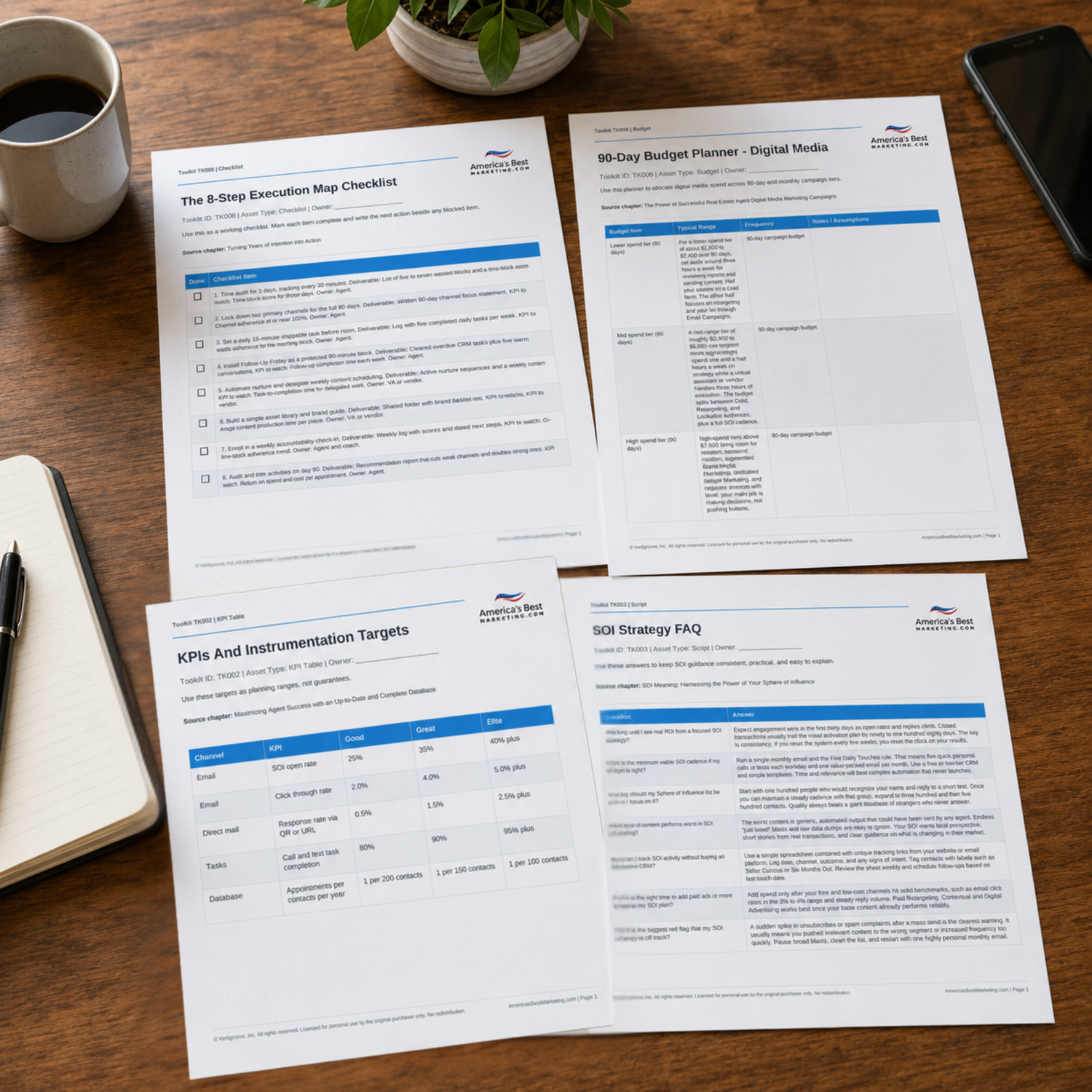
Download The Social Media Campaign Toolkit
Use the companion TK023 Toolkit to plan the 12-week campaign sprint, compare social media investment tiers, review weekly campaign KPIs, and turn listings, seller questions, and neighborhood features into repeatable content scripts.
Download the Toolkit ZIPRecommended reads
Recommended Reads for Real Estate Agents
These articles help agents connect follow-up discipline, database habits, client communication, and marketing execution into a repeatable system.

Social Media vs Multi-Channel Marketing for Agents
Turn social media into a local visibility system instead of a stream of disconnected posts.
Read article
Hyper-Local Content Kit for Real Estate Agents: Parks, Events, Map Posts
Turn local knowledge into searchable content buyers, sellers, and relocation prospects can actually use.
Read article
Proven Social Media Strategies for Agents to Convert Leads and Build Local Authority
Use social posts to support listings, education, trust, and follow-up without starting from scratch.
Read article
Real Estate Agent Social Media Marketing Strategies: What Works, What Doesn’t, and What Actually Attracts Clients
Turn social media into a local visibility system instead of a stream of disconnected posts.
Read articleReal Estate Social Media Campaign Questions Agents Should Be Ready To Answer
How long should I run a Real Estate Social Media Campaign before I expect results?
You can usually see early signals such as engagement, profile visits, saves, shares, comments, and website clicks inside the first month when the campaign is consistent. Closed business takes longer because buyers and sellers move on their own timeline. Treat the first 12 weeks as a sprint for testing audience, content pillars, offers, and follow-up.
What is the minimum posting cadence that still works for busy agents?
Three high-quality posts each week can work when they follow a clear pattern such as a market update, a practical tip, and a local spotlight. Cadence matters more than volume. Random bursts followed by silence make it harder for your audience and the platform to understand what you do.
Which content usually performs worst on agent social media feeds?
The weakest content is generic material that could have been posted by any agent in any city. Pure listing flyers, low-effort shares, and vague motivational posts rarely prove local expertise. Stronger campaigns use original commentary, local data, client stories, property context, and clear advice for a specific audience.
How can I track lead quality from social media without complex software?
Ask every new lead the same three questions as soon as you connect: timeline, price range, and whether they are already working with another agent. Keep a simple tracker that tags each lead as ideal, workable, or misaligned. Over a few months, you will see which platforms and content themes send the best opportunities.
How large should my target audience be for paid Real Estate Social Media Campaigns?
Keep the audience focused while still giving the platform enough room to deliver impressions. A few zip codes, one school zone, or a small radius around an anchor landmark can beat casting a wide net across an entire metro. Tight geography keeps the message relevant and protects the budget from random clicks.
When is it smart to raise my ad budget for Real Estate Social Media Campaigns?
Raise ad spend only after the current level produces useful signals. Confirm that the post earns engagement, clicks, or qualified conversations and that your follow-up system can handle the added activity. Increase spend in small steps and keep watching lead quality, not just volume.
Should I spend more time creating posts or engaging with people in comments and messages?
Creation can be delegated, but engagement needs the agent’s voice. Use services like Social Media Marketing to handle design and scheduling. Reserve your time for thoughtful replies, direct messages, voice notes, and real follow-up that builds trust.
Next step
Build the System Behind the Advice
Continue from one useful article into the larger ABM ecosystem: the book series for strategic depth and the full marketing program for done-for-you execution.

View the Book Series
Explore the America’s Best Real Estate Agent Marketing System books for a deeper strategic framework around visibility, referrals, listings, lead generation, and growth.
View the Book Series
See Full Marketing Program
See how AmericasBestMarketing.com runs real estate blog writing, social media, listing marketing, email, direct mail, and retargeting as one managed system.
See Full Marketing Program