Real Estate Brand Identity: More Than A Logo And How To Build It
Real Estate Agent Branding and Logo Development
Impactful identity systems for agents who need recognition, trust, and consistency.
A practical branding brief for turning positioning, logo rules, client proof, and channel execution into one recognizable real estate marketing system.

Real estate branding and logo development, explained
Real estate branding is the promise clients remember. Logo development is the visual shortcut that helps them recognize that promise faster. The strongest agents connect both into a repeatable system: one clear niche, one consistent look, one recognizable voice, and one proof engine that shows clients the brand is real.
- A real estate brand is not a logo. It is the full impression clients carry after repeated exposure to your message, service, visuals, and proof.
- A logo should be simple enough for a social avatar, strong enough for signage, and flexible enough for email, direct mail, listing materials, and video.
- Brand consistency becomes operational when the agent documents the promise, visual rules, channel templates, and review deployment process.
- The best scorecard tracks recognition, direct search, testimonial speed, brand consistency, and referral language instead of design activity alone.
Why Branding And Logo Development Pay Off
Impactful real estate agent branding and logo development should do more than make an agent look polished. It should make the agent easier to recognize, easier to remember, and easier to trust before a buyer or seller ever schedules a call.
A real estate brand is the full impression a buyer, seller, past client, neighbor, or referral partner carries after seeing your name repeatedly. A logo gives that impression a visual anchor, but the logo only works when the rest of the business supports it. The website, email header, social profile, postcard, listing presentation, video thumbnail, and yard sign all need to feel like the same professional is behind them.
The best brands answer three questions quickly. Who do you help? What do you help them accomplish? Why should they trust you instead of the next agent in the feed? When those answers show up consistently, the hiring decision feels less risky.
- You reduce confusion by giving prospects one clear promise and one consistent visual system.
- You make referrals easier because past clients can describe what you do in plain language.
- You make every marketing channel work harder because recognition compounds across repeated exposure.
The Four-Part Brand System Agents Should Build
Many agents start with art and skip strategy. That is backwards. A cleaner logo cannot rescue a vague position. Before you approve a color, font, or icon, define the brand system the logo is supposed to represent.
Start with positioning, then build the visual system, then roll it across channels, then reinforce it with proof. That sequence connects brand work to revenue instead of turning it into a design exercise.
Define the position clients remember
Choose the client category, market segment, and outcome you want to own. You might be the calm guide for first-time buyers, the listing strategist for move-up sellers, the local expert for waterfront homes, or the practical operator for investors.
Write the promise in one sentence. If a past client could not repeat it to a neighbor, it is still too fuzzy.
Create the recognition shortcut
Build a primary logo, simplified mark, color palette, font pairing, and usage rules. The goal is not more variety. The goal is faster recognition wherever the client sees your name.
Test the mark at small sizes before launch. Social avatars, email footers, and mobile headers reveal logo weaknesses quickly.
Deploy the identity everywhere
Apply the same look and language to your website, Google Business Profile, email signature, social profiles, listing templates, direct mail, open house materials, and follow-up campaigns.
The client should feel the same brand whether they meet you through search, a postcard, a listing, an email, or a referral.
Show that the promise is earned
Reviews, testimonials, listing stories, local content, and market examples should reinforce the promise. The brand should not just look consistent. It should be visibly true.
Treat every closing as a seventy two hour timer to capture, approve, and deploy one fresh piece of client proof.
Most branding failures are not dramatic. They are small disconnects that pile up. A premium listing agent uses playful templates, a neighborhood specialist uses generic stock visuals, or a strong logo becomes blurry in a profile photo. Each mismatch makes the business feel improvised.
Logo Development Rules That Keep The Brand Usable
Real estate logo development has to survive more use cases than most agents expect. Your mark may appear on a yard sign, rider, business card, email footer, video thumbnail, social profile photo, listing flyer, postcard, website header, and presentation cover. If it only looks good in one large mockup, it is not finished.
Keep the primary mark simple. A detailed house icon, tiny script font, or complex skyline can disappear at small sizes. Create a secondary mark with initials, a monogram, or simplified symbol for social profiles and tight placements.
Limit the palette. Two primary colors and one accent are usually enough for an agent brand. Document contrast rules so the correct version appears on dark, light, photo, and print backgrounds.
Protect spacing so the logo does not collide with brokerage marks, MLS language, or compliance copy. Use readable typography that remains legible on mobile and in print.
Build templates before launch. A logo is not operational until it works inside real social posts, email headers, direct mail pieces, listing materials, and presentation pages.
The test is simple. If a past client sees your postcard on a counter, your email in an inbox, your sign on a lawn, and your social post in a feed, all four should feel like they came from the same professional. That consistency is what turns design into recall.
Three Brand Narrative Scripts You Can Use Everywhere
A strong brand needs repeatable language. Use these short narrative scripts as starting points for bios, listing videos, open house conversations, email intros, and social captions. Adjust the niche, market, and proof points to match your business.
The niche brand promise intro
Agent dialogue
Hook lineMost lakefront owners want privacy, speed, and zero chaos when they move.
Build lineMy process is designed around quiet preparation, precise pricing, controlled exposure, and serious buyers.
CTA lineIf you live on the lake and want a calm upgrade plan, start with a fifteen minute call.
Use this script for a website bio intro, listing presentation opener, short-form video script, or pinned social profile.
The problem and outcome brand story
Agent dialogue
Hook lineToo many sellers feel like one more generic listing in the feed.
Build lineI build one clear story for the home, then align the photos, copy, pricing, launch plan, and follow-up around that story.
CTA lineAsk for the listing brand audit before you go live.
Use this script for seller consultation follow-up, listing video voiceover, email campaign openers, and direct mail farming messages.
The local authority brand story
Agent dialogue
Opening lineMost market reports stop at prices. Mine start with how people actually live here.
Explain lineI track the neighborhoods, schools, trails, restaurants, commute patterns, and listing trends my clients ask about most.
CTA lineIf you want a move that supports your daily life, start with my next neighborhood report.
Use this script for neighborhood content, Google Business Profile posts, monthly email features, and local SEO supporting content.
Brand Rollout Budgets And Execution Plans
Budget is where real estate branding often stalls. Some agents overspend on a logo they never deploy. Others underinvest and keep fighting inconsistent templates for years. Match the scope to your current business stage, then judge the rollout by whether the brand becomes easier to recognize and easier to repeat.
Invest five hundred to one thousand dollars across logo cleanup, a simple style guide, and reusable templates. Use this when your position is clear but your visual assets are inconsistent, dated, or scattered across old platforms.
Invest two thousand five hundred to four thousand five hundred dollars with a designer or marketing partner who can document the system and prepare practical assets for digital and print channels.
Distribute the brand through channels clients actually see. Align the website, social profiles, listing materials, email headers, direct mail pieces, and retargeting creative. A brand system gets stronger when Social Media Marketing, Listing Marketing, Email Campaigns, Direct Mail, and Digital Retargeting all tell the same story.
The important question is not how much design you bought. The important question is whether the brand is easier to recognize, easier to deploy, and easier for past clients to describe when they make a referral.
KPI Table For Brand Rollout
Track brand consistency like an operating metric. Design matters, but the business outcome is recognition, trust, and repeatable proof across the channels that shape client perception.
| Brand Tier | Initial Ninety Day Spend | Agent Hours In Ninety Days | Strategic Outcome Focus |
|---|---|---|---|
| Low DIY refined | $500 to $1,000 across logo cleanup and basic style guide work | 20 to 30 | Agent removes obvious inconsistencies and standardizes visible assets across the highest visibility channels. |
| Mid leveraged design | $2,500 to $4,500 with documented fonts, colors, layout rules, and template examples | 5 to 10 | Partner builds the system while the agent defines promise, niche, service examples, and proof points. |
| High full alignment | $5,000 plus across brand system, website alignment, templates, and launch materials | 0 to 5 | Specialists align every touchpoint so the agent focuses on delivery, reputation, listing opportunities, and referrals. |
Quarterly Brand Consistency Checklist
Run this checklist once a quarter. Treat it as pass or fail. The goal is not creative variety. The goal is a repeatable brand experience clients can recognize without working hard.
- Define three words that describe your brand voice, such as calm, data-driven, local, premium, practical, or approachable.
- Confirm your logo is consistent across your website, social profiles, email signature, print pieces, and listing materials.
- Use the same headshot or coordinated photo style across your highest visibility profiles.
- Check that your colors and fonts are consistent across social templates, email headers, and direct mail pieces.
- Update your website bio so it matches your niche, promise, and service approach.
- Confirm calls to action are consistent across website, social, email, and print channels.
- Review your testimonial flow and confirm recent proof is visible on your website and in your marketing.
- Remove off-brand graphics, outdated logos, old color palettes, and mismatched template styles.
- Audit one listing presentation and one buyer consultation asset for brand consistency.
- Verify that your brand promise is easy for a past client to repeat in one sentence.
Impactful real estate agent branding and logo development should make your business easier to choose. When your promise, visuals, language, and proof all point in the same direction, every marketing dollar works harder because the client already understands what you stand for.
How This Becomes Marketing
A brand system is more than a design project. It is a positioning asset. It gives you a credible reason to publish content, send market updates, explain your process, show client proof, and stay recognizable between transactions.
Turn the brand into a monthly operating rhythm. Publish one message that reinforces your promise, one proof asset that shows the promise in action, one local insight that supports your expertise, and one call to action that invites a real conversation. Use the same visual rules every time.
If you want help turning a stronger brand into marketing assets that win new clients, AmericasBestMarketing.com can help turn your positioning, proof, and channel plan into done-for-you real estate marketing that stays consistent long after the logo file is approved.
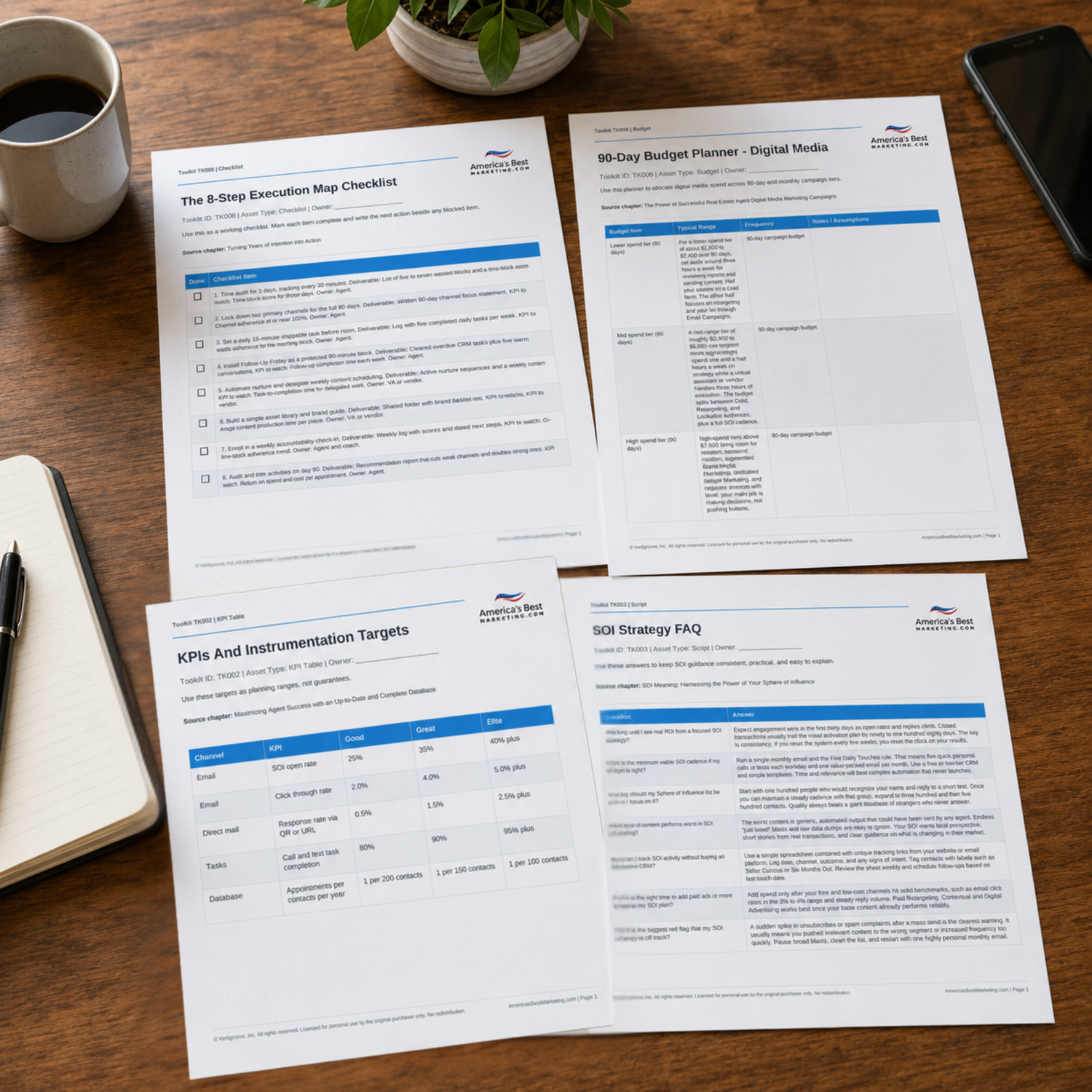
Download The Branding And Logo Development Toolkit
Use the TK022 Toolkit to plan brand spend, audit consistency across digital and print touchpoints, track brand tier outcomes, and keep your brand narrative consistent across client conversations.
Download the Toolkit ZIPRecommended reads
Recommended Reads for Real Estate Agents
These articles help agents connect marketing strategy, content, visibility, and follow-up into a more consistent growth system.

What Makes a Real Estate Agent Memorable? Branding Psychology Explained
Turn personal brand work into a system clients can notice, remember, and trust.
Read article
Real Estate Agent Branding: Crafting Your Unique Identity to Stand Out and Attract Clients
Clarify the message, visuals, and client experience that make an agent feel distinctive.
Read article
Your Brand is Built on Every Interaction: Managing Client Touchpoints for Lasting Success
Give client touchpoints a clearer role in the marketing system instead of treating the work as a one-off idea.
Read article
How to Handle Difficult Clients and De-escalate Situations
Use handle difficult clients and de-escalate situations to create a stronger bridge between client education and real conversations.
Read articleBranding And Logo Development Questions Agents Should Be Ready To Answer
What is the difference between a real estate brand and a logo?
A logo is the visual mark people recognize. A brand is the full impression people remember. Your brand includes your niche, voice, promise, service experience, proof, consistency, and follow-up. A good logo supports the brand, but it cannot replace the strategy behind it.
What should real estate agents include in a brand identity system?
A practical brand identity system should include a clear positioning statement, primary logo, secondary mark, color palette, font rules, photo style, bio language, call-to-action language, social templates, email styling, direct mail templates, and review deployment process.
How much should a real estate agent spend on branding and logo development?
A lean refresh may cost five hundred to one thousand dollars if the agent mainly needs cleanup, templates, and a simple guide. A more complete brand system often runs two thousand five hundred to four thousand five hundred dollars or more depending on design depth, website alignment, and template production.
Should solo agents have a brand style guide?
Yes. Even a one-page style guide saves time and protects consistency. It should list your colors, fonts, logo versions, tone, preferred calls to action, and basic usage rules. That makes it easier to create posts, mailers, emails, and listing materials without reinventing the look each time.
Which brand assets should agents update first?
Start with the highest visibility assets: website header, homepage, Google Business Profile, main social profiles, email signature, listing presentation, direct mail template, and testimonial page. These are the places where prospects most often form an early impression.
How does branding help with referrals?
Referrals depend on memory and confidence. When your brand is clear, past clients can explain who you help and why you are different. Consistent branding gives them simple language and recognizable visuals that make it easier to recommend you.
Next step
Build the System Behind the Advice
Continue from one useful article into the larger ABM ecosystem: the book series for strategic depth and the full marketing program for done-for-you execution.

View the Book Series
Explore the America’s Best Real Estate Agent Marketing System books for a deeper strategic framework around visibility, referrals, listings, lead generation, and growth.
View the Book Series
See Full Marketing Program
See how AmericasBestMarketing.com runs real estate blog writing, social media, listing marketing, email, direct mail, and retargeting as one managed system.
See Full Marketing Program