Are You Focusing Your Time on the Right Activities to Grow Your Real Estate Business?
Focus Your Time On Growth Work
A Real Estate Agent Time Management System
A calendar discipline briefing for agents who want to protect prospecting, follow-up, deep work, client communication, and the systems that create predictable growth.

Real estate time management starts with protected growth blocks
Real estate agents should protect the time blocks that create or advance client conversations first. That means follow-up, outbound conversations, listing strategy, buyer and seller consults, negotiation, and a short weekly pipeline review. Admin, formatting, file cleanup, and inbox work still matter, but they should be batched, delegated, or handled after revenue work has been protected.
- Your calendar is either a growth plan or a leak. The first protected block of the day decides which one it becomes.
- Revenue work deserves first access to your best energy because it creates appointments, listings, offers, and referrals.
- The Time Value Matrix separates work you must personally handle from tasks that should be batched, delegated, automated, or eliminated.
- A twelve week operating rhythm gives agents a practical way to audit time, remove low-value drag, and protect follow-up discipline.
Busy Is A Feeling. Revenue Work Is A Calendar Block.
Most real estate agents do not have a time problem. They have a decision problem. The day gets eaten by email, appointment shuffling, social media tinkering, document chasing, and admin. Then the work that creates income gets squeezed into whatever is left.
Time management starts when you define what counts as revenue work. Your job is moving conversations forward, not perfecting a document, fiddling with a graphic, or rearranging CRM tags for the fourth time. If you are newer, the same discipline pairs well with What New Real Estate Agents Should Focus On in Their First 90 Days.
Use a simple dollar-per-hour rule. If the task is not worth at least $100 per hour, it should be automated, delegated, or done inside a tight batch window. That rule does not mean the task is unimportant. It means the task should not get first access to your best energy.
- New conversations: outbound calls, texts, and voice notes that start appointments.
- Conversion work: follow up on hot leads and active clients with clear next steps.
- Listing leverage: pricing, prep plans, showing strategy, and offer negotiation.
- Sphere of Influence care: short touches that keep you top of mind.
- Pipeline clarity: one weekly review that removes stale leads and resets priorities.
When your day is messy, you feel busy and underpaid at the same time. When your day is clean, you feel calm and productive, even when you are handling a lot.
The Time Value Matrix Tells You What To Do Next
If you want your week to run on purpose, you need a sorting system. The Time Value Matrix is simple: every task gets scored by value and by who must do it.
Value means one thing. Does this task create or protect revenue by moving a client closer to a signed agreement, a showing, an offer, or a closed file. Ownership means one thing. Are you the only person who can do it, or can someone else do it to the same standard with the right checklist.
Protect the work only you can do
Consult calls, listing appointments, pricing strategy, negotiation, and high-stakes client conversations belong on your calendar before admin work gets a vote.
These moments require judgment, trust, and timing. They should not be squeezed into the scraps left after email and errands.
Remove low-value drag
Scheduling, document chasing, basic updates, file hygiene, simple graphics, and routine database cleanup still matter.
They do not deserve your best energy. Batch them into one controlled window or hand them off with a checklist and deadline.
Turn repeat work into assets
Email nurture sequences, saved replies, market update templates, buyer consult agendas, and seller prep checklists reduce future chaos.
A strong asset should make the next ten client conversations faster, cleaner, and easier to track.
Most agents protect follow-up time but leave deep work to chance. Deep work is where you build the templates and automations that prevent future chaos. Ask one question at the start of each week: what asset would make the next ten client conversations faster and cleaner.
Three Calendar Protection Scripts You Can Use Today
Scripts help because calendar boundaries can feel awkward until clients, leads, and team members understand the rhythm. Use plain language, clear timing, and a next step that keeps service high without sacrificing prospecting time.
The morning follow-up boundary
Agent dialogue
Hook lineI review active client messages and follow-up first each morning so nothing important gets buried.
Middle lineIf your message needs a decision, I will either answer it directly or schedule the right next step.
CTA lineSend me the address, timeline, and one question you want answered first, and I will respond with a clear next move.
Use this script in your email signature, CRM templates, and buyer or seller onboarding notes so your response rhythm feels professional instead of unavailable.
The lead qualification shortcut
Agent dialogue
Opening lineI can help. Before we jump on a call, I want to make sure I send the right next step.
Build lineWhat timeline, price range, and location are you considering right now.
CTA lineReply with those three pieces and I will point you toward the fastest path from here.
This keeps prime calling hours from getting consumed by leads who only wanted a quick number. Serious prospects still receive a human next step.
The weekly client update promise
Agent dialogue
Opening lineYou will get one organized update from me each week so the process does not feel scattered.
Explain lineIf something urgent changes, I will call you right away. Otherwise, I will collect the moving pieces and send the clean version.
CTA lineWatch for the update on Friday, and reply with anything you want included before then.
A predictable update rhythm beats five scattered texts that interrupt your blocks and still leave clients unsure what happens next.
The Twelve Week Efficiency Playbook You Can Actually Keep
Think in twelve weeks, not forever. You are building a repeatable week, not chasing a perfect planner. The goal is more high-value actions per hour, not more hours.
Phase one is a time audit for two weeks. Track your day in fifteen minute chunks for ten business days. Tag each block to a matrix quadrant so you can see the real leak, not the story you tell yourself. Make the audit easy with three columns: start time, task label, and quadrant.
Spend $450 per month total for CRM, scheduling, and email tooling. Cadence is one monthly newsletter, one weekly Sphere of Influence touch list, and one set of saved replies for showings and offers. Audience split is 80 percent Sphere of Influence and past clients, 20 percent new leads. If you boost anything, cap at one impression per person per day and stop boosts after five days.
Spend $1,650 per month plus a $300 ad budget. Cadence is one newsletter, one automated nurture sequence, one direct mail drop per month, and always-on retargeting. Audience split is 60 percent warm list and 40 percent new leads. Retargeting should be capped at two impressions per person per day with a 30 day membership window.
Phase two is system and delegate for four weeks. Pick the three biggest low-value drags and remove them from your plate. The best first moves are transaction coordination, listing marketing production, and appointment scheduling.
Phase three is protect and produce for six weeks. Schedule prospecting, follow-up, and deep work first, then let everything else fill in around it. If your blocks keep breaking, add accountability and keep score, not guilt, using How Coaching Programs Help Real Estate Agents.
At the end of each week, review two numbers: how many protected blocks you completed, and how many new conversations you started. Those two numbers tell you if the plan is working.
Efficiency KPIs That Keep You Honest
These are instrumentation benchmarks and process targets. They tell you if your week is doing what you intended, not what you felt busy doing.
| KPI | Acceptable Benchmark | Goal Benchmark | How To Track It |
|---|---|---|---|
| Lead response time | Within 1 business day | Within 2 hours | Use your CRM first response timestamp and review every Friday. |
| Protected blocks completed | 4 per week | 8 per week | Count completed blocks in your calendar. Missed blocks get rescheduled. |
| Admin hours per week | 12 hours | 6 hours | Track admin time during a two week audit and compare month over month. |
Systems That Buy Back Hours Without Lowering Your Service Level
Delegation fails when the handoff is sloppy. Your job is to standardize what repeats, then assign roles. Start by writing checklists for the five moments that eat your day: showing requests, pre-list prep, offer intake, inspection week, and closing week.
Next, set up automated nurture so you are not rebuilding the same reminder thread every time. A clean CRM plus Email Campaigns should carry the first seven touches for new leads, then route replies to you for the human conversation.
- Require timeline, price band, and location preferences before you jump on a call.
- Replace random texting with one scheduled weekly update for active clients.
- Use one education asset for buyers so you do not keep reinventing explanations.
- Batch admin into one daily block and end it on time.
For buyer education, a simple link to The First-Time Homebuyer's Guide to Navigating the Market saves time and sets expectations early.
A Weekly Calendar That Holds Up Under Pressure
A good schedule is not rigid. It is predictable. Predictable blocks make you faster because your brain is not renegotiating the day on every new message.
Use one theme per weekday and keep your high-value blocks at the same time. Clients learn the rhythm, and team members stop breaking your flow.
Pipeline review
Review active buyers, active sellers, warm leads, stale leads, and this week’s next steps. Lock the week before email takes control.
Listing prep
Handle pricing work, seller follow-up, listing preparation, and promotion planning so seller conversations stay sharp.
Buyer movement
Run buyer consults, tour planning, offer prep, lender check-ins, and education assets for buyers still learning the process.
Negotiation and coordination
Handle negotiation, repair strategy, lender updates, title coordination, and any decision that requires your direct judgment.
Marketing and reset
Batch marketing, next week scheduling, CRM cleanup, open file review, and the final sweep that prevents Monday chaos.
First and last moves
Start with follow-up and outbound conversations. End with a five minute next-step sweep so tomorrow has a clean launch point.
This Week’s Calendar Protection Sprint
Most days fall apart for one reason: the day starts without a protected first move. Build a default week that holds up even when you have inspections, surprises, and urgent texts.
- Block sixty minutes for follow-up before any inbox opens.
- Run outbound for thirty minutes right after follow-up.
- Check email only three times: late morning, early afternoon, and late afternoon.
- Batch admin into one daily block and end it on time.
- Keep one weekly deep work block for systems and prep.
- End the day with a five minute next-step sweep in your CRM.
These briefs are built to save time. For sellers, promote a five-step prep checklist with the headline Sell without chaos: the five prep moves that protect your timeline. For buyers, promote a first-offer plan with the headline Your first offer plan in ten minutes. Both routes create a clear next step without letting marketing steal the prospecting hours it is supposed to support.
If a client emergency shows up, handle it, then restart the block instead of abandoning the day. A reset beats a spiral. The calendar is not about perfection. It is about protecting the work that creates conversations, listings, offers, and referrals.
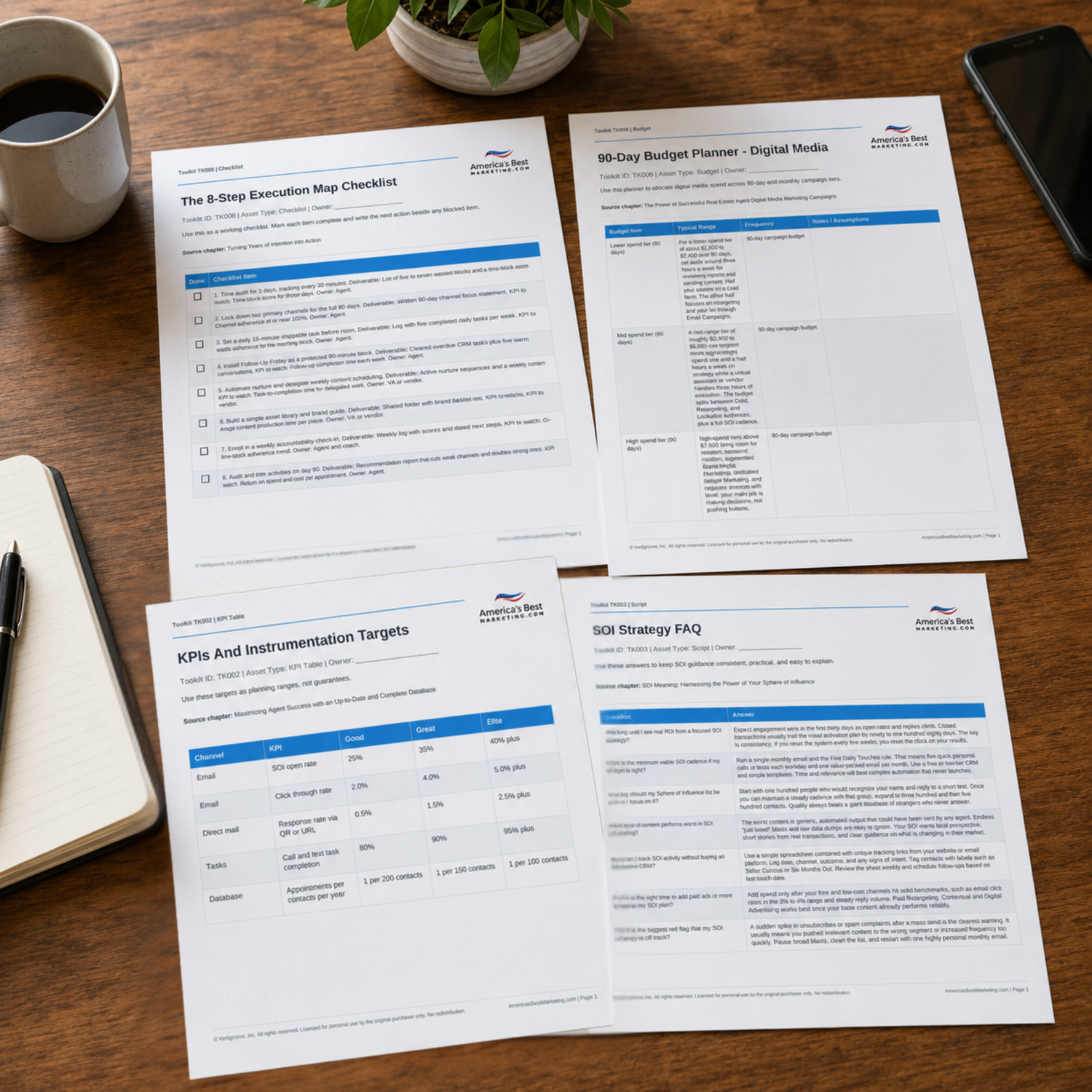
Download The Time Management Toolkit
Use the companion Toolkit to protect follow-up blocks, map the Time Value Matrix, track efficiency KPIs, plan a repeatable week, and script cleaner client communication.
Download the Toolkit ZIPRecommended reads
Recommended Reads for Real Estate Agents
These articles help agents connect follow-up discipline, database habits, client communication, and marketing execution into a repeatable system.

Why a Real Estate Agent Should Hire a Coach
Turn good intentions into a weekly operating rhythm with clearer priorities and accountability.
Read article
How to Choose the Right Real Estate Agent
Make “How to choose the right real estate agent” more useful by turning the topic into a clear buyer-and-seller education resource with a defined audience, message, and next step.
Read article
Google Business Profile for Real Estate Agents: Ranking & Review Scripts
Make Google Business Profile more useful by tying the message, audience, and next step together.
Read article
How Coaching Programs Help Real Estate Agents
Give how coaching programs help a clearer role in the marketing system instead of treating the work as a one-off idea.
Read articleTime Management Questions Real Estate Agents Ask
What is the fastest way to stop email from owning my morning?
Give email a schedule and a home. Check it three times a day and process it in a single pass: reply, delegate, schedule, or delete. Keep a saved reply library so you are not rewriting the same answers. If a message needs more than five minutes, schedule it into your admin block instead of letting it break your prospecting time.
How many hours should I prospect and follow up each day?
Start with ninety minutes total. Spend sixty minutes on follow-up and thirty minutes on new conversations. If you are newer, keep it simple and consistent rather than adding more time. The win is completing the block without interruptions. After four solid weeks, increase the outbound block first, then add a second follow-up block on high-volume days.
What should I delegate first if I cannot afford a full team?
Delegate the tasks that repeat and do not require your judgment. Scheduling, file naming, document chasing, and basic client updates are usually first. A part-time transaction coordinator often pays for itself in recovered hours and fewer mistakes. Your job is giving clean inputs: a checklist, a deadline, and a single source of truth for each file.
Will time blocks make me look unavailable to clients?
No. Set expectations and keep a predictable response rhythm. Tell clients when you do calls and when you do updates. Use one scheduled update per week and let them know you respond quickly to true emergencies. Most clients prefer a calm, organized process over rapid-fire messages that still leave them unsure about next steps.
How do I use a CRM without spending all day inside it?
Keep it lean. Track four fields that matter: stage, next step, next-step date, and notes. Everything else is optional until you have volume. Use templates for common sequences and let automation handle reminders. The CRM should reduce decisions, not create them. If an action is not tied to a next step, do not log it.
What is a good weekly deep work block for a real estate agent?
Two hours once a week is enough to change your month. Use it to build the asset that reduces future interruptions: a pricing explanation, a seller prep checklist, a buyer offer plan, or a market update template. Protect that block like a listing appointment. If you miss it, reschedule it the same week so you do not drift back into reactive work.
How long does it take for this system to feel natural?
Most agents feel a difference in two weeks because the day has a first move and a last move. It usually takes six weeks before the blocks stop feeling fragile. Keep the plan small until it is stable. Your goal is consistent execution, not a perfect calendar. Track block completion and lead response time, then adjust one thing per week.
Next step
Build the System Behind the Advice
Continue from one useful article into the larger ABM ecosystem: the book series for strategic depth and the full marketing program for done-for-you execution.

View the Book Series
Explore the America’s Best Real Estate Agent Marketing System books for a deeper strategic framework around visibility, referrals, listings, lead generation, and growth.
View the Book Series
See Full Marketing Program
See how AmericasBestMarketing.com runs real estate blog writing, social media, listing marketing, email, direct mail, and retargeting as one managed system.
See Full Marketing Program