Outdoor Lifestyle Neighborhood Guides: Searchable Relocation Content Real Estate Agents Can Publish
Outdoor Lifestyle Neighborhood Guides
Searchable relocation content real estate agents can publish
A field-ready content framework for turning parks, trails, water access, dog-friendly spaces, golf routines, and neighborhood context into searchable local authority.

Outdoor lifestyle neighborhood guides, explained
An outdoor lifestyle neighborhood guide is a local real estate marketing page that helps buyers understand how daily life works around a specific amenity. Instead of leading with market stats, it explains trails, parks, dog rules, boat launches, bike paths, golf access, seasonal constraints, nearby neighborhoods, and relevant homes. The business purpose is simple: attract relocation research early, answer practical questions, and create a low-pressure path from lifestyle interest to a real estate conversation.
- Outdoor lifestyle guides help agents capture relocation demand before buyers start searching for specific homes.
- The strongest guides name real amenities, explain access details, and connect lifestyle research to nearby neighborhoods.
- Each guide should become a search asset, a social media source, an email topic, a retargeting audience, and a lead-capture entry point.
- The best measurement plan looks beyond traffic and tracks dwell time, internal clicks, guide downloads, repeat visits, and booked conversations.
Why Lifestyle Guides Beat Generic Market Updates
Market updates compete with portals, automated reports, news sites, and every other agent in town. Outdoor lifestyle guides compete in a more valuable lane because they get specific. Someone searching for a trailhead name, dog park rule, waterfront path, boat launch, or golf access point wants practical detail, not another price chart.
This is Lifestyle SEO. It ranks by answering intent-first questions tied to day-to-day life. Relocation buyers often plan the routine before they plan the showing schedule. They want to know where they can walk the dog, ride the bike, launch the kayak, play nine holes before work, or reach a trail without turning the weekend into a commute.
The guide should not behave like a disposable blog post. It should work as an owned search asset, a content source for Social Media Management for Real Estate Agents, an email topic, a retargeting audience, and a low-pressure conversion path. When those pieces connect, a relocation visitor sees the agent as the local translator, not just another name beside an IDX search box.
- Publishing thin guides that never name specific trails, parks, launch ramps, route types, or seasonal constraints weakens trust and search visibility.
- Sending visitors from specific lifestyle content to a generic search page creates a hard pivot and lowers conversion intent.
- Measuring vanity traffic only hides the signals that matter, including return visits, guide downloads, saved-map actions, and booked calls.
The 12-Week Lifestyle Authority Buildout
This launch is a system, not a one-off article. The goal is a repeatable loop: harvest local assets, publish guides with clear structure, distribute them across channels, and use the data to double down on what pulls relocation leads.
Pick one outdoor theme to start. Hiking is easiest because it creates a natural ladder of content: beginner trails, dog-friendly routes, weekend loops, scenic viewpoints, rain-friendly options, and nearby coffee stops. Golf, waterfront access, boating, kayaking, tennis, pickleball, and mountain biking can work too. Do not start with the whole city. Start with one cluster of neighborhoods within a practical drive time.
Harvest the local assets
Create an inventory of outdoor assets like you build a listing package. Track amenity name, neighborhood proximity, parking notes, access type, seasonal constraints, photo needs, and one local tip that only a regular would know.
Put the amenity names in a working spreadsheet and rank them by search potential, buyer usefulness, and your ability to describe them with authority.
Publish the guide set
Write four guides with the same reader-friendly structure: who the place serves, how access works, the best route or activity options, one local rule people miss, and a neighborhood short list.
Each guide should point to a nearby inventory experience on your IDX Real Estate Websites, not to a generic portal search.
Run the distribution loop
Promote each guide for three straight weeks with a map snippet, a local tip, and a neighborhood comparison. Boost only what earns saves and shares.
Retarget guide readers with the next useful step, not a hard-sell listing ad. The objective is familiarity during a long research window.
Map every amenity to a five-minute, ten-minute, and fifteen-minute housing radius during normal traffic. That simple radius becomes your internal linking plan, your neighborhood comparison language, and your follow-up segmentation.
Budget Paths And Reusable Creative Briefs
Budget does not need to be big. It needs to be consistent and tied to a measurement plan. Treat spend as a way to buy learning speed, not as a promise of closings.
Spend two hundred fifty to four hundred fifty dollars per month. Publish one guide per month and promote each guide for twenty-one days. Use a social split of seventy percent organic posting and thirty percent boosted posts aimed at out-of-area interests. Use Digital Retargeting at five to eight dollars per day. Keep frequency at two to four impressions per week per person.
Spend six hundred fifty to eleven hundred dollars per month. Publish two guides per month plus one gated PDF per quarter. Use a social split of sixty percent organic and forty percent boosted to relocation states and mover interests. Use retargeting at twelve to eighteen dollars per day. Rotate two creative angles every fourteen days.
Build one lead magnet that matches your theme. A simple PDF works because it feels like something you would hand a friend. Examples include a hiking map, a dog park rule sheet, a waterfront access checklist, or a golf-neighborhood comparison sheet. Gate it lightly. Ask for name and email, then deliver it through Email Marketing for Real Estate Agents with a three-email welcome sequence that sets expectations and offers help without pressure.
Use two creative briefs. The first captures early relocation intent with a map-first post and one local rule people miss. The second converts repeat guide readers with a short tip carousel, a neighborhood comparison, and a reply-based offer to build a tailored neighborhood short list.
Creative And Messaging Guide
Relocation buyers do not need hype. They need clarity and proof that you know the area. Use specific nouns. Name the trail. Name the park entrance. Name the street feel. Then show the reader what to do next.
Use local nouns and practical outcomes
Trail accessThe five neighborhoods that put you ten minutes from the best trails.
WaterfrontLive where you play: a waterfront living guide for everyday routines.
Dog-friendlyDog-friendly neighborhood guide: parks, rules, and walkable routes.
Golf accessGolf-centered living: neighborhoods near practice ranges and early tee times.
Match the offer to the buyer stage
Soft offerDownload the trail guide so the visitor can keep researching without pressure.
Mid-intentJoin the lifestyle newsletter for monthly local tips and neighborhood comparisons.
High-intentSchedule a planning call and get a neighborhood short list tied to your preferred routine.
Lifestyle Content Performance Benchmarks
These targets are instrumentation benchmarks. They tell you if the content is useful and if your distribution loop is doing its job. If you see weak numbers, fix the page first. Add specificity, improve internal linking, and make the next step obvious.
| Content Tier | Keyword Intent | Target Metric | Success Signal |
|---|---|---|---|
| Trail guides | Long-tail research | Three minutes or more | Average dwell time above three minutes and at least two internal clicks per session. |
| Lifestyle videos | Visual discovery | Six percent or more | Share velocity above six percent per view and saves that outpace likes on the post. |
| Relocation PDF | Decision intent | Two percent or more | Guide-to-email conversion above two percent with low unsubscribe on the welcome sequence. |
The 10-Point Relocation Guide Audit
Use this list before you publish. It catches small gaps that kill trust with out-of-area buyers and keeps your guides compliant and measurable.
- Include a map embed or a clear directions section with the correct entrance and parking notes.
- Name specific amenities, not categories. Put trail and park names in the first one hundred fifty words.
- Use a neighborhood short list with two to four areas that match the lifestyle described.
- Link to nearby inventory experiences on your IDX site instead of a generic search page.
- Add one local rule people miss, such as leash rules, permit needs, launch hours, seasonal closures, or parking restrictions.
- Keep Fair Housing compliance tight. Describe features and amenities, not protected classes or buyer types.
- Place one lead capture opportunity near the top and one near the end with a clear value exchange.
- Add one internal link to a related guide and one service link to Listing Marketing when you reference active listings.
- Tag and track every distribution post with UTM parameters and label each guide in your CRM.
- Set a follow-up rule: respond to every lifestyle lead within fifteen minutes during work hours.
Describe places, amenities, access, commute context, and property characteristics. Do not describe who should live there. When a sentence starts to imply a preferred resident, replace it with measurable place-based facts and let the reader self-select.
The Mountain Town Guide Shift
An agent in a mountain town stopped posting generic sold posts and started publishing deep-dive guides on local mountain biking trails. Each guide listed trailhead parking, skill levels, seasonal closures, and the three closest neighborhoods for quick access. The agent paired every guide with a gated trail map and a short welcome email sequence.
Visitors who read two guides saw simple retargeting ads that promoted the next guide, not a hard sales pitch. The strongest result was not one viral post. It was a repeatable publishing rhythm that made the agent easier to find, easier to trust, and easier to contact during the relocation research window.
That is why this strategy belongs beside paid and organic lead planning, not underneath it. Lifestyle content is not filler. It is a demand-capture layer for people who are still deciding whether your market belongs on their short list.
Your Next Two Moves
Outdoor lifestyle neighborhood guides work because they match how relocation buyers think. They want a life plan first, then a home plan. When you publish with specificity, link readers to nearby inventory, and keep showing up during the research phase, you become the familiar option.
First, identify the top three outdoor amenities in your target farm and assign each one a practical neighborhood radius. Second, build a ninety-day publishing calendar that pairs each guide with distribution posts, retargeting, and a follow-up rule so leads do not stall.
When you want the publishing calendar, distribution, and follow-up system handled as one managed workflow, review the Full Marketing Program and choose one outdoor theme to turn into a search, social, email, and retargeting campaign.
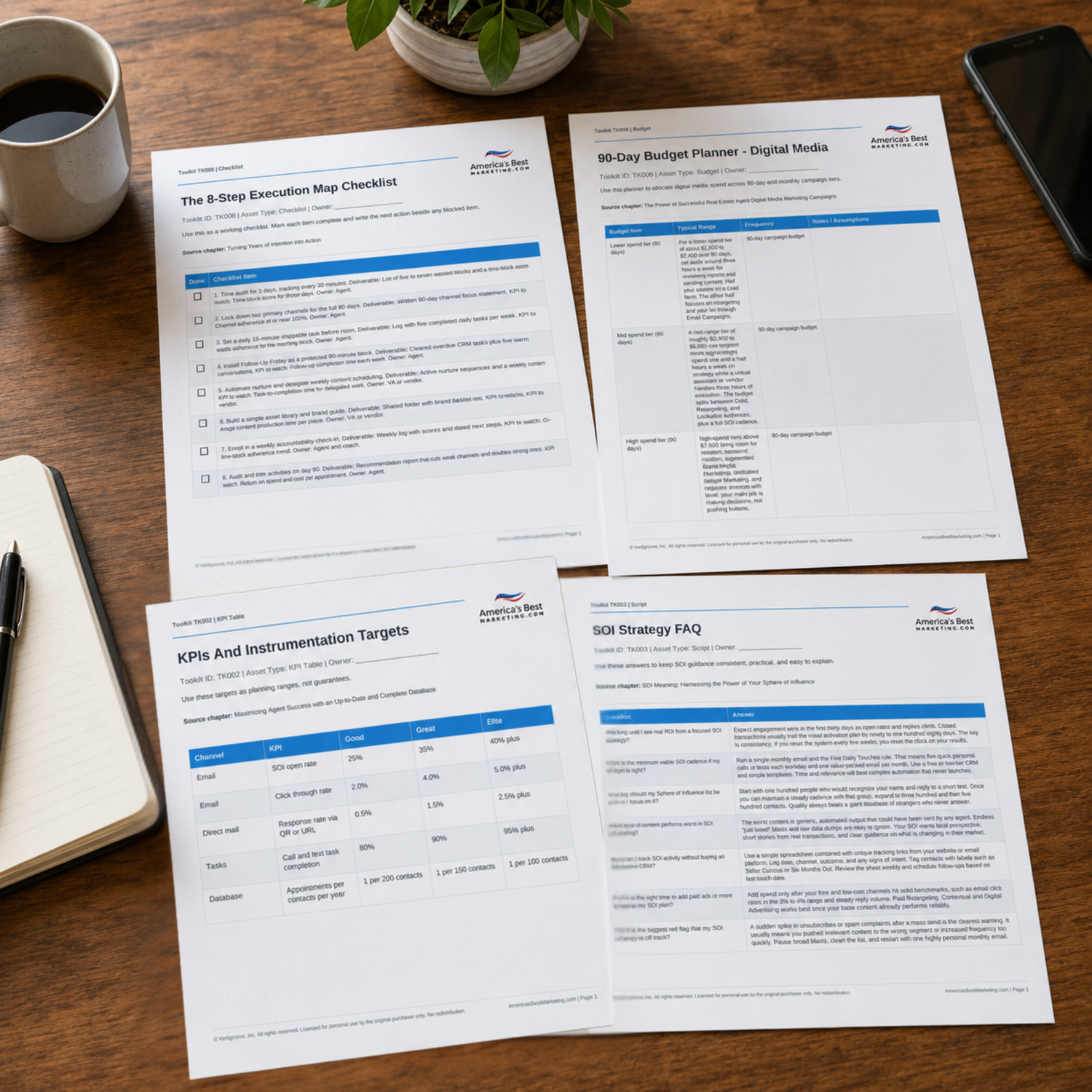
Download The Outdoor Lifestyle Guide Toolkit
Use the companion Toolkit to turn one local outdoor theme into a ninety-day publishing calendar with budget planning, KPI tracking, checklist review, lead capture, and follow-up structure.
Download the Toolkit ZIPRecommended reads
Recommended Reads for Real Estate Agents
These articles help agents turn client questions, local guidance, marketing channels, and follow-up into a more useful content system.

The Ultimate Guide to Local SEO for Real Estate Agents
Turn search visibility into a clearer publishing system for neighborhoods, services, and client decisions.
Read article
Neighborhood Guides for Young Professionals: Real Estate Agent Content Framework + Lead Capture
Build organic reach with pages and posts that are easier to find, trust, and act on.
Read article
Leveraging Hyper-Local SEO for Real Estate Success
Make hyper-local SEO for real estate success easier to plan, publish, and measure as part of a weekly marketing rhythm.
Read article
Local Restaurant Guides That Generate Leads: A Real Estate Agents-Friendly Where to Eat Framework
Publish content that answers local questions, supports lead capture, and gives future conversations a reason to start.
Read articleOutdoor Lifestyle Neighborhood Guide Questions Agents Should Answer
How long does it take to see measurable ROI from hyper-local SEO?
Plan for 60 to 120 days to see meaningful trend data, then refine based on what earns time on page and return visits. Early wins often show up as guide saves, email signups, and repeat sessions from out-of-area locations. Treat month one as baseline and instrumentation. The payoff improves when multiple guides interlink and you start ranking for amenity names.
What is the minimum viable cadence for publishing lifestyle guides?
Ship one strong guide per month for three months before you judge the strategy. Consistency beats volume because search needs time to crawl and rank, and your audience needs repetition. Pair each guide with three distribution posts and one email send. After month three, add a second guide per month or introduce a gated PDF.
People Also Ask: How do I write about neighborhoods without violating Fair Housing?
Describe places, amenities, and features, not who should live there. Focus on trail access, commute times, parks, walkability, and property characteristics. Avoid language that implies a preference for a protected class. When in doubt, replace buyer-type statements with measurable facts and let the reader self-select.
How do I pick which outdoor theme to start with?
Start where your market has both demand and weak information. Look for search behavior you already hear in calls, like dog-friendly trails, waterfront access, or golf-centered living. Then choose one cluster of neighborhoods where you want more business. If you can name five specific places without searching online, that theme is ready.
What should each guide include so it earns trust with out-of-area buyers?
Include access details, parking notes, seasonal constraints, and one local rule people often miss. Add a short neighborhood list that matches the lifestyle, then provide a clear next step like downloading a map. Keep the layout scannable with short paragraphs and short lists. The goal is to feel like a local friend with a tight process.
Do I need paid ads for lifestyle guides to work?
No, but paid support can speed up learning and keep your brand present during long research windows. Start with organic distribution and track what earns saves and clicks. If you add ads, keep budgets modest and use retargeting to reach only people who already read a guide. Use frequency caps so you stay helpful, not annoying.
How do I connect a lifestyle guide to listings without feeling pushy?
Make the listings step optional and relevant. Place a section that lists neighborhoods that fit the lifestyle, then offer a nearby inventory view as a convenience. Avoid hard-sell language. Your guide should stand on its own even if someone never clicks into listings, because trust is the currency in relocation timelines.
Next step
Build the System Behind the Guides
Continue from one useful article into the larger ABM ecosystem: the book series for strategic depth and the full marketing program for done-for-you execution.

View the Book Series
Explore the America’s Best Real Estate Agent Marketing System books for a deeper strategic framework around visibility, referrals, listings, lead generation, and growth.
View the Book Series
See Full Marketing Program
See how AmericasBestMarketing.com runs real estate blog writing, social media, listing marketing, email, direct mail, and retargeting as one managed system.
See Full Marketing Program