Local Restaurant Guides That Generate Leads: A Real Estate Agent’s Framework
Local Restaurant Guides That Generate Leads
A Real Estate Agent’s Where-To-Eat Framework
A lifestyle lead-generation playbook for agents who want restaurant guides to answer relocation intent, earn local shares, capture opt-ins, and create measurable follow-up.

How restaurant guides generate real estate leads
Local restaurant guides generate leads when they answer relocation questions with specific neighborhood context. The winning structure is simple: one neighborhood, one dining theme, five to seven credible picks, a best-for tag on every location, one matching lead capture offer, and a follow-up path through email, social posts, and retargeting.
- Restaurant guides work because they translate daily life in a neighborhood faster than generic market commentary.
- The strongest guide format pairs a narrow theme with best-for tags, original photos, a simple map angle, and one lead capture offer.
- Distribution matters as much as publication. Business tags, database email, social recaps, and light retargeting turn the page into a campaign.
- Agents should measure opt-ins, replies, guide visits, and follow-up conversations instead of treating dining content as a vanity post.
Foundations: Lifestyle Lead Magnets and Relocation Search Intent
Most agents post a meal photo and call it community marketing, then wonder why nothing converts. A better play is a consistent series of restaurant guides built around relocation intent, with a clear lead capture offer and planned distribution. Use Real Estate Blogging Made Simple: How Agents Can Attract Leads and Boost Their Online Presence as the baseline process, then apply the framework below to turn local dining content into a predictable pipeline.
A lifestyle lead magnet is a hyper-local page that answers a moving question with specifics, not fluff. People rarely start with “find an agent.” They start with “where should we eat,” “where can I work remotely,” or “which pocket feels family-friendly.” Your job is to meet that intent, then offer the next step.
Relocation search intent is the pattern behind those queries: routines, commute, weekends, noise, walkability, and social vibe. Dining is one of the cleanest signals because it reveals who is there, what time the area comes alive, and whether the neighborhood feels like your reader’s tribe. A strong guide gives them a confident vibe read in minutes.
Strong local pages send clearer local expertise signals when each page is narrow, current, and obviously written by someone on the ground. That means one neighborhood, one theme, five to seven picks, original photos you captured, and internal linking that shows you cover the market with intention. The goal is not to out-review directory sites. The goal is to out-serve them with context.
- Writing generic blurbs that feel copied from a directory weakens trust.
- Skipping a lead capture offer removes the reader’s next step.
- Ignoring your database leaves the guide without its warmest distribution lane.
- Forgetting to tag businesses wastes an easy share and comment opportunity.
- Publishing once, then quitting, prevents the habit from compounding.
Most agents think the value of a restaurant guide is the food, but the real value is the vibe check that answers lifestyle questions fast. Add a best-for tag to every pick, such as best for remote work or best for families, so readers can self-select quickly. When a newcomer can choose a Saturday plan in under two minutes, engagement rises and shares get easier.
The Local Authority Production Loop
Treat each guide as a small campaign, not a casual post. The page is the asset, distribution is the engine, and follow-up is the conversion layer. When you run the same loop monthly, you build a library of local pages that can rank, get shared, and feed retargeting audiences without reinventing your process every time.
The loop is designed to be realistic. It assumes you are using a phone, a simple notes document, and a consistent publishing format, not a full production crew. Consistency and specificity beat production theatrics.
Curation strategy
Pick one theme that maps to search intent, then choose five to seven spots that genuinely belong in that theme. Strong themes include patios, date-night spots, family-friendly dining, coffee for remote work, and quick bites near a specific neighborhood hub.
Production workflow
Capture three to five photos per location that show the exterior, the ordering area, and one signature item. Add one best-for tag, then write one short factual sentence that helps a newcomer choose.
Distribution engine
Publish the guide, then plan a seven-day recap sequence that spotlights one location per day and links back to the main page. Tag the business on every recap post and ask one simple question that invites comments.
Retargeting loop
Guide readers are signaling move intent, even when they are not ready to talk. Build a retargeting audience from guide visits and rotate one simple creative that offers your broader neighborhood PDF or moving guide.
Use Social Media Management tactics like local hashtags, story mentions, and saved highlight folders to keep the guide discoverable after the first week. For the mechanics of follow-up advertising, use How Contextual and Retargeting Digital Marketing Work for Real Estate Agents and Why They Matter More Than Ever and keep frequency light so you stay familiar without becoming annoying.
Your lead capture offer should match the reason the reader clicked. A patio guide can offer a weekend itinerary plus nearby neighborhood notes, while a remote-work coffee guide can offer a moving guide for that side of town. The closer the offer is to the original intent, the easier the opt-in decision becomes.
When your website supports local search and saved listings, route readers into an interactive experience instead of a dead end. Point them to a local map and nearby homes using IDX Real Estate Websites so the lifestyle content and the listings sit in the same session.
Creative and Messaging Guide
Your headline does most of the work. It must promise a clear use case and a clear geography, so the reader instantly knows this is for their move, not a generic list. Then your layout needs to be skim-friendly so the guide feels like a tool.
Use headline patterns that sound like how people talk when they are scouting a city. Keep the phrasing specific and avoid vague claims that feel like marketing copy.
- Where the locals actually eat in your city
- The five best coffee shops for house hunters
- A foodie guide to living in your neighborhood
- Hidden gem date spots that feel like a local secret
- Best patios for sunset and walkable nights
Soft and mid-intent offers
Use a soft CTA early in the guide, such as “Download a moving lifestyle guide for your city.” Use a mid-intent CTA near the bottom, such as “View the interactive local business map and nearby homes.”
Harder next step
Use the hard CTA sparingly and only after trust is earned. A clean example is “Book a 1:1 Marketing Coaching call to launch your hyper-local content loop.”
Email is where this content turns into replies, which is the real currency. Send the guide to your database with a simple prompt like “Reply with your favorite spot and I will add it to the next refresh,” because replies train deliverability and create warm follow-up angles. Plug that into Email Marketing for Real Estate Agents with consistent timing so your list learns to expect value, not spam.
Content Types vs Lead Potential
Not every lifestyle format does the same job. Best-of lists build shelf-stable search pages, spotlights trigger shares from owners, and event updates keep you current. Use the table below to choose the format that matches your time and your lead capture goal.
The index is not a literal lead count. A score of 1 to 3 usually means awareness and engagement. A score of 4 to 6 means stronger opt-in and reply potential. A score of 7 to 10 means the format is closer to direct lead intent because the next step is already built in.
| Type | Effort | Lead potential index | Best use |
|---|---|---|---|
| Best-of list | One focused list | 2 to 4 | Build search pages that keep working with simple quarterly refreshes. |
| Spotlight | One business story | 4 to 7 | Earn shares from owners and start direct conversations in comments. |
| Events | Fast monthly update | 1 to 3 | Create a reason to email your database and stay locally current. |
The 10-Point Guide Launch Checklist
Run this checklist before you publish. It prevents sloppy pages, unclear CTAs, and distribution that never happens. The goal is a guide that reads cleanly, shares easily, and routes the reader into one clear next step.
This also keeps your workflow consistent so you can improve month over month. When the structure stays the same, you can measure what changed and why.
- Pick one neighborhood and one theme.
- Choose five to seven locations that truly match the theme.
- Add one best-for tag to every location.
- Write one factual sentence per spot and avoid hype language.
- Add one lead capture offer that matches the theme.
- Tag every business in your recap posts.
- Schedule a seven-day recap sequence before you publish.
- Email your database and ask for one reply.
- Build a retargeting audience from guide visitors.
- Refresh the guide quarterly and update at least one photo per spot.
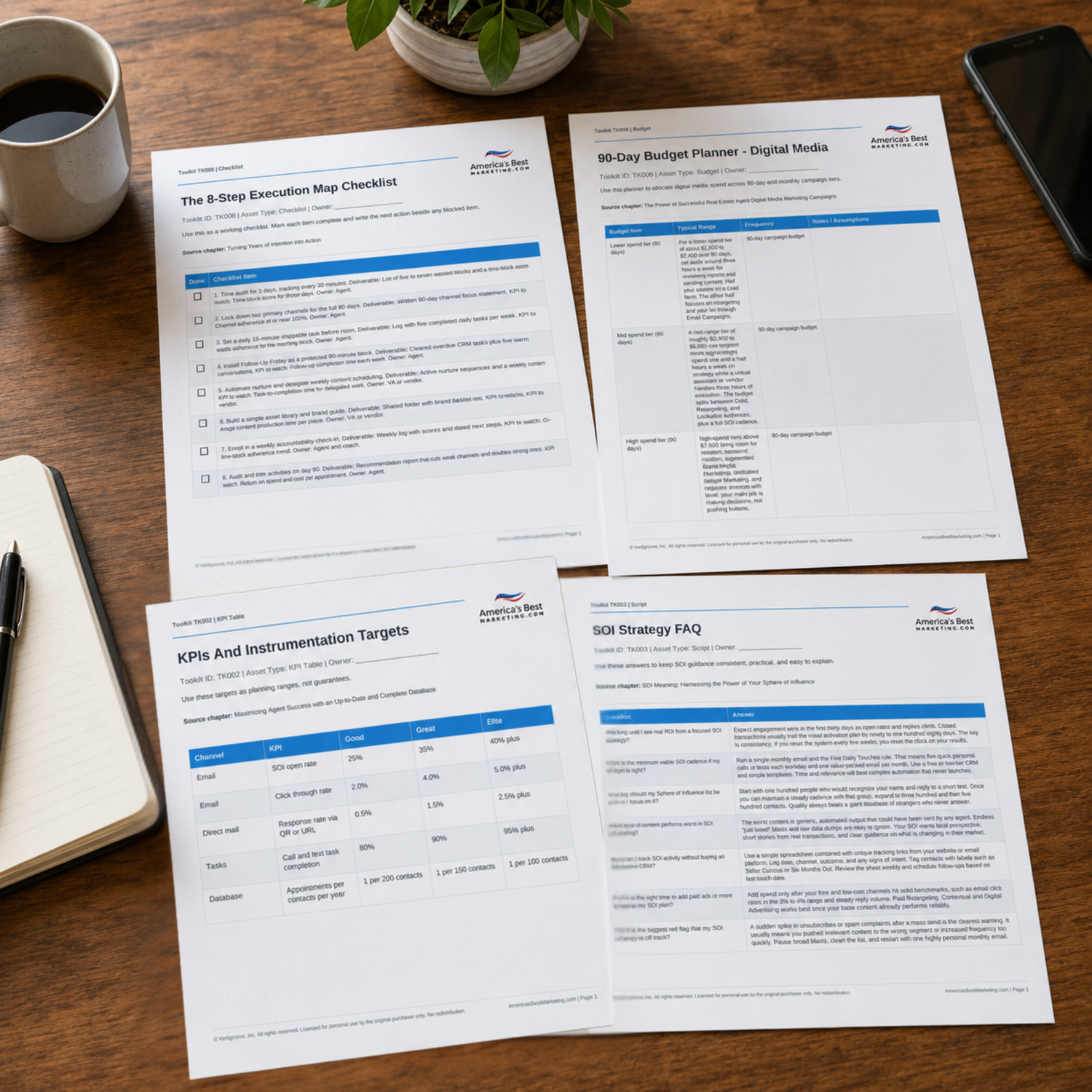
Download The Restaurant Guide Marketing Toolkit
Use the companion Toolkit to choose the right restaurant guide format, plan the launch sequence, organize business tags and email promotion, budget the retargeting step, and answer seller, buyer, and relocation questions with confidence.
Download the Toolkit ZIPMini Case Pattern
Agent Julian works a competitive coastal market and needed a relocation angle that felt human, not salesy. He spent about three hours each month creating themed restaurant guides focused on dog-friendly patios and walkable mornings. He used the same format every time, so production stayed fast and consistent.
He shared each guide in local Facebook groups, tagged every business, and ran five dollars per day in light retargeting to readers. Over the next 90 days, he began logging relocation inquiries, including one couple who mentioned the dog-friendly patio guide as part of why they reached out because it proved he understood their lifestyle before he showed a single home. He tracked which guide drove the first click and which CTA got the opt-in, then reused what worked.
Local SEO Notes That Keep This Working
Restaurant guides become search assets when each page has a tight scope and consistent internal structure. One page should cover one slice of the map, and the title should match how people search when they are planning a visit. This makes the guide easy for search engines to classify and easy for humans to skim.
Build your first guide page using a repeatable on-page pattern, then ship the same format across your next ten guides. Start with Proven SEO Strategies for Real Estate Websites to Increase Leads and keep your headings, CTAs, and internal links consistent across the series. The compounding effect comes from volume and consistency, not one perfect post.
Budgets That Pencil
These are process budgets, not promises. The goal is steady reach and measurable visits so you can improve what you publish and how you distribute it. Keep spend low until your workflow is consistent, then scale only what you can repeat.
If you do nothing else, budget time for distribution. A guide with no distribution is a brochure sitting in a drawer, and drawers do not generate leads.
Spend: $0 to $150 per month. Cadence: one guide per month plus one recap post per location over seven days. Audience split: 70% organic tags and local groups, 30% boost to local residents and recent movers. Frequency cap: 2 to 4 per week on boosted posts.
Spend: $150 to $450 per month. Cadence: one guide plus two short follow-up updates each month, then a quarterly refresh of top guides. Audience split: 50% relocation interest targeting, 50% site visitor retargeting. Frequency cap: 4 to 7 per week on retargeting.
Two Shippable Creative Briefs
A creative brief keeps you from drifting into vague lifestyle posting. It forces a clear goal, clear audience, and a clear CTA that matches the guide theme. These two briefs are designed to ship with a phone and a simple repeatable layout.
Use them as a starting point, then swap in your neighborhood names and your business picks. The point is to reduce decision fatigue so you publish consistently.
Dog-Friendly Patios
Goal: Turn lifestyle searchers into guide readers and email subscribers. Audience: buyers with dogs and renters planning a move who care about walkability. Creative: one entrance photo, one patio seating photo, and one menu item photo per location with a best-for tag. Headline: Dog-Friendly Patios That Feel Like the Neighborhood. CTA: Get the full dog-friendly neighborhood map and nearby home list.
Coffee for Remote Work
Goal: Capture relocation intent from people scouting work routines before they move. Audience: remote workers and couples visiting on weekends who care about daily convenience. Creative: one wide seating shot, one counter shot, and one quiet corner shot per location with a best-for tag. Headline: Coffee Shops Built for Remote Work and Open House Days. CTA: Download the moving guide for this side of town.
How This Becomes Marketing
A restaurant guide is more than a list. It is a positioning asset that tells relocation prospects you understand the rhythm of the community. The guide gives you website content, social proof, a database touch, a retargeting audience, and a natural reason to start conversations without begging for appointments.
If you want a done-for-you version of this system, treat each guide as a monthly asset that plugs into your SEO, email, and retargeting stack. AmericasBestMarketing.com builds the workflow, the publishing cadence, and the measurement so your local authority compounds without eating your calendar. You still look like the community concierge, but the machine behind it runs consistently.
Recommended reads
Recommended Reads for Real Estate Agents
These articles help agents connect follow-up discipline, database habits, client communication, and marketing execution into a repeatable system.

Community Events Calendar Content: How Real Estate Agents Publish It to Generate Leads
Build authority with content topics that are easier to plan, promote, and connect to follow-up.
Read article
Hidden Gems Content: How Real Estate Agents Create Local Guides That Generate Relocation Leads
Turn local knowledge into searchable content buyers, sellers, and relocation prospects can actually use.
Read article
Leveraging Hyper-Local SEO for Real Estate Success
Make hyper-local SEO for real estate success easier to plan, publish, and measure as part of a weekly marketing rhythm.
Read article
Family-Friendly Content That Converts: Activity Guide + Lead Capture Ideas for Real Estate Agents
Publish content that answers local questions, supports lead capture, and gives future conversations a reason to start.
Read articleRestaurant Guide Questions Agents Should Be Ready To Answer
Do I need permission from the restaurant to include them in my guide?
Most guides can include public businesses without permission, but be respectful and accurate. Use your own photos, keep comments factual, and avoid private areas. If you want a formal collaboration, a giveaway, or a co-branded offer, ask first and get the terms in writing. Always disclose paid partnerships or free perks so readers trust the content.
How do I make my restaurant guide rank on Google?
Start with one theme and one neighborhood, then write for the exact question behind the search. Put the neighborhood name in the title, keep the list tight, and include original photos that show the space. Add internal links that connect the guide to related local pages on your site so search engines understand coverage. Refresh the guide on a simple cadence and update at least one photo each time.
What is the minimum viable budget if I want to boost this content?
Start with $0 to $150 per month and measure page visits, time on page, and opt-ins, not vanity likes. Use a small boost on the main guide post, then retarget visitors with one offer like your moving guide. Keep frequency light and run the same creative long enough to learn what the market responds to. Increase spend only when your publishing and distribution routine is consistent.
How big should my target farm or audience be for local content to work?
Relevance beats size. A tight audience in one neighborhood can outperform a broad city-wide blast if your guide matches how people search and talk about the area. Pick one pocket where you can name streets, routines, and landmarks without guessing. Build one guide per pocket over time, and keep each page narrow so it ranks and converts.
Do I need to review every restaurant I mention?
You do not need a full review, and you should avoid playing critic. Your job is to curate and provide practical context for movers, such as vibe, seating, parking, and what it is best for. Keep the copy neutral and factual, and skip negative commentary. If a place does not meet your standard, leave it out and keep the guide clean.
What lead capture offer works best for a restaurant guide?
Match the offer to the guide theme so the next step feels natural. A patio guide can offer a weekend itinerary and a neighborhood map, while a remote-work coffee guide can offer a moving guide for that side of town. Keep the opt-in simple and deliver the asset fast. Then invite a reply with one short question so the relationship starts as a conversation.
Next step
Build the System Behind the Advice
Continue from one useful article into the larger AmericasBestMarketing.com ecosystem: the book series for strategic depth and the full marketing program for done-for-you execution.

View the Book Series
Explore the America’s Best Real Estate Agent Marketing System books for a deeper strategic framework around visibility, referrals, listings, lead generation, and growth.
View the Book Series
See Full Marketing Program
See how AmericasBestMarketing.com runs real estate blog writing, social media, listing marketing, email, direct mail, and retargeting as one managed system.
See Full Marketing Program