Pre-Approved vs Pre-Qualified: Real Estate Agent Talking Points + Email Templates
Pre-Approved vs Pre-Qualified for Buyer Leads
Agent Talking Points + Email Templates
A buyer-readiness briefing for real estate agents who want cleaner lender conversations, stronger offer packages, and fewer wasted showings.

Pre-approved vs pre-qualified, explained for agents
A pre-qualification is an early estimate based mostly on what the buyer reports. A pre-approval is a stronger lending signal because the buyer has provided documents and the lender has reviewed the file. Real estate agents should teach the difference early, verify readiness before serious tours, and package offers with financing proof that reduces seller doubt.
- Pre-qualified buyers may only have a rough estimate, while pre-approved buyers usually have document-backed lender review.
- The agent’s role is not lending advice. It is process clarity, buyer readiness, lender coordination, and offer-strength packaging.
- The compass vs GPS metaphor gives buyers a simple way to understand why pre-approval matters before showings.
- Buyer-readiness emails, lender verification questions, and a repeatable checklist reduce weak offers and wasted calendar time.
Why This Pays Off
Buyers confuse pre-qualified and pre-approved all the time, then agents pay for it in wasted showings, weak offers, and uncomfortable money conversations. A buyer who wants to see homes may not understand that a soft estimate is not the same thing as verified buying power. When that distinction is left vague, the agent becomes the person absorbing the fallout.
The operational win is simple. Teach the difference early, verify readiness before serious tours, and make financing proof part of every offer story. A pre-qualification is based mostly on self-reported information. A pre-approval is based on verified documents and lender review. Some lenders also offer an underwritten pre-approval, where an underwriter reviews the file early to reduce surprises later.
This buyer-readiness loop works best when it is connected to a consistent follow-up system. Pair the scripts below with a buyer-lead email campaign system so every new buyer lead gets financial clarity before you ever turn a key.
- You protect your calendar by separating planning-stage buyers from action-ready buyers.
- You help buyers avoid offer heartbreak caused by hopeful budgets and thin lender letters.
- You give sellers and listing agents fewer reasons to question whether your buyer can perform.
Compass vs GPS: The Buyer Readiness Standard
Here is the handoff note you can repeat without sounding like a loan officer. A pre-qualification is a compass. It points in a general direction based on what the buyer says. A pre-approval is a GPS. It uses verified inputs to give more accurate coordinates, price range, and route. You can shop with a compass, but you will waste time. You can win with a GPS.
Keep the definitions clean. Pre-qualified means the buyer shared income, debts, and assets, and a lender gave an informal estimate. Pre-approved means the buyer provided documents and the lender validated the picture well enough to issue an approval letter. Your language should stay procedural, calm, and buyer-protective.
Confirm the buyer’s true stage
Ask whether their number came from a conversation, a credit pull, uploaded documents, or an underwriter-reviewed file.
Do not treat a soft estimate as tour-ready proof when the buyer is targeting competitive homes.
Route the buyer to verification
Tell the buyer you want their budget to be real, not hopeful, before you invest time in serious tours.
Use 1:1 Marketing Coaching to sharpen your first-call script if the money conversation feels awkward.
Strength-check the letter
Ask whether the lender verified income, assets, credit, down payment source, and any conditions that could block closing.
Do not let the lender stay a black box until the offer is due, then learn the letter creates more questions than confidence.
Most agents treat the pre-approval letter as paperwork, but it is also an offer-strength signal. When the letter clearly shows verified funds, lender confidence, and any underwriter-reviewed status, the seller side has fewer unknowns to worry about. Ask this every time: does this letter reduce seller doubt in one sentence, or does it create questions?
The Financial Qualification Loop
This is a simple loop you run for every buyer lead. You are not interrogating them. You are protecting their time, your calendar, and the integrity of the offer. Run it the same way every time so it feels like a professional standard, not a personal judgment.
The discovery call
Agent dialogue
Opening lineBefore we tour, I want your budget to be real, not hopeful.
Status lineHave you talked to a lender yet, or are we still in the planning stage?
Verification lineIs your number based on documents you sent in, or just a conversation?
CTA lineIf we found the right home this week, could you write today?
Your close on this call is one of three outcomes: a pre-approval request, a lender verification step, or a tour schedule. Do not schedule serious tours until you know which outcome you are in.
First touch educational email
Subject: Do not shop without this: pre-approved vs pre-qualified
BodyThanks for reaching out. Before we tour, I want your budget to be verified so we do not waste time or fall in love with a home you cannot buy.
ExplainA pre-qualification is a rough estimate based on what you tell a lender. A pre-approval is based on documents and verification.
CTAReply with your letter if you already have one. If you do not, tell me your target price range and I will point you to a licensed lender to get a real pre-approval started.
Soft CTA: reply and I will send the Buyer Financial Readiness checklist.
Soft nudge for uncooperative buyers
Subject: Quick check before we book tours
BodyI can book showings as soon as your budget is verified. I do not want you competing with a letter that sellers view as weak.
ExplainIf you are pre-qualified only, that is fine, it just means the next step is a real pre-approval.
CTAReply with either your pre-approval letter or the lender contact so I can confirm the file strength. Once that is done, we will tour homes that match your verified range.
Mid CTA: use the mortgage math calculator on your IDX Real Estate Websites landing page before the lender call.
Lender verification email
Subject: Pre-approval strength check for offer readiness
OpeningHi, I am representing the buyer on a home search and want to confirm the strength of the approval letter before we submit an offer.
QuestionsIs this letter based on verified documents, and has the file had underwriter review yet? Are funds for down payment and closing costs verified?
CTAIf there are major conditions, what are they and what is the timeline to clear them? Thank you for keeping the process clean so the offer package is strong.
Use simple tracking so this does not live in your head. For automation ideas that reduce admin time, see Use AI to Cut 10+ Hours/Week: The Agent's Revenue-First Tech Stack Guide.
Pre-Qual vs Pre-Approval Comparison
Use this table in buyer consults. It is scannable, not academic, and it makes the compass vs GPS metaphor click fast.
| Factor | Pre-qualified | Pre-approved | Data source | Seller confidence | When to use |
|---|---|---|---|---|---|
| Verification | Low verification | Document verified | Buyer reported | Lower confidence | Early planning stage |
| Speed | Fast | Moderate | Quick inputs | Depends on clarity | First lender contact |
| Reliability | Variable | Higher reliability | Documents and review | Stronger signal | Before touring seriously |
| Offer power | Weak offer support | Strong offer support | Letter details | Risk looks lower | Any competitive offer |
| Underwriter | Usually not | Sometimes yes | Lender process | Best when reviewed | Multiple-offer markets |
| Best role | Compass | GPS | Direction vs coordinates | Confidence vs hope | Set tour standards |
The 10-Point Buyer Readiness Audit
Run this before the first showing. It protects your calendar and keeps your buyer from writing offers that do not have a real shot.
- Buyer can state a verified price range, not a wishlist number.
- Buyer has a lender identified and has completed an application.
- Buyer has a pre-approval letter based on documents, not a conversation.
- Down payment source is clear and available.
- Closing cost plan is known and realistic.
- Buyer understands payment range, not just purchase price.
- Buyer has an offer decision timeline and can move quickly.
- Buyer has reviewed basic terms such as earnest money and contingencies.
- Lender can communicate fast during offer windows.
- Approval letter can be updated the same day for the specific address and amount.
Offer a one-page Buyer Financial Readiness checklist as a reply incentive. For a harder operational reset, book a session through 1:1 Marketing Coaching to tighten your buyer consult so you qualify without sounding harsh.
Mini Case Pattern: The Letter That Changed The Offer
Agent Sarah was working with a first-time buyer who insisted on seeing a $500,000 home with only a pre-qualification. Sarah used the language above to explain the offer-killer risk of unverified data and set a tour standard. The buyer spent forty-eight hours getting an underwriter-reviewed pre-approval, then landed in a four-offer situation.
Sarah presented a clean letter with clear verification signals, and the seller chose their offer even though it was not the highest. The win was not magic. It was a stronger proof package, fewer seller doubts, and a process that made the buyer look prepared.
Budgets That Support This System
You do not need massive spend to run buyer education. You need consistency, clean follow-up, and one place to send people for next steps. If you are adding direct mail to stay visible while you work leads, reference Postcard vs. Letter vs. Brochure: Choosing the Best Direct Mail Format for Real Estate Agents.
Spend two hundred fifty to four hundred fifty dollars per month. Cadence is one buyer education email plus one follow-up email per new lead. Audience split is seventy percent new buyer leads and thirty percent warm sphere. Frequency cap is one email per lead per week after the first week.
Spend six hundred fifty to eleven hundred dollars per month. Cadence is two buyer education emails plus one lender sync touch per new lead. Audience split is sixty percent new buyer leads and forty percent warm sphere. Frequency cap is two emails in week one, then one per week.
If you want to stop retyping this step, build it into your onboarding so every buyer lead gets the same readiness standard within minutes. Pair the emails with Email Marketing for Real Estate Agents, use your Listing Marketing discipline to package offer certainty, and keep your buyer pipeline organized as a managed system.
KPIs To Keep The Loop Honest
Treat these as process benchmarks, not promises. You are instrumenting behavior so readiness becomes visible, measurable, and easier to coach.
| Metric | Definition | Target range | What to adjust |
|---|---|---|---|
| Reply speed | Time to first response. | 5 to 15 min | Use an auto reply plus a personal text within fifteen minutes. |
| Letter rate | Buyer leads who send a usable pre-approval letter within seven days. | 35% to 60% | Tighten the discovery call and resend the education email within twenty-four hours. |
| Tour quality | Showings tied to lender verification or a real letter. | 70% to 90% | Require lender contact or a real letter before scheduling serious tours. |
Two Creative Briefs You Can Deploy This Week
Compass vs GPS buyer post
Goal is to set a clear standard for tours. Audience is first-time buyers and relocation leads. Creative is one graphic with two columns and three bullets per side. Headline is Compass vs GPS: why a pre-approval saves you time. CTA is Reply with READY and I will send the Buyer Financial Readiness checklist.
Offer strength checklist post
Goal is to drive lender-ready conversations. Audience is buyers who have toured but have not submitted offers. Creative is a short checklist graphic plus a caption that explains risk. Headline is Before you write, run this 10-point readiness audit. CTA is Message me your price range and I will map the next step with a licensed lender.
Want this qualification loop running without manually chasing every buyer lead? See the done-for-you marketing system at AmericasBestMarketing.com and build a buyer-ready pipeline that respects your time.
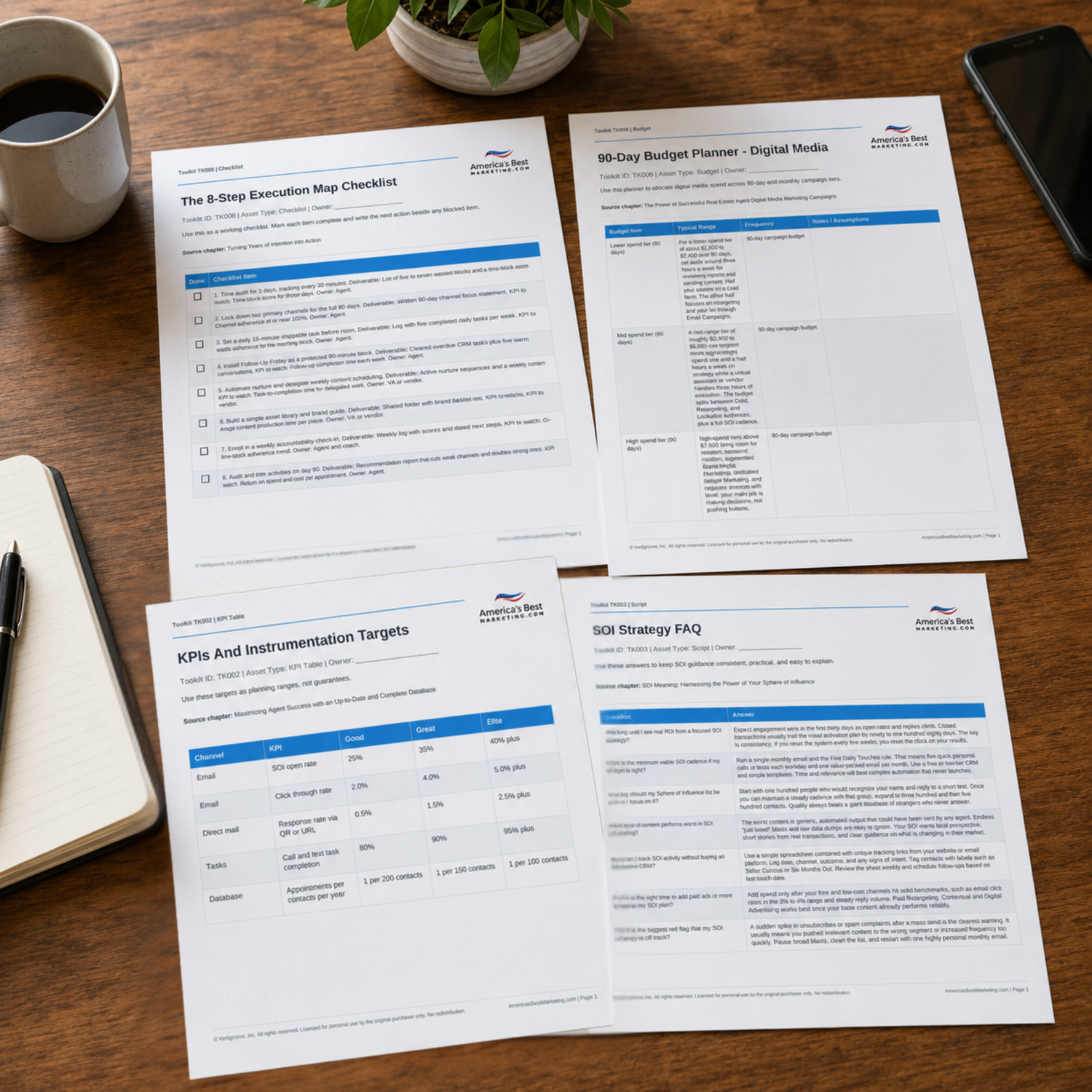
Download The Buyer Readiness Toolkit
Use the companion Toolkit to bring this system into the field with a buyer readiness audit, budget planner, pre-qualification vs pre-approval KPI table, and copy-ready follow-up emails.
Download the Toolkit ZIPRecommended reads
Recommended Reads for Real Estate Agents
These articles help agents turn client questions, local guidance, marketing channels, and follow-up into a more useful content system.

The Pros and Cons of All-Cash Offers
Use the pros and cons of all-cash offers to create a stronger bridge between client education and real conversations.
Read article
FHA vs Conventional Loans: Real Estate Agent Talking Points + Content Ideas That Convert
Build a cleaner system for FHA vs conventional loans, with better timing, clearer messaging, and a next step people can act on.
Read article
The Role of User Experience (UX) in Real Estate SEO
Build organic reach with pages and posts that are easier to find, trust, and act on.
Read article
Real Estate Team Growth: When to Hire, What to Hire, and How to Stay Profitable
Build a cleaner system for real estate team growth, with better timing, clearer messaging, and a next step people can act on.
Read articlePre-Approval Questions Agents Should Be Ready To Answer
What is the difference between a pre-approval and an underwriter pre-approval?
A standard pre-approval usually means the lender reviewed documents and issued a letter based on that process. An underwriter pre-approval means an underwriter reviewed the file earlier, which can reduce surprises during escrow. Not every lender offers it, and the exact meaning can vary by lender. Ask whether income, assets, and credit were reviewed by an underwriter and what conditions remain.
Does a pre-approval hurt a buyer's credit score?
Many lenders run a hard credit inquiry for a full pre-approval, which can have a small, temporary impact. The bigger risk is shopping homes without a verified budget and losing time in a fast market. Buyers should ask their licensed lender what type of credit pull is used and how rate shopping is handled. Your job is to set readiness standards, not give credit advice.
What is the major red flag to avoid when reviewing a lender letter?
A vague letter that does not clearly communicate verification strength is a risk signal. If the letter looks generic, has no loan type clarity, or feels like it could be generated without documents, sellers may assume the buyer is shaky. Ask the lender if documents were verified, if funds are confirmed, and what conditions remain. A strong letter reduces seller questions in one sentence.
What should I say when a buyer refuses to talk to a lender?
Keep it calm and procedural. Tell them you are happy to tour once the budget is verified because you do not want them competing with a weak letter. Offer to connect them with a licensed lender and frame it as protection, not pressure. If they still refuse, treat that person as a planning-stage lead and keep them in a nurture sequence until they are ready to act.
What is the minimum viable cadence for follow-up if spend is limited?
Run a simple sequence: one education email the day of the inquiry, one follow-up within 24 hours, then one touch per week for four weeks. Use one clear next step each time, such as send the letter, share the lender contact, or confirm a budget range. Consistency beats intensity. Track replies and upgrade responsive leads into the lender sync step.
Should the pre-approval letter match the exact offer amount?
Often yes. A letter that matches the offer amount can feel cleaner to a seller because it signals precision and reduces questions. In some cases, a buyer may prefer a higher letter for flexibility. Coordinate with the licensed lender and choose the strategy that best supports the offer. Your role is to package the offer professionally, not to advise on lending structure.
How do I explain this without sounding like I am judging the buyer?
Use standards and protectiveness, not pressure. Say you want their budget to be real so you do not waste their time or set them up for offer disappointment. Use the compass vs GPS metaphor to keep it light. Then give one next step: send the letter or start the pre-approval. Buyers respond well when your tone communicates that you are on their side and you run a clean process.
Next step
Build the System Behind the Advice
Continue from one useful article into the larger ABM ecosystem: the book series for strategic depth and the full marketing program for done-for-you execution.

View the Book Series
Explore the America’s Best Real Estate Agent Marketing System books for a deeper strategic framework around visibility, referrals, listings, lead generation, and growth.
View the Book Series
See Full Marketing Program
See how AmericasBestMarketing.com runs real estate blog writing, social media, listing marketing, email, direct mail, and retargeting as one managed system.
See Full Marketing Program