Google Business Profile for Real Estate Agents: Advanced Optimization for Local Rankings
Google Business Profile Local Ranking Playbook
Advanced optimization without risky shortcuts
A local search operating system for real estate agents who want profile accuracy, review velocity, weekly updates, citation hygiene, and stronger conversion paths from map visibility.

How real estate agents turn Google Business Profile into client action
Advanced Google Business Profile optimization means keeping your profile accurate, active, and connected to conversion paths. Clean NAP data, choose defensible categories, earn reviews steadily, respond fast, publish useful weekly updates, refresh photos, control Q&A, and link profile traffic to local pages that make the next step obvious.
- Google Business Profile performance is an operating rhythm, not a one-time verification task.
- Profile accuracy, category discipline, review count and rating, current photos, useful updates, and clear conversion paths are practical elements agents can manage. Google does not publish review velocity, posting frequency, or Q&A activity as separate ranking factors.
- Profile clicks should move to local landing pages, valuation pages, IDX pages, or focused service pages instead of an unfocused homepage.
- Available Business Profile interactions, such as calls, website clicks, direction requests, messages where enabled, and review activity, can help turn local visibility into an accountable marketing system. Not every metric is available for every profile.
Why This Matters
If your Google Business Profile sits outside the most visible map results, the issue is usually not verification. It is drift. Profile data gets stale, reviews arrive randomly, photos go untouched, Q&A sits unanswered, and the website click lands on a page that does not match the searcher’s intent.
Google says local results are mainly based on relevance, distance, and prominence. You cannot control the searcher’s distance from the business. You can improve profile completeness, category accuracy, review count and rating, current business information, photos, and the website experience that supports relevance and prominence.
The payoff is not vanity ranking. The payoff is more qualified calls, clearer website behavior, stronger review proof, and better local recall before a buyer or seller decides whom to contact. The profile becomes a storefront that earns confidence before the first conversation.
- Clean profile data reduces uncertainty before a prospect clicks or calls.
- Consistent review requests prove recent client trust instead of relying on old social proof.
- Local landing pages keep the click aligned with the neighborhood, service, or decision that triggered the search.
The Elements That Support Local Search Confidence
NAP consistency means your business name, address, and phone match across your Google Business Profile, website, directories, and citation sources. One mismatch can create confusion, and confusion weakens the consistency that supports local confidence.
The Local 3-Pack is the map set of three local listings that often appears above organic results. It captures high-intent searches from people who want an agent near them and want a next step quickly.
An individual real estate agent should maintain a dedicated Business Profile only when the agent is a public-facing practitioner with their own customer base and can be contacted directly at the verified location during stated hours. Support staff, lead-generation representatives, and duplicate profiles for multiple specialties are not eligible practitioner profiles.
Review velocity is an internal operating metric for tracking the pace of new reviews. Google publicly states that review count and positive ratings can help local ranking, but it does not disclose a separate review-velocity factor. Use a steady, policy-compliant request process to keep feedback current without promising ranking gains.
Distance versus prominence is the practical tradeoff between where the searcher is and which business appears relevant and established. You cannot control the searcher’s location. You can improve the profile completeness, review count and rating, current information, photos, and website experience that support prominence.
Make every listing tell the same story
Audit the business name, address model, phone number, website URL, service areas, hours, and appointment paths across the profile, website, and core citations.
Remove duplicates, stale phone numbers, old office addresses, and directory records that create entity confusion.
Use categories you can defend
Set the tightest primary category for the real business and only add secondary categories that reflect real services.
Do not stuff services into the business name or category set to chase a temporary lift that creates suspension risk later.
Ask neutrally after eligible milestones
Send the same neutral review request to all eligible clients after a completed service milestone, regardless of the rating you expect. Do not offer incentives, selectively request reviews only from satisfied clients, or require particular wording. Respond to reviews promptly under the agent’s internal service standard.
Useful reviews describe the real service context, such as listing preparation, buyer guidance, relocation help, pricing strategy, or calm negotiation support.
Make the next click specific
Profile traffic should land on pages that answer the searcher’s likely question, not a generic homepage that forces the visitor to hunt.
Agents with stronger local pages can connect profile traffic to IDX Real Estate Websites and community content that makes the click feel relevant.
Failure Modes That Create Policy or Conversion Risk
Most profile problems are self-inflicted. The biggest red flag is trying to outsmart policy instead of representing the business accurately. Google can suspend or edit profiles that look inconsistent, spammed, duplicated, or disconnected from a real business operation.
Do not use a rented mailing address or virtual office where the business does not genuinely operate. A coworking office may be listed only when it has clear business signage, receives customers at the location during stated hours, and is staffed during those hours by the business’s own staff. A service-area business that does not receive customers at its address should hide the address. Do not create fake suite numbers. Do not keyword-stuff the business name. A stale profile can reduce customer confidence, but Google does not publish a 30-day inactivity penalty. Keep business information, hours, photos, public answers, and review responses current because accuracy and customer usefulness matter.
Never turn a clean business name into a keyword billboard. If the real business name is Thomas Gray Real Estate, do not edit it into Best Local Agent Thomas Gray Homes. That pattern can trigger manual corrections, suspension risk, and a slow reinstatement cycle.
- Business information, hours, photos, links, or public answers are stale or inaccurate.
- Business name contains service keywords that are not part of the real name.
- Address signals do not match real operations.
- Q&A contains unanswered questions or incorrect public answers.
- Negative reviews sit unanswered while new prospects are deciding whom to call.
Most agents chase star count and ignore response recency. Reviews and replies should help a stranger understand where you work, what you helped with, and why the client trusted you. A useful review system invites an honest review based on the client’s genuine experience without suggesting a rating or requiring specific wording.
The 12-Week Local Visibility Playbook
This is a 12-week sprint that turns the profile from a neglected listing into a repeatable visibility system. The goal is not a one-time cleanup. The goal is a cadence that keeps the profile current, measurable, and hard to ignore.
Technical foundation
Audit NAP across your profile, website, major directories, and core citations. Set the primary category to match the real business and remove bloated secondary categories.
Upload 25 to 40 high-quality photos across team, local context, office, listings, and community proof. Rewrite services in client language so buyers and sellers understand what you actually do.
Review engine
Create one neutral review request for buyers and sellers. Send the same neutral review request to all eligible clients after a completed service milestone, regardless of the rating you expect.
Track review pace as an internal operating metric. Do not offer incentives, selectively request reviews only from satisfied clients, or require particular wording. Respond to reviews promptly under the agent’s internal service standard.
Content and engagement
Publish two Google Business Profile updates per week. Rotate proof posts, market advice, listing prep tips, buyer guidance, and local observations.
Seed Q&A with real questions you hear on calls and answer them in plain language. Add fresh photos tied to current activity instead of dumping generic stock-style images.
External signal building
Clean up citations and remove duplicates that dilute entity confidence. Link the profile to local landing pages that match the neighborhoods and services you want to win.
Track available Business Profile interactions, such as direction requests, calls, messages where enabled, and website clicks, as weekly benchmarks. Not every metric is available for every profile. Add short-window retargeting so qualified profile and website visitors continue seeing your brand.
Review requests should be part of follow-up, not a last-minute favor. If you already send nurture campaigns, build the neutral review request into the closing and post-closing cadence with Email Marketing for Real Estate Agents so every successful client relationship gets a clean next step.
Google Business Profile updates should also connect to your wider publishing system. If you already post on social channels, align the weekly themes through Social Media Management for Real Estate Agents so your profile, feed, and email content reinforce each other instead of competing for attention.
Local landing pages matter because the click after the map result is where trust either compounds or collapses. A strong next step is the IDX SEO Community Page Blueprint for Agents, which shows how to map local intent to pages that can answer the search.
Budget Ranges That Support Profile Traffic
The profile work itself is operational. Paid support should amplify warm traffic, not replace the weekly discipline. Start with retargeting once profile clicks and website visits are strong enough to build a useful audience.
$150 to $300 per month
Use retargeting only. Keep the internal cadence at two Google Business Profile updates per week, 10 new photos per month, and one neutral review request after each eligible closing or completed service milestone.
Audience split should stay focused on website and profile visitors. Keep the frequency cap near 2 to 4 impressions per person per day.
$400 to $900 per month
Use retargeting plus local contextual placements. Maintain two profile updates per week, one Q&A refresh per week, and 15 new photos per month.
Use a split near 70 percent retargeting and 30 percent contextual local intent. Keep the frequency cap near 3 to 6 impressions per person per day.
When paid support is ready, use Retargeting and Contextual Ads to stay visible to visitors who already showed intent. Keep the audience tight, the creative local, and the frequency cap respectful.
Creative And Messaging That Gets Clicks
Google Business Profile updates are not a place for inflated copy. They are a place to prove activity and relevance. Write like a busy homeowner is scanning the profile in a grocery line, because that is often the attention span you get.
Proof from a nearby result
Profile update angle
Hook lineJust sold nearby: what helped this home stand out.
Middle lineCall out preparation, pricing discipline, presentation, and the local buyer signal that mattered.
CTA lineInvite sellers to request a focused valuation or listing preparation review.
Use this when you have permission to discuss the result and can keep the lesson useful without exposing private transaction details.
Neighborhood market guidance
Profile update angle
Hook lineWhy this neighborhood is moving faster right now.
Middle lineExplain inventory, pricing, commute, amenities, or buyer competition in plain language.
CTA lineSend readers to the matching local page instead of a generic homepage.
Use this post type to connect map visibility to local pages, current buyer questions, and clean follow-up.
Listing preparation advice
Profile update angle
Hook lineListing prep checklist: the first three moves.
Middle lineCover the highest-friction preparation decisions first, such as repairs, photography, clutter, and pricing expectations.
CTA lineOffer a simple planning session for owners who are considering a sale.
Keep the tone calm and specific. Avoid exaggerated urgency, unsupported claims, and keyword stuffing.
Also make sure the website matches the profile promise. If your profile is strong but your site feels thin, people bounce and you waste intent. The website side is explained in Why Every Real Estate Agent Needs an IDX-Integrated Website.
Weekly GBP Hygiene Checklist
This is the operating table to run every week. The point is not perfection. The point is steady proof that the profile is alive, useful, and managed by someone who pays attention.
| Cadence | Task | Time | Impact |
|---|---|---|---|
| Daily check | Reply to new reviews and messages where enabled. | 10 to 15 min | Supports customer confidence and keeps response recency high. |
| Weekly set | Publish two updates and refresh Q&A. | 45 to 60 min | Keeps the profile active and reinforces service language. |
| Monthly scan | Upload photos and audit NAP and citations. | 2 to 3 hrs | Reduces data drift and improves conversion after the click. |
The 10-Point Local 3-Pack Audit
Run this audit once, then rerun it monthly. If you cannot prove a point with a screenshot or a link, it is not done.
- Business name matches legal signage and invoices, with no service keywords added.
- Address is a real staffed location or correctly set to a service-area model.
- Phone number matches the website header and primary citations.
- Primary category is accurate and secondary categories are not bloated.
- Services are written as client outcomes and include target local areas in plain language.
- Description reads cleanly, lists core services, and avoids stuffed keyword strings.
- Photos include team, local context, and recent work, with new uploads each month.
- Review requests are neutral and policy-compliant, and every review receives a response under the agent’s internal service standard.
- Q&A includes real questions prospects ask, with clear answers that reduce friction.
- Profile links point to matching landing pages, not a generic homepage.
Illustrative 90-Day Operating Scenario
Consider an agent competing with larger teams in a downtown market. Over 90 days, the agent could standardize profile information, send neutral review requests to all eligible clients, publish useful updates, refresh current photos, and respond to reviews under a consistent internal service standard.
Track calls, website clicks, direction requests, and other available interactions before and after the cadence. Report any observed lift as account-specific data rather than proof that one activity caused the change or as a guaranteed result.
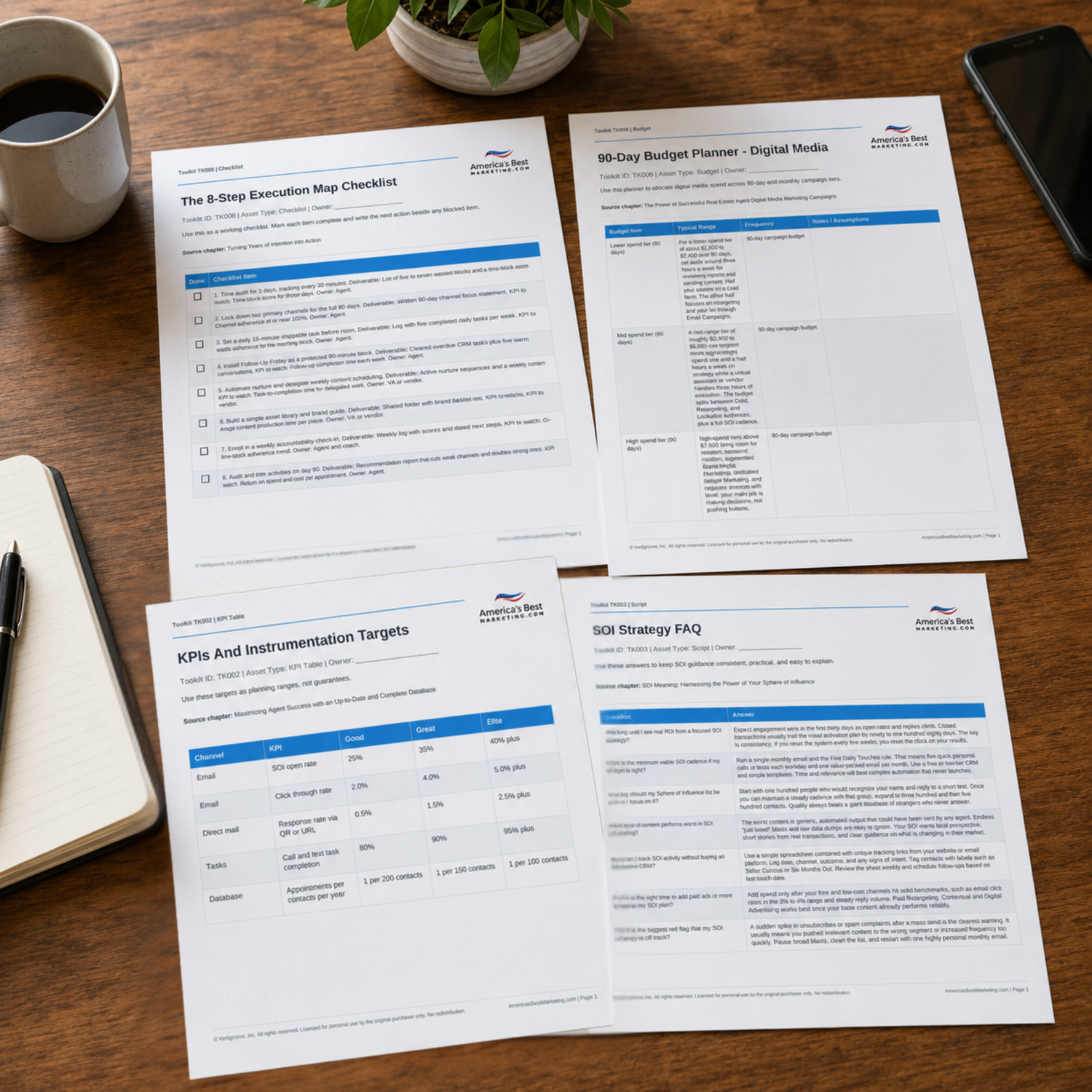
Download The Google Business Profile Toolkit
Use the companion Toolkit to tighten your profile audit, weekly planner, review request cadence, Q&A prompts, citation cleanup, KPI tracker, and 12-week rollout plan.
Download the Toolkit ZIPRecommended reads
Recommended Reads for Real Estate Agents
These articles help agents connect follow-up discipline, database habits, client communication, and marketing execution into a repeatable system.

Google Business Profile for Real Estate Agents: Ranking & Review Scripts
Make Google Business Profile more useful by tying the message, audience, and next step together.
Read article
The Ultimate Guide to Local SEO for Real Estate Agents
Turn search visibility into a clearer publishing system for neighborhoods, services, and client decisions.
Read article
Google Business Profile Photos, Posts & Q&A: A 30-Minute Weekly Routine
Turn Google Business Profile photos, posts, and Q&A into a steady operating habit, not another item that waits for a quiet week.
Read article
Local Restaurant Guides That Generate Leads: A Real Estate Agents-Friendly Where to Eat Framework
Publish content that answers local questions, supports lead capture, and gives future conversations a reason to start.
Read articleFAQ
How do I get my Google Business Profile to rank higher?
Start with clean NAP, correct categories, a real address or service-area setup, and a weekly activity cadence. Publish two updates each week, add fresh photos monthly, and respond to every review quickly. Then connect the profile to a matching local landing page so profile clicks do not land on a generic homepage.
Can I have a Google Business Profile if I work from home?
Yes, if the business is eligible and the profile is configured honestly. If clients do not visit your home, hide the address and use service areas. Do not use a virtual office, mailbox, or fake suite as a public address. Keep the business name, phone, website, and service-area model consistent everywhere.
How long does it take to see measurable ROI from local SEO?
Early activity indicators can appear in 4 to 8 weeks after data cleanup, fresh posts, better photos, and consistent review responses. Measurable appointment flow usually takes longer, often 60 to 120 days, because current review feedback, citation consistency, and landing page engagement need time to compound. Treat this as an operating benchmark, not a ranking guarantee.
What is the biggest suspension risk for a real estate agent profile?
The biggest risk is a mismatch between the profile and the real business. Keyword-stuffed names, fake locations, virtual offices, duplicate profiles, and unsupported address claims can create suspension risk. Treat every profile edit like a controlled change request and document what changed.
Should I respond to every review, including negative ones?
Yes. Responses protect the brand, show professionalism, and keep response recency high. Thank the reviewer, stay calm, mention the service context when appropriate, and offer a private follow-up path. Do not argue, disclose private details, or turn the response into a sales pitch.
How often should I post photos and updates?
Use two updates per week and one photo upload session per month as the operating floor. Posts should rotate proof, market guidance, listing preparation, and neighborhood insight. Photos should represent real activity, local context, team presence, and property work you have permission to show.
Do Google Posts really matter for local rankings?
Posts matter because they keep the profile active, give prospects timely context, and support the broader visibility system. They are not a shortcut by themselves. They work best when paired with clean profile data, steady reviews, useful photos, strong landing pages, and consistent follow-up.
Next step
Build the System Behind the Visibility
Continue from one useful article into the larger ABM ecosystem: the book series for strategic depth and the full marketing program for done-for-you execution.

View the Book Series
Explore the America’s Best Real Estate Agent Marketing System books for a deeper strategic framework around visibility, referrals, listings, lead generation, and growth.
View the Book Series
See Full Marketing Program
See how AmericasBestMarketing.com runs real estate blog writing, social media, listing marketing, email, direct mail, and retargeting as one managed system.
See Full Marketing Program